Total Rail Solutions: History, Services, Acquisition and UK Railway Industry Impact
Total Rail Solutions was a recognised name in the United Kingdom’s railway infrastructure sector. The company built its reputation by providing specialist road-rail vehicles, railway plant equipment, labour, and operational support for railway construction, maintenance, and repair projects. For contractors and organisations working within the rail industry, these services played an important role in keeping projects moving safely and efficiently.
However, the story of total rail solutions is more than a description of railway equipment and engineering services. The business experienced significant changes in ownership, financial circumstances, and corporate structure. In October 2023, Readypower Group acquired 100% of Total Rail Solutions Limited, marking an important change in the company’s history. The acquisition was intended to provide financial stability and bring its capabilities into a larger railway infrastructure organisation.
Today, people searching for this company may encounter older business profiles, historical service descriptions, recruitment references, and information about its previous management. This can make it difficult to understand whether the original company is still operating independently or whether its services have moved under another organisation.
The most important distinction is that the former UK business is no longer an independent trading operation. Its acquisition and integration into Readypower Group changed how its equipment, workforce, and railway capabilities were organised. The original legal company subsequently entered members’ voluntary liquidation.
This article explores the company’s background, business model, railway equipment, operational services, acquisition, industry contribution, and current corporate position. It also explains what contractors, railway professionals, researchers, and general readers should understand when looking for information about this historic UK railway specialist.
What Is Total Rail Solutions?
Total Rail Solutions, commonly known as TRS, was a UK-based railway infrastructure services company specialising in road-rail vehicles and associated plant operations.
Its business was designed to support organisations responsible for building, maintaining, and repairing railway infrastructure. Rather than operating passenger trains or selling railway tickets, the company concentrated on the equipment and operational resources needed to complete engineering work on railway lines.
Railway infrastructure projects require specialised machinery because ordinary construction equipment cannot always work directly on railway tracks. Traditional road vehicles are not designed to travel along railway lines, while conventional rail equipment may not offer the flexibility needed for work across different construction environments.
Road-rail vehicles help bridge this gap.
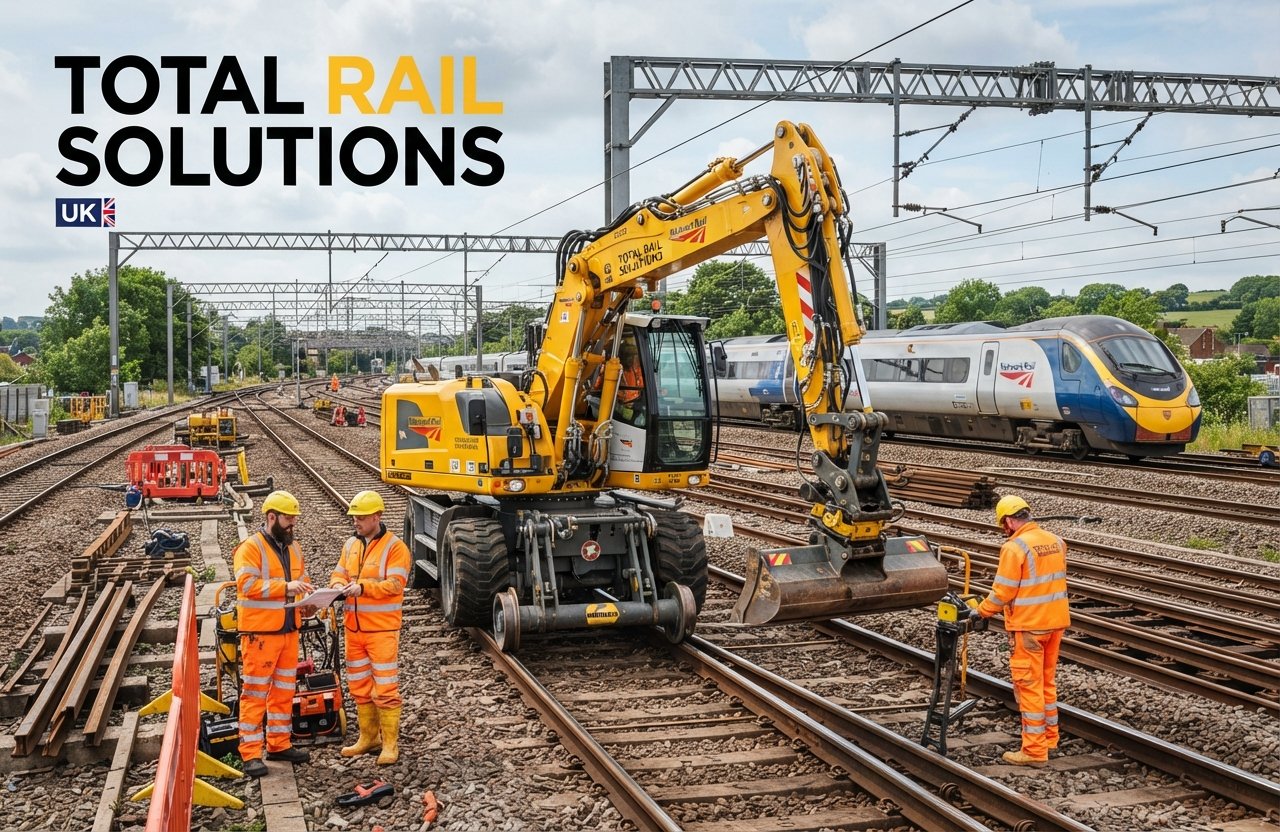
These machines can operate on ordinary roads and, when properly configured, travel along railway tracks. This flexibility allows contractors to transport equipment and personnel to railway work locations and complete specific engineering activities.
The former company provided different types of plant support, including operated and non-operated road-rail equipment, subcontracting services, labour, and Plant Operations Scheme services.
Its customers and industry relationships included Network Rail and principal railway contractors.
An important point for understanding its history is that the company was not simply an equipment rental business. Its activities also involved planning, coordination, operational management, and supporting the safe delivery of railway engineering work.
The History and Development of Total Rail Solutions
Understanding the company’s background helps explain why its acquisition became significant for the UK railway industry.
Establishment and Early Business Development
Total Rail Solutions Limited was incorporated in the United Kingdom on 31 January 2007.
The company developed within a specialist area of the railway market where contractors needed reliable access to road-rail plant and skilled operational support.
Railway infrastructure work involves different types of activities, from routine track maintenance to major construction programmes. Each project may require different machines, attachments, operators, and logistical arrangements.
A specialist supplier can help contractors obtain these resources without having to purchase and maintain every machine themselves.
This was an important part of the business model associated with TRS.
As the company developed, it became involved in supplying railway plant and related operational services across different parts of the country.
Its activities were particularly relevant to contractors working on Network Rail infrastructure and other railway projects.
The 2018 Management Buyout
A significant ownership change occurred in November 2018.
Rutland Partners completed a management buyout of Total Rail Solutions from its founders, Martin Mould and Julie Caldwell.
This investment represented an important stage in the company’s development.
At the time, Rutland described the business as a leading provider of operated and non-operated road-rail plant, subcontracting services, and labour to railway sites across the UK.
The investment announcement also highlighted its Plant Operations Scheme services.
These activities included:
- On-track plant planning.
- Equipment delivery and coordination.
- Railway site management.
- Specialist plant support.
- Labour and subcontracting services.
- Operational assistance for infrastructure contractors.
Rutland reported that the company had a turnover of approximately £30 million at the time of its investment.
This figure is a historical reference from the 2018 announcement, not a statement of its current revenue.
The management buyout demonstrated that specialist railway plant operations represented an established commercial market with demand from infrastructure contractors.
Challenges Before the 2023 Acquisition
Like other infrastructure businesses, Total Rail Solutions operated in a market influenced by project schedules, investment decisions, contractual arrangements, and the availability of railway work.
The company faced financial difficulties before its acquisition.
In its October 2023 announcement, Readypower Group explained that project cancellations and a shrinking work bank had created challenges for the business.
The railway industry was also approaching the end of Control Period 6, commonly known as CP6.
This was relevant because Network Rail’s infrastructure investment programmes operate through defined control periods. Changes between these periods can affect project schedules, contractor demand, and the timing of available work.
The company’s circumstances created a need for additional financial support and a longer-term business solution.
This situation eventually led to the acquisition by Readypower Group.
The Readypower Group Acquisition
Readypower – Doosan DX170W-5 HS Ultimate 270 — ontrackplant.com
One of the most important events in the history of Total Rail Solutions occurred on 16 October 2023.
On this date, Readypower Group Limited acquired 100% of the issued share capital of Total Rail Solutions Limited.
The acquisition was announced by Readypower Group as a transaction intended to support the business and provide greater stability.
According to the announcement, the buyer planned to provide initial capital and integrate the acquired operation into its wider organisation before the beginning of the next railway control period.
This was not simply a change of ownership. It represented a strategic decision to bring two specialist railway plant operations together.
Why Did Readypower Acquire the Company?
There were several commercial reasons behind the transaction.
- Strengthening specialist equipment capabilities
Readypower already operated in the specialist railway plant market. Adding the capabilities of TRS provided an opportunity to expand its equipment resources and operational capacity.
- Supporting existing railway customers
Both organisations operated within the railway infrastructure supply chain.
Combining their resources could help support contractors requiring road-rail vehicles, specialist equipment, and associated services.
- Providing financial stability
The acquisition announcement specifically referred to the financial challenges faced by TRS.
Readypower intended to provide initial capital and assess the best way to secure the long-term future of the business and its employees.
- Improving operational integration
A larger organisation can potentially coordinate equipment, maintenance, transport, staffing, and project support across a wider operational network.
This can be particularly useful in railway infrastructure work, where the availability of the correct machine at the correct location is essential.
What Was the Acquisition Worth?
Readypower Group’s published 2023 financial statements recorded a cash purchase consideration of £2.542 million for the acquisition of Total Rail Solutions Limited.
The financial statements also recorded the fair value of the assets and liabilities acquired.
This is an important distinction because the acquisition value should not be confused with the company’s historical turnover, equipment fleet value, or overall market worth.
The published financial information provides a documented figure for the purchase consideration rather than an estimate.
What Happened After the Acquisition?
Following the transaction, Readypower began integrating the acquired business into its wider operations.
The integration included the transfer of assets and the development of a more unified operational structure.
Readypower Rail Services’ 2023 financial statements reported that £7.6 million of assets had been transferred from Total Rail Solutions following the acquisition.
This helps explain why historical equipment and service references associated with TRS may now appear within the wider Readypower business.
The original company name remains relevant when researching the transaction, but it should not be treated as evidence that the former business still operates independently.
Main Services Provided by Total Rail Solutions
The company’s service portfolio covered several areas of railway infrastructure support. Its activities were closely connected to the equipment and workforce requirements of railway contractors.
Although its former services should not be presented as current independent offerings, understanding them helps explain the business’s importance.
1. Road-Rail Vehicle Services
Road-rail vehicles were one of the most important parts of the company’s historical business.
A road-rail vehicle, often abbreviated as RRV, is a specialised machine designed to operate on both conventional roads and railway tracks.
These vehicles are commonly used in railway maintenance and construction because they provide access to areas where standard construction equipment cannot operate effectively.
Different machines can perform different tasks depending on their design and attachments.
Examples include:
- Excavators for digging and material handling.
- Road-rail dumpers for transporting materials.
- Specialist lifting equipment.
- Access platforms for overhead railway work.
- Machines designed for track maintenance.
- Equipment used in railway construction and renewal.
The main advantage of this equipment is its flexibility.
A contractor can use an appropriate road-rail machine to reach a worksite and perform a specific task without depending entirely on conventional rail-mounted machinery.
However, these vehicles require suitable inspection, maintenance, competent operators, and railway-specific safety controls.
Their performance depends on the working environment, track conditions, machine specifications, and the requirements of the engineering project.
2. Operated and Non-Operated Plant Hire
Another important part of the historical business model involved operated and non-operated plant.
These two arrangements serve different customer requirements.
Operated plant hire
Under an operated arrangement, the equipment is supplied with an appropriately qualified operator.
This option can be useful for contractors who need specialist machinery but do not have the required operators available within their own workforce.
Benefits may include:
- Access to experienced machine operators.
- Reduced pressure on internal staffing resources.
- Better coordination between machinery and personnel.
- Access to specialist equipment without purchasing it.
- Greater flexibility when planning temporary projects.
Non-operated plant hire
Non-operated hire generally means that equipment is supplied without an operator.
The customer is responsible for providing suitable personnel who can operate the machine in accordance with the relevant requirements.
This arrangement can work for contractors with established engineering teams and the necessary operational qualifications.
The choice between operated and non-operated hire depends on project complexity, equipment requirements, workforce availability, and contractual responsibilities.
3. Plant Operations Scheme Services
Plant Operations Scheme, commonly shortened to POS, was another important part of the company’s service portfolio.
This area involved more than supplying machinery.
Railway projects require detailed planning before equipment arrives at a worksite. Contractors need to understand what machinery is required, how it will reach the site, who will operate it, and how its activities will fit into the wider engineering programme.
POS-related services historically associated with TRS included:
- On-track plant planning.
- Equipment delivery arrangements.
- Site coordination.
- Plant management.
- Operational planning.
- Support for railway engineering contractors.
These activities help connect equipment availability with the practical demands of a project.
For example, a contractor carrying out a track renewal project may need several machines with different capabilities. Those machines must be available during the correct working period and positioned according to the approved work plan.
Without effective coordination, delays can occur even when the required equipment is available.
Plant planning therefore plays an important role in the successful delivery of railway infrastructure projects.
4. Labour and Subcontracting Support
Specialist railway work depends on both equipment and people.
A machine may have the technical capability to complete a task, but it still requires qualified personnel, suitable supervision, and effective coordination.
Total Rail Solutions historically provided labour and subcontracting support to railway sites.
This allowed principal contractors to obtain additional operational resources when project requirements exceeded their internal capacity.
Labour support can be valuable during:
- Major infrastructure upgrades.
- Planned railway maintenance.
- Track renewal projects.
- Engineering possessions.
- Specialist equipment operations.
- Construction activities involving multiple contractors.
Subcontracting also gives principal contractors access to specialist knowledge without having to employ every skill permanently.
However, subcontracting does not remove the need for clear responsibilities. Railway projects require appropriate competence checks, site induction, safety procedures, and coordination between organisations.
5. Railway Infrastructure Maintenance Support
Railway infrastructure requires regular inspection, maintenance, and improvement.
Tracks, drainage systems, access routes, electrical infrastructure, and other railway assets must remain suitable for their intended use.
Historical TRS activities supported this wider infrastructure environment through equipment and plant operations.
Road-rail machinery can assist with a range of maintenance activities, including:
- Moving materials.
- Supporting excavation work.
- Accessing restricted railway locations.
- Handling equipment.
- Supporting construction teams.
- Assisting with planned engineering work.
The specific task depends on the machine, the approved method of work, and the railway infrastructure involved.
It is important not to confuse this specialist plant support with the full responsibility for maintaining the UK’s railway network. Network Rail, train operators, principal contractors, and specialist suppliers have different responsibilities within the industry.
Understanding Road-Rail Vehicles and Their Importance
Road-rail vehicles deserve particular attention because they were central to the historical identity of Total Rail Solutions.
These machines provide a practical solution to one of the most difficult aspects of railway construction: moving suitable equipment between ordinary transport routes and railway infrastructure.
How Do Road-Rail Vehicles Work?
A road-rail vehicle normally has a conventional road-going base vehicle with additional railway guidance equipment.
Depending on its design, the machine can be positioned onto railway tracks and configured to travel along them.
Specialist equipment allows the vehicle to operate in the railway environment while retaining the flexibility associated with road transport.
The conversion between road and rail modes must follow the manufacturer’s instructions and applicable operational procedures.
Not every road-rail vehicle performs the same function.
Some are designed for excavation, while others support lifting, material transportation, access, or other specialist activities.
Why Are These Vehicles Useful?
There are several reasons why road-rail vehicles are valuable in infrastructure projects.
Flexible access: They can help contractors access railway work locations from suitable road access points.
Multiple applications: Different attachments and machine configurations allow them to support a variety of tasks.
Project coordination: They can form part of a wider equipment plan involving multiple contractors and engineering teams.
Specialist capability: They provide functions that ordinary road vehicles cannot perform safely or effectively on railway tracks.
Operational planning: They can help contractors organise work during scheduled railway access periods.
Why Does Equipment Reliability Matter?
Railway projects often operate within restricted access windows.
A machine that becomes unavailable during a scheduled engineering period can affect more than one task.
For instance, if an excavator is required to prepare an area before another team installs equipment, a breakdown may delay the entire sequence.
This is why equipment reliability is not simply a maintenance issue. It is also a project management consideration.
Important reliability practices include:
- Following planned maintenance schedules.
- Inspecting machines before use.
- Checking safety-critical components.
- Maintaining accurate equipment records.
- Ensuring operators are competent.
- Reporting faults promptly.
- Confirming that attachments are suitable for the intended work.
A well-maintained machine is more likely to be available when a contractor needs it.
However, no maintenance programme can eliminate every operational risk. Proper planning must also account for unexpected equipment failures and alternative arrangements.
The Role of Total Rail Solutions in the UK Railway Supply Chain
The railway industry depends on cooperation between different organisations.
Network Rail manages much of Britain’s railway infrastructure, while train operating companies, freight operators, engineering contractors, equipment providers, and specialist suppliers perform different functions.
Total Rail Solutions operated within this wider supply chain.
Its historical position was particularly relevant to contractors who needed specialist plant and associated services.
Working With Network Rail and Principal Contractors
Network Rail is responsible for operating, maintaining, and developing much of the railway infrastructure in Great Britain.
Its projects often involve principal contractors and specialist suppliers.
These organisations work together to complete engineering activities within defined technical and operational requirements.
Total Rail Solutions historically worked closely with Network Rail and its principal contractors.
This relationship placed the company within an important part of the infrastructure delivery process.
However, working with Network Rail does not automatically mean a company is a subsidiary of Network Rail or has exclusive rights to supply railway equipment.
Such relationships should be understood through the relevant contracts and corporate records.
Supporting Railway Construction Projects
Railway construction involves many different activities.
A project may require excavation, material handling, access equipment, drainage work, lifting operations, and the installation of new infrastructure.
Specialist plant suppliers can help provide the machinery required for these activities.
The advantage is that principal contractors do not need to purchase every type of equipment for every project.
They can arrange access to suitable machinery according to the planned scope of work.
This can improve resource flexibility, particularly when equipment requirements change between projects.
Supporting Maintenance Programmes
Railway maintenance is not limited to emergency repairs.
It also involves planned work designed to preserve the condition and reliability of infrastructure.
Road-rail equipment can support maintenance teams by transporting materials, providing access, and assisting with specialist engineering activities.
The effectiveness of this support depends on equipment suitability and coordination with the wider railway programme.
Health, Safety and Operational Responsibilities
Safety is one of the most important subjects in railway infrastructure.
Working on or near railway tracks presents risks that are different from those encountered on ordinary construction sites.
Electricity, moving trains, restricted access, heavy machinery, uneven surfaces, and limited working periods all require careful management.
For this reason, specialist equipment providers and contractors must operate within appropriate railway safety arrangements.
Equipment Inspection and Maintenance
Road-rail vehicles require regular inspection and maintenance.
Their road and railway operating systems must remain suitable for their intended use.
Maintenance planning may involve:
- Mechanical inspections.
- Brake-system checks.
- Wheel and rail-interface inspections.
- Hydraulic-system maintenance.
- Electrical-system checks.
- Examination of safety devices.
- Testing after relevant repairs.
- Documentation of maintenance activities.
The exact requirements depend on the equipment design, applicable standards, and operational conditions.
Operator Competence
Operating specialist railway machinery requires appropriate training and competence.
A person who can operate a conventional excavator may not automatically be qualified to operate a road-rail excavator.
Operators must understand the machine’s functions, limitations, operating procedures, and railway-specific requirements.
Competence arrangements should be appropriate to the equipment and the work being undertaken.
Site Planning and Risk Assessment
Before work begins, contractors must understand the hazards associated with the location and the planned activity.
A suitable risk assessment should consider:
- Railway access arrangements.
- Machinery movements.
- Ground conditions.
- Electrical hazards.
- Working distances.
- Other contractors on site.
- Emergency procedures.
- Communication arrangements.
- Equipment failure scenarios.
The objective is to identify hazards before they become incidents.
Why Safety Cannot Depend on Machinery Alone
Even a technically advanced machine cannot guarantee a safe operation.
Safety also depends on people, planning, supervision, communication, and compliance.
A machine may be maintained correctly but still create risks if it is used outside its approved operating conditions.
Likewise, a qualified operator needs clear information about the worksite and the task.
This is why railway safety should be treated as a complete operational system rather than a single equipment feature.
What Happened to Total Rail Solutions After 2023?
One of the most common questions people have when researching this company concerns its present status.
The answer requires looking at two separate developments: the integration of its business operations and the later legal position of its original company.
Integration Into Readypower Group
Following the October 2023 acquisition, Readypower Group began bringing TRS into its existing business structure.
The intention was to combine resources and create a stronger specialist railway infrastructure operation.
This process involved more than changing the name on company documents.
A railway plant business has several interconnected resources, including:
- Specialist machinery.
- Equipment maintenance facilities.
- Transport arrangements.
- Operational personnel.
- Customer relationships.
- Equipment management systems.
- Project coordination capabilities.
Integrating these resources requires planning because railway contractors depend on equipment availability and operational continuity.
Readypower’s acquisition announcement explained that the integration was intended to be completed before the start of 2024.
The transfer of £7.6 million in assets to Readypower Rail Services, reported in the 2023 financial statements, provides further evidence of the operational consolidation.
Is Total Rail Solutions Still Operating?
No longer an independent UK business
No. The former UK Total Rail Solutions business is no longer operating as a separate independent supplier.
Readypower Group acquired the company in October 2023 and integrated its operations into the wider group.
The original company, Total Rail Solutions Limited, subsequently entered members’ voluntary liquidation.
This distinction matters because some online directories and older articles still describe the company’s historical services as though they were current.
When researching the business, readers should separate three things:
- The historical company and its former activities.
- The railway equipment and operational capabilities transferred into the acquiring group.
- The current legal status of the original limited company.
These are related but different matters.
What Does Members’ Voluntary Liquidation Mean?
Members’ voluntary liquidation, commonly abbreviated as MVL, is a formal process used to wind up a solvent company.
It is different from a creditors’ voluntary liquidation, which generally involves a company that cannot pay its debts.
In an MVL, the directors make a declaration of solvency before shareholders approve the winding-up process.
The process allows the company’s remaining affairs to be settled in an organised legal manner.
For the former Total Rail Solutions business, the acquisition and subsequent integration are important background to understanding why the original legal entity was no longer needed as a standalone operating company.
Readypower Group’s published financial statements for the year ending 31 December 2024 recorded Total Rail Solutions Limited as being in members’ voluntary liquidation.
The group’s financial statements for 2025, published in 2026, continued to record the original company in liquidation.
This confirms that the historic legal entity should not be confused with the continuing railway operations of its acquiring group.
Readypower Group: The Organisation to Know Today
A road rail vehicle on the track at Chorley station
For people looking for the specialist railway capabilities historically associated with Total Rail Solutions, Readypower Group is the more relevant organisation to investigate.
Readypower operates in the UK railway infrastructure and specialist plant sector.
Its services extend beyond equipment hire and include railway plant, civil engineering, drainage, haulage, and related infrastructure support.
The group’s structure allows it to serve different requirements across the infrastructure market.
Specialist Rail Equipment
Readypower operates a specialist fleet of railway plant and road-rail vehicles.
Such machinery supports different engineering activities across the railway network.
The fleet approach is important because infrastructure projects do not all require identical equipment.
A track maintenance project may require different machinery from an overhead-line engineering programme.
Having access to a varied fleet can help contractors organise equipment according to the work involved.
Civil Engineering Support
Civil engineering is another important part of railway infrastructure delivery.
Projects may involve earthworks, foundations, construction activities, access improvements, and other engineering requirements.
These tasks often require specialist knowledge and equipment.
A provider with multiple infrastructure capabilities can help contractors coordinate different activities within a wider project.
Drainage Services
Drainage is essential to railway infrastructure because water can affect ground stability, track conditions, and surrounding assets.
Drainage maintenance and clearance help manage water movement and reduce the risks associated with blocked systems.
Specialist equipment may be required where access is difficult or conventional machinery is unsuitable.
Nationwide Operational Coverage
Readypower describes its UK operations as being supported by strategically located hubs and regional facilities.
Its geographical coverage is important because railway engineering work takes place across different regions.
A contractor working on a project in one part of the country may have different logistical requirements from one operating elsewhere.
Regional facilities can help with equipment positioning, maintenance, transport, and operational coordination.
Readers seeking current services, contact details, or commercial information should consult the official Readypower Group website.
Benefits of Specialist Railway Plant Services
Although Total Rail Solutions is no longer an independent supplier, its historical business model demonstrates why specialist railway plant services are important.
1. Reduced Equipment Ownership Requirements
Buying specialist railway machinery requires substantial investment.
Contractors must also consider storage, maintenance, inspections, insurance, and replacement costs.
Hiring suitable equipment can provide access to machinery without requiring the customer to own every asset.
This can be particularly useful for companies whose equipment requirements change between projects.
2. Access to Specialist Knowledge
Specialist suppliers develop knowledge about the machinery they operate and maintain.
This experience can help customers identify equipment that is suitable for particular tasks.
It can also support planning, maintenance, and operational coordination.
3. Greater Resource Flexibility
Railway projects can change because of weather, engineering priorities, access restrictions, and programme adjustments.
A specialist plant provider can help contractors arrange resources according to changing requirements.
However, availability should always be confirmed before a project begins.
4. Support for Complex Projects
Large railway projects may involve several contractors and multiple types of machinery.
Specialist suppliers can provide additional resources that support the principal contractor’s overall delivery plan.
5. More Focused Equipment Management
An organisation that specialises in railway machinery can concentrate on equipment inspection, maintenance, and operational readiness.
This can be beneficial when compared with maintaining a large and diverse fleet internally.
The actual financial and operational benefits depend on contract terms, utilisation rates, transport costs, and equipment availability.
Challenges in the UK Railway Plant Industry
The specialist railway equipment market offers important opportunities, but it also faces several challenges.
The historical experience of Total Rail Solutions illustrates why business stability and operational planning matter in this sector.
1. Changing Infrastructure Investment Cycles
Railway infrastructure spending is influenced by government policy, Network Rail investment plans, and wider economic conditions.
When a control period approaches its end, project schedules and procurement requirements may change.
This can create uncertainty for specialist suppliers.
A company that depends heavily on a particular group of projects may experience reduced demand when those projects are cancelled or delayed.
The circumstances described in Readypower’s 2023 acquisition announcement demonstrate how project cancellations and a shrinking work bank can affect a specialist railway business.
2. High Equipment Costs
Road-rail vehicles are specialised machines.
Their purchase and maintenance costs can be significant, particularly when the fleet includes several machine types and specialist attachments.
Businesses must balance equipment investment with expected demand.
If a machine remains unused for long periods, its financial contribution may become weaker.
On the other hand, insufficient equipment availability can make it difficult to meet customer requirements.
3. Skilled Workforce Requirements
Railway plant operations require trained and competent personnel.
Recruitment, training, staff retention, and ongoing competence management are important business responsibilities.
A shortage of qualified personnel can affect project delivery even when the required equipment is available.
4. Equipment Reliability
Unexpected machinery problems can create delays during restricted railway working periods.
Specialist suppliers must therefore maintain appropriate inspection and maintenance programmes.
Equipment reliability also affects customer confidence and long-term commercial relationships.
5. Competition and Commercial Pressure
The railway plant market includes specialist suppliers and larger infrastructure groups.
Businesses compete through equipment availability, operational capability, reliability, service quality, and commercial terms.
Smaller suppliers may face difficulties when large competitors can invest more heavily in machinery, facilities, technology, and staffing.
The acquisition of TRS illustrates how consolidation can change the competitive structure of a specialist market.
How to Research Total Rail Solutions Before Making a Business Decision
People searching for the company may have different reasons for doing so.
Some may be investigating its history, while others may be looking for former employees, equipment suppliers, commercial contacts, or information about a previous contract.
The correct research approach depends on the purpose.
Step 1: Confirm the Legal Company Name
Start by identifying the exact company name.
Total Rail Solutions Limited is the former UK legal entity discussed in this article.
Do not assume that every organisation using similar words is connected to the same business.
Step 2: Check the Company Registration Number
The former UK company was registered under company number 06076007.
Using the registration number helps distinguish it from similarly named organisations.
It is particularly important when researching company filings, historical accounts, ownership, and liquidation records.
Step 3: Examine the Acquisition History
Look for the October 2023 acquisition by Readypower Group.
This provides context for understanding why the original company stopped operating independently.
It also helps explain where its historical business capabilities were integrated.
Step 4: Verify Current Corporate Information
Do not rely entirely on old business directories.
Company status, ownership, and legal arrangements can change.
For an accurate picture, review the latest available company filings and published financial statements.
Step 5: Identify the Current Service Provider
If your objective is to obtain railway plant or infrastructure services, investigate the current organisation responsible for those capabilities.
For the former TRS business, Readypower Group is the relevant starting point.
Check the current service description, equipment availability, geographical coverage, and contractual requirements directly with the provider.
Step 6: Verify Operational Requirements
Before arranging any railway plant services, establish:
- What equipment is required.
- Whether an operator is included.
- Whether the equipment is suitable for the intended work.
- What access arrangements apply.
- What qualifications are required.
- Who is responsible for transport and maintenance.
- What insurance and contractual conditions apply.
These checks can help prevent misunderstandings and reduce operational risks.
Frequently Asked Questions About Total Rail Solutions
1. What was Total Rail Solutions in the UK?
Total Rail Solutions was a specialist railway infrastructure company based in the United Kingdom. It provided road-rail vehicles, operated and non-operated plant, labour, subcontracting, and Plant Operations Scheme services to railway contractors.
2. Who acquired Total Rail Solutions?
Readypower Group Limited acquired 100% of Total Rail Solutions Limited on 16 October 2023. The acquisition was intended to provide financial stability and integrate the business into Readypower’s existing railway infrastructure operations.
3. Is Total Rail Solutions still operating?
No. The former UK business no longer operates as an independent company. Its operations were integrated into Readypower Group, while the original legal entity subsequently entered members’ voluntary liquidation.
4. What equipment did Total Rail Solutions provide?
Its historical equipment portfolio focused on road-rail vehicles and specialist railway plant. This included machinery used for excavation, material handling, access, lifting, and other railway engineering activities.
5. Did Total Rail Solutions work with Network Rail?
Yes. Historical company information confirms that Total Rail Solutions worked closely with Network Rail and its principal contractors, supporting railway construction, maintenance, and repair projects.
6. What is the connection between Total Rail Solutions and Readypower Group?
Readypower Group purchased the company in October 2023. Following the acquisition, its operations and assets were integrated into the wider group. Readypower is therefore the more relevant organisation for people researching the railway capabilities previously associated with TRS.
Conclusion
Total Rail Solutions played a recognised role in the UK’s specialist railway infrastructure market. Its historical business focused on road-rail vehicles, specialist plant, equipment operations, labour, subcontracting, and support for railway construction and maintenance projects.
The company’s development included several important milestones. It was incorporated in 2007, underwent a management buyout backed by Rutland Partners in 2018, and was acquired by Readypower Group in October 2023.
The acquisition marked a major change in its business structure. Readypower intended to provide financial support and integrate the company’s capabilities into its wider railway infrastructure operations. The subsequent transfer of assets helped consolidate those resources.
It is equally important to understand the company’s present corporate position. The original Total Rail Solutions Limited is no longer an independent operating supplier and was recorded in members’ voluntary liquidation in Readypower Group’s published financial statements. Its historical services should therefore not be mistaken for a separate business that is still trading.
For railway professionals, contractors, researchers, and readers interested in UK infrastructure companies, the history of TRS offers an example of how specialist equipment providers operate within a larger railway supply chain. It also demonstrates how changing investment conditions, equipment requirements, and commercial pressures can influence the future of infrastructure businesses.
Ultimately, total rail solutions is a keyword with an important historical connection to the UK railway industry. Understanding its background, services, acquisition, and current legal position provides a much clearer picture than relying on outdated company descriptions.