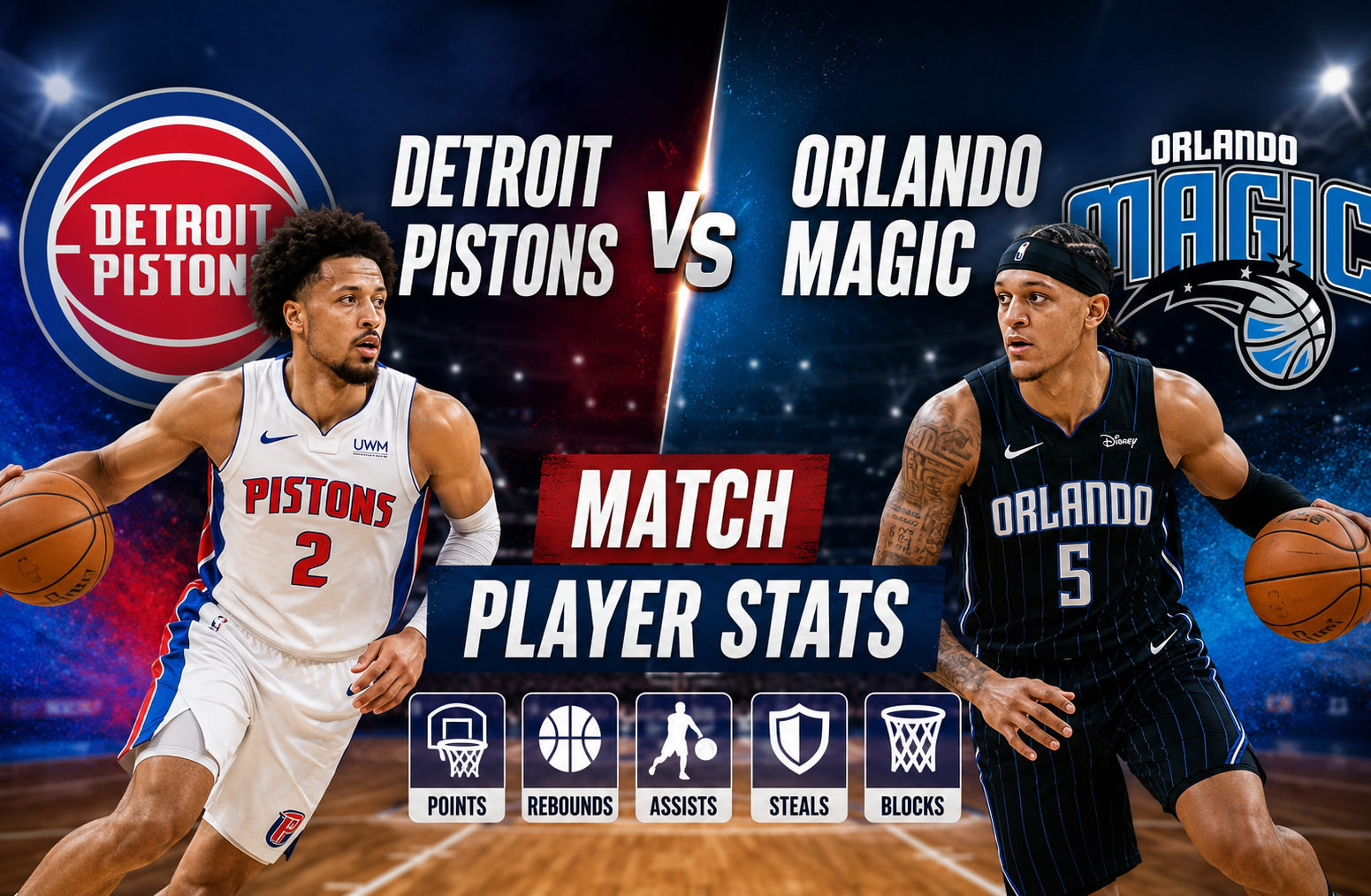
Detroit Pistons vs Orlando Magic Match Player Stats
The detroit pistons vs orlando magic match player stats from Game 4 of the 2026 Eastern Conference First Round tell a much deeper story than the 94-88 final score. Orlando, the No. 8 seed, defeated the No. 1 seeded Detroit Pistons at Kia Center and moved within one victory of winning the series. Detroit entered the postseason with a 60-22 regular-season record, but Orlando’s defensive pressure, rebounding, three-point shooting and ability to protect the basketball proved decisive in a low-scoring playoff battle.
The most important individual performance came from Desmond Bane, who scored 22 points and connected on five of his 10 three-point attempts. Franz Wagner added 19 points in only three quarters before leaving with right calf soreness. Paolo Banchero contributed 18 points and eight rebounds, while Wendell Carter Jr. produced 12 points and 11 rebounds. For Detroit, Cade Cunningham led all Pistons scorers with 25 points and added nine rebounds and six assists, while Tobias Harris scored 20 points.
This was not simply a game where Orlando shot better. In fact, both teams struggled badly from the field. The difference came from possessions. Orlando committed substantially fewer turnovers, won the rebounding battle and generated enough three-point production to survive Detroit’s superior interior scoring.
Detroit Pistons vs Orlando Magic Match Player Stats at a Glance
The game was played at Kia Center in Orlando, Florida, with 19,040 fans in attendance. The official NBA record identifies it as Game 4 of the Eastern Conference First Round, with Orlando taking a 3-1 series advantage.
| Category | Detroit Pistons | Orlando Magic |
| Final Score | 88 | 94 |
| Q1 | 27 | 26 |
| Q2 | 25 | 28 |
| Q3 | 17 | 21 |
| Q4 | 19 | 19 |
| Field Goals | 31-82 | 30-92 |
| Field Goal % | 37.8% | 32.6% |
| Three-Pointers | 6-30 | 9-35 |
| Three-Point % | 20.0% | 25.7% |
| Free Throws | 20-28 | 25-34 |
| Rebounds | 49 | 52 |
| Assists | 18 | 15 |
| Turnovers | 20 | 12 |
| Steals | 5 | 8 |
| Blocks | 18 | 6 |
| Offensive Rebounds | 12 | 16 |
| Defensive Rebounds | 37 | 36 |
| Points in the Paint | 44 | 34 |
The official NBA game record lists Detroit at 88 points and Orlando at 94, with Orlando leading the series 3-1.
One detail is especially revealing: Detroit made more field goals than Orlando, 31 to 30, despite losing the game. That immediately shows why raw field-goal totals do not explain this contest.
Orlando compensated for its poor overall shooting by creating more opportunities. The Magic collected 16 offensive rebounds, made nine three-pointers and committed far fewer turnovers.
How the Game Was Decided
The four-quarter scoring pattern shows how tightly contested this matchup remained.
Detroit opened with a 27-26 first quarter lead. Orlando responded in the second quarter by scoring 28 points to Detroit’s 25, giving the Magic a 54-52 halftime advantage.
The third quarter became the turning point. Orlando outscored Detroit 21-17 and entered the final period with a six-point advantage. Neither team produced an offensive explosion in the fourth, with both scoring 19 points.
The final score therefore reflects a game decided by a handful of possessions rather than a prolonged offensive collapse.
The official game recap describes several momentum swings. Orlando began the third quarter strongly, building a 19-7 advantage, before Detroit responded with a 20-5 run. Detroit later led 40-30 in the second quarter, demonstrating just how quickly control changed hands.
The decisive sequence arrived late.
With 5:24 remaining, Ausar Thompson scored to tie the game at 85. Orlando then closed the contest with a 9-3 run. Bane’s three-pointer with 1:16 remaining became the critical shot in that closing stretch.
That sequence explains the result better than the final margin alone.
Cade Cunningham’s 25-Point Performance
Cade Cunningham was Detroit’s leading scorer with 25 points, but his line was a mixture of production and difficulty.
He finished with:
- 25 points
- 9 rebounds
- 6 assists
- 2 blocks
- 7-of-23 shooting
- 3-of-11 from three
- 8-of-10 from the free-throw line
- 8 turnovers
- 5 personal fouls
- Minus-7 plus/minus
The scoring total looks impressive, but the shooting efficiency tells another story. Cunningham made only 30.4 percent of his field-goal attempts and 27.3 percent from three-point range. The biggest concern was his eight turnovers.
This is one of the most important lessons from these detroit pistons vs orlando magic match player stats.
A primary ball-handler can lead a team in scoring and still have a negative offensive impact if the defense consistently turns his possessions into empty trips.
Cunningham was responsible for a large share of Detroit’s creation. Orlando’s ability to pressure him and force eight turnovers placed considerable strain on the rest of the Pistons’ offense.
His nine rebounds and six assists show that he was involved across the floor. However, the eight turnovers became especially damaging because Orlando itself protected the ball much better.
Tobias Harris Provides Efficient Secondary Scoring
Tobias Harris gave Detroit an important offensive contribution with 20 points.
His line was:
- 20 points
- 6 rebounds
- 8-of-17 shooting
- 0-of-5 from three
- 4-of-5 from the free-throw line
- 1 steal
- 1 block
Harris shot 47.1 percent from the field, making him one of Detroit’s more efficient high-volume scorers in the game.
The problem was that Detroit needed more perimeter efficiency around Cunningham.
Harris did not make a three-pointer, while Duncan Robinson shot only 2-of-8 from the field and 1-of-6 from three. Cunningham also struggled from long range.
When a playoff offense is already dealing with aggressive defensive pressure, missed open perimeter opportunities can make every possession harder.
Jalen Duren’s Interior Efficiency
Jalen Duren quietly produced one of Detroit’s more efficient individual performances.
He scored 12 points on 5-of-8 shooting, grabbed eight rebounds and recorded three assists. He also blocked one shot and had one steal.
Most importantly, Duren was 5-of-8 from the field, good for 62.5 percent, and made both of his free throws.
Detroit therefore received efficient production around the basket.
However, Duren’s four turnovers and five fouls limited the overall value of his contribution. Orlando’s frontcourt combination of Banchero and Carter Jr. also helped the Magic win the overall rebounding battle.
Ausar Thompson’s Defensive Contribution
Ausar Thompson scored only six points, but evaluating his game strictly through scoring would miss his broader role.
He finished with:
- 6 points
- 9 rebounds
- 1 assist
- 1 steal
- 2 blocks
- 4 offensive rebounds
- 5 defensive rebounds
His nine rebounds tied Cunningham for Detroit’s team high.
Thompson also made the late layup that tied the game at 85, briefly putting Detroit in position to take control.
The problem was offensive efficiency. He shot 2-of-8 from the field and did not attempt a three-pointer.
His defensive and rebounding value was useful, but Detroit needed additional offensive production from its supporting players.
Desmond Bane Was Orlando’s Offensive Difference-Maker
Desmond Bane was the most important scorer in the game.
He finished with 22 points on 7-of-18 shooting and went 5-of-10 from three-point range. He also added five rebounds, one assist and one steal.
His 50 percent three-point shooting was particularly valuable because Orlando struggled to score efficiently overall.
Bane’s biggest contribution came at the right moment. With the game tied late, he hit the three-pointer that helped Orlando regain control during the decisive closing run.
This is why shot timing matters when evaluating playoff performances.
A player does not need to score 30 points to dominate a game. A timely three-pointer during a tied game can carry more practical value than several baskets scored during a comfortable lead.
Franz Wagner’s Efficient First Three Quarters
Franz Wagner scored 19 points while shooting 7-of-15 from the field.
He also recorded:
- 5 rebounds
- 3 assists
- 4 steals
- 1 three-pointer
- 4-of-4 free throws
- 0 turnovers
His 24:11 of playing time makes the production even more notable. Wagner scored 19 points in just over 24 minutes and finished with a strong plus-17 rating.
Wagner left the game with right calf soreness late in the third quarter and did not return for the fourth. The injury was significant because Orlando had to close a playoff game without one of its most efficient offensive players.
His absence also made the final minutes more impressive from Orlando’s perspective.
Instead of allowing Detroit to exploit the missing scorer, the Magic found enough production from Bane, Banchero, Carter Jr. and their defensive structure to protect the lead.
Paolo Banchero’s 18 Points and Eight Rebounds
Paolo Banchero had a difficult shooting night but still made meaningful contributions.
His final line included:
- 18 points
- 8 rebounds
- 4 assists
- 1 steal
- 1 block
- 4-of-18 shooting
- 0-of-4 from three
- 10-of-13 free throws
The 4-of-18 field-goal shooting stands out immediately. Banchero was not efficient from the floor, but his ability to get to the free-throw line helped compensate.
He converted 10 of 13 free throws, which produced more points than his four made field goals.
That is another important part of understanding playoff scoring. Field-goal percentage alone does not capture a player’s offensive pressure. Getting defenders into difficult situations and earning free throws can remain valuable even when jump shots are not falling.
Wendell Carter Jr. Controls the Glass
Wendell Carter Jr. recorded 12 points and 11 rebounds for a double-double.
He shot 3-of-8 from the field, made one three-pointer and went 5-of-8 at the free-throw line. He also contributed four assists and two blocks.
His 11 rebounds were particularly important because Orlando finished with a 52-49 rebounding advantage.
Carter Jr. collected five offensive rebounds. Those extra possessions helped offset Orlando’s 32.6 percent shooting.
When a team shoots poorly, offensive rebounding becomes even more important. Missing a shot is less damaging when the offense immediately recovers the ball and gets another opportunity.
Jalen Suggs Struggles From the Field
Jalen Suggs had the toughest shooting performance among Orlando’s major rotation players.
He scored five points on 1-of-13 shooting and went 1-of-11 from three. He also had two assists, two steals and one block.
From a scoring perspective, this was a poor night.
Yet Orlando still won.
That matters because it demonstrates how well the Magic’s overall defensive and possession strategy compensated for individual offensive struggles.
Suggs’ two steals and defensive activity contributed to the team’s ability to pressure Detroit, while Bane, Wagner, Banchero and Carter Jr. supplied enough scoring elsewhere.
Detroit’s Biggest Problem Was Turnovers
If one statistic deserves to be placed at the center of this game, it is turnovers.
Detroit committed 20 turnovers compared with 12 for Orlando. The official game summary states that Orlando turned those Detroit turnovers into 23 points.
That eight-turnover difference created an enormous possession advantage.
Consider the context.
Detroit scored 88 points while making 31 field goals. Orlando scored 94 while making only 30 field goals.
Orlando did not win because it consistently converted shots at a higher rate.
It won because it created and protected more possessions.
The Magic also produced 17 points off turnovers compared with 14 for Detroit in the official game summary’s possession statistics, while Orlando’s total turnover advantage remained one of the central differences.
This is why playoff basketball often becomes a possession game.
One careless pass can lead to a transition basket. Several turnovers can completely change the expected outcome of a low-scoring game.
Rebounding Gave Orlando Extra Chances
Orlando grabbed 52 rebounds compared with Detroit’s 49.
The offensive rebounding margin was even more important:
- Orlando: 16 offensive rebounds
- Detroit: 12 offensive rebounds
Those four additional offensive boards helped the Magic overcome poor shooting.
Detroit actually shot considerably better from the field, around 38 percent compared with Orlando’s roughly 33 percent. Yet Orlando still won.
The explanation is straightforward.
The Magic generated additional attempts through offensive rebounding while also limiting wasted possessions through better ball security.
That combination is extremely difficult to overcome in a playoff game.
Three-Point Shooting Favored Orlando
Neither team shot particularly well from three-point range, but Orlando still held an advantage.
Detroit made 6 of 30 three-point attempts, a 20 percent conversion rate.
Orlando made 9 of 35, approximately 25.7 percent.
That difference translated to nine additional points from three-point shooting.
Bane was responsible for five of Orlando’s nine makes by himself.
Detroit’s perimeter shooting was especially problematic because several key players struggled.
Cunningham went 3-of-11 from three.
Harris went 0-of-5.
Robinson went 1-of-6.
As a team, Detroit therefore had difficulty creating efficient points when Orlando forced possessions away from the paint.
Free Throws Helped Orlando Survive Poor Shooting
Orlando also reached the free-throw line more frequently.
The Magic went 25-of-34, compared with Detroit’s 20-of-28.
Orlando’s 34 attempts provided an important source of reliable scoring in a game where field-goal shooting was poor.
Banchero alone attempted 13 free throws.
This helped turn a difficult shooting night into a manageable offensive performance.
Detroit’s 71.4 percent free-throw shooting was respectable, but the Pistons simply did not receive the same number of opportunities.
Detroit Won the Paint Battle but Still Lost
One of the more interesting aspects of the game was Detroit’s advantage in points in the paint.
The Pistons scored 44 points in the paint compared with Orlando’s 34.
That should normally provide a strong foundation for victory.
Instead, Orlando compensated through other areas:
- More rebounds
- More offensive rebounds
- More three-pointers
- Fewer turnovers
- More free-throw attempts
- More steals
This illustrates why a box score should always be read as a connected system.
A team can dominate one statistical category and still lose because the opponent wins several smaller battles that collectively produce more possessions and more efficient scoring opportunities.
Detroit’s 18 Blocks Were Not Enough
Detroit recorded an extraordinary 18 blocks compared with six for Orlando.
That number is striking.
The Pistons clearly protected the rim effectively at certain points, and their shot-blocking presence helped limit Orlando’s interior scoring.
Yet blocks do not automatically translate into defensive success.
A blocked shot that remains with the offense can produce another scoring chance. A defensive possession is only truly successful when the team finishes the possession with control of the ball.
Orlando’s 16 offensive rebounds demonstrate that the Magic were able to recover some missed opportunities.
The Pistons therefore produced impressive individual defensive plays without consistently ending possessions.
What the Advanced Possession Story Says
The detroit pistons vs orlando magic match player stats become more informative when the major categories are viewed together.
Detroit had:
- Better field-goal percentage
- More assists
- More points in the paint
- More blocks
Orlando had:
- More total rebounds
- More offensive rebounds
- More three-pointers
- More free-throw attempts
- More steals
- Fewer turnovers
The most important distinction was possession quality.
Orlando did not need to shoot well because it repeatedly gave itself another chance to score.
Detroit’s 20 turnovers were particularly damaging because Orlando converted those mistakes into transition and secondary scoring opportunities.
What This Game Says About the Series
The result moved Orlando to a 3-1 series lead.
That was a dramatic development because Detroit entered the playoffs as the Eastern Conference’s No. 1 seed after winning 60 regular-season games.
Orlando entered as the No. 8 seed with a 45-37 record.
The historical context made the situation even more significant. According to the Associated Press game report carried by the NBA, Orlando was one win away from eliminating a 60-win No. 1 seed and reaching its first second round since 2010. Detroit was also facing a long second-round drought, having not advanced beyond the first round since 2008.
This made Game 4 more than another playoff game.
It became a test of whether regular-season dominance could translate into playoff execution.
What Detroit Needed to Fix
The numbers point to several practical areas.
1. Reduce Turnovers
Eight turnovers separated Cunningham’s team from Orlando’s ball security at the team level.
Detroit could not afford to give away 20 possessions in a game where it scored only 88 points.
2. Improve Perimeter Efficiency
A 6-of-30 three-point performance is difficult to overcome.
Detroit needed better shot selection and more reliable shooting around Cunningham.
3. Finish Defensive Possessions
The Pistons blocked 18 shots, which was impressive, but Orlando still grabbed 16 offensive rebounds.
The next step was not simply contesting shots.
It was securing the rebound after the contest.
4. Create More Efficient Offense for Cunningham
Cunningham’s 25 points came on 23 field-goal attempts.
His eight turnovers made the workload even more expensive.
Detroit needed to reduce the defensive burden on its primary creator by generating easier scoring opportunities elsewhere.
What Orlando Did Right
Orlando’s formula was surprisingly simple.
The Magic protected the basketball, attacked the glass and hit enough perimeter shots.
Bane’s shooting gave the offense an essential source of spacing.
Carter Jr. controlled the boards.
Banchero generated free throws.
Wagner produced efficient scoring before leaving the game.
And the defense continually pressured Detroit’s ball-handlers.
None of those factors alone explains a six-point victory.
Together, they do.
Player-by-Player Statistical Summary
Detroit Pistons
Cade Cunningham: 25 points, 9 rebounds, 6 assists, 2 blocks, 8 turnovers, 7-of-23 shooting.
Tobias Harris: 20 points, 6 rebounds, 8-of-17 shooting, 4-of-5 free throws.
Jalen Duren: 12 points, 8 rebounds, 3 assists, 5-of-8 shooting.
Ausar Thompson: 6 points, 9 rebounds, 4 offensive rebounds, 2 blocks.
Duncan Robinson: 7 points, 2-of-8 shooting and 1-of-6 from three.
Javonte Green: 5 points, 5 rebounds and 2 blocks.
Orlando Magic
Desmond Bane: 22 points, 5 rebounds, 5-of-10 from three.
Franz Wagner: 19 points, 5 rebounds, 3 assists and 4 steals in 24:11.
Paolo Banchero: 18 points, 8 rebounds and 4 assists.
Wendell Carter Jr.: 12 points, 11 rebounds, 4 assists and 2 blocks.
Jalen Suggs: 5 points, 2 assists, 2 steals and 1 block.
These numbers are based on the official NBA box score.
Why the Box Score Should Not Be Read in Isolation
One of the easiest mistakes when researching a playoff game is focusing only on the leading scorer.
Cunningham had the highest scoring total for Detroit.
Bane had the highest total for Orlando.
But the game was not decided by scoring alone.
Orlando’s eight-turnover advantage, four-rebound advantage and three-point edge collectively created the conditions for victory.
This is especially important for readers comparing individual performances.
A player with 25 points may appear more productive than a player with 19, but efficiency, turnovers, defensive activity, rebounding and game context can completely change the evaluation.
That is why a complete player-stat analysis needs to combine traditional numbers with possession-based interpretation.
A Note on the Game Date
There is a small date distinction worth clarifying for anyone archiving this game.
The official NBA game page identifies the contest as Monday, April 27, 2026, while its game information is dated Tuesday, April 28, 2026. The official game location was Kia Center in Orlando.
For search and publishing purposes, readers may encounter both April 27 and April 28 associated with this game depending on the source and time zone.
The actual game was played Monday night in Orlando and reported in the early hours of April 28.
The Biggest Takeaways From the Match
Several conclusions stand out from the numbers.
First, Orlando won the possession battle. The Magic committed only 12 turnovers while Detroit committed 20.
Second, Orlando dominated offensive rebounding. Sixteen offensive rebounds kept possessions alive.
Third, Bane’s shooting mattered enormously. His five three-pointers accounted for a major share of Orlando’s perimeter production.
Fourth, Detroit’s shooting was inefficient despite better overall field-goal accuracy. The Pistons made only six three-pointers.
Fifth, Cunningham produced a strong volume scoring line but struggled with efficiency and ball security.
Sixth, Wagner’s 19 points in limited playing time were highly efficient before his injury.
Seventh, Orlando proved it could win even when its own shooting was poor. That is arguably the most encouraging takeaway for the Magic.
Frequently Asked Questions
Who led the Detroit Pistons in scoring?
Cade Cunningham led Detroit with 25 points. He also recorded nine rebounds and six assists, although he committed eight turnovers.
Who led the Orlando Magic in scoring?
Desmond Bane led Orlando with 22 points. He shot 7-of-18 from the field and made five of 10 three-point attempts.
What was the final score?
The Orlando Magic defeated the Detroit Pistons 94-88 in Game 4 of the Eastern Conference First Round.
Who had the most rebounds?
Wendell Carter Jr. led all players with 11 rebounds. Ausar Thompson and Cade Cunningham each had nine for Detroit.
Why did Orlando win despite shooting poorly?
Orlando compensated for its 32.6 percent field-goal shooting by winning the rebounding battle, making more three-pointers, getting to the free-throw line more often and committing eight fewer turnovers than Detroit.
What was the series score after the game?
Orlando took a 3-1 series lead after the 94-88 victory. The Magic needed one more win to eliminate the top-seeded Pistons.
Conclusion
The most important lesson from the detroit pistons vs orlando magic match player stats is that playoff basketball is often decided by possession control rather than one headline scoring number.
Cade Cunningham’s 25 points gave Detroit a clear individual scoring leader, while Tobias Harris added 20 and Jalen Duren provided efficient interior scoring. Detroit also dominated points in the paint and recorded an impressive 18 blocks.
Yet Orlando found a more reliable winning formula.
Desmond Bane supplied 22 points and five three-pointers. Franz Wagner scored 19 points efficiently before leaving with a calf issue. Wendell Carter Jr. controlled the glass with 11 rebounds, while Paolo Banchero used his ability to draw fouls to produce 18 points despite difficult shooting.
The most decisive difference was possession management. Orlando committed only 12 turnovers compared with Detroit’s 20 and collected 16 offensive rebounds. Those extra opportunities allowed the Magic to survive a poor shooting night and close a tightly contested game.
For Detroit, the numbers pointed to a clear problem: too many empty possessions. For Orlando, they demonstrated the value of defense, rebounding and disciplined ball security.
In a game decided by only six points, those details were the difference between a tied series and a 3-1 Orlando advantage.