Roach Eggs: What They Look Like, Where to Find Them, and How to Get Rid of Them
Roach Eggs are one of the most important signs of a cockroach problem in a home, apartment, restaurant, or commercial building. Finding even one small, brown capsule in a kitchen cabinet, behind an appliance, or near a bathroom drain can raise serious concerns about a possible infestation. However, many people do not recognize these egg cases because they look different from what they expect. Unlike many insects, cockroaches do not usually leave individual eggs scattered around a room. Instead, they protect their developing eggs inside a special capsule called an ootheca.
Understanding how these capsules look, where cockroaches leave them, and how quickly they can hatch is essential for preventing a growing pest problem. A single egg case can contain numerous developing cockroaches, depending on the species. Once they hatch, the young insects can hide in small spaces, find food and water, and gradually develop into adults capable of reproducing.
The good news is that identifying the problem early makes it easier to take effective action. With proper inspection, careful cleaning, moisture control, and suitable pest management methods, homeowners can reduce the chances of a larger infestation. This guide explains everything you need to know, including identification, common hiding places, hatching times, species differences, removal methods, prevention strategies, and frequently asked questions.
What Are Roach Eggs?
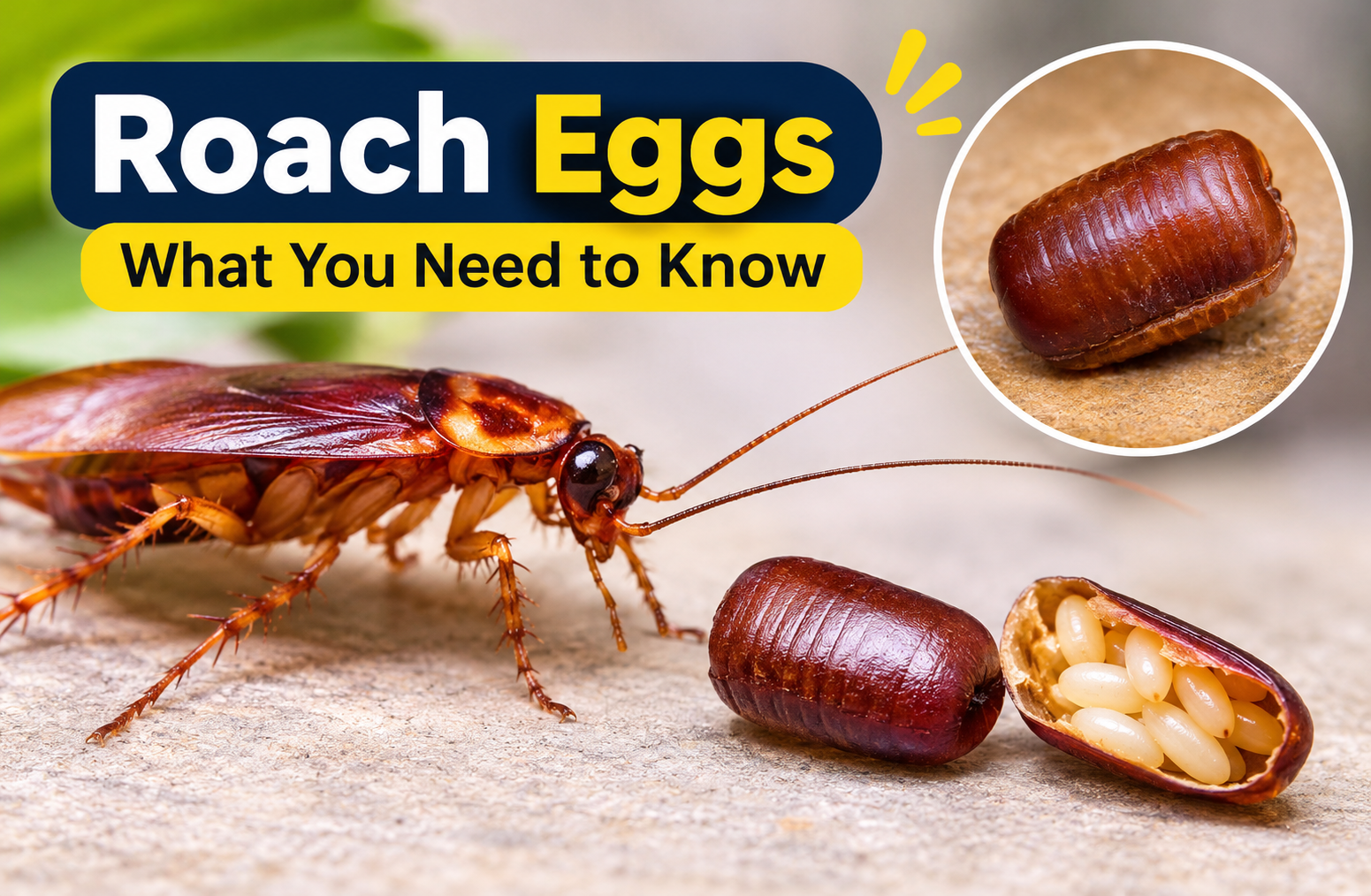
Roach eggs are the reproductive structures produced by female cockroaches. In most common household species, these eggs develop inside a protective capsule known as an ootheca.
An ootheca is a small, firm covering that protects multiple eggs during development. Its outer surface is generally brown, reddish-brown, tan, or dark brown, although the appearance varies between species.
The capsule serves several important purposes:
- Protects developing embryos from physical damage.
- Helps prevent eggs from drying out.
- Keeps multiple eggs together in one protective structure.
- Provides a safer environment during development.
- Supports successful hatching under suitable environmental conditions.
The number of eggs inside a capsule depends on the cockroach species. German cockroaches, for example, commonly produce egg cases containing approximately 30 to 40 eggs. American cockroach egg cases generally contain around 12 to 15 eggs.
This difference matters because identifying the species can help explain how quickly a cockroach population might increase.
Female cockroaches also behave differently when carrying their egg cases. Some species carry the capsule until shortly before the young hatch, while others deposit it in a protected location soon after producing it.
Therefore, finding an egg case does not always mean that the female cockroach is still nearby.
What Do Roach Eggs Look Like?
How to Get Rid of Cockroach Eggs For Good
Œufs de cafard (oothèques) : reconnaître, trouver, éliminer (photos)
Cockroach Eggs: How They Look, Where They Hide, & Get Rid
10
One of the most common questions homeowners ask is how to distinguish a cockroach egg case from ordinary household debris.
These capsules are generally small, elongated, and slightly rounded. They often have a textured or ridged surface, with visible divisions along one edge.
Depending on the species, an egg case may look like a tiny brown bean, a miniature purse, or a narrow capsule.
Common Physical Characteristics
Here are the features that can help you recognize one:
- Shape
Most cockroach egg cases have an elongated oval, rectangular, or purse-like appearance. Their edges may look slightly curved or rounded.
- Color
Common colors include:
- Light brown
- Dark brown
- Reddish-brown
- Tan
- Nearly black in some cases
Color alone is not enough to confirm identification because different species produce capsules with overlapping colors.
- Size
Most household cockroach egg cases are relatively small. Some measure only a few millimeters, while larger species produce noticeably bigger capsules.
- Texture
The outer covering is generally firm and leathery. It may have small ridges, grooves, or segmented sections.
- Surface Details
Some capsules have a raised seam or ridge along one side. This area is associated with the structure through which young cockroaches emerge.
Are Cockroach Eggs Visible Individually?
Usually, no.
The individual eggs are enclosed inside the protective capsule. You generally cannot see each developing egg without examining or opening the structure.
This is why people sometimes mistake an egg case for a small seed, dried food particle, or piece of insect debris.
If you find an unfamiliar capsule, avoid crushing it with your bare fingers. Photograph it and compare its shape, size, and location with reliable identification information.
Different Types of Cockroach Egg Cases
Not every cockroach produces an identical egg capsule. Different species have different reproductive habits, and their egg cases can vary considerably.
Understanding these differences is particularly useful when dealing with an infestation because species identification can influence treatment decisions.
1. German Cockroach Egg Cases
Institut de Biologia Evolutiva – CSIC UPF (UPF)
The German cockroach is one of the most troublesome indoor cockroach species.
Its scientific name is Blattella germanica. It is commonly found in kitchens, bathrooms, food storage areas, and places where moisture is readily available.
Its egg case generally has these characteristics:
- Brown or tan coloration.
- Approximately 8 mm long.
- Around 30 to 40 eggs per capsule.
- Narrow, purse-like appearance.
- A ridged outer covering.
One particularly important characteristic is the female’s reproductive behavior.
A female German cockroach usually carries her egg capsule protruding from the end of her abdomen for most of its development period. She generally deposits it shortly before hatching.
This behavior protects the developing eggs and makes the species especially successful at reproducing indoors.
German cockroaches can produce several egg cases during their lifetime. As a result, an established population can grow quickly when food, water, and shelter are readily available.
2. American Cockroach Egg Cases
Guide to Cockroach Eggs: Size, Appearance, & Frequency | EcoGuard
American cockroaches are larger than German cockroaches and are commonly associated with drains, basements, sewers, utility areas, and other damp environments.
Their egg cases are generally:
- Dark reddish-brown.
- Approximately 8 mm long.
- Slightly rectangular or capsule-shaped.
- Relatively firm.
- Commonly associated with 12 to 15 eggs.
Unlike German cockroaches, female American cockroaches generally deposit their egg cases after carrying them for a relatively short period.
They may attach the capsules to suitable surfaces or place them in protected locations.
Common areas include:
- Behind appliances.
- Near damp basement walls.
- Around utility pipes.
- Inside protected cracks.
- Near food sources.
Because American cockroaches can enter buildings from outdoor environments, finding one egg case does not automatically mean that a large indoor colony exists.
The surrounding evidence should also be examined.
3. Oriental Cockroach Egg Cases
Cockroach Eggs: What They Look Like and What You Need To Do – Cockroach Facts
Oriental cockroaches are dark-colored insects that prefer cool, damp environments.
They are frequently associated with:
- Basements.
- Drains.
- Crawl spaces.
- Damp storage rooms.
- Areas around leaking pipes.
Their egg cases are generally dark brown or reddish-brown and contain approximately 12 to 18 eggs, depending on the biological characteristics of the population.
Female Oriental cockroaches usually deposit their capsules in protected locations.
Their development can take considerably longer than that of German cockroaches. Temperature, humidity, and other environmental conditions influence the time required for the eggs to hatch.
This species is particularly important to consider when inspecting buildings with persistent moisture problems.
4. Brown-Banded Cockroach Egg Cases
UF/IFAS Cockroach Photographs CD-ROM
Brown-banded cockroaches have different hiding preferences from many other household species.
Instead of concentrating mainly around sinks and other damp locations, they may occupy relatively dry areas throughout a building.
Their egg cases are generally:
- Light brown to reddish-brown.
- Approximately 5 mm long.
- Small and elongated.
- Attached to protected surfaces.
- Capable of containing approximately 15 to 20 eggs.
Female brown-banded cockroaches often attach their capsules to furniture, cabinets, walls, and other sheltered surfaces.
This makes inspection particularly important in bedrooms, living rooms, offices, and storage spaces.
A person who checks only the kitchen and bathroom may overlook an infestation involving this species.
Comparison of Common Cockroach Egg Cases
The following table provides a simple comparison of the major household species.
| Cockroach species | Approximate eggs per case | Typical appearance | Common location |
| German | 30 to 40 | Brown, purse-shaped | Kitchens and bathrooms |
| American | 12 to 15 | Dark reddish-brown | Basements and damp areas |
| Oriental | 12 to 18 | Dark brown | Drains and cool spaces |
| Brown-banded | 15 to 20 | Light reddish-brown | Furniture and dry areas |
These figures are approximate biological ranges, not guaranteed counts for every individual capsule.
The most useful identification method combines appearance, location, and evidence of nearby cockroach activity.
Where Do Cockroaches Lay Their Eggs?
Cockroaches prefer locations that provide protection, suitable temperatures, and access to food and water.
However, their preferred nesting areas differ according to species.
A German cockroach, for example, is commonly associated with warm kitchen spaces, while a brown-banded cockroach may hide inside furniture or behind wall decorations.
Understanding these habits helps homeowners inspect the places that are most likely to contain egg cases.
1. Kitchen Cabinets
Easy guide to eliminate cockroaches around homes by doing it yourself
Kitchen cabinets provide several conditions that cockroaches need to survive.
They offer shelter, food particles, warmth, and relatively undisturbed spaces.
Check these areas carefully:
- Behind stored food containers.
- Inside cabinet corners.
- Beneath cabinet shelves.
- Around hinges.
- Behind loose panels.
- Along the edges of cabinet doors.
Pay special attention to areas containing crumbs, grease, or spilled food.
2. Under Kitchen Sinks
Home Inspector | Seller To-Do List Prior to Inspections
The area beneath a kitchen sink is one of the most important places to inspect.
Water leaks, condensation, cleaning supplies, and stored objects can create favorable hiding conditions.
Look around:
- Drain pipes.
- Water supply connections.
- Cabinet corners.
- Pipe openings.
- Damp wood surfaces.
- Gaps between the cabinet and wall.
Fixing leaks is particularly important because moisture can support cockroach survival even when food is limited.
3. Behind Refrigerators
Cada cuánto recomiendan limpiar la parte de atrás de la heladera – Infobae
Refrigerators produce warmth around their compressor and motor areas.
Food particles may also collect underneath or behind the appliance.
These conditions can attract cockroaches looking for shelter and food.
Move the appliance carefully, where safe, and inspect the surrounding floor, wall, and nearby cracks.
Do not spray liquid pesticides directly into electrical components.
4. Bathrooms and Drain Areas
Why spraying pests inside your home rarely solves the real problem – West Pest Co.
Bathrooms offer water and sheltered spaces that can support cockroach activity.
Inspect:
- Behind toilets.
- Beneath bathroom sinks.
- Around drain connections.
- Behind washing machines.
- Inside vanity cabinets.
- Near leaking plumbing.
Not every cockroach species prefers wet environments, but bathrooms can provide suitable shelter for several common household species.
5. Furniture and Storage Areas
Common Mistakes When Buying Vintage Furniture (And How to Avoid Them) – Éco-Dépôt Montréal
Some cockroaches hide in furniture, especially when the surrounding environment is quiet and undisturbed.
Look behind picture frames, inside drawers, beneath tables, and around furniture joints.
Brown-banded cockroaches are particularly associated with these less obvious locations.
Cardboard boxes, old newspapers, and unused storage containers can also provide shelter.
How Long Do Roach Eggs Take to Hatch?
The time required for cockroach eggs to hatch depends mainly on the species and environmental conditions.
Temperature, humidity, and the developmental stage of the embryos all influence the process.
There is no single hatching period that applies to every cockroach.
For example, German cockroach egg cases commonly develop over approximately 20 to 30 days under favorable conditions. Other species may require several weeks or longer.
Approximate Development Periods
| Species | General egg development period |
| German cockroach | Around 20 to 30 days |
| American cockroach | Around 6 to 8 weeks |
| Oriental cockroach | Around 2 months |
| Brown-banded cockroach | Around 1 month or longer |
These are general reference ranges. Actual development can vary with temperature and other environmental factors.
What Happens Before Hatching?
The development process occurs inside the protective capsule.
During this period:
- Fertilized eggs develop into embryos.
- The embryos gradually grow.
- Their bodies become more developed.
- The capsule eventually opens.
- Young cockroaches emerge as nymphs.
The nymphs are usually pale or whitish immediately after emerging. Their outer coverings gradually darken and harden.
They do not look exactly like adult cockroaches because they are smaller and generally lack fully developed wings.
Can Cockroach Eggs Hatch Without the Mother?
Yes.
Once a female has deposited a viable egg case in a suitable location, the developing embryos may continue growing without her presence.
This is one reason why removing visible adult cockroaches does not always solve an infestation.
An egg case may remain hidden in a protected location and produce young insects later.
However, the reproductive behavior of German cockroaches is different because females usually retain their capsules until shortly before hatching.
How Many Cockroaches Can Hatch From One Egg Case?
The number of young cockroaches depends on the species.
A German cockroach egg case commonly contains approximately 30 to 40 developing eggs. An American cockroach capsule generally contains around 12 to 15.
Not every egg necessarily produces a surviving nymph.
Some embryos may fail to develop, and newly hatched insects may face environmental challenges.
Nevertheless, a single successful egg case can introduce numerous young cockroaches into a building.
The population can grow further when newly mature females begin producing their own capsules.
This explains why early detection is important.
A small number of cockroaches may appear manageable, but an established breeding population can become difficult to control if suitable food, water, and shelter remain available.
What Happens When Cockroach Eggs Hatch?
Cockroaches | Horticulture, Landscape, and Environmental Systems | Nebraska
The German Cockroach Lifecycle: From Egg to Infestation in 100 Days
9
When the egg case opens, small cockroaches called nymphs emerge.
These insects are immature versions of adult cockroaches.
They have similar body structures but are smaller, wingless, and not yet capable of reproduction.
Stage 1: Newly Hatched Nymphs
Newly emerged nymphs are often white or pale because their outer coverings have not fully hardened.
They may remain close to the egg case for a short time.
Their bodies gradually become darker as their external coverings harden.
Stage 2: Early Growth
The nymphs begin searching for food, water, and protected hiding places.
They can fit into very small spaces, making them difficult to detect.
They may gather around cracks, cabinet joints, plumbing openings, and other sheltered areas.
Stage 3: Molting
Cockroaches grow through a process called molting.
During this process, they shed their old external covering and develop a larger one.
They repeat this process several times before reaching adulthood.
The discarded coverings can sometimes be found near cockroach hiding places.
Stage 4: Adult Development
After completing their immature stages, cockroaches become adults.
Adult females may eventually produce new egg cases, continuing the reproductive cycle.
The time required to reach adulthood varies considerably between species and environmental conditions.
Signs That Cockroaches May Be Reproducing in Your Home
Finding an egg case is a significant clue, but it is not the only sign of cockroach activity.
Several other indicators can help determine whether insects are reproducing inside a property.
1. Small Cockroaches
How to get rid of cockroaches | PestXpert – PestXpert NZ
Finding several small, wingless cockroaches is one of the strongest signs of nearby breeding activity.
Nymphs often remain close to suitable hiding places because they need food, moisture, and protection.
If you repeatedly see small cockroaches in the same area, inspect nearby cracks and enclosed spaces.
2. Shed Cockroach Skins
Cockroaches shed their outer coverings as they grow.
These discarded skins may look like thin, empty insect bodies.
They can accumulate near hiding places, especially where populations are established.
3. Dark Droppings
Cockroach droppings may resemble black pepper, coffee grounds, or small dark particles.
Their appearance depends on the species and the type of food consumed.
You may find them around:
- Cabinet corners.
- Behind refrigerators.
- Inside drawers.
- Along wall edges.
- Near plumbing openings.
4. Unpleasant Odors
Large cockroach populations can produce a noticeable musty or unpleasant smell.
This odor may become stronger in enclosed areas where insects gather.
However, odor alone cannot confirm that an egg case is present.
5. Repeated Nighttime Sightings
Cockroaches are generally more active during the night.
If you repeatedly see them when turning on kitchen or bathroom lights, there may be a nearby hiding area.
Frequent daytime sightings can also indicate substantial activity or disturbance of their normal hiding places.
How to Get Rid of Roach Eggs
Removing an egg case is an important step, but successful cockroach control requires more than picking up a visible capsule.
You must also address the conditions that allow cockroaches to survive and reproduce.
A practical approach combines physical removal, sanitation, moisture control, monitoring, and suitable pest control products.
Step 1: Identify the Egg Case
Before taking action, check whether the object is actually a cockroach egg capsule.
Look for its:
- Shape.
- Size.
- Color.
- Outer ridges.
- Location.
- Attachment to nearby surfaces.
Photographing the object can help with later identification.
If you are uncertain, a pest management professional can examine it.
Step 2: Remove the Capsule Safely
If you find a suspected egg case, avoid handling it with bare hands.
A practical removal method is:
- Put on disposable gloves.
- Use tissue, paper, or a disposable tool to pick it up.
- Place it inside a sealed plastic bag.
- Dispose of the sealed bag in an appropriate outdoor waste container.
- Clean the surrounding surface.
Do not crush the capsule with your fingers.
Sealing it before disposal reduces the chance of accidentally spreading insects or debris.
Step 3: Vacuum Nearby Areas
Vacuuming can remove cockroach nymphs, droppings, shed skins, and other debris.
Pay attention to:
- Cabinet corners.
- Floor edges.
- Spaces beneath appliances.
- Furniture joints.
- Wall gaps.
- Areas behind storage containers.
After vacuuming, empty the contents into a sealed bag and dispose of them appropriately.
If you use a vacuum cleaner with a reusable collection container, clean it according to the manufacturer’s instructions.
Step 4: Remove Food Sources
Cockroaches can survive on many types of organic material.
Even small amounts of food can support their activity.
To reduce available food:
- Clean kitchen counters regularly.
- Remove crumbs from floors.
- Wash dishes after meals.
- Store dry food in sealed containers.
- Clean grease from cooking areas.
- Empty garbage frequently.
- Avoid leaving pet food exposed overnight.
Pay particular attention to areas beneath refrigerators and cooking appliances.
These locations can collect food debris that is not visible during ordinary cleaning.
Step 5: Eliminate Water Sources
Moisture control is one of the most important parts of long-term cockroach prevention.
Inspect the property for:
- Leaking taps.
- Damaged drain connections.
- Condensation.
- Wet cabinet floors.
- Standing water.
- Leaking washing machines.
- Poorly ventilated bathrooms.
Repair leaks and dry wet surfaces.
Where possible, improve ventilation in damp rooms.
Removing unnecessary moisture makes the environment less suitable for cockroach survival.
Step 6: Use Cockroach Baits
Cockroach baits can be useful for controlling insects that hide in areas that are difficult to reach.
They typically contain an attractant combined with an insecticidal ingredient.
Cockroaches consume the bait and receive the active ingredient.
For better results:
- Follow the product label carefully.
- Apply bait only in approved locations.
- Keep it away from children and pets.
- Place it near suspected cockroach activity.
- Avoid contaminating bait with cleaning chemicals.
- Monitor activity and replace bait as directed.
Bait performance can decrease when alternative food sources are readily available.
Some cockroach populations also show resistance or bait avoidance, so a product that works in one situation may not work equally well in another.
Step 7: Consider Insect Growth Regulators
Insect growth regulators, commonly called IGRs, are products designed to interfere with insect development or reproduction.
Depending on the active ingredient, they may disrupt normal growth, molting, or reproductive development.
They are not necessarily immediate killers of adult cockroaches.
However, they can form part of a broader management strategy.
Always select products approved for the intended pest and follow their instructions.
Step 8: Seal Entry Points
Cockroaches can enter buildings through surprisingly small openings.
Inspect areas around:
- Plumbing pipes.
- Electrical conduits.
- Doors.
- Windows.
- Wall joints.
- Floor gaps.
- Ventilation openings.
Use appropriate sealing materials to close unnecessary gaps.
Door sweeps and suitable screens can also help reduce entry from outdoor areas.
Step 9: Monitor the Property
After removing an egg case and cleaning the surrounding area, continue monitoring.
Sticky monitoring traps can help reveal where cockroaches are moving.
Place them near suspected activity, such as:
- Under sinks.
- Behind refrigerators.
- Near cabinet corners.
- Along walls.
- Close to plumbing openings.
Record the locations where insects are caught.
Repeated captures in one area may indicate a nearby hiding place that needs further inspection.
Step 10: Arrange Professional Pest Control When Necessary
Professional assistance may be appropriate when:
- Cockroaches appear repeatedly.
- Multiple egg cases are discovered.
- Small cockroaches are found in several rooms.
- Bait treatments are not reducing activity.
- The infestation involves an apartment building.
- Cockroaches are spreading through wall or plumbing openings.
A qualified pest management professional can identify the species, inspect hidden locations, and develop a treatment plan.
This is particularly important for German cockroach infestations, which can become difficult to manage without coordinated treatment and follow-up inspections.
Do Home Remedies Kill Cockroach Eggs?
Many people search for inexpensive household solutions when they discover a cockroach egg case.
Some remedies can help with cleaning or removing visible insects, but they should not be treated as guaranteed methods for eliminating developing eggs.
The protective capsule makes the eggs more difficult to reach than exposed insects.
Here is a closer look at common household approaches.
1. Vinegar
Vinegar is frequently recommended for household cleaning.
It can help remove some surface residues, but ordinary household vinegar should not be considered a reliable method for killing cockroach embryos inside a protective capsule.
Use it only where appropriate for the surface being cleaned.
2. Baking Soda
Baking soda is sometimes promoted as a natural cockroach killer.
However, there is insufficient reason to rely on ordinary baking soda as a dependable treatment for cockroach egg cases.
It should not replace proper inspection and evidence-based pest management.
3. Essential Oils
Certain essential oils have shown insect-repellent or insecticidal effects in research settings.
However, results depend on concentration, exposure, formulation, and insect species.
They should not be assumed to destroy protected embryos inside an egg capsule.
Some essential oils can also irritate people and harm pets.
4. Hot Water
Pouring hot water over a suspected egg case may appear like a simple solution.
However, this approach is unreliable when the capsule is hidden inside a crack, behind a cabinet, or near electrical equipment.
It can also cause burns, damage surfaces, or create plumbing problems.
5. Diatomaceous Earth
Some appropriately labeled insecticidal diatomaceous earth products can help control crawling cockroaches by damaging their protective outer covering.
However, this approach does not reliably penetrate an intact egg case.
Use only products specifically labeled for pest control and avoid creating airborne dust.
The important distinction: A method that kills exposed cockroaches does not necessarily kill the eggs protected inside their capsules.
Can Roach Eggs Survive Without Food or Water?
Developing cockroach embryos inside an egg case do not depend on the same external food sources as adult cockroaches.
Their development takes place within the protective capsule.
Therefore, removing food and water from a room does not guarantee that an existing egg case will become nonviable.
However, food and moisture control remain essential because newly hatched nymphs need suitable environmental conditions to survive and develop.
This is why sanitation should be combined with direct removal, monitoring, and appropriate pest management.
Can Cockroach Eggs Spread From One House to Another?
Yes. Cockroach egg cases can be transported accidentally through everyday household items.
This is one reason infestations sometimes appear in places where people have not previously noticed cockroaches.
Potential sources include:
Cardboard Boxes
Used cardboard boxes can contain cockroaches or egg cases hidden in folds and corners.
This is particularly relevant when moving homes or receiving deliveries.
Secondhand Furniture
Used furniture may contain insects or egg cases in hidden joints, drawers, and enclosed spaces.
Inspect furniture before bringing it indoors.
Grocery Bags and Storage Containers
Cockroaches can hide in packaging, reusable bags, and storage containers.
Check items that have been kept in warehouses, garages, or other areas with known pest activity.
Electronic Equipment
Some cockroach species can hide in warm electronic equipment.
Inspect secondhand appliances and equipment carefully, particularly if they come from an environment with a known infestation.
These risks do not mean that every secondhand item is contaminated. They simply highlight why inspection is useful.
Are Roach Eggs Dangerous to Humans?
The egg case itself is not generally considered a direct physical threat to people.
However, the presence of cockroaches can create sanitation and health concerns.
Cockroaches may move through drains, garbage, contaminated surfaces, and food storage areas.
They can transfer microorganisms mechanically as they move between these environments.
Their droppings, shed skins, and body fragments may also contribute to indoor allergens.
For some people, cockroach allergens can worsen asthma symptoms and allergic reactions.
Possible Health Concerns
- Food Contamination
Cockroaches can contaminate food and food preparation surfaces.
Food that may have been exposed to cockroach activity should be handled carefully and discarded when contamination is suspected.
- Allergic Reactions
Cockroach body parts, saliva, and droppings can contribute to indoor allergen exposure.
Some individuals may experience sneezing, coughing, or other allergic symptoms.
- Asthma Triggers
Cockroach allergens are recognized indoor asthma triggers, particularly in environments with persistent infestations.
Reducing cockroach activity can therefore improve indoor environmental conditions.
- Hygiene Problems
Repeated cockroach activity around food preparation areas creates an avoidable sanitation problem.
Regular cleaning and effective pest management are important for reducing this risk.
How to Prevent Cockroaches From Producing More Egg Cases
Practical Strategies to Prevent Cockroach Infestations at Home –
Preventing future reproduction requires making the property less suitable for cockroaches.
There is no single preventive action that works in every situation. The most reliable approach combines several practical habits.
Maintain a Regular Cleaning Schedule
Clean food preparation surfaces daily.
Remove crumbs, grease, and food waste before they accumulate.
Pay attention to spaces that are often overlooked, such as the area beneath appliances and the back corners of cabinets.
Store Food Properly
Keep dry foods inside sealed containers.
Avoid leaving open packets of cereal, flour, sugar, or snacks inside cabinets.
Use tightly closed garbage bins.
Fix Plumbing Problems
Repair leaking pipes and taps as soon as possible.
Check beneath sinks regularly.
Do not allow standing water to remain in storage areas or around appliances.
Reduce Clutter
Cardboard, newspapers, unused containers, and piles of stored materials can provide hiding places.
Remove unnecessary items and keep storage areas organized.
Inspect Incoming Items
Check secondhand furniture, appliances, boxes, and storage containers before bringing them indoors.
This is especially useful when moving into a new property.
Seal Cracks and Openings
Close gaps around plumbing and construction joints.
Repair damaged door seals and window screens.
Reducing access to hidden spaces makes it easier to inspect and manage cockroach activity.
Use Monitoring Traps
Monitoring traps provide useful information about insect activity.
They can help identify problem areas before a large population becomes established.
Check the traps regularly and record where cockroaches are being caught.
Why Cockroach Infestations Sometimes Return After Treatment
One frustrating experience for homeowners is seeing cockroaches again after cleaning or pesticide treatment.
There are several possible explanations.
Hidden Egg Cases Were Missed
Cockroach capsules may be deposited inside inaccessible cracks or behind fixed appliances.
Removing visible adults does not necessarily eliminate every developing egg case.
New Cockroaches Entered the Property
Cockroaches can move between apartments, neighboring buildings, storage spaces, and outdoor environments.
An infestation may return if entry points remain open.
Food and Water Sources Remain Available
Even after treatment, accessible food and moisture can support surviving cockroaches.
Cleaning and repairs must continue alongside pest control.
Insecticide Resistance
Some cockroach populations have developed resistance to certain insecticides.
Repeated use of the same product may therefore produce disappointing results.
Professional pest management can help determine whether a different treatment approach is necessary.
Inadequate Follow-Up
Cockroach control is not always a one-time activity.
Monitoring, inspection, and follow-up treatment may be required, particularly in buildings with established infestations.
Professional Cockroach Management: Why an Integrated Approach Matters
Effective cockroach management generally requires more than applying a pesticide.
A method known as Integrated Pest Management, or IPM, combines inspection, monitoring, sanitation, exclusion, and carefully selected treatments.
The purpose is to reduce the conditions that allow pests to survive while targeting existing populations.
A typical professional approach includes:
Inspection: Identifying cockroach species, hiding places, and signs of reproductive activity.
Monitoring: Using traps and repeated inspections to understand where cockroaches are active.
Sanitation: Removing food debris, grease, and other accessible resources.
Moisture control: Repairing leaks and reducing unnecessary dampness.
Exclusion: Sealing cracks, gaps, and potential entry points.
Targeted treatment: Applying appropriate baits or other approved products according to the infestation.
Follow-up: Checking whether cockroach activity has decreased and adjusting the treatment plan when necessary.
The University of California’s Integrated Pest Management guide to cockroaches explains why correct species identification, inspection, and suitable management methods are important for controlling these pests.
This approach is particularly useful in apartments, restaurants, hotels, and other buildings where cockroaches may move between connected spaces.
Common Mistakes to Avoid When Dealing With Cockroach Egg Cases
Even when people recognize an egg case, certain mistakes can make the situation more difficult.
Mistake 1: Removing Only Adult Cockroaches
Adult insects are visible, but egg cases and young nymphs may remain hidden.
Successful control requires attention to every life stage.
Mistake 2: Ignoring Small Cockroaches
Some people assume that tiny cockroaches are harmless because they cannot fly.
In reality, they are immature insects that can eventually become reproductive adults.
Mistake 3: Spraying Every Surface
Applying excessive insecticide throughout a home is not a reliable solution.
It may expose people and pets unnecessarily, contaminate surfaces, and interfere with bait effectiveness.
Use products only according to their labels.
Mistake 4: Ignoring Moisture
Cleaning food debris while leaving leaking pipes untreated can allow cockroaches to continue surviving.
Moisture control is a key part of prevention.
Mistake 5: Assuming One Treatment Is Enough
Some infestations require repeated inspection and treatment.
Ignoring follow-up can allow surviving insects or newly introduced cockroaches to establish another population.
Mistake 6: Checking Only the Kitchen
Cockroaches can hide in bedrooms, storage rooms, bathrooms, and furniture.
The inspection should reflect the species and the evidence found throughout the property.
Frequently Asked Questions About Roach Eggs
1. What do roach eggs look like?
They usually look like small, brown, oval, or capsule-shaped structures with a firm outer covering. Most household cockroaches keep multiple developing eggs inside one protective case called an ootheca. The capsule may have visible ridges or segments along its surface.
2. How many cockroaches can come from one egg case?
The number depends on the species. German cockroach egg cases commonly contain approximately 30 to 40 eggs, while American cockroach capsules generally contain around 12 to 15. Not every egg is guaranteed to hatch successfully.
3. Where do cockroaches usually lay their eggs?
Common locations include kitchen cabinets, spaces beneath sinks, areas behind refrigerators, plumbing gaps, storage spaces, and furniture joints. Different species prefer different environments, so a thorough inspection should include both damp and dry areas.
4. How long does it take for cockroach eggs to hatch?
The development period varies by species and environmental conditions. German cockroach eggs commonly hatch after approximately 20 to 30 days under favorable conditions. Other species may require several weeks or longer.
5. Can cockroach eggs hatch after the mother is killed?
Yes. Once a viable egg case has been deposited, the embryos can continue developing without the female. This is why killing adult cockroaches alone may not eliminate an infestation.
6. Does bleach kill cockroach eggs?
Ordinary household bleach should not be considered a dependable method for killing developing cockroach embryos inside a protective egg case. It may disinfect suitable surfaces, but it is not a substitute for physical removal and proper pest management. Never mix bleach with other cleaning chemicals.
7. Can cockroach eggs survive without food?
The embryos develop using resources contained within the eggs, so an egg case does not need an external food source during development. However, newly hatched cockroaches need suitable environmental conditions and access to food and water to survive.
8. Should I be worried if I find one cockroach egg case?
Finding one capsule does not establish the size of an infestation, but it should not be ignored. Inspect the surrounding area, look for nymphs and droppings, remove the capsule safely, and monitor the property for additional activity.
9. Do all cockroach species carry their egg cases?
No. Reproductive behavior differs between species. German cockroach females generally carry their egg cases until shortly before hatching, while many other species deposit them in protected locations earlier.
10. Can cockroach eggs spread through cardboard boxes?
Yes. Cockroaches and their egg cases can be transported accidentally in cardboard boxes and other stored items. Inspect packaging before bringing it indoors, particularly when moving or receiving used storage materials.
Conclusion
Understanding cockroach reproduction is essential for recognizing and controlling an infestation before it becomes difficult to manage. Roach Eggs develop inside protective capsules called oothecae, and the number of developing insects inside each capsule varies according to the species. German cockroaches, American cockroaches, Oriental cockroaches, and brown-banded cockroaches all have different reproductive habits and egg case characteristics.
Recognizing the appearance of these capsules is the first step toward effective control. Checking kitchens, bathrooms, furniture, plumbing areas, and storage spaces can help identify hidden breeding locations. Removing visible egg cases, cleaning affected surfaces, controlling moisture, storing food properly, and sealing entry points can reduce the conditions that support cockroach populations.
It is also important to remember that removing adult insects does not always eliminate developing eggs. Some capsules can continue their development after the female is no longer present. For this reason, monitoring and follow-up inspections are valuable parts of long-term pest management.
A clean environment, careful inspection, and an integrated approach provide a more dependable strategy than relying on a single household remedy or pesticide application. By understanding the cockroach life cycle and responding to early signs of activity, homeowners can make better decisions about protecting their living spaces.