Golden State Warriors vs Brooklyn Nets Match Player Stats
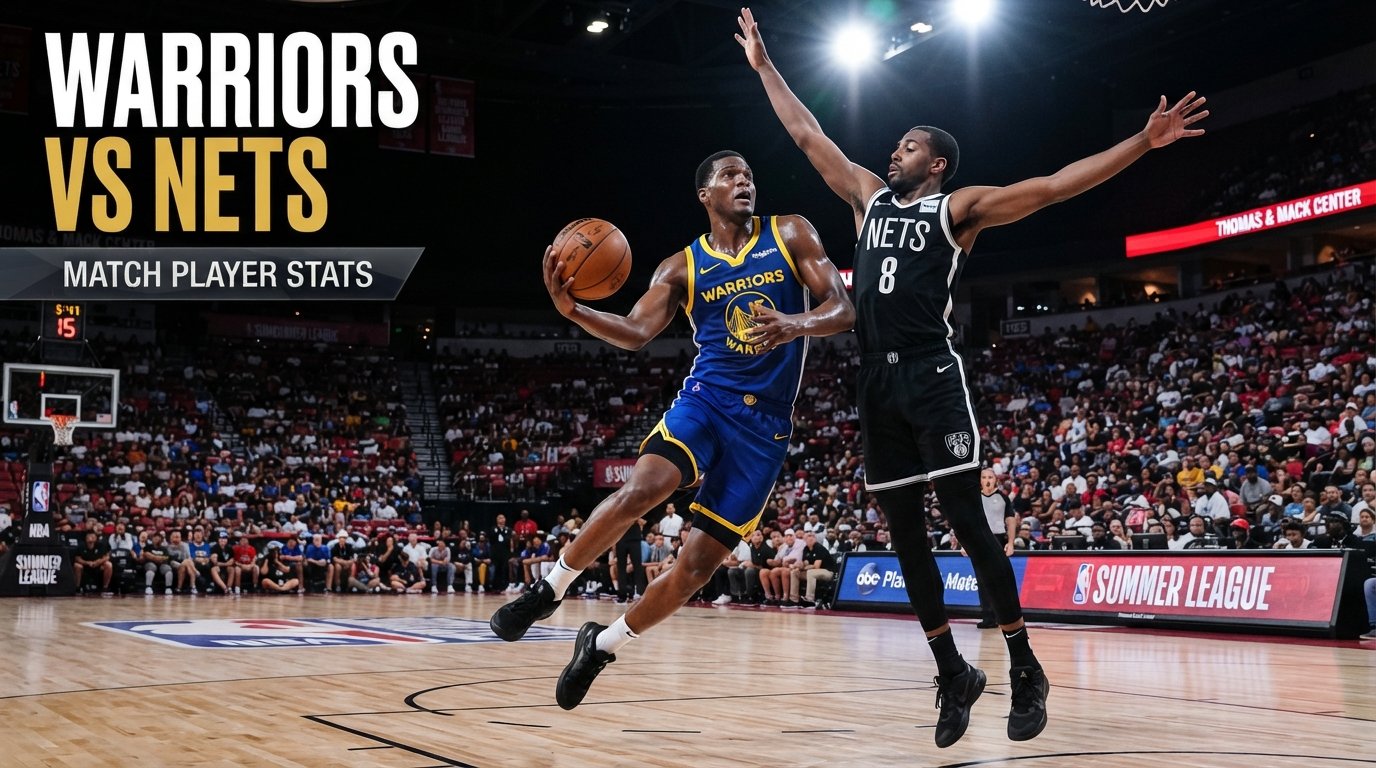
The golden state warriors vs brooklyn nets match player stats provide a detailed look at Brooklyn’s 100-79 victory over Golden State Warriors Blue in the 2026 California Classic. Played on July 7, 2026, at Golden 1 Center in Sacramento, the contest featured an impressive scoring performance from Egor Demin, strong outside shooting from Tyler Bilodeau, and a major second-quarter turnaround that changed the direction of the game.
Golden State started with confidence and finished the opening quarter ahead 28-24. However, Brooklyn responded with a dominant 32-point second quarter, improved its shooting efficiency, and established control through rebounding and ball movement. The Nets eventually secured a convincing 21-point victory, finishing their California Classic campaign with a 2-1 record.
This matchup offered more than a final score. It highlighted the importance of efficient shooting, bench production, defensive rebounding, and adjustments during a short-format summer basketball tournament. The individual performances also provided an opportunity to evaluate young players competing for professional opportunities and greater responsibilities.
Game information
| Category | Details |
| Matchup | Brooklyn Nets vs Golden State Warriors Blue |
| Competition | 2026 California Classic |
| Date | July 7, 2026 |
| Venue | Golden 1 Center |
| Location | Sacramento, California |
| Final score | Brooklyn 100, Golden State 79 |
| Winning team | Brooklyn Nets |
| Brooklyn record | 2-1 |
| Warriors Blue record | 0-3 |
| Biggest scoring difference | 21 points |
It is important to distinguish this contest from a regular-season NBA meeting between the main Warriors and Nets rosters. This was a California Classic summer league game featuring Brooklyn and Golden State Blue.
Golden State Warriors vs Brooklyn Nets Match Player Stats
The player statistics from this contest show how Brooklyn gradually turned an early deficit into a comfortable victory. Although Golden State had the better opening period, the Nets produced more consistent offense over the remaining quarters.
Final Score and Quarter-by-Quarter Breakdown
| Team | Q1 | Q2 | Q3 | Q4 | Total |
| Golden State Warriors Blue | 28 | 18 | 16 | 17 | 79 |
| Brooklyn Nets | 24 | 32 | 15 | 29 | 100 |
Brooklyn won the game by 21 points, but the result was not decided during the opening minutes.
Golden State began with a four-point advantage after the first quarter. Its offense was active, and its players found opportunities to attack the basket. Brooklyn, however, responded with a much stronger second period.
The Nets scored 32 points in the second quarter while limiting Golden State to 18. That 14-point difference completely changed the scoreboard.
The third quarter was more balanced. Golden State scored 16 points compared with Brooklyn’s 15, showing that the Warriors could still compete defensively. However, they needed a much stronger offensive finish to make the game competitive again.
Instead, Brooklyn delivered its best closing performance in the fourth quarter, scoring 29 points and holding Golden State to 17.
Three important scoring developments shaped the result:
- Golden State established an early lead through a productive first quarter.
- Brooklyn created separation with a 20-2 scoring run during the second quarter.
- The Nets finished strongly, winning the fourth quarter by 12 points.
The second-quarter turnaround was particularly important because it allowed Brooklyn to enter halftime with a 56-46 advantage.
Brooklyn Nets Player Stats and Individual Performances
Brooklyn’s victory was built around several productive performances rather than one player carrying the entire offense. Egor Demin led the scoring, while Chaney Johnson and Tyler Bilodeau provided important contributions.
Ben Saraf also played an influential role from the bench, creating opportunities for teammates and maintaining offensive pressure.
| Brooklyn player | Points | Rebounds | Assists |
| Egor Demin | 23 | 8 | 5 |
| Chaney Johnson | 19 | 7 | 2 |
| Tyler Bilodeau | 18 | 5 | 2 |
| Ben Saraf | 15 | 3 | 7 |
| Mikel Brown Jr. | 10 | Not specified | 4 |
These figures highlight Brooklyn’s offensive balance. Four players reached at least 15 points, giving the Nets several scoring options throughout the game.
Egor Demin: Brooklyn’s Leading Scorer
23 POINTS | 8 REBOUNDS | 5 ASSISTS
Egor Demin delivered the most complete individual performance of the contest. His 23 points led all players, and his contributions extended beyond scoring.
He finished with eight rebounds and five assists, demonstrating his ability to influence several areas of the game.
Demin’s shooting performance was particularly effective. According to the NBA game recap, he made seven of his 12 field-goal attempts, including two three-pointers. He also converted four of five free throws.
That shooting efficiency made a significant difference.
Rather than needing a large number of attempts to reach his scoring total, Demin converted opportunities at a strong rate. His ability to score from different areas also made it difficult for Golden State to focus exclusively on stopping him.
His second-quarter contribution helped Brooklyn take control after trailing early. He scored 10 points in that period, helping the Nets establish their halftime advantage.
His eight rebounds were another important part of his performance. For a guard, contributing on the defensive glass helps end opposing possessions and creates opportunities for transition offense.
His five assists demonstrated that he was not simply looking for individual scoring opportunities. He also helped teammates find better positions to attack.
Why his performance mattered: Demin combined scoring efficiency, rebounding, and playmaking. That combination made him Brooklyn’s most influential offensive player.
Chaney Johnson: Efficient Scoring and Interior Production
19 POINTS | 7 REBOUNDS
Chaney Johnson delivered one of Brooklyn’s most efficient performances.
He finished with 19 points and seven rebounds while converting seven of nine field-goal attempts. That shooting performance represented approximately 77.8% accuracy from the field.
His ability to score without requiring many attempts was valuable because it allowed Brooklyn to maintain offensive balance.
Johnson also provided physical presence around the basket. His seven rebounds helped Brooklyn compete for possession and reduced Golden State’s opportunities to create additional scoring chances.
He contributed defensively as well, recording two steals and one blocked shot according to the NBA recap.
His performance demonstrated how efficient interior scoring can support a team with strong perimeter shooters.
When Johnson converted opportunities near the basket, Golden State had to account for another scoring threat. That created more space for Brooklyn’s guards and outside shooters.
Johnson’s contribution was especially important because he complemented Demin rather than duplicating his role.
Tyler Bilodeau: The Three-Point Shooting Specialist
18 POINTS | 6 THREE-POINTERS
Tyler Bilodeau was one of Brooklyn’s most dangerous perimeter players.
He scored 18 points and made six three-pointers, giving the Nets an important outside scoring advantage.
His shooting was particularly valuable because three-point baskets can change the pace of a game quickly.
Every successful three-pointer produces more points than a conventional two-point field goal. When a team consistently makes outside shots, its opponents must defend a larger area of the court.
Bilodeau’s shooting therefore created more than just individual scoring production.
Golden State had to respect his ability to shoot from beyond the arc. That defensive attention could create additional driving and passing opportunities for Brooklyn’s other players.
He also finished with five rebounds and two assists, showing that his contribution was not limited to perimeter shooting.
His performance illustrates why outside shooting is such an important part of modern basketball. A player who can consistently convert open opportunities forces opponents to adjust their defensive positioning.
Ben Saraf: Valuable Bench Production
15 POINTS | 3 REBOUNDS | 7 ASSISTS
Ben Saraf produced one of the most important supporting performances for Brooklyn.
He finished with 15 points and seven assists, making him a major contributor to the team’s offensive organization.
His seven assists were particularly valuable because they helped distribute scoring opportunities among teammates.
Basketball is not simply about identifying the player who scores the most points. The quality of possessions also matters.
A successful pass can create an open three-point attempt, an uncontested layup, or a favorable mismatch near the basket.
Saraf’s playmaking helped Brooklyn generate these opportunities.
He also made three three-pointers, giving the Nets another perimeter threat. His offensive contribution was especially valuable because he provided production outside the starting group.
According to the NBA game recap, Saraf finished with a plus-28 point differential, the best figure in the contest.
Plus-minus should not be treated as a complete measure of individual ability because it reflects what happens while a player is on the court. However, a strong figure can help illustrate how effectively a lineup performed during a particular game.
Saraf’s combination of scoring and passing made him one of Brooklyn’s most productive players.
Mikel Brown Jr.: A Promising Summer League Debut
10 POINTS | 4 ASSISTS
Mikel Brown Jr. also made an important contribution in his first professional summer league appearance.
He recorded 10 points and four assists, adding another ball-handling and scoring option to Brooklyn’s rotation.
His debut attracted attention because he was the sixth overall selection in the 2026 NBA Draft.
For a young player entering professional basketball, the first summer league appearance provides an opportunity to adjust to a faster and more physical environment.
Brown showed his offensive potential through his ability to attack the basket, create opportunities, and contribute from the perimeter.
His four assists were especially encouraging because they indicated that he could contribute to team offense even when he was not taking a shot.
The most important takeaway from his performance was the balance between individual scoring and team involvement.
He did not need to dominate possession to make a useful contribution.
Golden State Warriors Player Stats and Individual Performances
Golden State had a difficult finish, but several players produced useful individual performances.
The Warriors Blue squad had four players reach double figures in scoring. However, their offensive production was not enough to match Brooklyn’s shooting efficiency.
| Golden State player | Points | Additional contribution |
| RJ Nembhard Jr. | 14 | Scoring leader |
| Cameron Tyson | 14 | Scoring leader |
| Nick Boyd | 13 | 5 assists |
| Wade Taylor IV | 13 | Double-digit scoring |
| Andersson Garcia | Not specified | 9 rebounds |
These contributions show that Golden State had multiple players capable of producing points.
The main problem was maintaining that offensive production across all four quarters.
RJ Nembhard Jr.: One of Golden State’s Leading Scorers
14 POINTS
RJ Nembhard Jr. finished with 14 points to share Golden State’s scoring lead.
His contribution was important because the Warriors needed players capable of creating offense against Brooklyn’s improving defense.
Nembhard provided one of the team’s primary scoring options. However, his individual production could not completely offset Brooklyn’s balanced attack.
Golden State needed additional scoring consistency from its supporting players, particularly after the first quarter.
The challenge became more difficult when Brooklyn increased its defensive pressure and established a substantial halftime lead.
Nembhard’s scoring remained a positive aspect of the Warriors’ performance, but the overall team result showed that individual contributions needed stronger collective support.
Cameron Tyson: Important Perimeter Scoring
14 POINTS
Cameron Tyson also finished with 14 points, matching Nembhard as Golden State’s leading scorer.
Tyson’s offensive contribution was important in a contest where Brooklyn produced strong outside shooting.
His scoring helped Golden State remain competitive, especially during the earlier stages of the game.
However, the Warriors struggled to maintain the same offensive rhythm after their opening quarter.
Tyson’s performance demonstrates the importance of having reliable perimeter options in a summer league rotation.
When a team faces an opponent with multiple shooting threats, it must find ways to keep its own scoring production consistent.
Golden State received useful production from Tyson, but Brooklyn had more players contributing at a similarly effective level.
Nick Boyd: Scoring and Playmaking Contribution
13 POINTS | 5 ASSISTS
Nick Boyd delivered a balanced performance for Golden State.
He finished with 13 points and five assists, showing that he could contribute both as a scorer and as a facilitator.
His five assists were important because the Warriors needed better offensive organization when Brooklyn began creating separation.
A player who can distribute the basketball effectively helps prevent an offense from becoming overly dependent on individual scoring attempts.
Boyd’s ability to contribute in both areas gave Golden State another option in its backcourt.
His two steals also demonstrated defensive activity.
However, the Warriors needed more consistent execution from the entire rotation to turn these individual contributions into a competitive finish.
Wade Taylor IV: Another Double-Figure Scoring Option
13 POINTS
Wade Taylor IV added 13 points, providing another important scoring contribution.
His performance helped Golden State avoid becoming completely dependent on Nembhard and Tyson.
Having multiple players reach double figures is generally a positive sign because it creates several potential scoring options.
However, the number of players scoring in double figures does not automatically indicate offensive efficiency.
Shot selection, turnovers, defensive pressure, and the ability to create high-quality opportunities all influence the final result.
Golden State needed its scoring options to remain productive after halftime.
The team’s declining quarter-by-quarter output made that difficult.
Andersson Garcia: Rebounding Strength
9 REBOUNDS
Andersson Garcia recorded nine rebounds, giving him Golden State’s strongest reported individual rebounding contribution.
His work on the glass was important because rebounding helps determine which team controls possession.
Defensive rebounds prevent opponents from creating second-chance opportunities. Offensive rebounds give a team additional chances to score.
Garcia’s nine rebounds represented a positive individual contribution in a game where Brooklyn held an overall rebounding advantage according to the supplied team comparison.
His performance also highlights an important point about evaluating players.
Scoring receives the most attention, but rebounds, assists, steals, and defensive activity can have a meaningful influence on the outcome.
Garcia’s contribution was a good example of a player helping his team without necessarily leading the scoring column.
Team Statistical Comparison: Brooklyn vs Golden State
Individual performances explain part of the result, but the team statistics provide a clearer picture of why Brooklyn won.
The Nets were more efficient from the field, made a greater percentage of their three-point attempts, and finished ahead in the reported rebounding and assist categories.
| Statistical category | Brooklyn Nets | Warriors Blue |
| Final points | 100 | 79 |
| Field-goal percentage | 50% | 40% |
| Three-point percentage | 43% | 32% |
| Rebounds | 41 | 32 |
| Assists | 22 | 17 |
| Steals | 7 | 7 |
The comparison identifies several areas where Brooklyn performed better.
Field-Goal Efficiency
Brooklyn’s 50% field-goal percentage was a major advantage.
The Nets converted approximately half of their field-goal attempts, while Golden State finished at approximately 40%.
That difference meant Brooklyn generated more scoring value from its shooting opportunities.
Field-goal percentage is particularly useful when evaluating offensive efficiency because it measures how frequently a team converts its attempts into successful baskets.
Golden State had an encouraging opening quarter, but its shooting consistency declined as the contest progressed.
Brooklyn, meanwhile, maintained enough offensive efficiency to establish a comfortable lead.
Three-Point Shooting Advantage
The Nets also held a significant advantage beyond the three-point line.
| Team | Three-point percentage |
| Brooklyn Nets | 43% |
| Golden State Warriors Blue | 32% |
The difference was 11 percentage points.
Tyler Bilodeau’s six successful three-point attempts were particularly important in creating Brooklyn’s perimeter advantage.
Outside shooting can influence defensive positioning. When a player consistently makes three-pointers, defenders must move farther away from the basket to contest those attempts.
That movement creates additional space for drives, cuts, and interior scoring opportunities.
Brooklyn benefited from having multiple players capable of contributing offensively.
Golden State needed a stronger perimeter response to keep pace.
Rebounding: Brooklyn Controlled More Possessions
Brooklyn held a 41-32 rebounding advantage according to the supplied team statistics.
That nine-rebound difference was another important part of the contest.
Rebounding is sometimes overlooked when people evaluate basketball performances through scoring statistics alone.
However, every rebound can influence the number of offensive opportunities available to a team.
Defensive rebounds help teams complete possessions. Offensive rebounds create additional chances after missed shots.
Brooklyn’s advantage on the glass helped it maintain control and reduce Golden State’s opportunities to recover momentum.
Garcia’s nine rebounds were a positive individual contribution for the Warriors, but the overall team comparison favored Brooklyn.
Assists and Offensive Ball Movement
Brooklyn recorded 22 assists compared with Golden State’s 17.
That five-assist difference suggests that the Nets generated more scoring opportunities through passing.
Assists are useful when examining offensive teamwork because they help identify how frequently successful baskets result from passes that directly create scoring opportunities.
Ben Saraf’s seven assists were particularly important.
Demin also contributed five assists, while Mikel Brown Jr. added four.
These performances demonstrate how Brooklyn distributed playmaking responsibilities across its rotation.
Golden State had useful contributions from Nick Boyd, who recorded five assists, but the team did not match Brooklyn’s overall passing production.
Steals and Defensive Activity
Both teams recorded seven steals.
This result suggests that neither side had a clear statistical advantage in this particular defensive category.
Steals can indicate defensive awareness, anticipation, and the ability to disrupt passing lanes.
However, the same number of steals does not necessarily mean that two teams defended equally well.
Defensive performance also depends on contested shots, defensive rotations, rebounding, communication, and the ability to prevent high-quality attempts.
Brooklyn’s superior shooting and rebounding numbers were more decisive in this game than the identical steals total.
How Brooklyn Changed the Game in the Second Quarter
The second quarter was the defining period of this matchup.
Golden State entered the game with positive momentum and scored 28 points in the opening quarter. Brooklyn had scored only 24.
The Warriors continued their strong start into the second period and reportedly held a 38-28 advantage with 7:22 remaining.
At that stage, Golden State appeared capable of maintaining control.
However, Brooklyn responded with a 20-2 scoring run.
That sequence changed the entire direction of the game.
What Made the 20-2 Run So Important?
A scoring run is not simply a collection of successful shots.
It can also change the psychological and tactical conditions of a basketball game.
Brooklyn’s run created three major advantages.
- Offensive confidence increased
After finding its rhythm, Brooklyn began converting more opportunities and playing with greater confidence.
Demin’s scoring contribution was especially important during this period.
His ability to create offense helped Brooklyn recover from the early deficit.
- Golden State lost its early momentum
The Warriors had been productive during the opening quarter.
However, when Brooklyn started scoring consistently, Golden State struggled to maintain the same offensive rhythm.
The pressure of protecting an early advantage can also influence shot selection and decision-making.
- Brooklyn established halftime control
The Nets entered halftime ahead 56-46.
A 10-point halftime advantage gave Brooklyn more flexibility in the second half.
The team could continue attacking without needing to take unnecessary risks.
Golden State, meanwhile, had to find ways to reduce the deficit.
Why the Second Half Favored Brooklyn
Brooklyn did not need another dramatic scoring run to maintain control.
Instead, the Nets continued producing enough offense to prevent Golden State from building a serious comeback.
The third quarter was relatively close, with Golden State scoring 16 points and Brooklyn adding 15.
However, the fourth quarter created further separation.
Brooklyn scored 29 points in the final period, compared with 17 from the Warriors.
That 12-point quarter advantage confirmed that Golden State could not find a reliable offensive response.
The Nets finished with 100 points, while the Warriors stopped at 79.
Shooting Efficiency Was the Biggest Difference
One of the most important lessons from this game is that scoring opportunities must be converted efficiently.
Golden State had several players who reached double figures.
Nembhard, Tyson, Boyd, and Taylor all contributed at least 13 points.
On paper, that looks like a reasonably distributed scoring performance.
However, Brooklyn’s offensive production was more efficient.
Demin scored 23 points, Johnson added 19, Bilodeau contributed 18, and Saraf recorded 15.
The Nets had four players scoring at least 15 points.
This gave Brooklyn a stronger combination of scoring volume and shooting efficiency.
The Value of Multiple Scoring Threats
When an opponent has several reliable scoring options, defensive planning becomes more difficult.
Golden State could not focus all its attention on Demin because Johnson and Bilodeau were also producing points.
Similarly, leaving Saraf open to create offense could lead to additional scoring opportunities.
Brooklyn’s balanced attack reduced its dependence on any single player.
This was particularly important in a summer league environment, where rotations and player combinations may change frequently.
A team that can create points through several different players is better positioned to handle difficult stretches.
The Importance of Bench Contributions
Summer league games provide opportunities for young players to demonstrate their abilities in different roles.
Some players are expected to lead the offense. Others must provide defensive energy, spacing, rebounding, or secondary playmaking.
Brooklyn received valuable production from its supporting players.
Ben Saraf’s 15 points and seven assists were particularly influential.
Mikel Brown Jr. also contributed 10 points and four assists in his professional summer league debut.
These performances helped the Nets maintain offensive production beyond their primary scoring options.
Golden State also received contributions from several players, including Nick Boyd and Wade Taylor IV.
However, the Warriors needed more consistent production across their rotation.
Why Bench Scoring Matters in Summer League
Bench production becomes especially important in summer basketball because coaches frequently experiment with player combinations.
A player who can provide efficient scoring without requiring extensive possession time can become valuable to a team’s rotation.
Other players may attract attention through defensive intensity or their ability to organize an offense.
The Brooklyn performance demonstrated the benefits of having multiple players contribute in different ways.
Saraf’s passing, Brown’s playmaking, and Bilodeau’s shooting gave the Nets several ways to maintain their offensive pressure.
What the Match Revealed About Brooklyn’s Young Players
The California Classic provided a useful opportunity to evaluate Brooklyn’s young talent.
Although one game cannot establish a player’s long-term NBA potential, individual performances can reveal strengths, weaknesses, and areas for development.
Several observations stood out.
Egor Demin’s All-Around Offensive Ability
Demin’s 23-point performance demonstrated that he could contribute in several offensive areas.
His five assists showed playmaking ability, while his eight rebounds reflected activity beyond scoring.
His performance was particularly encouraging because he helped Brooklyn recover from an early deficit.
Tyler Bilodeau’s Perimeter Value
Bilodeau’s six three-pointers demonstrated the importance of reliable perimeter shooting.
Players who can consistently create spacing are valuable because they make defensive assignments more complicated.
His performance suggested that he could provide a useful shooting option within Brooklyn’s offensive structure.
Chaney Johnson’s Scoring Efficiency
Johnson’s seven successful field goals on nine attempts highlighted his ability to convert opportunities efficiently.
His rebounding and defensive contributions also made his performance more complete.
Ben Saraf’s Playmaking
Saraf’s seven assists were a major part of Brooklyn’s offensive balance.
His ability to distribute the basketball gave teammates additional scoring opportunities.
His plus-28 rating also reflected the strong results of the lineups featuring him during the game.
Mikel Brown Jr.’s Professional Adjustment
Brown’s debut offered an early opportunity to assess his adjustment to professional basketball.
His 10 points and four assists were encouraging, particularly given the importance of developing confidence and decision-making in a new competitive environment.
The most useful future evaluation will involve observing how consistently he performs against different defensive styles.
What Golden State Can Learn From the Defeat
Golden State’s 79-point performance revealed several areas that required improvement.
The Warriors had a productive first quarter, but their offensive output decreased in the remaining periods.
They scored 28 points in the first quarter and just 51 across the final three quarters.
That difference highlights the importance of maintaining offensive consistency.
Improving Offensive Continuity
Golden State needed better offensive execution after Brooklyn increased its defensive pressure.
A successful offense should not depend entirely on early shooting success.
Teams must have alternative ways to create opportunities when opponents adjust defensively.
These options can include:
- More effective ball movement.
- Better spacing between perimeter players.
- Attacking defensive mismatches.
- Creating opportunities through off-ball movement.
- Improving shot selection under pressure.
Strengthening Perimeter Defense
Brooklyn’s 43% three-point shooting created a significant challenge.
Golden State needed more effective closeouts and defensive communication to limit open perimeter attempts.
However, aggressive closeouts must be balanced with protecting the basket.
If defenders rush toward outside shooters without proper positioning, opponents can exploit the resulting space through drives and cuts.
The Warriors needed a more consistent defensive approach.
Turning Individual Production Into Team Success
Golden State had four players score at least 13 points.
That was a positive sign.
However, the final result demonstrated that individual scoring totals must translate into effective team offense.
Better shooting efficiency, stronger ball movement, and defensive consistency could help convert those individual contributions into improved results.
Statistical Context and Box-Score Accuracy
A useful match analysis must distinguish between confirmed information and figures that require further verification.
The supplied match summary includes a box-score caveat indicating that some individual and team point totals do not reconcile with the reported shooting figures. It also notes that Mikel Brown Jr. appears twice in Brooklyn’s lineup.
These details should not be ignored.
For this reason, the individual scoring and headline performance figures in this article should be read alongside the published game recap rather than treated as a fully reconciled statistical database.
The NBA’s official recap independently confirms the 100-79 result, the quarter-by-quarter scoring, and the principal player performances.
The detailed reporting is available in the official NBA California Classic game recap.
Why Statistical Verification Matters
Basketball box scores contain several different types of information.
These include:
- Points scored.
- Field goals attempted and made.
- Three-point attempts and conversions.
- Free throws.
- Offensive and defensive rebounds.
- Assists.
- Steals.
- Blocks.
- Turnovers.
- Personal fouls.
- Minutes played.
These figures should be consistent with one another.
For example, a player’s total points should be explainable through successful two-point shots, three-point shots, and free throws.
A team total should also reconcile with the combined scoring of its players.
When these figures do not match, readers should avoid making unsupported conclusions.
This is particularly important for summer league statistics because multiple teams, experimental rotations, and changing player combinations can make reporting more complicated.
A responsible analysis should identify uncertainty rather than invent missing numbers.
California Classic Standings and Tournament Context
Brooklyn’s victory also mattered because it determined how the team finished its California Classic campaign.
The Nets completed the competition with a 2-1 record.
Golden State Blue finished at 0-3.
The reported standings across the eight-team field were:
| Team | Record |
| Sacramento | 3-0 |
| Brooklyn Nets | 2-1 |
| Golden State Warriors | 2-1 |
| Miami Heat | 2-1 |
| Los Angeles Lakers | 2-1 |
| Milwaukee Bucks | 1-2 |
| Other Golden State entry | 0-3 |
| San Antonio Spurs | 0-3 |
Sacramento finished at the top of the standings with an undefeated record.
Brooklyn’s second victory provided a positive finish to its tournament schedule.
For Golden State Blue, the defeat completed a difficult 0-3 campaign.
However, summer league standings should be interpreted differently from regular-season NBA standings.
The primary objective of these competitions is player development and evaluation.
Coaches use the games to assess:
- Individual offensive skills.
- Defensive awareness.
- Passing decisions.
- Shooting consistency.
- Rebounding ability.
- Team communication.
- Adaptability to professional basketball.
A summer league defeat does not automatically indicate a player’s long-term potential.
Similarly, a strong tournament record does not guarantee future NBA success.
The most useful evaluation comes from examining how individual players perform and whether they demonstrate progress throughout the competition.
Tactical Lessons From the Warriors and Nets Matchup
Beyond the individual numbers, this contest offered several useful basketball lessons.
1. Strong Starts Must Be Supported by Consistent Execution
Golden State scored 28 points in the first quarter.
That was a positive opening, but the Warriors could not maintain their offensive output.
The decline from 28 first-quarter points to 18 in the second quarter was significant.
Teams must maintain offensive discipline even when opponents begin adjusting defensively.
2. Outside Shooting Can Change Defensive Priorities
Brooklyn’s 43% three-point shooting made it difficult for Golden State to defend only the interior.
Bilodeau’s six three-pointers were particularly influential.
The ability to threaten opponents from long range creates more opportunities throughout the offensive system.
3. Playmaking Helps Distribute Offensive Responsibility
Brooklyn finished with 22 assists.
Demin and Saraf were especially productive in this area.
Their passing helped create opportunities for teammates and reduced the pressure on individual scorers.
4. Rebounding Supports Defensive Control
The reported 41-32 rebounding advantage favored Brooklyn.
That advantage helped the Nets control possession and limited Golden State’s ability to generate additional opportunities.
5. Finishing Games Is as Important as Starting Them
Golden State led after the first quarter but lost the game by 21 points.
Brooklyn’s strong fourth quarter demonstrated the value of maintaining concentration and execution until the final possession.
The Nets did not simply recover from an early deficit. They continued building their advantage after halftime.
How to Evaluate These Player Statistics Correctly
Readers looking at a basketball box score should avoid judging a player solely by total points.
A deeper evaluation involves examining several categories together.
Scoring efficiency: Consider field-goal percentage, three-point percentage, and free-throw accuracy.
Playmaking: Review assists alongside turnovers to understand whether a player creates opportunities effectively.
Rebounding: Examine total rebounds and, where available, offensive and defensive rebounds separately.
Defensive activity: Consider steals and blocks, but also recognize that these numbers do not capture every defensive contribution.
Team impact: Use plus-minus as supporting information rather than a standalone measure of individual quality.
Game situation: Consider when the player produced their statistics. A strong performance during a decisive scoring run can have a different influence from points scored after the result is largely settled.
For example, Demin’s second-quarter scoring helped Brooklyn reverse the early deficit. That contribution had direct importance to the game’s momentum.
Similarly, Saraf’s playmaking helped the Nets distribute offensive responsibilities.
Looking at these details provides a more meaningful understanding of individual performances.
Why This Summer League Matchup Deserves Attention
The California Classic provides an early opportunity to observe young basketball talent in competitive situations.
Unlike a regular-season NBA game, summer league contests are often focused on experimentation, development, and evaluating potential roster contributions.
That makes individual statistics particularly interesting.
Demin’s scoring and playmaking, Bilodeau’s perimeter shooting, Johnson’s efficiency, and Saraf’s passing all provided useful information about Brooklyn’s young rotation.
For Golden State, the performances of Nembhard, Tyson, Boyd, Taylor, and Garcia offered several individual positives despite the final result.
The game also demonstrated that team execution matters as much as individual talent.
Brooklyn did not win simply because one player scored 23 points. The Nets combined efficient shooting, several double-digit scorers, better reported rebounding, and stronger execution during the decisive quarters.
Golden State showed potential early but could not maintain the same level of production.
That contrast made the matchup a useful example of how basketball games can change through adjustments, offensive efficiency, and collective execution.
Frequently Asked Questions
1. Who won the Golden State Warriors vs Brooklyn Nets game in the 2026 California Classic?
The Brooklyn Nets defeated Golden State Warriors Blue 100-79 on July 6, 2026, in Sacramento. Brooklyn finished its California Classic campaign with a 2-1 record.
2. How many points did Egor Demin score against Golden State?
Egor Demin scored 23 points, collected eight rebounds, and recorded five assists. He was Brooklyn’s leading scorer and one of the most influential players in the contest.
3. Who was Brooklyn’s second-highest scorer?
Chaney Johnson was Brooklyn’s second-highest scorer with 19 points. He also recorded seven rebounds and demonstrated excellent shooting efficiency by making seven of nine field-goal attempts.
4. How many three-pointers did Tyler Bilodeau make?
Tyler Bilodeau made six three-pointers and finished with 18 points. His outside shooting helped Brooklyn establish a significant perimeter advantage.
5. Who were Golden State’s leading scorers?
RJ Nembhard Jr. and Cameron Tyson led Golden State with 14 points each. Nick Boyd and Wade Taylor IV contributed 13 points apiece.
6. What was the biggest reason Brooklyn defeated Golden State?
Brooklyn’s shooting efficiency and second-quarter scoring run were major factors. The Nets shot approximately 50% from the field, created a 20-2 run, and outscored Golden State 29-17 in the fourth quarter.
Conclusion
The July 2026 California Classic matchup between Brooklyn and Golden State demonstrated how shooting efficiency, offensive balance, and game management can determine a basketball result.
Brooklyn secured a 100-79 victory after recovering from an early four-point deficit. Its dominant second quarter established control, while a strong fourth-quarter performance prevented Golden State from mounting a comeback.
Egor Demin led the Nets with 23 points, eight rebounds, and five assists. Chaney Johnson contributed 19 points, Tyler Bilodeau added 18 points with six three-pointers, and Ben Saraf recorded 15 points and seven assists.
Golden State received 14 points each from RJ Nembhard Jr. and Cameron Tyson, while Nick Boyd and Wade Taylor IV contributed 13 points apiece. Andersson Garcia also provided an important rebounding contribution with nine boards.
The team comparison further explains the outcome. Brooklyn had better reported shooting percentages, a nine-rebound advantage, and five more assists.
Ultimately, the game was a reminder that basketball success depends on more than individual scoring. Efficient shooting, defensive organization, ball movement, rebounding, and consistent execution all contribute to winning.
For readers following summer league development, this contest provided an interesting look at Brooklyn’s young talent and the areas Golden State Blue needed to improve.