Blessed Upgrade Scroll: A Complete Guide to Safer Gear Upgrades
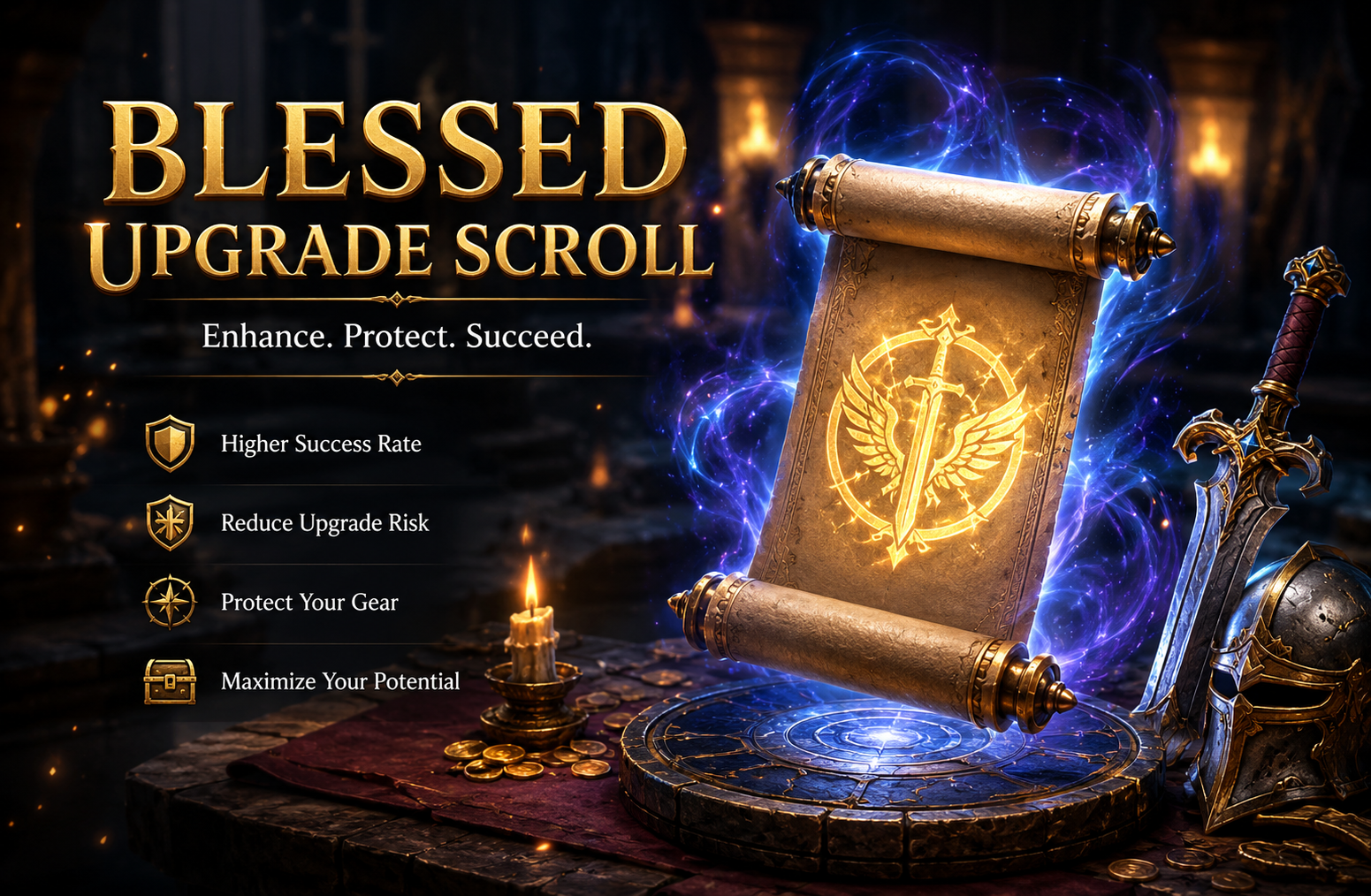
If you have spent hours farming valuable equipment only to lose it during a failed enhancement, you already understand why the blessed upgrade scroll is such an important item in many RPG and MMORPG upgrade systems. It is designed to make high-risk equipment enhancement more manageable, although its exact effect depends on the game, server, item class, and upgrade rules.
The biggest mistake players make is assuming that every item called a blessed upgrade scroll works in exactly the same way. It does not. In some games, the scroll mainly provides a better success rate. In others, it protects equipment from destruction or reduces the consequences of failure. And in Knight Online, for example, the Blessed Upgrade Scroll is associated with equipment upgrading, particularly High Class items, and official community discussions describe its use through the Magic Anvil.
That distinction matters because using a valuable scroll without understanding the actual upgrade table can turn a smart investment into an expensive mistake.
This guide explains what the item is, how the mechanic works, when it makes sense to use one, how to evaluate upgrade risk, common mistakes, and how experienced players can approach enhancement decisions more logically.
What Is a Blessed Upgrade Scroll?
A blessed upgrade scroll is a special consumable used to improve equipment through an in-game enhancement system.
Depending on the game, it may be designed to provide one or more advantages over a standard upgrade scroll:
- A higher chance of successful enhancement
- Protection against certain failure outcomes
- Reduced risk of losing valuable equipment
- Access to higher upgrade levels
- Better compatibility with premium enhancement materials
- More favorable progression at difficult upgrade stages
The exact mechanics are not universal.
This is the first principle worth remembering: the name describes a class of enhancement item, not one universal rule set.
For example, Knight Online documentation and community discussions show the Blessed Upgrade Scroll being used with the Magic Anvil for equipment enhancement. An official forum discussion also identifies Blessed Upgrade Scrolls as the appropriate scroll for certain High Class and Unique upgrade situations.
Other games may use the same name while giving the item a completely different effect.
So before spending one, check three things:
- What item are you upgrading?
- What upgrade level are you attempting?
- What does the current version of your game say about the scroll?
Never assume that a success percentage from another server or another game applies to your own character.
Blessed Upgrade Scroll Explained in Simple Terms
The easiest way to understand the mechanic is to think of equipment upgrading as a risk ladder.
At low enhancement levels, the cost of failure may be small. You might lose a cheap scroll or a small amount of currency.
At higher levels, the situation changes.
Your equipment may be expensive, difficult to replace, or central to your entire build. A failed attempt can therefore cost much more than the material used for the upgrade.
That is where a blessed enhancement item becomes valuable.
Instead of viewing the scroll simply as another consumable, experienced players view it as a risk-management resource.
The question is not:
“Can this scroll make my item stronger?”
The better question is:
“Does the additional protection or probability justify the cost of using this scroll on this particular upgrade?”
That change in thinking is important.
How a Blessed Upgrade Scroll Works
The basic enhancement process is usually straightforward.
You select an eligible item, choose the appropriate upgrade material, and place both into the game’s enhancement interface. The system then determines whether the upgrade succeeds.
In Knight Online, the Magic Anvil is the relevant interface for equipment upgrades. Historical official forum guidance describes placing the item and scroll into the Magic Anvil before confirming the attempt.
The result normally falls into one of several categories:
- Successful upgrade
- Failed upgrade
- Downgrade
- Item destruction
- Protected failure
- Special outcome determined by the game’s enhancement rules
The important part is that these outcomes are game-specific.
A blessed item should therefore never be treated as a guarantee unless the game’s own rules explicitly say so.
Success Does Not Mean Guaranteed Success
One of the most common misunderstandings surrounding blessed scrolls is the assumption that “blessed” means guaranteed.
That is rarely a safe assumption.
A blessed scroll can have a better success rate while still carrying substantial risk.
Consider a hypothetical upgrade with a 30% success probability.
That means:
- 30% chance of success
- 70% chance of failure
It does not mean the fourth attempt must succeed.
Probability does not remember previous attempts.
If three attempts fail, the fourth attempt does not automatically become successful unless the game specifically uses a pity, failstack, or similar mechanic.
This is why emotional decision-making can be dangerous during enhancement.
Failure Outcomes Matter as Much as Success Rates
Two upgrade systems can have exactly the same success probability while producing completely different player experiences.
Imagine:
System A
- 30% success
- Failed attempt leaves equipment intact
System B
- 30% success
- Failed attempt destroys equipment
The probability of success is identical, but the economic risk is dramatically different.
That is why an expert evaluation should consider both:
Probability of success + financial consequence of failure
rather than looking at the percentage alone.
Why Players Value Blessed Upgrade Scrolls
The value of a blessed enhancement material comes from the relationship between risk and reward.
Suppose you own an ordinary weapon that can easily be replaced.
Using a premium scroll on it may provide little economic benefit.
Now consider a rare weapon that required weeks of farming or substantial trading to acquire.
The calculation changes.
A safer enhancement method becomes much more attractive because the replacement cost is high.
This produces a useful rule:
The more expensive the item is to replace, the more important the cost of failure becomes.
That does not automatically mean you should use a blessed scroll every time.
It means the value of the scroll should be evaluated against the value of the equipment.
When Should You Use a Blessed Upgrade Scroll?
There is no universal upgrade level at which every player should switch to a blessed scroll.
However, there are several situations where the decision deserves serious consideration.
Use It for Expensive Equipment
If your weapon or armor is difficult to replace, a premium enhancement material can make more sense than gambling with a cheaper method.
This is particularly relevant for:
- Rare weapons
- Endgame armor
- High-value accessories
- Limited equipment
- Difficult-to-farm items
- Gear that is central to your build
The principle is simple: protect the assets that would hurt most to lose.
Use It When Failure Becomes Expensive
Early upgrades are often inexpensive.
Later upgrades can require dramatically more resources.
At that point, the scroll itself becomes part of a larger risk calculation.
Ask:
- What does the equipment cost?
- How much does one upgrade attempt cost?
- What happens if it fails?
- How difficult is the item to replace?
- What is the expected value of the upgraded item?
These questions are more useful than simply asking whether the scroll is “good.”
Avoid Overusing It on Disposable Gear
A premium item does not become automatically valuable just because it provides protection.
If you are upgrading temporary leveling equipment, spending scarce blessed materials may be inefficient.
For example, if you expect to replace an item tomorrow, protecting it today may not justify a resource that could have been used on your permanent gear.
This is where resource discipline separates experienced players from impulsive ones.
Blessed Upgrade Scroll and Standard Upgrade Scroll
The comparison between a standard scroll and a blessed version depends on the game.
In general terms, the standard option is usually designed for ordinary progression, while the blessed version provides a more favorable enhancement experience.
However, the exact difference can involve:
- Success rate
- Failure protection
- Item class compatibility
- Upgrade range
- Cost
- Availability
- Additional materials
Knight Online provides a useful example of why the distinction matters. Official forum discussions identify different scroll categories according to item class and describe Blessed Upgrade Scrolls in connection with High Class equipment.
That means players should not simply select the most expensive scroll.
They need to select the correct scroll for the item and upgrade system.
A Practical Comparison
| Factor | Standard Upgrade Scroll | Blessed Upgrade Scroll |
| Cost | Usually lower | Usually higher |
| Risk | Often higher | Usually more favorable |
| Best use | Ordinary progression | Valuable upgrades |
| Availability | Usually easier | Often more limited |
| High-level upgrades | Depends on game | Often preferred |
| Protection | Game dependent | Game dependent |
This table is intentionally general because enhancement rules differ between games and servers.
Understanding Upgrade Success Rates
Success rates are among the most searched and misunderstood parts of enhancement systems.
A percentage tells you the probability of a successful attempt under the stated conditions.
It does not tell you exactly when success will happen.
For example, if an upgrade has a 20% success chance, then each attempt is generally evaluated independently unless the game explicitly includes another mechanic.
The expected number of attempts is not a promise.
With a 20% probability, the mathematical expected number of attempts for one success is 5, but you can succeed on the first attempt or fail five times.
That distinction is critical.
Why “It Has to Hit Soon” Is Bad Logic
Players often fall into the gambler’s fallacy.
They may think:
“I have already failed several times, so the next one must succeed.”
That is not necessarily true.
If every attempt is independent and the probability remains unchanged, previous failures do not force future success.
A better approach is to decide beforehand how many resources you are willing to risk.
For example:
- Set a maximum budget
- Set a maximum number of attempts
- Stop when the expected cost becomes unreasonable
- Never chase losses simply because you have already spent resources
This turns enhancement from an emotional decision into a controlled resource decision.
How to Calculate the Real Cost of an Upgrade
The visible scroll price is only one part of the cost.
A serious upgrade calculation should consider:
Total attempt cost = scroll + item/material cost + opportunity cost + expected failure cost
Suppose one attempt requires:
- 1 blessed scroll
- 500,000 coins
- Additional enhancement material
If the equipment itself is worth 20 million coins and can be destroyed on failure, the real risk is much larger than the price of the scroll.
This is why players should calculate the replacement cost of their equipment.
Expected Cost Matters
Imagine a simplified system with a 25% success rate.
Ignoring other mechanics, the expected number of attempts for one success is:
1 ÷ 0.25 = 4 attempts
If each attempt costs 1 million coins, the simple expected attempt cost is about:
4 × 1 million = 4 million coins
But this does not mean you are guaranteed to succeed after spending 4 million.
- You could succeed immediately.
- You could spend substantially more.
- You could also fail repeatedly.
Expected value is a planning tool, not a guarantee.
How to Use a Blessed Upgrade Scroll More Intelligently
Using the scroll correctly is more than placing it into an upgrade interface.
A disciplined process helps reduce unnecessary losses.
Step 1: Identify the Item Class
Before clicking anything, confirm that the scroll is compatible with your item.
This is especially important in games such as Knight Online, where different equipment classes use different upgrade materials.
Do not rely on memory if the game has changed recently.
Step 2: Check the Current Upgrade Level
The probability can change dramatically as enhancement levels increase.
An item moving from a low level to the next level may be relatively safe.
A late-stage enhancement may be far more difficult.
The correct decision therefore depends on the specific transition.
Step 3: Read the Failure Rules
Find out what happens when the attempt fails.
Does the item:
- Stay unchanged?
- Lose an enhancement level?
- Become damaged?
- Disappear?
- Become temporarily unusable?
- Receive another penalty?
This is often more important than the success rate.
Step 4: Calculate Your Budget
Decide how much you can afford before starting.
Do not create the budget after the first failure.
That is when emotions can take over.
A predetermined limit protects you from chasing an increasingly expensive upgrade.
Step 5: Compare Alternative Uses
A blessed scroll could potentially be used on another item.
Ask yourself whether upgrading your current weapon provides more value than saving the resource for:
- Better armor
- A stronger weapon
- A rare accessory
- A future event
- An endgame upgrade
Scarce resources have opportunity costs.
Step 6: Confirm the Interface
Before pressing the final confirmation button, verify:
- Correct item
- Correct scroll
- Correct upgrade level
- Correct additional material
- Correct quantity
- Correct enhancement destination
A surprising number of costly mistakes happen because the player moves too quickly.
Common Mistakes Players Make
Understanding what not to do is just as valuable as knowing the correct procedure.
Mistake 1: Assuming Blessed Means 100% Success
This is the most dangerous assumption.
Unless the game explicitly states that an upgrade is guaranteed, treat it as a probability-based attempt.
Mistake 2: Copying Another Server’s Rates
A success table from one server may not apply to another.
Private servers can change enhancement probabilities, costs, item behavior, and additional materials.
Even versions of the same game can differ.
Therefore, a table found online should always be treated as version-specific information unless it comes from an authoritative source for your exact environment.
Mistake 3: Spending Rare Scrolls on Temporary Gear
If an item is going to be replaced soon, premium enhancement materials may have greater value elsewhere.
Mistake 4: Upgrading Without a Budget
This creates a dangerous cycle.
- You fail.
- You try again.
- You fail again.
- You tell yourself the next attempt will recover everything.
Soon, the original upgrade has consumed resources that could have purchased a finished item.
Mistake 5: Trusting “Secret” Upgrade Timing
You may hear claims that upgrading at a particular time, after a particular number of failures, or after another player succeeds will increase your chances.
Unless the game’s mechanics actually support that behavior, these claims are not reliable.
A screenshot of someone getting lucky is not evidence of a hidden upgrade method.
Mistake 6: Ignoring the Item’s Market Value
Sometimes upgrading an item is economically worse than purchasing the desired upgraded version directly.
Always compare:
Cost of upgrading yourself
against
Cost of buying the finished item
This simple comparison can prevent major losses.
Blessed Upgrade Scroll in Knight Online
Knight Online is one of the games where the term is particularly familiar to players.
In that environment, Blessed Upgrade Scrolls are associated with equipment enhancement and the Magic Anvil. Official NTTGame forum discussions describe the upgrade process and identify Blessed Upgrade Scrolls as part of the upgrade system.
There is an important detail here.
Upgrade rates can vary by game version, server configuration, item type, and additional enhancement materials. Historical community documentation shows different success-rate tables, while other servers publish their own numbers.
Therefore, it would be misleading to publish one universal Knight Online percentage table and claim it applies everywhere.
For current players, the safest method is to verify the exact upgrade rules for the server and version being played.
The Magic Anvil
The Magic Anvil is central to the equipment enhancement process.
The general workflow is:
- Open the upgrade interface.
- Select the equipment.
- Add the appropriate scroll.
- Add any required enhancement material.
- Review the resulting upgrade information.
- Confirm the attempt.
The exact interface can change between versions, so players should follow the current in-game system rather than an outdated screenshot or guide.
What About Trina’s Piece?
Some Knight Online upgrade systems also use additional items such as Trina’s Piece to improve enhancement chances.
This creates an important distinction:
Blessed Upgrade Scroll + additional enhancement material
may produce a different probability from:
Blessed Upgrade Scroll alone.
Historical Knight Online documentation and community discussions show that Trina’s Piece has been associated with improved success rates in certain upgrade scenarios.
However, players should not assume that every server applies the same percentage.
If your server publishes an upgrade table, use that table.
If it does not, avoid treating unofficial numbers as guaranteed facts.
How to Decide Whether an Upgrade Is Worth It
A useful decision framework is to score the upgrade on four factors.
1. Item Value
How difficult is the item to replace?
2. Upgrade Benefit
How much stronger does the equipment become?
3. Attempt Cost
How much does each attempt consume?
4. Failure Cost
What happens if the attempt fails?
You can then classify the upgrade.
Low value + low benefit + high cost: Usually avoid.
High value + high benefit + manageable cost: Worth considering.
High value + catastrophic failure: Use the safest available method.
Low value + easy replacement: Save premium resources.
This framework works across many games because it focuses on economic logic rather than one particular enhancement system.
Real-World Application: Building an Upgrade Budget
Imagine you have a weapon worth 15 million coins.
You need several expensive materials to attempt the next enhancement.
Instead of saying:
“I want this weapon at the next level.”
Set a concrete objective:
“I am willing to spend up to 5 million coins trying to improve this weapon. If that limit is reached, I stop.”
That decision has two benefits.
First, you control your maximum loss.
Second, you avoid making financial decisions while frustrated.
If the upgrade succeeds early, you win.
If it fails repeatedly, you still have resources left for your broader progression.
This is how experienced players turn a gambling-like mechanic into a controlled resource-management decision.
How to Farm or Obtain Blessed Upgrade Scrolls
There is no universal source.
Depending on the game, blessed enhancement items can appear through:
- NPC vendors
- Monster drops
- Quests
- Events
- Crafting
- Trading
- Player marketplaces
- Reward systems
- Premium stores
- Special promotions
Knight Online community discussions have historically referenced NPC-based acquisition and other sources, but availability can change with server updates.
For that reason, the best current method is to check the game’s active item database, NPC inventory, event announcements, or server-specific documentation.
Do not assume that a farming location from an older guide still works.
Why Blessed Upgrade Scrolls Affect the Game Economy
These items are not merely enhancement tools.
They can influence the entire player economy.
When a premium upgrade item becomes scarce, its price can increase.
That creates several effects:
- Players farm more aggressively for the item.
- Traders hold scrolls as valuable assets.
- Finished equipment can become more expensive.
- Upgrade materials become part of speculative trading.
- High-end gear can command significant premiums.
- Event rewards can temporarily change market supply.
This is why an upgrade scroll should sometimes be viewed as currency rather than merely a consumable.
If its market value is high, consuming it is effectively choosing to destroy a tradable asset in exchange for a chance at a stronger item.
That can still be the correct decision, but it should be deliberate.
Should You Sell the Scroll Instead?
Sometimes, yes.
This is one of the most overlooked questions in enhancement strategy.
Suppose you own a blessed scroll that can be sold for enough currency to purchase a finished weapon upgrade.
You now have two options:
Option A: Use the scroll and gamble.
Option B: Sell it and buy guaranteed equipment.
The correct choice depends on:
- Your current equipment
- Market prices
- Scroll scarcity
- Upgrade probability
- Replacement cost
- Your tolerance for risk
- The value of the finished item
If the market already prices the scroll at a premium, selling it can be surprisingly efficient.
Not every enhancement material should automatically be consumed.
A Better Way to Think About Upgrade Probability
Players often focus on one question:
“What’s the chance?”
A more sophisticated approach asks three questions:
- What is the probability of success?
- What do I gain if I succeed?
- What do I lose if I fail?
Suppose an upgrade has a 20% chance of success.
If success increases the equipment’s value by 10 million coins and failure costs only 500,000 coins, the risk may be attractive.
But if failure destroys a 15 million coin weapon, the same 20% probability becomes much less appealing.
The percentage did not change.
The economics did.
That is the central idea behind intelligent enhancement.
How to Avoid Confirmation Bias
Upgrade systems create strong emotional memories.
If you successfully upgrade an item after using a particular method, you may believe that method is responsible.
But one successful result does not establish causation.
Likewise, one failed attempt does not prove that a particular scroll is bad.
Players should separate:
Personal experience
from
repeatable evidence.
Your experience matters, but it should be interpreted carefully.
If the game publishes official mechanics, those rules should carry more weight than anecdotal claims.
What Information Should You Record?
If you regularly upgrade equipment, keeping simple records can improve decision-making.
Track:
- Item type
- Starting upgrade level
- Target upgrade level
- Scroll type
- Additional materials
- Number of attempts
- Successful attempts
- Failed attempts
- Total currency spent
- Final result
After enough attempts, you have a much better understanding of your own resource consumption.
You still should not assume a small personal sample proves the game’s true probability, but the records can help you understand your spending habits.
For example, you might discover that you regularly spend far more attempting upgrades than you would have spent purchasing finished equipment.
That insight can be worth more than another scroll.
Blessed Upgrade Scroll Strategy for Beginners
New players should keep the strategy simple.
Start With Information
Before upgrading anything valuable, learn:
- Item classes
- Scroll types
- Success rates
- Failure outcomes
- Required materials
- Market prices
Practice With Low-Value Gear
If the game allows inexpensive upgrades, learn the interface first.
Do not learn by risking your best weapon.
Save Premium Materials
Your early resources are limited.
Save valuable scrolls for equipment that will remain useful.
Avoid Emotional Upgrades
If you become frustrated after several failures, stop.
Taking a break costs nothing.
Another attempt costs resources.
Advanced Strategy for Experienced Players
Experienced players can go beyond basic protection.
Compare Market Prices
Track both scroll prices and finished equipment prices.
A market can sometimes make self-upgrading irrational.
Use Expected Value
Estimate the average resource requirement instead of focusing on a single lucky outcome.
Separate Core Gear From Experimental Gear
Keep your primary equipment stable.
Use spare equipment for aggressive enhancement attempts when the game permits it.
Plan Around Events
If your game offers temporary enhancement bonuses, increased drop rates, or special upgrade materials, the expected cost of enhancement can change.
However, verify the event’s actual rules before committing resources.
Maintain a Reserve
Never spend every valuable enhancement material simply because you have it.
A reserve gives you flexibility when better equipment becomes available.
The Biggest Lesson About Blessed Upgrade Scrolls
The most important lesson is surprisingly simple:
A safer upgrade is not necessarily a profitable upgrade.
A blessed scroll can reduce risk while still producing a poor economic decision.
Imagine paying a premium to protect a low-value item.
The protection works.
You still made a bad investment.
The goal is therefore not to eliminate every possible failure.
The goal is to make better decisions about which risks are worth taking.
That distinction is what separates careful progression from endless resource burning.
Frequently Asked Questions
What is a blessed upgrade scroll?
A blessed upgrade scroll is an enhancement item used in many RPG and MMORPG systems to improve equipment. Its exact benefits vary by game, but it commonly provides a more favorable upgrade process than a standard scroll.
Does a blessed upgrade scroll guarantee success?
No, not necessarily. The exact rule depends on the game. Many blessed scroll systems still use probability-based enhancement, meaning failure remains possible.
Is a blessed upgrade scroll better than a normal scroll?
Usually, it is designed to offer a more favorable enhancement experience, but “better” depends on its cost, success rate, failure protection, and the item being upgraded.
When should I use one?
They are generally most valuable when upgrading expensive or difficult-to-replace equipment, particularly when the consequences of failure are significant.
Can upgrade rates change?
Yes. Rates can differ between games, versions, servers, item classes, and additional enhancement materials. Never assume a percentage from an old guide applies to your current server.
Is it better to sell a blessed upgrade scroll?
Sometimes. Compare the scroll’s market value with the expected cost and benefit of using it. If selling the scroll lets you buy a finished upgrade for less risk, selling may be the smarter choice.
Conclusion
A blessed upgrade scroll is best understood as a strategic enhancement resource rather than a magic button that guarantees better equipment.
Its real value comes from how it changes the risk associated with upgrading. Depending on the game, it may improve success rates, reduce failure penalties, protect equipment, or provide another advantage within the enhancement system.
The important part is not the word “blessed.” The important part is the actual mechanic behind the item.
Before every serious upgrade, verify the equipment class, current enhancement level, success probability, failure outcome, additional materials, and total economic cost. In games such as Knight Online, official forum information confirms that Blessed Upgrade Scrolls form part of the equipment enhancement system, while historical documentation also shows why rates and mechanics should be checked against the specific version or server being played.
The smartest player is not necessarily the one who gets the luckiest upgrade.
It is the player who knows when an upgrade is worth attempting, when to protect valuable gear, when to stop, and when keeping or selling the scroll is actually the better decision.