The Black Tailor of the Axe: A Cameron Legend and the Tartan with a Bar Sinister
Every Taylor has been asked, at some point, whether an ancestor made suits. For a great many Taylors in Scotland, the answer is more interesting than that.
In the middle of the sixteenth century, the story goes, a chief of Clan Cameron fathered a son outside marriage. The mother was a lady of good family, and the matter had to be handled quietly. The baby was sent away to be fostered, as Highland custom allowed, in a humble household at Lundavra, in the hills above Loch Linnhe. His foster-father was a tailor. The boy grew up dark-haired in a tailor’s house, and the name stuck to him for life. They called him An Taillear Dubh, the Black Tailor. His descendants, the Taylors of Cameron country, have a cloth of their own, the Taylor tartan, and the Black Tailor is woven into it.
He was never going to sit cross-legged on a board with a needle. He grew into a big, quick, fearless young man, and the weapon he made his own was the Lochaber axe: a heavy curved blade a foot and a half long, mounted on a six-foot shaft, with a hook on the back for dragging a horseman out of the saddle. It took great strength to use and was horribly effective. By the time he was twenty he was reckoned the best man with it in Lochaber, and his full title had been settled for posterity. Taillear Dubh na Tuaighe. The Black Tailor of the Axe.
Bun Garbhain
The Camerons of that time were locked in a feud with their eastern neighbours, the Mackintoshes of Clan Chattan, over the lands of Glen Loy and Loch Arkaig. It had been running for two hundred years and would run for another hundred.
Around 1570 the young Cameron chief was a child, and the clan was being led by his guardians. The Mackintoshes chose their moment and came west in force. Clan Cameron tradition says the two sides met at a place called Bun Garbhain, near the head of Loch Eil, and that the Black Tailor was given command. It was a Cameron victory. In the thick of it, the tradition says, he came face to face with the chief of Mackintosh himself and cut him down with the axe.
It made him the hero of Lochaber, and it made him a problem. He was the old chief’s son, he was enormously popular, and he was illegitimate, in a clan whose rightful heir was a small boy. There were men around the young chief who thought the Black Tailor far too dangerous to have about the place. He was warned, or he read the signs. One night he gathered a small band of loyal followers and left Lochaber for good.
He went south, to Cowal in Argyll, and he and his men settled there under the protection of the Campbells. Their descendants took their name from him. They were Clann an Tàilleir, the children of the tailor. In English, Taylor. To this day the Taylors are counted a sept of Clan Cameron, and the clan looks on the Black Tailor as one of its great men.
How much of this is history and how much is fireside tale, nobody can now say. The feud was real, the axe was real, and the Taylors of Cowal were real. The rest has come down by word of mouth, and is none the worse for it.
A tartan with a secret in it
For nearly four hundred years the Taylors wore the Cameron tartan, if they wore one at all. Then, in 1955, they were given their own, and it was done properly.
The Scottish tartan registers record that the Taylor tartan “was designed in 1955 by two outstanding authorities on tartans: Miss Margaret MacDougall, of the Inverness Museum, and Lt. Col. I. B. Cameron Taylor.” Miss MacDougall was one of the most respected tartan scholars of the century. The Colonel, as his name announces, was both a Cameron and a Taylor, and knew the legend well.
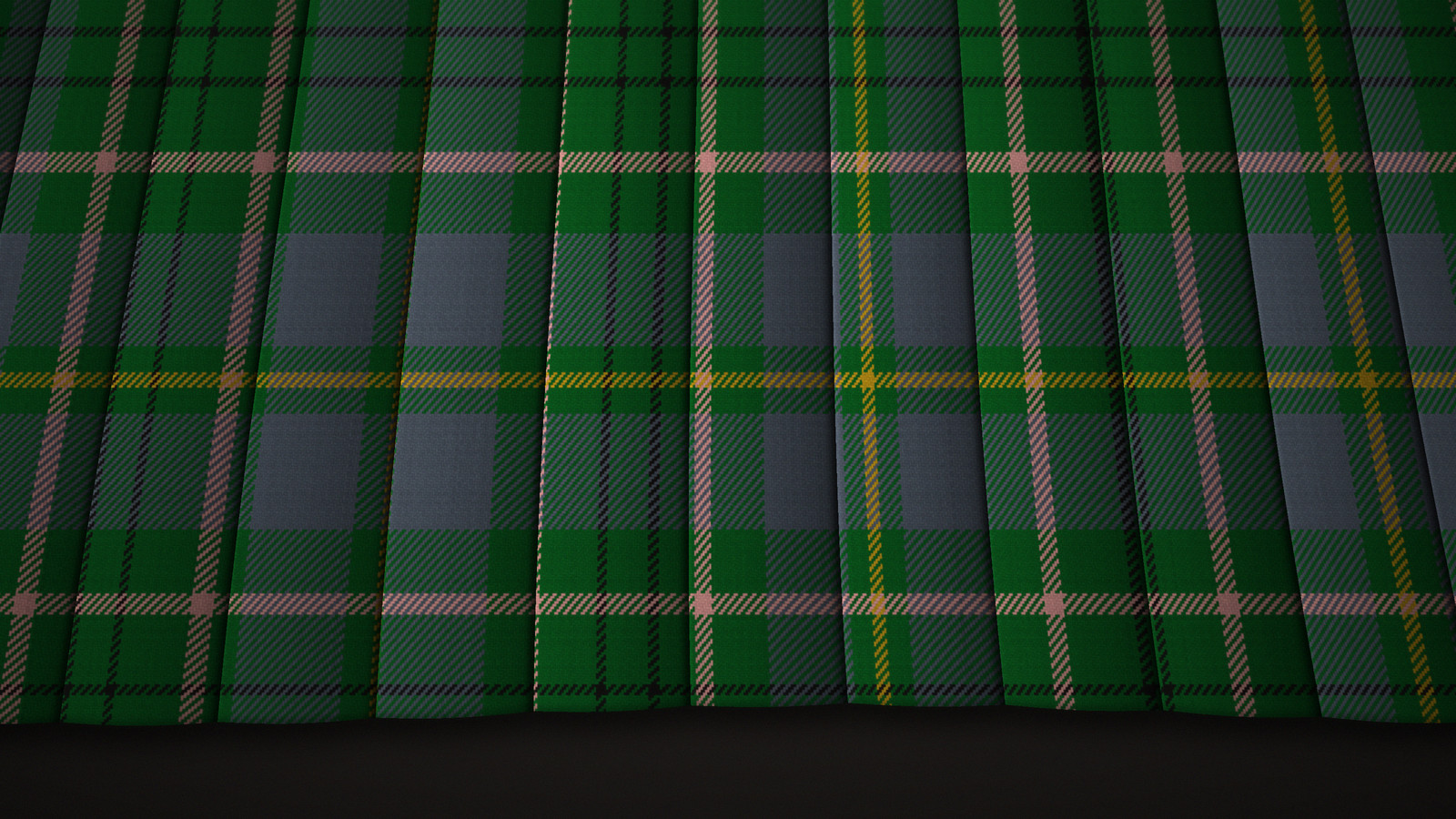
They based the design, the archive notes suggest, on the hunting tartan of Cameron of Lochiel, to honour the connection. The ground is a fresh green, with a broad band of soft slate blue. Through it run a stripe of coral red and a fine line of old gold. It is a gentle, unusual colour scheme, quite unlike the hard reds and navies of the older setts, and it is very easy to wear.
Then there is the detail that makes it one of the wittiest tartans in the book. Running through the green are two fine black lines, side by side. The register explains them in a single sentence: “The double black lines in the tartan are said to represent the Black Tailor and his bar sinister.” The bar sinister is the heraldic mark of illegitimacy. The designers wove the founder of the family, and the circumstances of his birth, into the cloth.
The Taylor tartan is carried today by the Highland outfitters, made to order as kilts, skirts, sashes, scarves and ties, or sold by the yard. It is one of the commonest surnames in the English-speaking world, and a good many of the people who bear it have no idea that a tartan, an axe and a scandal come with it. For women it makes up particularly well in kilt skirts, which carry the green and blue without the weight of a full kilt.
Nashville, a Thursday night in November
Morgan Taylor is thirty-one, plays pedal steel in other people’s bands, and found out about the Black Tailor on a tour bus somewhere in Ohio at three in the morning, looking up her own name for want of anything else to do. She read the whole story twice. She particularly liked the part about the bar sinister. Her own parents had not been married either, and she had always rather enjoyed the fact.
She ordered a length of the tartan the next day, and then had a long scarf made in it, and then a fitted shirt. What she did not want was the full Highland look. She is a musician in Nashville. She wears black, denim and leather, and she was not about to stop.
What she worked out, by trial and error, is one of the oldest tricks in dressing: put a soft pattern against a hard plain. Tartan is wool or a wool-like weave, matt, warm and busy. Leather is smooth, cold, and absolutely plain. Each makes the other look better. The punks understood it in the seventies when they wore tartan trousers with leather jackets. The Highlanders understood it long before, since the whole of Highland dress is a length of soft tartan held together with leather straps, a leather belt and a leather sporran.
Her version turns it upside down. The tartan goes on top, and the leather goes below, in the shape of a kilt.
She found the skirt at Scottish Kilt, the made-to-measure Highland outfitter, which as well as tartan makes women’s leather kilt skirts and other leather skirts in a range of cuts. They are, in the site’s words, 100% genuine leather, never bonded or coated, in mini, midi and pencil lengths, made to the customer’s own waist and hip measurements exactly. That last point decided her. Leather does not stretch or forgive the way cloth does. A leather skirt a size too big stands away from the body like a lampshade, and one a size too small cannot be sat down in. Made to her own numbers, it fits like a second skin.
Several of the styles borrow directly from the kilt. There is a mini with a panel of knife pleats. There is a wrap skirt that crosses over at the front exactly as a kilt’s aprons do. There is one that fastens at the hip with a row of buckled straps, which is how every kilt has fastened for two hundred years. She chose the pleated mini, in black.
Tonight she is playing a showcase at a club on the east side. She is wearing the black leather kilted skirt, black tights and heavy black boots. Above it, the Taylor tartan shirt, green and slate blue with its coral stripe, sleeves rolled to the elbow, tucked in. A plain black leather belt. Silver rings. Nothing else.
It works for exactly the reason she thought it would. The black takes all the fuss out of the outfit and leaves the tartan as the only colour on the stage. Under the lights the coral line glows.
At the bar afterwards the singer’s manager, a man from Glasgow who has been in Tennessee for twenty years, nods at the shirt.
“That’s no’ a tartan I know.”
“Taylor.”
“There’s a Taylor tartan? Since when?”
“1955. Two people who knew what they were doing.” She pulls the cuff straight and shows him. “See those two black lines, side by side? That’s my ancestor. He was the chief’s son, but his mum and dad weren’t married, so they farmed him out to a tailor. He grew up to be the best axe fighter in Scotland. The two lines are him and his bar sinister.”
The man from Glasgow looks at the lines, and then at her.
“They put that in the tartan?”
“They put it right in the tartan,” says Morgan. “I think that’s the classiest thing I ever heard.”
Children of the tailor
The Black Tailor of the Axe had every disadvantage a man of his time could be born with, and made himself a legend regardless. When the time came to give his descendants a tartan, the people who designed it did not tidy him up. They put him in, along with the irregularity of his birth, as a badge of honour.
It is a tartan for people who are comfortable with where they come from. It is soft in colour and has that bit of steel running through it. Worn over black leather cut like a kilt, on a stage in Tennessee, it is a long way from Lochaber, but the Black Tailor himself ended up a long way from home too.