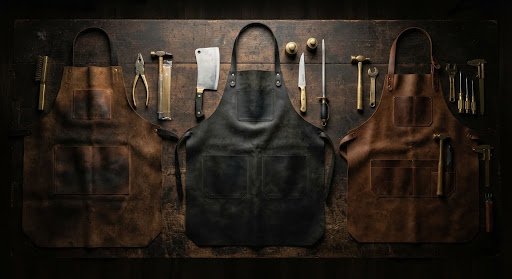
Which Apron Will Suit You? A Complete Guide
Not every leather apron is built for the same job, and mixing them up costs more than comfort. A thin apron in front of a welding torch is a safety risk. A soft, flexible apron behind a butcher’s block won’t survive a week of blade work and blood. The trade you’re in should decide the apron you buy, not the other way around.
This guide walks through how to match an apron to the work it actually needs to survive, so you’re not stuck relearning that lesson the hard way.
Start With the Baseline: What Makes an Apron “Good” at All
Before comparing trade-specific styles, it helps to know what separates the best leather aprons from the ones that fall apart in a season. Regardless of the job, look for:
- Full-grain cowhide, ideally in the 1.0–1.4mm range, thick enough to protect, flexible enough not to fight your movement.
- Solid brass hardware rivets, D-rings, and buckles that won’t rust or snap under load.
- Double-stitched stress points pocket corners and strap attachments take the most abuse and are usually the first place a cheap apron tears.
- Adjustable, cross-back-capable straps: anyone wearing an apron for a full shift needs the weight distributed across the shoulders, not the neck.
Once those fundamentals are in place, the differences between trades come down to thickness, coverage, and pocket layout, which is where things really start to diverge.
For the Forge and the Fab Shop: Choosing a Leather Apron for Welding
Welding is the one trade where “close enough” leather genuinely isn’t safe. Sparks, molten spatter, and radiant heat all behave differently than the everyday wear and tear another trade might put an apron through, so the standards are higher.
A proper leather apron for welding should offer:
- Full-grain, heavier-gauge cowhide: leather naturally chars instead of melting the way synthetic fabric does, which matters if a spark lands and lingers.
- Reinforced, heat-resistant stitching: regular thread can weaken under repeated heat exposure; welding aprons need stitching built to hold up to it.
- Full front and knee coverage: a short apron leaves a gap exactly where dropped slag or spatter tends to land.
- An ergonomic cut: welders need to bend, crouch, and reach without the apron riding up or restricting the arms.
- Tool pockets positioned away from direct spark exposure convenient storage for gloves, pliers, or a wire brush, without putting flammable contents directly in the line of fire.
It’s worth noting that leather is a strong, naturally heat-resistant material for welding work, but it functions as PPE, not a fireproof guarantee. It’s meant to be worn alongside gloves, a welding hood, and the rest of standard shop safety gear, not instead of them.
For the Block and the Counter: What Makes a Heavy Duty Butcher Apron
Butchery puts an apron through a different, equally punishing test: not heat, but constant moisture, blade contact, and the physical weight of the job itself. A good butcher apron has to survive blood, fat, and bone splinters shift after shift, while still being comfortable enough to wear for eight or more hours on your feet.
Look for these features in a heavy duty butcher apron:
- Thick, tightly grained leather naturally resists cuts and knife slips better than canvas or synthetic fabric.
- A water- and stain-resistant finish: leather that’s been properly finished sheds blood and moisture instead of soaking it in, making cleanup a wipe-down rather than a scrub.
- Full torso coverage: butchery work happens close to the body, so the apron needs to guard the chest and thighs, not just the front of the waist.
- Cross-back straps: The physical demands of butchery (lifting, cutting, standing for hours) make shoulder-distributed straps far more comfortable than a simple neck loop over a full shift.
- Minimal, well-placed pockets: Unlike a woodworking apron, a butcher apron doesn’t need many pockets; too many just catch on equipment and create more surface area to clean.
A heavy-duty butcher apron is one of the few categories where “more protection” almost always wins over “more features”; simplicity and coverage matter more than storage.
What If You Work Across Multiple Trades?
Plenty of people don’t fit neatly into one category: a hobbyist blacksmith who also grills, or a woodworker who occasionally welds a jig together. In that case, the smartest move is to buy toward the harshest condition you’ll face. A heavier-gauge apron built for welding or butchery will comfortably cover lighter tasks like woodworking or bartending, but the reverse usually isn’t true: a lightweight bartender apron won’t hold up to sparks or a boning knife.
If you’re outfitting a whole crew across different roles distillery staff, a barbershop team, or a fabrication shop it’s often more efficient to go trade-by-trade rather than force one apron style onto every job. Each trade collection is built around the specific stresses of that work, and matching the apron to the task is what makes it last for years instead of one hard season.
A Fast Way to Decide
If you’re still not sure which direction to go, ask three questions:
- What’s the primary hazard?
Heat and sparks → welding-grade leather. Blades and moisture → butcher-grade leather. General wear → a standard all-purpose apron from the best leather aprons range.
- How many hours will you wear it at a stretch?
Longer shifts mean cross-back straps and weight distribution should be non-negotiable.
- Do you need tool access, or just protection?
More pockets help trades that reach for tools constantly; fewer pockets suit trades where simplicity and coverage matter more.
Answering those honestly points you toward the right collection faster than scrolling through every product on a site.
Final Thoughts
The right apron isn’t the one with the best reviews in general; it’s the one built for the specific hazards of your trade. A leather apron for welding needs heat resistance and full coverage above everything else. A heavy-duty butcher apron needs to shrug off moisture and blade contact while staying comfortable through a long shift. And if your work doesn’t fall neatly into either category, starting from a trusted range of best leather aprons with full-grain hide, brass hardware, and real stitching is the safest way to find something that fits the job and lasts well beyond it.