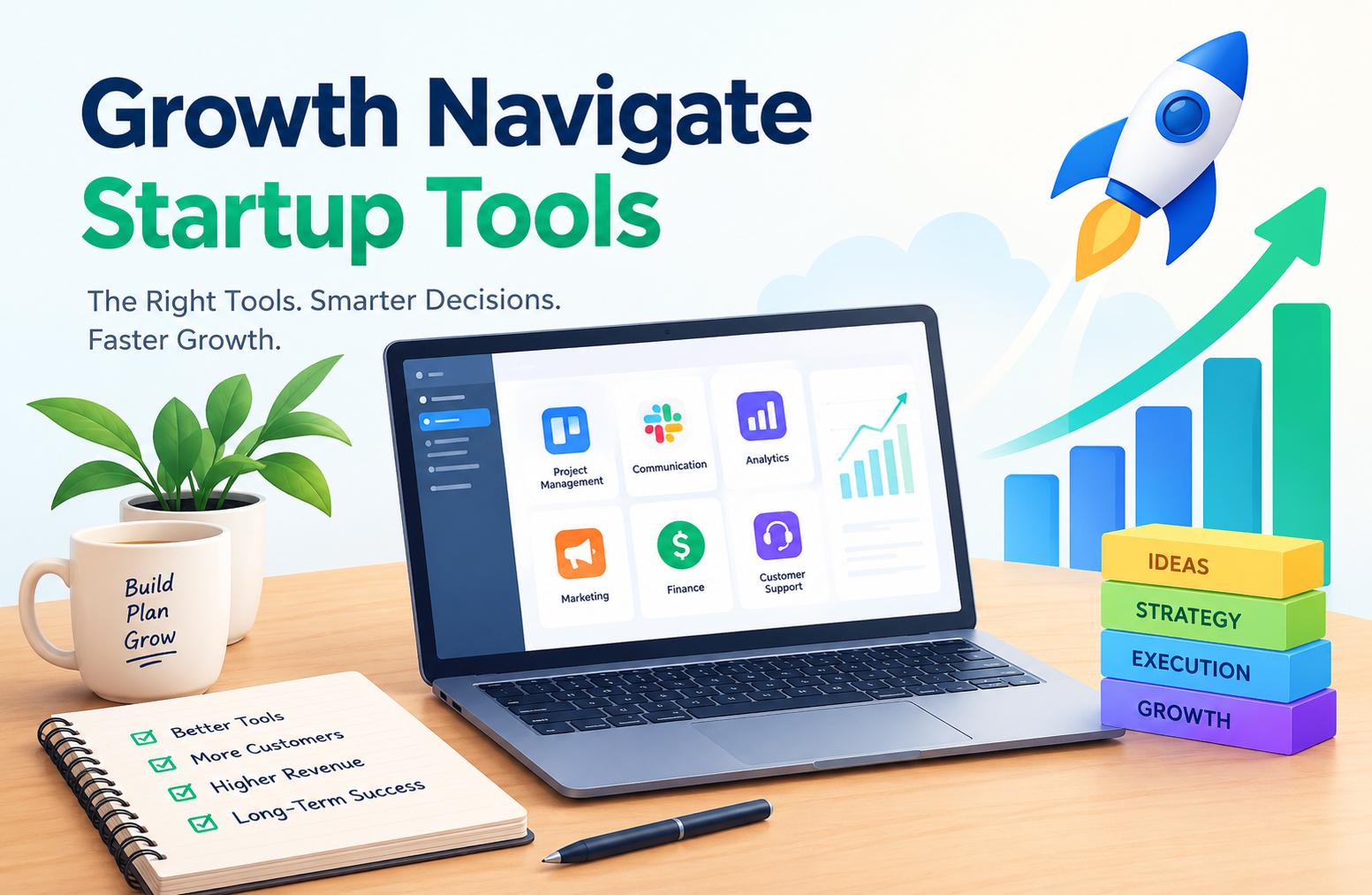
Growth Navigate Startup Tools: A Guide for Growing Businesses
Starting a business is challenging, but managing its growth can be even more complex. Growth navigate startup tools refers to the practical software, digital platforms, and business resources that help founders plan expansion, manage daily operations, understand customers, track finances, and make informed decisions. These tools give startups a clearer way to move from an early idea to a stable, growing business without adding unnecessary complexity.
Many founders begin with a simple spreadsheet, a few customer conversations, and a basic website. These methods can work well at first. However, as orders increase, teams expand, and customer expectations change, informal systems become harder to manage. Important information gets scattered across applications, communication slows down, and decisions become more difficult to make.
The right combination of startup tools can reduce these problems. It can help a founder see where the business stands, identify what needs attention, and decide which activities deserve more time and money. However, success does not come from collecting as many applications as possible. It comes from choosing tools that solve genuine business problems and using the information they provide to improve results.
Understanding how to navigate startup growth requires more than knowing which software is popular. Founders must understand their business model, customers, financial position, operational needs, and growth objectives. Technology supports these decisions, but it cannot replace sound judgment, customer feedback, or a clear strategy.
This guide explains the meaning of growth navigation tools, the main categories available to startups, how to select the right solutions, common implementation mistakes, and practical ways to build a technology system that supports sustainable growth.
What Are Growth Navigate Startup Tools?
Growth navigation tools are digital resources that help entrepreneurs organize, measure, and improve the activities that contribute to business growth. They include project management applications, customer relationship management systems, accounting software, marketing platforms, analytics tools, communication applications, and automation services.
The phrase growth navigate startup tools describes a broad approach rather than one specific software product. There is no single application that performs every function a startup needs. Instead, founders combine several solutions to create a working system that supports their goals.
For example, a small online business might use:
- An accounting platform to record income and expenses.
- A customer relationship management system to track potential buyers.
- An email marketing application to communicate with customers.
- A project management tool to organize tasks and deadlines.
- A website analytics platform to understand visitor behavior.
- A communication application to coordinate the team.
Each application serves a different purpose. When the tools are selected carefully, they help the business operate with greater visibility and consistency.
The Difference Between Startup Tools and Growth Tools
Startup tools are often associated with launching a business. They help founders establish a website, create a product, register customer information, manage initial expenses, and coordinate early tasks.
Growth tools focus more directly on improving performance as the business develops. They help measure customer acquisition, retention, sales conversion, operating costs, productivity, and other important indicators.
The distinction is not absolute. Many applications support both stages.
A basic customer database, for instance, may help a founder manage the first 20 customers. Later, the same system may support automated follow-ups, sales forecasting, customer segmentation, and team reporting.
The key is to recognize when the current system no longer meets the business’s needs. A startup does not necessarily need to replace its tools as it grows. It may only need to configure them differently, connect them to other applications, or upgrade when a specific limitation becomes costly.
Why Growth Navigation Matters
Growth introduces new demands. A founder who once handled sales, customer support, marketing, and accounting personally may eventually need to coordinate several employees or contractors.
Without reliable systems, the business can become dependent on individual memory and informal communication. That creates operational risks.
A customer request may be missed because it was discussed in a private message. An invoice may remain unpaid because no one followed up. A marketing campaign may continue spending money even though it is no longer producing suitable leads.
Growth navigation creates a more structured approach to these challenges. It helps founders answer practical questions:
- Which products or services generate the strongest margins?
- Where do potential customers leave the sales process?
- Which marketing channels attract valuable customers?
- What tasks consume too much employee time?
- How much cash is available for future commitments?
- Which operational problems are preventing further expansion?
These questions matter because growth is not simply an increase in sales. Healthy growth also requires financial control, customer satisfaction, manageable workloads, and reliable delivery.
Why Startups Need the Right Growth Tools
A startup’s early decisions can influence its ability to scale. The tools selected during the first stages affect how information is stored, how work is assigned, how customers are supported, and how leaders evaluate performance.
The goal is not to automate everything immediately. It is to establish systems that solve the most important problems without consuming too much money or attention.
1. Better Decision-Making
Founders often make decisions with incomplete information. A business analytics platform, financial dashboard, or customer management system can provide a more organized view of available evidence.
For example, a subscription business may discover that its customer numbers are increasing while cancellations are also rising. Looking only at new subscriptions might suggest strong performance. Reviewing both acquisition and retention reveals a more complete picture.
Useful information allows founders to investigate the reasons behind changes instead of relying entirely on intuition.
2. Improved Productivity
Many startup tasks are repetitive. Employees may spend hours arranging meetings, sending routine updates, updating spreadsheets, preparing invoices, or manually moving information between systems.
Appropriate software can reduce this administrative workload.
Consider a small consulting firm that receives project requests through its website. A connected workflow could record the request, notify the relevant employee, create a follow-up task, and send an acknowledgment to the customer.
The benefit is not simply saving a few minutes. It is creating a process that remains consistent when the number of requests increases.
3. Stronger Customer Relationships
Growth depends on attracting customers and giving them reasons to return. Customer relationship management software helps teams maintain records of conversations, purchases, preferences, complaints, and follow-up activities.
Without a shared system, customer information may remain in individual inboxes or personal notes. This makes it harder for another team member to provide informed support.
A centralized record helps employees understand the customer’s history and respond more consistently.
4. Greater Financial Visibility
Revenue alone does not show whether a startup is financially healthy. A business can generate more sales while experiencing shrinking margins, rising operating costs, or delayed customer payments.
Accounting software and cash flow forecasting tools help founders track financial activity and anticipate upcoming obligations.
They can also support budgeting, expense categorization, invoice management, and financial reporting.
For practical guidance on business planning, market research, startup costs, and related decisions, the U.S. Small Business Administration’s business planning resources provide a useful starting point. The specific legal, tax, and reporting requirements for a startup depend on its location and business structure.
5. Easier Team Coordination
As teams grow, informal communication becomes less reliable. Employees need to know who owns each task, when it is due, what has changed, and which decisions require approval.
Project management and communication applications create shared expectations.
A well-managed system can make responsibilities clearer without forcing employees to attend unnecessary meetings or send constant status updates.
The most effective setup makes essential information easier to find rather than creating more administrative work.
Essential Categories of Startup Growth Tools
There is no universal software stack that works for every startup. An online retailer, a software company, a local service provider, and a business consultancy have different operational requirements.
The following categories cover the main areas most founders should evaluate.
1. Project Management and Task Organization
Project management tools help teams plan work, assign responsibility, monitor deadlines, and coordinate projects.
They are particularly useful when a business has several ongoing activities that depend on one another.
Typical features include:
- Task assignments and deadlines.
- Project boards and progress tracking.
- Shared calendars.
- File attachments and comments.
- Workload visibility.
- Recurring task templates.
- Notifications and reminders.
For example, a company launching a new product may need its design, development, marketing, customer support, and sales teams to complete related tasks in a particular order.
A project management system gives everyone a shared view of progress and outstanding work.
How to choose: Start with the simplest tool that supports the team’s workflow. A small team may only need task lists and deadlines. A larger team may require dependencies, reporting, permissions, and multiple project views.
Avoid selecting a complex platform simply because it offers advanced features. Features that employees rarely use can make work harder instead of easier.
2. Customer Relationship Management Software
Customer relationship management, commonly called CRM, organizes interactions with prospects and existing customers.
It is especially valuable when sales involve several conversations before a purchase.
A CRM may help a startup:
- Store customer and prospect details.
- Track sales opportunities.
- Record calls, emails, and meetings.
- Schedule follow-ups.
- Monitor sales pipeline stages.
- Identify inactive prospects.
- Review sales performance.
Imagine a small software company receiving 80 inquiries in a month. Without a reliable tracking system, some prospects may receive several follow-up messages while others receive none.
A CRM can help the team maintain a consistent process and prioritize opportunities according to their needs and likelihood of converting.
How to choose: Evaluate the sales process before evaluating features. Determine how leads arrive, what information needs to be recorded, which follow-ups are necessary, and how sales progress should be measured.
A startup with a short buying process may need only a simple CRM. A company selling expensive business software may need more advanced reporting, account management, and forecasting.
3. Accounting and Financial Management Tools
Financial management tools help startups understand where money comes from, where it goes, and what obligations are approaching.
Depending on the platform, features may include:
- Income and expense tracking.
- Invoice creation and payment monitoring.
- Bank transaction reconciliation.
- Financial statements.
- Budget comparisons.
- Cash flow forecasts.
- Payroll support.
- Tax-related records.
These functions are important because cash availability and accounting profit are not the same thing.
For example, a business may issue a large invoice in October but receive payment in December. The company might record the sale before the money arrives, depending on its accounting method. Meanwhile, salaries, rent, and supplier bills may need to be paid in October and November.
A cash flow forecast helps the founder evaluate this timing difference.
How to choose: Look for accurate reporting, appropriate access controls, reliable backups, and compatibility with local tax and accounting requirements. Confirm that the software supports the currency, payment methods, and reporting rules relevant to the business.
Financial software can organize records, but it does not automatically guarantee accurate bookkeeping or regulatory compliance. Professional accounting advice may be necessary as the business becomes more complex.
4. Marketing and Customer Acquisition Tools
Marketing platforms help startups reach suitable audiences, communicate their value, and measure the results of promotional activities.
This category includes email marketing systems, social media management tools, advertising platforms, search engine optimization software, and landing page builders.
Different tools support different stages of the customer journey.
For example:
- SEO tools help identify search demand and evaluate website performance.
- Email platforms help manage subscriber lists and send targeted messages.
- Social media tools help organize publishing schedules.
- Advertising dashboards help monitor campaign spending.
- Landing page software helps businesses test offers and improve conversion.
The most important principle is to connect marketing activity with business outcomes.
A campaign that generates thousands of website visits may still perform poorly if those visitors are unlikely to become customers. Another campaign may attract fewer visitors but produce more qualified inquiries and sales.
How to choose: Begin with the main acquisition channel your customers actually use. A business serving local clients may benefit more from a well-maintained local presence and a simple lead tracking system than from an expensive enterprise marketing platform.
An online subscription business may need stronger conversion tracking, audience segmentation, and automated onboarding emails.
Do not purchase several marketing applications until you know which activities require separate tools and which can be managed in one platform.
5. Website Analytics and Business Intelligence
Analytics tools help startups understand how users interact with websites, products, campaigns, and services.
They can answer questions such as:
- Which pages attract the most relevant visitors?
- Where do users abandon a signup process?
- Which traffic sources produce paying customers?
- How often do customers return?
- Which product features receive the most engagement?
- How does performance change over time?
Business intelligence tools can combine information from different systems to create reports and dashboards.
However, analytics are only useful when the underlying data is reliable and the team understands what it means.
For example, a sudden increase in website traffic could result from a successful campaign, an irrelevant referral source, automated bot activity, or a tracking change. Traffic alone does not explain the cause.
How to choose: Identify three to five business questions you need to answer regularly. Select tools that can provide those answers with minimal manual work.
Also define important metrics clearly. If one report measures a lead when a form is submitted and another measures it only after qualification, the numbers will not be directly comparable.
6. Communication and Collaboration Applications
Communication tools support internal discussions, video meetings, document sharing, and coordination between employees.
They become especially important when a startup works remotely or across different time zones.
Useful capabilities include:
- Team messaging.
- Video conferencing.
- Shared documents.
- File storage.
- Meeting scheduling.
- Searchable discussion history.
- Permission management.
The challenge is preventing communication from becoming fragmented.
When employees use too many channels, decisions may disappear into private chats, email threads, or meeting notes.
A practical approach is to define which communication method belongs to which type of work. Urgent issues might require direct messaging, project decisions might belong in the project record, and formal policies might belong in a shared document.
How to choose: Consider team size, security requirements, existing habits, integrations, and the need to retain important records.
The best communication system is not necessarily the one with the most features. It is the one that helps people find the information they need and understand what action is expected.
7. Automation and Artificial Intelligence Tools
Automation tools connect applications and perform repetitive tasks according to defined rules. Artificial intelligence tools can also assist with drafting, classification, summarization, research, and analysis.
Potential uses include:
- Creating tasks from submitted forms.
- Sending appointment reminders.
- Categorizing customer inquiries.
- Summarizing internal meeting notes.
- Preparing first drafts of routine content.
- Identifying unusual changes in reports.
- Routing support requests to the appropriate team.
Consider a small online store that receives order notifications, shipping updates, and customer questions. A carefully designed workflow could send order confirmations automatically, update the order record, and alert a staff member when a customer reports a delivery problem.
Yet automation should not be treated as a substitute for process design.
If the underlying workflow is confusing, automation may simply make mistakes happen faster. AI-generated content may also contain factual errors, and automated decisions can affect customers in unexpected ways.
How to choose: Begin with a repetitive task that has a clear input, predictable steps, and an easy way to verify the outcome. Keep human review for sensitive financial decisions, important customer commitments, legal matters, and other high-impact activities.
8. Customer Support and Feedback Tools
Customer support platforms help businesses receive, organize, and resolve customer questions or complaints.
They may include shared inboxes, help desks, ticketing systems, knowledge bases, and chat tools.
These systems help teams monitor unresolved issues, identify repeated problems, and establish response responsibilities.
For example, if several customers report difficulty completing checkout, the issue may indicate a product or website problem rather than isolated customer confusion.
A support system can reveal patterns that might otherwise remain hidden in separate conversations.
How to choose: Consider the number of customer inquiries, response expectations, available staff, and complexity of the product.
A small service business may be able to manage customer communication through a shared inbox. A larger company with several support agents may need ticket assignment, escalation rules, response tracking, and a searchable help center.
9. Cybersecurity and Data Protection Tools
As startups collect customer details, process payments, and store internal documents, protecting information becomes increasingly important.
Security tools and practices may include password managers, multifactor authentication, endpoint protection, encrypted storage, access controls, and backup systems.
Founders should consider security from the beginning rather than waiting until the business becomes larger.
A practical security process includes:
- Giving employees access only to the information they need.
- Requiring strong authentication for important accounts.
- Reviewing access when employees change roles or leave.
- Backing up essential business records.
- Keeping software and devices updated.
- Establishing a response plan for suspected security incidents.
How to choose: Assess the type of data your company handles, the consequences of losing it, and any legal or contractual obligations that apply.
A business processing payments or sensitive customer information may need stronger controls than a company managing a simple public website. Even a small startup, however, should protect administrator accounts and essential records.
How to Choose the Best Growth Tools for Your Startup
Choosing software should begin with a business problem, not a product advertisement. The following process helps founders make more disciplined decisions.
Step 1: Identify the Main Business Bottleneck
A bottleneck is the problem that most restricts performance.
For one startup, the main issue may be a shortage of qualified leads. For another, it may be slow project delivery, poor cash visibility, or a high volume of unresolved support requests.
Write down the problem in specific terms.
Instead of saying, “We need better productivity,” define the issue as, “Customer inquiries are sometimes left unanswered because requests arrive through three separate channels.”
The second statement provides a clearer basis for selecting a solution.
Step 2: Define the Outcome You Want
Decide what improvement would demonstrate that the tool is working.
Possible outcomes include:
- Fewer missed customer inquiries.
- Shorter project completion times.
- More accurate financial reports.
- Less manual data entry.
- Better visibility into upcoming payments.
- Fewer abandoned customer signups.
Where possible, establish a baseline before implementation.
For instance, record how many hours employees spend preparing a weekly report. After introducing an automated reporting process, measure the time required to complete the same task.
This approach helps distinguish actual improvements from assumptions.
Step 3: Set a Realistic Budget
The cost of software extends beyond its advertised subscription price.
Founders should consider setup fees, employee training, integration costs, data migration, usage-based charges, and the time required to maintain the system.
A free plan may be sufficient for a small team, but it might lack important permissions or reporting features. A paid plan may save time, but only if its benefits justify the additional expense.
Create a budget that reflects current needs and foreseeable growth rather than purchasing an enterprise package in anticipation of a hypothetical future.
Step 4: Compare a Small Number of Options
Evaluating too many products can consume time without improving the final decision.
Select two or three plausible options and compare them against the same criteria.
| Evaluation factor | Key question |
| Core features | Does it solve the main problem? |
| Ease of use | Can employees learn it quickly? |
| Total cost | What will it cost over the next year? |
| Integration | Does it work with existing systems? |
| Security | Are access and data protection controls suitable? |
| Scalability | Can it support expected business needs? |
| Support | Is help available when problems arise? |
| Data portability | Can information be exported if you switch? |
A short trial using real business tasks can reveal more than a long feature list.
Step 5: Check Integration Requirements
A collection of useful tools can still create an inefficient workflow if the applications do not share information.
For example, a sales team may record customer details in a CRM while the accounting team enters the same details into a separate billing platform. Repeated manual entry increases the risk of errors and wastes time.
Before purchasing a tool, identify the information that should move between systems.
Check whether native integrations are available, whether a connector is required, and whether the connection creates additional costs or security concerns.
Not every application needs to connect to every other application. Integration should focus on important workflows where shared information saves time or improves accuracy.
Step 6: Test Before Rolling Out
Start with a small pilot involving a limited number of employees or one defined process.
Use the trial period to test ordinary work, unusual cases, reporting accuracy, and access permissions.
Ask the people who will use the software whether it makes their tasks easier. Their feedback may reveal problems that are not obvious during a product demonstration.
Only expand the rollout after the workflow is reliable and employees understand how to use it.
Step 7: Review Performance Regularly
A tool that worked well during the launch stage may become less suitable as the business changes.
Review whether the application still solves the original problem, whether its cost remains reasonable, and whether employees actually use it.
If a tool creates more work than it removes, simplify the configuration, improve training, or consider an alternative.
Technology decisions should be revisited as business needs evolve, but frequent switching without a clear reason can create its own problems.
Practical Applications of Growth Navigation Tools
The best way to understand these tools is to examine how they fit into real business situations. The following examples are illustrative scenarios, not claims about specific companies or measured results.
Example 1: A Small E-Commerce Startup
Imagine an online store selling home accessories. The founder manages orders, product listings, customer questions, advertising, and inventory.
Initially, a spreadsheet and email account may be enough. As the number of orders grows, however, the founder may struggle to identify popular products, track delivery issues, and calculate the true cost of acquiring customers.
A more structured system could include:
- An e-commerce platform for orders and product listings.
- Accounting software for expenses and revenue.
- Inventory management for stock levels.
- Customer support software for complaints and questions.
- Marketing analytics for campaign performance.
The important improvement is the connection between these functions.
Suppose advertising generates more orders for a particular product. Before increasing the advertising budget, the founder should check inventory availability, shipping costs, product margins, and return rates.
More sales are beneficial only when the business can fulfill orders profitably and maintain a satisfactory customer experience.
Example 2: A Software-as-a-Service Startup
A software-as-a-service business, commonly called SaaS, provides software through recurring subscriptions.
Its growth depends on several related activities, including attracting new users, helping them experience value, converting them into paying customers, and retaining them.
A useful technology setup might include:
- Product analytics to track user activity.
- A CRM to manage business customers and sales opportunities.
- Email automation for onboarding and product updates.
- Subscription billing software for recurring payments.
- Customer support tools for resolving problems.
- Financial reporting for revenue and expenses.
The team should avoid focusing exclusively on new signups.
If new users register but fail to complete the initial setup, the business may have an onboarding problem. If users become active but cancel shortly afterward, the product may not be meeting their expectations.
A combination of product analytics, customer feedback, and subscription data can help the team identify where the experience needs improvement.
Example 3: A Service-Based Business
Consider a small digital marketing agency with several clients and a team of freelancers.
The agency needs to coordinate project deadlines, manage client expectations, record billable work, send invoices, and track payments.
Its core tools might include project management software, shared document storage, accounting software, time tracking, and a CRM.
A practical workflow could begin when a client approves a proposal. The team creates a project, assigns tasks, records deadlines, and schedules progress reviews. Once the agreed work is completed, the relevant billing information is prepared for invoicing.
This system reduces the need to reconstruct project history from scattered messages.
It also helps management identify which projects consume more time than expected. If a particular service consistently requires additional work, the agency can review its pricing, scope, or delivery process.
Example 4: A Startup Operating With a Small Budget
A founder with limited funding may need to perform several roles without hiring a large team.
In this situation, the priority is not building a sophisticated software stack. It is establishing the minimum set of systems needed to operate reliably.
The founder might begin with a spreadsheet, a basic accounting solution, a shared calendar, cloud document storage, and a simple customer tracking system.
As the workload increases, individual functions can be upgraded.
For example, manually tracking customer inquiries may be reasonable at first. If missed follow-ups begin affecting sales, introducing a CRM becomes more valuable.
This staged approach preserves cash and helps ensure that each new expense addresses a demonstrated need.
Common Challenges When Using Startup Growth Tools
Technology can improve business operations, but implementation introduces its own risks. Understanding these challenges helps founders avoid unnecessary costs and operational disruption.
1. Using Too Many Applications
One of the most common problems is tool overload.
A startup may adopt separate applications for tasks, communication, notes, documents, reporting, and customer records without considering whether those functions overlap.
Employees then spend time switching between platforms, copying information, and maintaining duplicate records.
The solution is to review the existing software before adding anything new.
Ask whether the current platform already supports the required function. If two applications provide nearly identical benefits, determine whether both are genuinely necessary.
A smaller, well-integrated system is often easier to maintain than a collection of disconnected subscriptions.
2. Underestimating the Total Cost
Software expenses can accumulate gradually. Individual subscriptions may seem affordable, but several paid plans can become a significant recurring cost.
Additional expenses may include premium integrations, extra users, storage upgrades, professional setup, and staff training.
Founders should calculate the expected annual cost and compare it with the value the tool provides.
That value may include revenue opportunities, reduced errors, time saved, improved customer retention, or lower operating risk. Not every benefit will translate directly into immediate revenue, but the reasoning should still be clear.
3. Poor Data Quality
Analytics and automation are only as useful as the information they receive.
Duplicate customer records, missing transaction details, inconsistent naming conventions, and incorrect tracking settings can produce misleading reports.
Before introducing advanced dashboards, establish basic rules for data entry and ownership.
For example, decide which system contains the official customer record, how customer status is defined, and who is responsible for correcting errors.
Clean data creates a more reliable foundation for future analysis.
4. Low Employee Adoption
A technically capable application can fail if employees find it difficult to use or do not understand why it was introduced.
This often happens when management selects a tool without consulting the people who perform the work.
A better approach includes employee input, practical training, clear instructions, and a limited rollout.
The team should understand which problem the new system solves and which existing process it replaces. If employees are expected to maintain the same information in two separate places, adoption will likely be harder.
5. Security and Privacy Risks
Every additional application may create another place where business information is stored or accessed.
Founders should review the vendor’s security practices, data retention policies, access controls, backup options, and account recovery procedures.
They should also consider what happens if a vendor changes its pricing, discontinues a product, or experiences an outage.
Essential records should not depend entirely on a single application with no export or recovery plan.
Businesses operating across borders should pay particular attention to relevant privacy, contractual, and data protection requirements.
6. Automating the Wrong Process
Automation is most useful when a process is stable and well understood.
If employees regularly change how a task is performed because the underlying requirements are unclear, automating it too early can make errors more difficult to detect.
Document the process first. Identify the normal steps, exceptions, approval requirements, and possible failure points.
Then automate the repetitive portions while preserving human review where judgment is necessary.
7. Mistaking Activity for Progress
A startup may track hundreds of metrics and still struggle to identify what is driving results.
Website visits, email opens, social media followers, and tasks completed can all provide useful information. However, their importance depends on the business objective.
A growing audience is not necessarily evidence of profitable customer acquisition. A busy team is not necessarily delivering valuable outcomes.
Each metric should have a clear purpose and a relationship to a decision the business needs to make.
How to Measure the Impact of Growth Tools
Choosing a tool is only the beginning. Founders need a practical way to determine whether it improves business performance.
A useful measurement system connects the original problem, the expected outcome, and the evidence collected after implementation.
Track Time Saved
Estimate how much time employees spend on a task before introducing a tool.
After implementation, measure the same activity using a comparable workload.
For example, if a weekly report previously required three hours of manual preparation, record how long it takes after the reporting process changes. Also consider the time needed to check data and correct errors.
Time saved is valuable when it can be redirected toward productive work, customer service, or business development.
Monitor Customer Conversion
For businesses that generate leads, conversion rates help show whether marketing and sales processes are working.
A basic calculation is:
ConversionRate=SuccessfulConversionsTotalEligibleOpportunities100
The definition of an opportunity must remain consistent. A website visitor, a qualified lead, and a sales-ready prospect are different groups and should not be treated as interchangeable.
A CRM or analytics platform can help track these stages and identify where potential customers leave the process.
Review Customer Retention
Retention measures whether customers continue using a product or purchasing from a business over time.
For a subscription company, customer churn is particularly important. A simple customer churn rate can be calculated as:
CustomerChurnRate=CustomersLostDuringPeriodCustomersatPeriodStart100
The period and customer definition should be clearly specified. New customers acquired during the period should not be added to the starting customer count when calculating this basic measure.
A retention dashboard can help a startup identify changes in customer behavior and investigate possible causes.
Understand Customer Acquisition Cost
Customer acquisition cost, or CAC, estimates how much a business spends to acquire a customer.
A simplified calculation is:
CAC=AcquisitionCostsDuringPeriodNewCustomersAcquired
The result depends on which costs are included. A more complete calculation may include advertising, sales salaries, commissions, marketing software, and relevant agency fees.
CAC should be interpreted alongside customer value, profit margins, and the time required to recover acquisition spending.
A lower acquisition cost is not automatically better if the customers acquired are less likely to remain or make repeat purchases.
Monitor Cash Flow and Operating Costs
Financial tools should help founders understand expected payments, upcoming expenses, and available cash.
Useful indicators include outstanding invoices, monthly operating expenses, gross margin, payment delays, and projected cash requirements.
The appropriate measures depend on the business model. A retailer may focus heavily on inventory costs and stock turnover, while a service company may pay closer attention to utilization, project margins, and payment collection.
Use a Simple Review Dashboard
A startup does not need dozens of metrics to make better decisions.
A basic review might include the following:
| Business area | Example metric | Decision it supports |
| Marketing | Qualified leads | Where to focus acquisition efforts |
| Sales | Conversion rate | Which sales stages need improvement |
| Finance | Cash forecast | Whether upcoming commitments are affordable |
| Operations | Task completion time | Where delivery processes are inefficient |
| Customers | Retention rate | Whether customers continue receiving value |
| Support | Time to resolution | Whether customer problems are being handled effectively |
Review these metrics on a schedule appropriate to the business. Weekly reviews may help with fast-moving sales and operational issues, while longer-term trends may be more meaningful when assessed monthly or quarterly.
The purpose is not to create another reporting obligation. It is to make important business decisions easier and more informed.
Building a Startup Technology Stack at Each Growth Stage
A startup’s needs change as its customer base, revenue, and team develop. A staged approach helps prevent premature spending and unnecessary complexity.
Stage 1: Idea and Validation
At this stage, the founder is testing whether a genuine customer problem exists and whether people are willing to pay for a solution.
Priorities include customer interviews, basic market research, cost estimates, and a simple way to document assumptions.
Useful resources may include spreadsheets, survey platforms, a landing page builder, a document application, and a basic task manager.
The most important goal is learning. Expensive automation and complex reporting systems are rarely the first priority when the business model remains uncertain.
Stage 2: Early Launch
Once the startup begins serving customers, reliable operations become more important.
The business may need:
- Accounting and invoicing software.
- A basic CRM or customer database.
- Website analytics.
- Project and task management.
- Secure file storage.
- Customer communication tools.
The founder should establish consistent processes for recording sales, managing expenses, responding to inquiries, and fulfilling customer commitments.
This stage creates the operational foundation that later growth will depend on.
Stage 3: Growing Customer Demand
As sales and workload increase, manual processes may become bottlenecks.
The startup may benefit from more structured customer segmentation, workflow automation, improved reporting, inventory management, or a dedicated support platform.
At this stage, integration becomes more valuable because separate teams need access to consistent information.
The founder should also begin reviewing software permissions, data quality, system ownership, and the total cost of the technology stack.
Stage 4: Scaling Operations
A scaling business needs repeatable processes that work across larger teams and higher transaction volumes.
Its technology requirements may include advanced analytics, role-based access controls, more detailed financial forecasting, structured onboarding, and reliable system integrations.
However, scaling does not mean purchasing the most sophisticated option in every category.
A platform should be upgraded when the current system creates a measurable limitation, unacceptable risk, or recurring cost that a better solution can reasonably reduce.
Stage 5: Established Growth
At a more mature stage, management may need to evaluate the entire technology environment rather than individual applications.
This includes reviewing overlapping subscriptions, data consistency, integration reliability, vendor risk, access policies, and reporting standards.
Some functions may benefit from specialized platforms, while others can be consolidated.
The central question becomes whether the overall system supports strategic priorities without creating unnecessary operational complexity.
A Practical Framework for Implementing Growth Tools
Selecting software is only one part of building a dependable business system. Founders also need a clear implementation plan that connects technology with everyday work.
The following framework can help turn the idea behind growth navigate startup tools into a practical operating strategy.
Step 1: Map the Current Workflow
Write down how important tasks are completed today, from the first customer interaction to payment collection and after-sales support.
Identify where information is entered, who handles each step, where delays occur, and which tasks are repeated manually.
This provides a baseline for deciding whether software is needed and what it should accomplish.
Step 2: Prioritize the Most Expensive Problem
Not every inefficiency deserves immediate attention.
Prioritize problems that create significant financial losses, customer dissatisfaction, operational delays, compliance risks, or excessive staff workload.
A minor inconvenience may be acceptable temporarily. Repeated missed payments or lost customer inquiries may require a faster response.
Step 3: Assign Ownership
Every important system should have a responsible person.
That person does not necessarily need to manage every technical detail. Their responsibility is to ensure that the system remains useful, accurate, and aligned with the team’s needs.
Ownership may include reviewing permissions, maintaining workflow documentation, checking data quality, and coordinating support when problems arise.
Step 4: Document the New Process
Create simple instructions that explain how employees should use the tool.
Document the steps that matter most, including who enters information, how tasks are assigned, when exceptions require approval, and where completed work is recorded.
Clear documentation reduces dependence on individual memory and makes employee onboarding easier.
Step 5: Evaluate the Results
After implementation, compare performance with the baseline established earlier.
Look at time saved, error frequency, customer outcomes, financial impact, and employee feedback.
If the results are weaker than expected, investigate the cause before adding more software. The problem may involve training, process design, data quality, or an unsuitable product.
The Role of AI in Startup Growth
Artificial intelligence is becoming a useful part of many business workflows. For startups, its appeal lies in helping small teams handle tasks that might otherwise require significant time or specialized support.
AI applications can assist with drafting documents, summarizing information, organizing customer feedback, generating initial marketing ideas, and analyzing structured data.
However, the value of AI depends on the quality of the task and the reliability of its output.
For example, an AI assistant might summarize hundreds of customer comments and identify recurring complaints. The founder can then review those themes, examine representative comments, and decide which product changes deserve attention.
This can accelerate analysis, but it does not prove that the suggested priorities are correct. The team still needs to verify the evidence and understand the customers involved.
Where AI Can Help Most
AI is often useful when a task involves large amounts of information, repeated language-based work, or a clear pattern that can be checked by a human.
Potential applications include:
- Preparing first drafts of internal documents.
- Summarizing meeting notes and customer feedback.
- Organizing support inquiries into categories.
- Producing initial versions of marketing content.
- Helping employees search internal documentation.
- Identifying unusual patterns for further investigation.
These applications are most effective when the startup defines clear quality standards and review procedures.
What Startups Should Avoid
Founders should not assume that AI-generated output is automatically accurate, unbiased, or appropriate for publication.
Important risks include incorrect factual claims, exposure of confidential information, inconsistent customer communication, and decisions based on incomplete context.
Businesses should review the privacy and data-use terms of AI services before entering sensitive information. They should also establish human approval requirements for financial, legal, contractual, and customer-impacting decisions.
AI should support the business’s judgment rather than replace accountability.
Frequently Asked Questions
1. What are growth navigate startup tools?
Growth navigate startup tools are software applications and digital resources that help startups manage operations, track performance, attract customers, control finances, and support business expansion. Examples include CRM platforms, accounting software, analytics applications, project management tools, and automation systems.
2. Which tools should a startup use first?
Most startups should begin with tools that address their immediate operational needs. Depending on the business, these may include accounting software, task management, customer tracking, secure document storage, and basic website analytics. The best starting point is the problem that currently limits progress.
3. Can startups use growth tools for free?
Yes. Many software providers offer free plans, limited-use versions, or trial periods. Free tools can be suitable for early-stage businesses, although restrictions may apply to users, storage, reporting, integrations, and automation. Founders should review these limitations before relying on a tool for essential operations.
4. How do startup growth tools improve productivity?
They can reduce repetitive work, centralize information, clarify responsibilities, automate routine processes, and make important data easier to access. Productivity improves when these benefits reduce meaningful work or errors, rather than simply adding another application to the workflow.
5. How many software tools does a startup need?
There is no fixed number. A startup should use enough tools to manage its essential activities without creating unnecessary complexity. A small business may operate effectively with a few carefully selected applications, while a larger company may require specialized systems for different departments.
6. How can founders measure whether a growth tool is working?
Founders should define a measurable objective before implementation and compare the results with an initial baseline. Useful measures include time saved, conversion rates, customer retention, error frequency, operating costs, and cash flow visibility. The most relevant metric depends on the problem the tool was selected to solve.
7. Are AI tools necessary for startup growth?
No. AI can help with selected tasks, but it is not a requirement for every startup. Businesses should first establish clear processes and identify work that would benefit from automation or AI assistance. Human review remains important when accuracy, privacy, or customer trust is involved.
Conclusion
Sustainable startup growth requires more than an appealing product or an effective marketing campaign. It depends on the ability to understand customers, manage money, coordinate people, deliver consistent service, and make informed decisions as the business develops.
Growth navigation tools support these responsibilities by creating more organized workflows and making important information easier to use. Project management software improves coordination, CRM systems help maintain customer relationships, financial platforms strengthen oversight, and analytics tools reveal patterns that may influence business decisions.
However, no software stack can guarantee success. Tools can be expensive, difficult to integrate, or poorly suited to a company’s needs. Their value depends on whether they solve real problems, fit existing processes, protect business information, and produce useful outcomes.
A disciplined approach starts with identifying the most important bottleneck, defining a measurable objective, comparing suitable options, and testing a solution before expanding its use. As the business grows, regular reviews help ensure that its systems remain practical, secure, and cost-effective.
Ultimately, the purpose of growth technology is to make a startup easier to manage as its responsibilities increase. When tools are selected carefully and supported by sound processes, founders can spend less time dealing with avoidable operational friction and more time understanding their customers, improving their products, and building a business that can grow sustainably.