UploadWords Com Tech: Features, Benefits, and How It Works
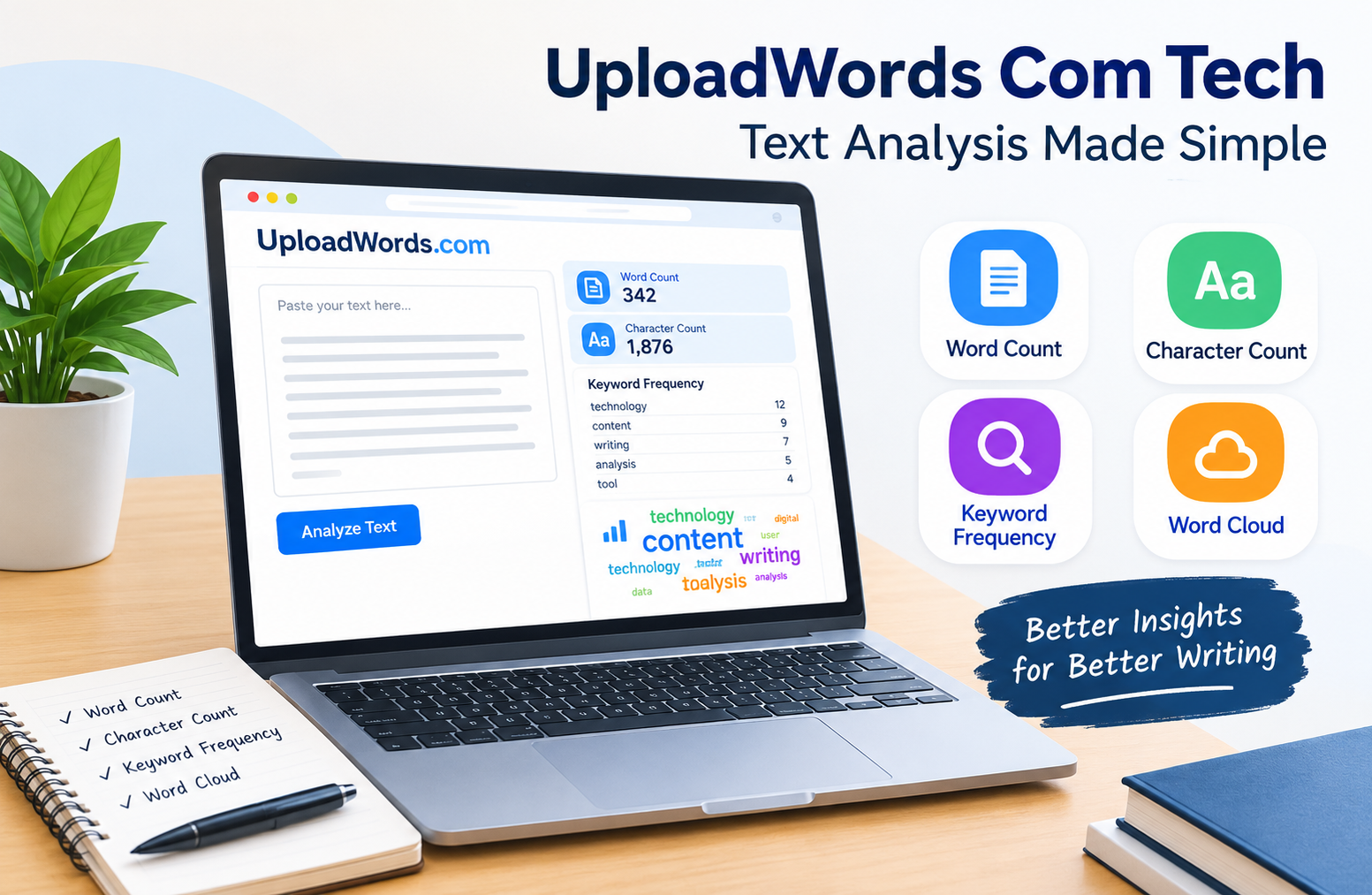
Technology has made writing and content analysis easier, but creating a clear, well-organized document still requires attention to detail. Uploadwords com tech is a search term associated with UploadWords.com, a browser-based text analysis tool designed to help users understand the basic structure of their writing. Its reported features include word counting, character counting, keyword frequency analysis, and word cloud generation. These functions can be useful for students, bloggers, writers, researchers, and digital marketers who want to review text before publishing or submitting it.
Understanding the platform begins with knowing what it does and what it does not do. A text analysis tool can reveal how often certain words appear, how long a document is, and which terms dominate a piece of writing. However, it cannot automatically determine whether an article is accurate, whether an argument is convincing, or whether a webpage will rank well in search engines. Those decisions require context, research, and human judgment.
This guide explains the technology associated with UploadWords.com, its main features, practical applications, benefits, limitations, and important privacy considerations. It also explores how writers can incorporate basic text analysis into a more reliable content creation process.
What Is UploadWords Com Tech?
The phrase uploadwords com tech generally refers to the technology and text analysis functions associated with UploadWords.com. It is not, by itself, the name of a separate software product or a verified technology company.
The platform is described in online reviews as a lightweight text analysis utility. Rather than functioning as a full word processor or cloud storage service, its primary purpose is to help users examine written material and generate simple statistics.
Depending on the features available on the current website, users may be able to enter text, analyze its contents, and review several types of results.
These may include:
- Word count: The total number of words in a document.
- Character count: The number of characters in the submitted text, depending on the counting method.
- Keyword frequency: A list of words that appear repeatedly in the text.
- Word cloud: A visual representation of frequently occurring terms.
- Text filtering: Options that may exclude common words or apply a minimum word length when analyzing text.
These functions address a common problem in writing. People often understand what they want to communicate but have difficulty spotting repetition, measuring document length, or identifying patterns across a long passage.
A basic analysis tool can make these patterns easier to see without requiring a complex application.
It is important to distinguish reported features from independently verified capabilities. Website interfaces can change, and third-party reviews may describe different versions of a service. Users should confirm current functionality on the official website before relying on a specific feature.
How Does UploadWords Technology Work?
The general process behind a text analysis utility is straightforward. The software receives a text input, processes its words and characters, calculates relevant statistics, and presents the results in an understandable format.
For example, imagine that a blogger has written a 1,500-word article about home office productivity. The draft contains repeated references to remote work, productivity, office equipment, and time management.
Instead of manually counting every occurrence, the blogger can use a text analysis tool to identify recurring terms and review the document’s overall length.
The basic workflow involves several stages.
1. Entering the Text
The first stage involves providing the material that needs to be analyzed. Depending on the current interface, this may involve pasting text into an input field or using a supported file upload option.
The distinction matters because not every text analysis website supports every file format. A service that accepts plain text should not automatically be assumed to support Microsoft Word documents, PDFs, or large files.
Before preparing a document, check the available input options and any stated file size limits.
2. Processing the Content
Once the text has been submitted, the tool examines its contents according to its programmed rules.
A word counter might separate text into tokens using spaces and punctuation. A character counter measures individual characters according to its own implementation. A keyword analyzer counts repeated terms, while a word cloud converts frequency information into a visual arrangement.
The precise implementation can differ between tools.
For instance, a hyphenated expression, an apostrophe, a number, or a web address may be counted differently by two separate word counters. This explains why different applications can produce slightly different totals for the same document.
3. Displaying the Results
The tool then presents the calculated information in a readable format.
A user might see the total number of words, a character count, a list of frequent terms, or a visual word cloud. The usefulness of these results depends on the task.
A student may primarily need the word count. A blogger may care more about repeated phrases. A researcher may use a word cloud to explore themes in a collection of notes.
4. Reviewing and Improving the Text
The final stage requires human judgment.
Suppose the analysis shows that the word “important” appears 24 times in an article. That result does not automatically mean the article is poorly written. The word may be necessary in some contexts.
However, the count gives the writer a reason to review those occurrences. Some may be replaced with more precise language, while others may remain because they communicate the intended meaning.
This is the central principle of useful text analysis: measurements help identify potential problems, but writers must decide what changes actually improve the document.
Main Features of UploadWords Com Tech
The value of a text analysis platform depends on the practical problems it helps users solve. A simple interface can be useful when it provides clear results without forcing people to learn complicated software.
The following features are associated with UploadWords.com in available third-party descriptions. Their current availability should be checked directly on the website.
Word Count for Documents and Articles
Word counting is one of the most useful functions for anyone who regularly works with written content.
Students may have minimum and maximum word limits for assignments. Bloggers may plan articles around a particular scope. Editors may need to shorten a report, while business professionals may need to prepare concise summaries.
A word counter provides an immediate measurement of document length.
Consider a student who must submit an essay between 1,000 and 1,200 words. A quick count can show whether the draft falls within the required range. The student can then focus on improving the argument rather than counting words manually.
The same principle applies to online publishing. If a writer plans a detailed tutorial, the word count can help reveal whether the draft covers the subject at the intended level of depth.
However, a longer article is not necessarily a better article. The goal should be to cover the subject thoroughly without adding unnecessary paragraphs merely to increase the total.
Character Counting
Character counting serves a different purpose from word counting.
A character count measures the length of text, including letters, numbers, spaces, and punctuation according to the tool’s counting rules. Some applications report characters with spaces and characters without spaces separately.
This information can help users prepare:
- Social media posts with character limits.
- Short product descriptions.
- Form submissions with maximum text lengths.
- Website headings and introductory snippets.
- Email subject lines.
- Brief summaries and announcements.
For example, a business writing a short product description may need to fit within a platform’s maximum character allowance. A character counter helps the writer make adjustments before submitting the text.
One important limitation is that different systems may count characters differently. Unicode symbols, emojis, and certain accented characters can produce unexpected results. When text must meet a strict technical limit, the destination platform’s own counter should be treated as the final authority.
Keyword Frequency Analysis
Keyword frequency analysis identifies words that appear repeatedly in a piece of writing.
This feature can be especially helpful for bloggers, editors, and content marketers. It provides a quick way to notice repeated vocabulary and determine whether a draft consistently addresses its intended subject.
For instance, an article about sustainable gardening might repeatedly use terms such as soil health, composting, native plants, and water conservation.
A frequency list can help the writer determine which ideas dominate the text. It may also reveal that a particular word appears much more often than expected.
However, keyword frequency should not be confused with keyword research.
Keyword research investigates what people search for, how search demand varies, and how competing pages address a topic. Text frequency analysis examines the contents of a document that already exists.
A tool that counts words cannot, by counting alone, establish search volume, search intent, competition, or ranking potential.
For SEO professionals, this distinction is essential. Frequency analysis is useful as an editing aid, but it is not a substitute for understanding the audience or researching a topic.
Word Cloud Generation
A word cloud displays terms from a text in a visual arrangement. In many word clouds, frequently occurring words appear larger than less common words.
This format can make recurring themes easier to recognize at a glance.
For example, a teacher reviewing several short student responses about climate change might use a word cloud to identify frequently mentioned concepts. A content manager could use one to explore recurring themes in meeting notes.
A word cloud may be useful for:
- Initial exploration of research notes.
- Classroom activities and presentations.
- Brainstorming sessions.
- Reviewing customer feedback.
- Summarizing recurring terms in reports.
- Identifying possible themes in a text collection.
Yet a word cloud does not show the full meaning of a document. Common words may dominate the display, while an important but infrequent term may appear small.
Context is also missing. A word cloud cannot reliably distinguish between a positive statement and a negative statement simply because both contain the same term.
For these reasons, a word cloud should be treated as an exploratory aid rather than a complete summary or analytical conclusion.
Simple Browser-Based Access
Browser-based tools are convenient because users can often access them without installing desktop software.
This approach can reduce setup time and make basic text analysis accessible to people who use different operating systems or devices.
A student using a school computer, a writer working on a laptop, and a marketer using a desktop browser may all benefit from a tool that does not require a complicated installation process.
However, browser access alone does not guarantee compatibility with every device or browser. It also does not establish that all processing occurs locally on the user’s device.
Users should check the current interface, privacy policy, and technical documentation before making assumptions about compatibility or data handling.
Who Can Benefit From UploadWords Com Tech?
The practical value of this type of technology depends on the user’s goals. It is most useful when someone needs quick, basic information about existing text.
Students and Academic Writers
Students frequently work with essays, assignments, reports, and research summaries that have length requirements.
A text analysis tool can help students check whether a document meets a word limit and identify repeated terminology. It can also provide an initial overview of recurring themes in notes.
For example, a student writing an essay about renewable energy might discover that the introduction repeats several ideas that are explained more clearly in later sections.
That observation creates an opportunity to remove unnecessary repetition and improve the structure.
Students should still follow their institution’s academic integrity policies. A word counter does not verify originality, validate citations, or determine whether a submission meets academic standards.
Bloggers and Website Owners
Bloggers need to balance completeness with readability. A detailed article should answer the reader’s questions, but it should not repeat the same points simply to appear comprehensive.
Text analysis can support the editing process by revealing article length and repeated terms.
A website owner preparing a tutorial, comparison, or informational guide can use those results to identify passages that may need revision.
For example, a writer may notice that every section begins with the same phrase. Although the content may be factually sound, the repeated structure can make the article feel mechanical.
A quick review of frequent words can help identify such patterns.
For bloggers, the most effective approach is to use text statistics alongside fact-checking, editorial review, and a clear understanding of the reader’s needs.
SEO Specialists and Content Marketers
Search engine optimization involves more than inserting keywords into an article.
An effective page should satisfy the searcher’s intent, answer relevant questions, use accurate information, and provide a useful reading experience.
Text analysis can support a content review by highlighting repeated terms and helping editors inspect whether a draft remains focused on its subject.
For example, a marketer writing a guide to email marketing may want to examine how often the draft refers to automation, segmentation, deliverability, and campaign performance.
These counts can reveal the vocabulary used in the draft, but they cannot establish whether the article adequately covers the topic.
A page could repeat its target keyword dozens of times and still fail to answer the reader’s question.
A stronger SEO workflow combines text analysis with audience research, competitor analysis, reliable sources, internal links, technical SEO, and substantive editorial improvements.
Google’s SEO Starter Guide explains the importance of creating useful content and making websites understandable to both people and search engines.
Freelance Writers and Editors
Freelance writers often prepare content for clients with different editorial standards.
One client may request a short product description, while another may need a detailed report or a long-form article. A text analysis utility can help writers check length and inspect recurring vocabulary before delivery.
Editors may also use keyword frequency information to identify overused phrases.
Consider an article in which the phrase “in today’s digital world” appears in several sections. A frequency review can prompt the writer to remove repetitive introductions and replace them with more specific explanations.
This type of editing improves the reading experience without requiring a major rewrite.
However, client requirements should always take priority over generic metrics. A word count is a constraint, not a measure of editorial quality.
Researchers and Analysts
Researchers sometimes work with interview notes, survey responses, transcripts, and large collections of written observations.
Frequency analysis and word clouds can provide an initial overview of recurring terms. These results may help researchers decide which parts of a dataset deserve closer examination.
For instance, a researcher studying customer feedback about a mobile application may notice frequent references to loading speed, navigation, and login problems.
Those patterns can help guide further investigation.
Nevertheless, simple frequency counts are not equivalent to rigorous qualitative research. A frequently mentioned issue may not be the most serious issue, and different words can describe the same underlying problem.
Researchers should preserve context, use appropriate analytical methods, and avoid drawing conclusions from word frequency alone.
Small Businesses and Professionals
Small businesses regularly prepare proposals, reports, service descriptions, internal documents, and marketing messages.
A basic text analysis tool can help teams check document length and identify recurring terminology before sharing a document with customers or colleagues.
A consultant preparing a short project summary, for example, may use a word counter to keep the document within a requested limit.
A business owner reviewing a service page might use keyword frequency information to notice repeated claims that could be expressed more clearly.
These applications do not require advanced technical knowledge. They require a clear objective and a willingness to review the results critically.
How to Use UploadWords Com Tech Effectively
The best results come from using a text analysis tool as part of a defined workflow rather than treating it as an automatic editor.
Although the exact interface may change, the following process applies to most basic text analysis utilities.
Step 1: Define Your Objective
Before entering any text, decide what you want to learn.
Your objective might be to:
- Check the length of an article.
- Meet an assignment’s word limit.
- Identify repetitive vocabulary.
- Examine recurring themes in notes.
- Prepare a short description for publication.
A clear objective helps you focus on the measurements that matter.
If you only need a word count, there is little reason to spend time interpreting a word cloud. If you are exploring themes in a long report, a frequency list may be more useful than a simple character total.
Step 2: Prepare the Text
Review the document before analyzing it.
Remove content that should not be included in the measurement, such as unrelated notes, duplicate passages, or temporary editing instructions.
For an article, decide whether the title, headings, captions, references, and frequently asked questions should be part of the count.
This matters because different publishing requirements define word limits differently.
If a university assignment excludes references, for example, counting the reference list may produce a misleading total.
Step 3: Enter or Upload the Content
Open the intended website and check which input methods are currently available.
If text can be pasted directly, copy the relevant passage into the input area. If a file upload option is available, confirm its accepted formats and size limits before using it.
Do not assume that every version of the service supports direct file uploads.
It is also wise to avoid entering passwords, confidential client information, unpublished sensitive research, or private records into an unfamiliar online tool.
Step 4: Run the Analysis
Use the available analysis control to generate the results.
Review the word count, character count, frequency list, or other displayed measurements according to your original objective.
At this stage, avoid making immediate changes based on one number. A result should be interpreted in relation to the document’s purpose.
For example, a long report may need a high word count because it covers several complex issues. A short product description may need to be concise because readers are comparing multiple products.
Step 5: Identify Patterns
Look for patterns that could indicate an editing opportunity.
These may include:
- Repeated words that add little meaning.
- Sections that discuss the same point more than once.
- A document that exceeds its required length.
- Frequent terms that seem unrelated to the intended subject.
- Important concepts that appear only briefly.
A frequency list can help you locate possible issues, but it cannot explain why they occur.
Read the surrounding sentences before deciding whether a term should be removed or replaced.
Step 6: Make Meaningful Revisions
Edit the text to improve clarity, precision, and organization.
Replace vague expressions with specific language where appropriate. Remove duplicated ideas. Shorten unnecessarily complicated sentences. Add missing explanations when a topic needs more context.
Do not change every repeated word simply because it appears frequently. Repetition is sometimes necessary for clarity, especially when discussing a technical subject or using a consistent term of art.
The goal is not to minimize every repeated word. It is to make the writing easier to understand.
Step 7: Check the Revised Version
After editing, run the analysis again if the measurements are relevant.
Compare the revised word count with the required range. Review whether excessive repetition has decreased and whether the document still covers its important points.
Then perform a separate editorial review for grammar, factual accuracy, citations, tone, and logical structure.
A text analyzer should support this final review, not replace it.
UploadWords Com Tech and Search Engine Optimization
One reason people investigate text analysis tools is their potential role in improving website content.
However, the relationship between keyword frequency and search performance is often misunderstood.
Keyword Frequency Is Not the Same as Keyword Strategy
Keyword frequency tells you how often a word or phrase appears in a particular text.
Keyword strategy begins with a different question: what information does the intended audience want, and how should the page satisfy that need?
Suppose a website publishes an article about choosing a laptop for university. Repeating the phrase “best student laptop” throughout every paragraph will not automatically make the page more useful.
Readers may need information about battery life, weight, software compatibility, durability, repair options, and price.
An article that answers these questions clearly may be more valuable than one that focuses primarily on repeating a target phrase.
Frequency analysis can reveal repetition, but it cannot establish whether the writer has understood the audience.
Avoid Keyword Stuffing
Keyword stuffing occurs when words or phrases are repeated excessively in an attempt to manipulate search rankings.
This can make a page difficult to read and reduce the amount of useful information it provides.
A text analysis tool can help identify unusually frequent terms, allowing an editor to review whether those repetitions are justified.
For example, if the main keyword appears repeatedly in the introduction, every heading, and several consecutive sentences, the writer should consider whether the language sounds natural.
There is no universal frequency threshold that guarantees a page is properly optimized. The right approach depends on context, clarity, and the subject being discussed.
Use Related Terms Naturally
Well-written content often includes related concepts because they help explain the topic.
An article about online privacy may discuss data collection, account security, encryption, permissions, and information retention. These terms contribute meaning when they are relevant to the reader’s questions.
Writers should introduce related concepts because they improve understanding, not because they want to meet an arbitrary keyword quota.
A frequency report can help identify the vocabulary already present in a draft. Additional research and editorial judgment are needed to determine what information is missing.
Review the Whole Page, Not Just the Text Statistics
A useful SEO review considers several elements together.
These include the title, introduction, headings, accuracy, page structure, links, readability, and whether the content provides a satisfying answer to the search query.
A technically well-organized article can still be unhelpful if it contains unsupported claims or repeats information without adding value.
Likewise, a document with a modest word count may fully answer a straightforward question.
The most important objective is to help the reader accomplish what they came to do. Text statistics are supporting measurements, not the final definition of quality.
Benefits of Using UploadWords Com Tech
A lightweight text analysis tool can provide several practical advantages when its capabilities match the task.
Saves Time During Editing
Manual word counting and repeated-term checking can become tedious when working with long documents.
Automated analysis can produce these measurements quickly, leaving more time for substantive editing, research, and fact-checking.
This is particularly useful for writers who regularly prepare articles, reports, or assignments.
Makes Text Patterns Easier to Notice
Writers can become so familiar with their own drafts that they stop noticing repeated expressions.
A keyword frequency list provides another perspective. It can reveal patterns that may be difficult to recognize during ordinary reading.
This does not mean every repeated expression should be removed. Instead, the results help writers decide where closer review is worthwhile.
Supports Consistent Workflows
A repeatable analysis process can help teams apply the same basic checks to different documents.
For example, an editorial team may check article length, inspect frequently used terms, and then complete a human review before publication.
The tool does not establish editorial standards by itself. Those standards must be defined by the people responsible for the content.
Reduces the Need for Complex Software
For simple tasks, users may not need a full writing suite or advanced analytics platform.
A browser-based utility can provide a convenient starting point for checking existing text.
However, specialized software remains useful when a project requires advanced grammar analysis, document collaboration, plagiarism checking, or detailed SEO research.
Helps Beginners Understand Their Writing
People who are learning to write can use basic statistics to develop better editing habits.
A word count makes document length concrete. A frequency list illustrates repetition. A word cloud provides an accessible introduction to how text can be examined through data.
These tools can encourage more careful revision, provided users understand that numerical results do not measure the overall quality of their writing.
Limitations and Challenges to Consider
Although UploadWords.com is associated with straightforward text analysis, users should understand the limitations of this category of tool before relying on it.
Limited Depth of Analysis
A basic text analyzer measures selected characteristics of writing. It does not necessarily evaluate grammar, argument quality, factual accuracy, or the strength of the evidence.
A document can have an ideal word count and a balanced keyword distribution while still containing misleading claims or confusing explanations.
More advanced tasks require appropriate specialist tools and human review.
Differences Between Word Counters
Word-counting methods are not always identical.
Consider a document containing hyphenated terms, abbreviations, numbers, URLs, and contractions. Different applications may interpret these elements differently.
This can create discrepancies between the totals produced by separate tools.
When a strict limit applies, use the counting method specified by the institution, publisher, or destination platform whenever possible.
Privacy and Confidentiality
Text analysis sometimes involves submitting material to an online service. Before entering information, users should understand how the website handles their content.
A website’s use of HTTPS helps protect information while it travels between a browser and a server, but HTTPS alone does not prove that submitted content is never stored, accessed, or processed elsewhere.
Similarly, the absence of a registration requirement does not guarantee complete anonymity.
Before using any unfamiliar tool, review its privacy policy and look for information about:
- Whether text is processed locally or sent to a server.
- Whether submitted content is retained.
- Whether analytics or technical information is collected.
- Whether the service shares information with third parties.
- Whether users can request deletion of stored data.
Do not submit confidential business documents, private personal records, passwords, or sensitive research unless the service’s data handling has been adequately verified and its use is permitted.
Accessibility and Compatibility
Browser-based tools can be convenient, but performance may vary with the device, browser, internet connection, and document size.
Some interfaces may also be less accessible to people using screen readers or keyboard navigation.
Users who depend on accessibility features should test whether the controls, result panels, and visual outputs work with their preferred setup.
A word cloud, for example, may communicate information visually but may not provide the same experience to someone who cannot easily perceive differences in text size.
Uncertainty About Current Features
Third-party articles can describe different versions of a website or repeat claims that have not been independently confirmed.
This is particularly relevant when an article discusses file upload support, local processing, export options, pricing, or account requirements.
The safest approach is to verify these details on the current official website rather than relying exclusively on descriptions published elsewhere.
UploadWords Com Tech Compared With Other Writing Tools
Different tools solve different problems. Choosing the right one depends on whether the user needs basic counting, language improvement, keyword research, or document management.
| Tool category | Main purpose | Best use |
| Basic text analyzer | Counts words and characters and identifies frequent terms | Quick document checks |
| Word processor | Creates, formats, and edits documents | Writing and document production |
| Grammar checker | Identifies possible language errors | Proofreading and language improvement |
| SEO research platform | Examines search demand and keyword opportunities | Content planning and SEO strategy |
| Plagiarism checker | Compares submitted text against available sources | Similarity and originality checks |
| Research analysis software | Supports structured analysis of qualitative or quantitative data | Formal research projects |
These categories can overlap, but they should not be treated as interchangeable.
For example, a basic text analyzer may reveal that a phrase occurs frequently. A grammar checker may identify an awkward sentence containing that phrase. An SEO platform may help a marketer investigate whether the topic matches audience demand.
Each tool answers a different question.
The most efficient workflow uses the simplest suitable tool for each task rather than expecting one application to solve every writing problem.
Practical Tips for Getting Better Results
A few simple habits can make text analysis more useful and reduce the risk of misinterpreting its output.
Start with a clear question. Decide whether you need to check length, examine repetition, or explore themes. This prevents you from spending time on irrelevant statistics.
Analyze the correct text. Make sure the input contains the material you actually intend to measure. Unrelated notes, duplicated sections, and references can distort the results.
Interpret numbers in context. A high frequency count may indicate repetition, but it may also reflect the natural vocabulary of a specialized subject.
Avoid arbitrary keyword targets. Do not force a document to meet a fixed keyword percentage without a meaningful editorial reason.
Verify important claims independently. A text analyzer does not establish whether a statistic, quotation, or factual statement is correct.
Protect sensitive information. Review the service’s privacy terms and avoid submitting confidential material to an unfamiliar platform.
Check the final document in its intended destination. Word limits, character counts, and formatting may behave differently in the publishing system where the text will eventually appear.
Keep human judgment central. The best revision is the one that improves accuracy, clarity, usefulness, and readability, not necessarily the one that produces the smallest number of repeated words.
Frequently Asked Questions
1. What is UploadWords Com Tech?
Uploadwords com tech is a search phrase associated with UploadWords.com and its reported text analysis features. These include word counting, character counting, keyword frequency analysis, and word cloud generation. The phrase does not establish that the website is a separate technology company or a comprehensive file storage service.
2. Is UploadWords.com free to use?
Third-party descriptions report that the core text analysis features are available without payment or account registration. However, current access conditions and available features should be confirmed on the official website because online services can change.
3. Does UploadWords.com help with SEO?
It may support basic content review by showing document length and frequently used words. It does not replace keyword research, search intent analysis, competitor research, technical SEO, or editorial judgment. Word frequency alone cannot predict search rankings.
4. Is UploadWords.com safe for private documents?
Safety cannot be established solely from a website’s name, browser-based interface, or HTTPS connection. Review the current privacy policy and data handling practices before submitting content. Avoid uploading sensitive or confidential information unless its handling has been verified and authorized.
5. Can UploadWords.com check grammar or plagiarism?
Word counting and keyword frequency analysis do not automatically provide grammar correction or plagiarism detection. Unless those features are explicitly available and documented on the current website, users should choose dedicated tools for those tasks.
6. Is UploadWords.com a cloud storage or file-sharing service?
The available descriptions primarily associate the website with text analysis rather than a traditional cloud storage or file-sharing platform. Users should not assume that it stores, transfers, or manages files like a dedicated cloud service simply because its name contains the word “upload.”
Conclusion
Uploadwords com tech is best understood as a search term associated with a straightforward approach to text analysis. UploadWords.com is described in third-party sources as a browser-based utility for examining word counts, character counts, frequently used terms, and word clouds.
These functions can help students check assignment lengths, bloggers review drafts, marketers inspect repeated vocabulary, and researchers explore patterns in written material. Their main advantage is convenience: basic measurements can be generated quickly without requiring users to perform every calculation manually.
However, the usefulness of the results depends on how they are interpreted. Word frequency does not measure factual accuracy, writing quality, originality, or SEO performance. A word cloud can reveal recurring terms without explaining their meaning, while a word count can measure document length without showing whether the document adequately answers its intended question.
Privacy also deserves attention. Users should verify the website’s current features and data handling practices before submitting sensitive material, and they should avoid assuming that a browser-based tool automatically guarantees confidentiality.
Ultimately, a text analysis utility works best as one part of a broader writing and editing process. Combine its measurements with careful proofreading, reliable research, thoughtful organization, and an understanding of the intended audience. This balanced approach makes basic technology more useful while keeping accuracy and human judgment at the center of the work.






One Comment