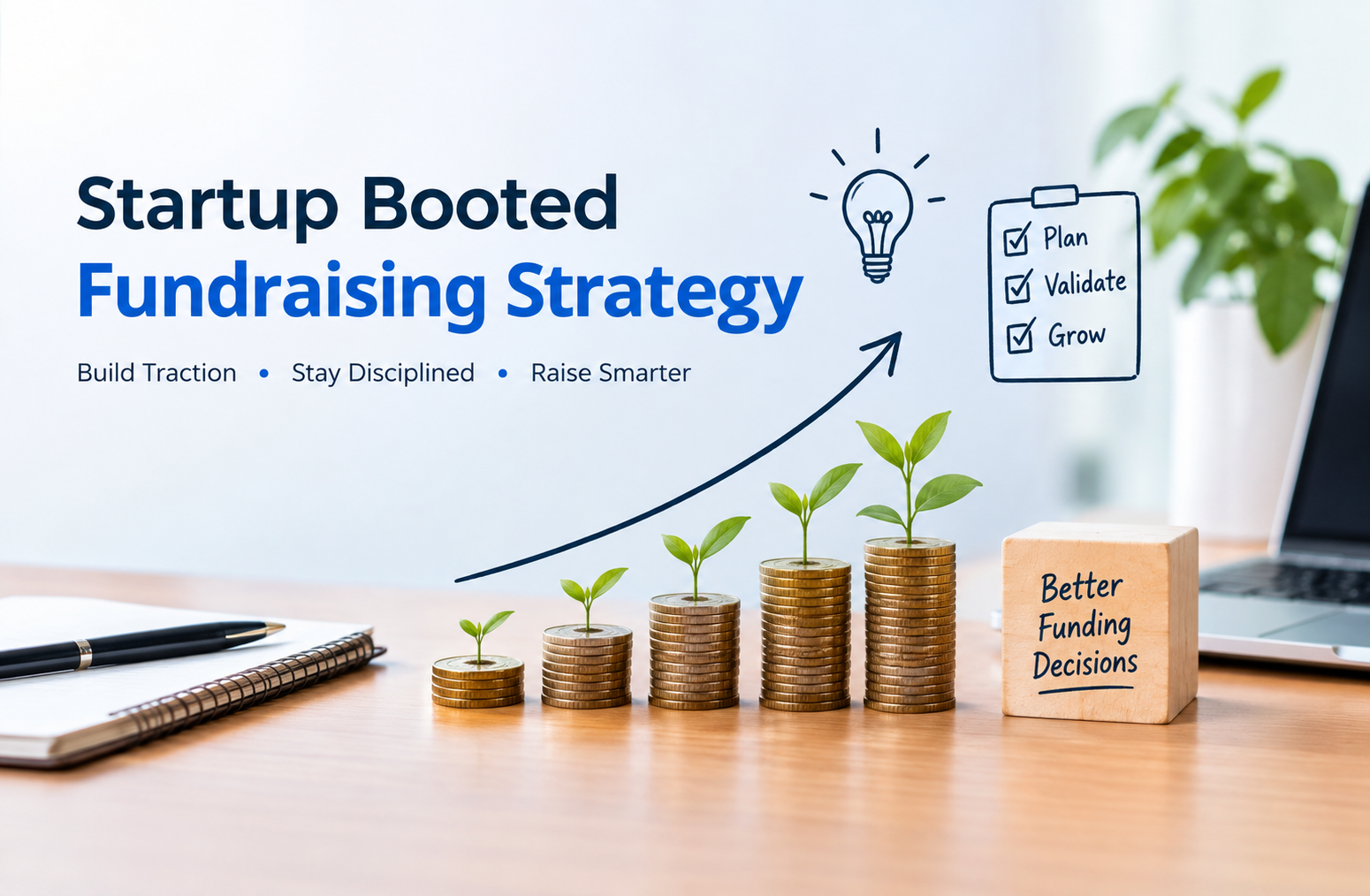
Startup Booted Fundraising Strategy: A Practical Guide
A startup booted fundraising strategy is a practical approach for founders who want to raise capital without allowing fundraising to become the main engine of the business. The goal is not simply to collect investor money. It is to build enough traction, financial discipline, customer evidence, and fundraising readiness that outside capital becomes a strategic tool rather than a survival requirement.
For many early-stage companies, this distinction matters. A startup can spend months preparing pitch decks, attending meetings, rewriting financial projections, and chasing investors while customer development slows down. A better approach is to build the company first, understand exactly what capital is needed, and then approach fundraising with evidence.
This guide explains how to build that approach from the ground up, including when to raise, how much to seek, what investors usually examine, how to create a fundraising process, which mistakes can weaken a round, and how founders can remain financially disciplined while pursuing growth.
What Is a Startup Booted Fundraising Strategy?
The phrase startup booted fundraising strategy can be understood as a fundraising model built around disciplined company building.
Instead of starting with the question, “How much money can we raise?” the founder starts with:
- What problem are we solving?
- Who is paying for the solution?
- What evidence proves the problem is real?
- What can we accomplish with existing resources?
- What specific milestone would outside capital help us reach?
- How much capital is required to reach that milestone?
- What type of funding is appropriate for the company at its current stage?
This changes fundraising from a vague search for money into a structured business process.
Bootstrapping and fundraising are not necessarily opposites. A company can operate with founder capital, customer revenue, and careful cost control while simultaneously preparing for an equity round.
The important principle is sequencing.
A founder should avoid raising capital simply because fundraising feels like a normal milestone for startups. Capital should have a job.
For example, $1 million invested into a company with unclear customer demand can create a larger company with the same underlying problem. The same amount invested after strong product validation, repeatable customer acquisition, and clear operational bottlenecks can potentially accelerate something that is already working.
That difference is central to disciplined fundraising.
Why a Bootstrapped Approach Can Strengthen Fundraising
Bootstrapping forces founders to pay attention to the fundamentals that investors eventually examine anyway.
When external capital is limited, founders often become more careful about:
- Customer acquisition costs
- Pricing
- Gross margins
- Cash flow
- Product development
- Customer retention
- Sales efficiency
- Hiring
- Operating expenses
- Revenue quality
This does not mean that every startup should remain bootstrapped for as long as possible.
Some businesses require significant capital early. Hardware, biotechnology, infrastructure, deep technology, regulated products, and other capital-intensive models can have very different financing requirements from a software company that can reach customers with a small team.
The useful lesson is not “never raise.”
It is “know why you are raising.”
A strong fundraising plan connects capital to measurable progress.
For example:
We need $750,000 to expand from 20 paying customers to 100, hire two engineers, improve onboarding, and establish a repeatable sales process.
That is more useful than:
We need $750,000 to grow the company.
The first statement gives investors something they can evaluate. The second provides almost no operational information.
The Difference Between Bootstrapping and Being Underfunded
One of the most important distinctions founders should understand is that disciplined capital management is not the same as starving the company.
Bootstrapping can become counterproductive when founders refuse to spend money even when spending would clearly increase revenue or reduce a serious operational constraint.
For example, imagine a company has:
- Strong demand
- High customer retention
- Positive contribution margins
- A reliable sales process
- A product backlog that is delaying contracts
If one additional engineer could unlock significant revenue, refusing to hire that person simply to maintain a “bootstrapped” identity may not be financially disciplined.
The better question is:
What is the highest-return use of the next dollar?
Sometimes the answer is spending less.
Sometimes it is hiring.
Sometimes it is marketing.
Sometimes it is product development.
Sometimes it is raising external capital.
Good fundraising strategy begins with understanding that difference.
Startup Booted Fundraising Strategy: Start With Milestones
One of the strongest ways to organize fundraising is to work backward from milestones.
Instead of setting a random fundraising target, identify the next major proof point.
Common milestones include:
Product validation
You may need enough customers to demonstrate that people will pay for the product.
Revenue validation
You may need to demonstrate that revenue is growing and that the revenue is not based entirely on one unusual transaction.
Customer retention
A startup with recurring customers may need to demonstrate that customers continue using and paying for the product.
Distribution validation
A product can be excellent and still struggle because customer acquisition is too expensive.
Investors therefore may want evidence that there is a repeatable path to customers.
Operational scaling
The business may have demand but lack the team or infrastructure required to serve it.
Market expansion
A startup with a proven model may raise capital to enter additional geographic markets or customer segments.
The milestone should determine the capital requirement.
This creates a much cleaner relationship between fundraising and business strategy.
How Much Should a Startup Raise?
There is no universal fundraising amount that works for every startup.
The amount should depend on the company’s stage, business model, operating costs, expected milestone, and financing environment.
A practical framework is:
Required capital = operating requirement + growth investment + contingency
Operating requirements include the expenses necessary to keep the business running.
Growth investment includes spending intended to increase future revenue or strengthen the company’s position.
Contingency provides protection against delays and unexpected expenses.
The mistake is to treat contingency as permission to spend unnecessarily.
A startup should know what happens if a major milestone takes six months instead of three.
That scenario matters because fundraising rarely happens exactly according to the original plan.
Build a Cash Runway Model
Cash runway tells founders how long the company can operate before its cash runs out.
A simple calculation is:
Runway = Available cash ÷ Monthly net cash burn
For example, if a company has $300,000 available and spends $30,000 more each month than it receives, its simple runway is approximately 10 months.
However, this calculation is only a starting point.
A more realistic model should include:
- Expected revenue changes
- Hiring dates
- Payroll increases
- Marketing expenses
- Software costs
- Taxes
- Professional services
- One-time expenses
- Equipment
- Debt payments
- Fundraising costs
- Delayed customer payments
Founders should also model different scenarios.
Conservative scenario
Revenue grows slowly and expenses increase.
Base scenario
The company performs approximately as expected.
Upside scenario
Revenue grows faster than expected and some planned expenses can be delayed.
The purpose of these scenarios is not to predict the future perfectly.
It is to prevent the founder from making decisions based on one optimistic spreadsheet.
When Should You Start Fundraising?
Fundraising should usually begin before the company reaches a crisis.
Waiting until the bank account is nearly empty creates unnecessary pressure.
Investors can sense urgency, and desperate fundraising can reduce negotiating flexibility.
A better approach is to begin preparation well before the desired closing date.
Preparation can include:
- Updating financial statements
- Organizing customer data
- Preparing a data room
- Clarifying the investment thesis
- Identifying relevant investors
- Creating a fundraising narrative
- Reviewing the cap table
- Documenting major business metrics
- Preparing answers to common investor questions
This preparation allows the founder to spend fundraising time speaking with investors instead of searching for basic company information.
What Investors Actually Need to Understand
A pitch deck is not merely a presentation.
It is a compressed explanation of why the business exists, why it can work, what evidence exists today, and why additional capital could create meaningful progress.
A useful investor narrative generally explains:
The problem
What painful or expensive problem exists?
The customer
Who experiences the problem?
The solution
How does the company solve it?
Evidence
What has happened in the real world?
This may include revenue, customers, usage, retention, contracts, partnerships, or other relevant indicators.
Market
How large and accessible is the opportunity?
Business model
How does the company make money?
Distribution
How does the company acquire customers?
Competition
What alternatives already exist?
Team
Why is this team particularly suited to solving the problem?
Financial requirement
How much capital is being raised and what will it accomplish?
The strongest decks are usually not the ones containing the most information.
They are the ones that make the business understandable.
Traction Is More Than Revenue
Revenue is important, but traction has different forms.
Depending on the business, useful evidence might include:
- Paying customers
- Recurring revenue
- Customer retention
- Usage growth
- Pipeline
- Conversion rates
- Waitlists
- Signed contracts
- Partnerships
- Product engagement
- Gross margin improvement
- Reduced acquisition costs
- Successful pilots
A pre-revenue startup should not pretend that revenue exists.
Instead, it should demonstrate the strongest available evidence.
For example, if customers are repeatedly requesting the product, several companies have agreed to pilot it, and early users are highly engaged, those signals can help explain why the company deserves further attention.
The key is honesty.
A small but genuine metric is more credible than an inflated metric with unclear meaning.
The Importance of Customer Revenue
Customer revenue can be particularly powerful because it shows that someone has made an economic decision to purchase.
But founders should examine revenue quality.
Consider two companies.
Company A generates $100,000 from one unusually large customer.
Company B generates $100,000 from 40 customers who repeatedly purchase.
The revenue totals are identical.
The underlying risk is not.
A thoughtful fundraising process therefore examines:
- Customer concentration
- Recurring versus one-time revenue
- Contract duration
- Renewal rates
- Gross margin
- Payment terms
- Customer acquisition cost
- Expansion revenue
The headline number is only the beginning.
Create an Investor Target List
One of the most common fundraising mistakes is contacting investors without understanding their investment criteria.
A useful investor list can be organized around:
- Investment stage
- Typical check size
- Geography
- Industry focus
- Business model
- Founder profile
- Portfolio conflicts
- Follow-on capacity
- Previous investments
This research improves efficiency.
A founder building enterprise cybersecurity software should not spend hours pitching an investor who only invests in consumer marketplaces.
Fundraising is partly a matching exercise.
The objective is to find investors whose mandate overlaps with the company’s current stage and opportunity.
Warm Introductions and Direct Outreach
Warm introductions can be useful, but founders should not assume that every investor requires one.
Direct outreach can work when the message is specific and relevant.
A good investor email should quickly explain:
- What the company does
- Who uses it
- The strongest traction signal
- What is being raised
- Why the investor may be relevant
The message should not become a long company history.
Investors have limited attention.
The first communication should create enough clarity for them to decide whether a conversation is worth having.
Build a Fundraising Pipeline
Fundraising should be managed like a sales pipeline.
Track:
- Investor identified
- Contacted
- Response received
- Introductory meeting
- Follow-up
- Partner or investment committee discussion
- Due diligence
- Term discussion
- Commitment
- Closed
This makes the process measurable.
It also helps founders avoid the common mistake of having 30 investor conversations but no clear understanding of where those conversations stand.
A simple spreadsheet can be enough.
The important part is consistent tracking.
The Fundraising Narrative Should Match the Business
Founders sometimes create an impressive story that does not match the actual company.
That can create problems during diligence.
For example, if a company presents itself as a rapidly scaling enterprise platform but most of its revenue comes from small one-time projects, investors may question the difference.
The narrative should explain reality, not replace it.
A strong narrative might say:
We started with project-based work to understand the problem. We are now converting the most repeatable use cases into a recurring software product.
That creates a logical development story.
It acknowledges where the company is today while explaining where it is going.
Common Fundraising Challenges
Challenge 1: Raising too early
A founder may raise before there is enough evidence to support the valuation or business thesis.
This can result in difficult investor conversations and unfavorable terms.
Challenge 2: Raising too late
Waiting until cash is nearly exhausted can create emergency fundraising conditions.
Challenge 3: Unclear use of funds
Investors may struggle to understand what additional capital actually changes.
Challenge 4: Overly optimistic projections
A spreadsheet showing explosive growth without a credible customer acquisition mechanism can weaken trust.
Challenge 5: Founder distraction
Fundraising can consume significant time.
The business still needs to operate during the process.
Challenge 6: Poor investor fit
A founder can waste weeks speaking with investors who are structurally unlikely to invest.
Challenge 7: Weak financial controls
Messy accounting and unclear cash records can make diligence harder.
These challenges are not purely fundraising problems.
They are business management problems that become visible during fundraising.
How to Prepare for Investor Due Diligence
Before serious investor conversations, founders should organize core documents.
A typical data room may contain:
- Corporate formation documents
- Cap table
- Financial statements
- Bank statements
- Tax documents where relevant
- Material customer contracts
- Employment agreements
- Intellectual property documentation
- Key supplier agreements
- Debt agreements
- Historical fundraising documents
- Major business metrics
The exact requirements vary by investor and jurisdiction.
The underlying principle is simple:
Do not wait until an investor requests a document to discover that the document is missing.
Clean documentation communicates operational maturity.
Understand Your Cap Table
The capitalization table shows who owns what.
Founders should understand:
- Founder ownership
- Employee equity
- Options
- Previous investors
- Convertible securities
- Outstanding commitments
- Potential dilution
A fundraising round changes ownership.
The founder therefore needs to understand both the amount being raised and the percentage of the company that may ultimately be given up.
A simple focus on valuation can be misleading.
Two deals with similar headline valuations can produce very different ownership outcomes depending on the structure.
Valuation Is Only One Part of the Deal
Founders often focus heavily on the valuation.
Other terms can matter as well.
Depending on the financing structure, founders may encounter provisions involving:
- Liquidation preferences
- Board rights
- Voting rights
- Protective provisions
- Anti-dilution mechanisms
- Information rights
- Founder vesting
- Option pools
These terms can have meaningful consequences.
Because investment documents are legal instruments, founders should obtain qualified legal advice before signing them.
Bootstrapping Can Improve Negotiating Position, But Not Automatically
A company with strong revenue and substantial cash reserves may have more flexibility than a company that urgently needs financing.
However, bootstrapping does not guarantee better terms.
Investor negotiations depend on many variables, including:
- Company performance
- Market conditions
- Competitive investor interest
- Capital requirements
- Business risk
- Founder experience
- Growth potential
- Financing structure
The practical advantage of financial discipline is that it can give founders more time to make decisions carefully.
Time is often an underrated fundraising asset.
A Better Way to Think About Dilution
Dilution is not automatically bad.
Giving up ownership can make sense when the capital creates substantially greater enterprise value.
For example, suppose a founder owns 80% of a company worth $2 million.
If raising capital reduces the founder’s ownership percentage but enables the business to build a much larger and more valuable company, the economic outcome may still be favorable.
The reverse can also happen.
Giving away a large ownership stake to fund inefficient spending can destroy value.
Therefore, the relevant question is not simply:
How much ownership am I giving away?
It is:
What measurable business progress does that capital make possible?
Startup Booted Fundraising Strategy and Revenue Discipline
One of the strongest advantages of a capital-conscious company is that every expense has to justify itself.
This does not require extreme cost cutting.
Instead, founders can categorize expenses into three groups:
Essential
Expenses required to operate.
Growth-producing
Expenses with a credible path to generating additional value.
Optional
Expenses that can be delayed without materially affecting the business.
This classification can make difficult decisions easier.
A founder may discover that several expenses are traditional startup habits rather than genuine business requirements.
Examples can include oversized offices, unnecessary software subscriptions, premature hiring, excessive events, and marketing activities that cannot be measured.
Customer-Funded Growth
Customer revenue can sometimes finance growth without immediate equity dilution.
Potential approaches include:
- Pre-orders
- Annual contracts
- Paid pilots
- Implementation fees
- Service revenue supporting product development
- Deposits
- Milestone-based contracts
The suitability of these models depends heavily on the industry.
The objective is not to manipulate customers into financing a startup.
It is to structure legitimate commercial arrangements where customers receive real value while the company improves its cash position.
When Venture Capital Makes Sense
Venture capital is generally designed for companies with the potential and ambition to grow substantially.
That does not mean venture capital is appropriate for every profitable small business.
A founder should consider:
- Expected growth rate
- Market size
- Capital intensity
- Competitive dynamics
- Need for rapid expansion
- Desire for external governance
- Potential exit paths
- Founder ownership goals
Some companies are better suited to remaining privately controlled and growing through revenue.
Others may require substantial external capital to pursue their opportunity.
There is no universal financing model.
Alternatives to Equity Fundraising
Equity is only one financing option.
Depending on the company, alternatives can include:
- Revenue-based financing
- Bank financing
- Business credit
- Grants
- Strategic partnerships
- Customer financing
- Crowdfunding
- Venture debt
- Government programs
- Founder capital
Each option has different costs, risks, eligibility requirements, and repayment or ownership implications.
Debt, for example, does not usually create the same ownership dilution as equity, but it can create repayment obligations.
Founders should evaluate financing based on the economics and risk profile of the company rather than treating one funding source as inherently superior.
How to Make Fundraising More Efficient
A disciplined process can significantly reduce wasted time.
Step 1: Define the funding objective
Write one sentence explaining what the capital will accomplish.
Step 2: Identify the milestone
Choose a measurable outcome that should exist after the funding period.
Step 3: Build the financial model
Calculate expected expenses, revenue, runway, and financing requirements.
Step 4: Prepare the evidence
Collect the metrics that demonstrate progress.
Step 5: Build the investor list
Research investors based on fit.
Step 6: Prepare the narrative
Explain the problem, solution, traction, market, business model, team, and funding requirement.
Step 7: Start conversations systematically
Track every investor interaction.
Step 8: Continue operating the company
Do not allow fundraising to completely replace customer development.
Step 9: Conduct due diligence carefully
Review terms and documents with appropriate professional support.
Step 10: Convert capital into measurable progress
Once the round closes, execute against the milestones that justified the raise.
This final step is frequently overlooked.
Fundraising is not the finish line.
It creates a new obligation to deploy capital responsibly.
Metrics Founders Should Monitor
The right metrics depend on the business model.
For a recurring-revenue software company, relevant metrics may include:
- Monthly recurring revenue
- Annual recurring revenue
- Churn
- Net revenue retention
- Customer acquisition cost
- Customer lifetime value
- Gross margin
- Payback period
- Burn rate
- Runway
For a marketplace, founders may examine:
- Gross merchandise value
- Take rate
- Buyer growth
- Seller growth
- Repeat transactions
- Liquidity
- Contribution margin
For an ecommerce company, useful indicators may include:
- Average order value
- Conversion rate
- Repeat purchase rate
- Gross margin
- Customer acquisition cost
- Return rate
- Contribution margin
The important point is not to copy a fashionable metric list.
Choose measurements that explain how the company creates and retains economic value.
What Makes a Fundraising Strategy Trustworthy?
Trust is built through consistency.
If the pitch deck says one thing, the financial model says another, and the founder explains something different during a meeting, investors may become concerned.
A trustworthy fundraising process has alignment between:
- The pitch
- Financial statements
- Customer data
- Product claims
- Market claims
- Founder statements
- Legal documentation
It also acknowledges uncertainty.
A founder does not need to pretend to know exactly what will happen three years from now.
A stronger approach is to explain the assumptions behind the forecast.
For example:
Our projection assumes that sales representatives reach a certain productivity level within six months and that customer retention remains above a specified threshold.
Now the investor can evaluate the assumption.
That is more useful than presenting a precise forecast as if it were guaranteed.
How to Avoid Fundraising Theater
“Fundraising theater” occurs when founders spend significant effort creating the appearance of progress without improving the underlying business.
Examples can include:
- Constantly redesigning the pitch deck
- Chasing every investor
- Celebrating meetings instead of customer wins
- Inflating pipeline numbers
- Announcing vague partnerships
- Measuring social attention instead of commercial results
- Spending heavily on startup events without a clear purpose
Fundraising activity should support company building.
If a founder spends 80% of their time raising money and 20% operating the company, the process can become self-defeating.
The business needs evidence to make the next fundraising conversation stronger.
How Google’s 2025 Search Changes Affect This Article’s SEO Approach
There is an important factual clarification regarding the SEO requirements around this topic.
Google’s official ranking history shows that June 2025 had a June 2025 core update, beginning June 30, rather than a separately named “June 2025 Helpful Content Update.” Google had already incorporated the former helpful content system into its core ranking systems in March 2024.
Google did release an August 2025 spam update, beginning August 26, 2025, and its rollout completed on September 22, 2025. Google stated that the update applied globally and across languages.
That distinction matters because sustainable SEO should be based on documented search guidance rather than assumed algorithm names.
Google’s spam documentation specifically describes scaled content abuse as producing large amounts of content primarily to manipulate rankings rather than help users. It also explains that such content can be problematic regardless of whether automation or generative AI was used.
For this article, that means the SEO strategy should focus on:
- Genuine usefulness
- Original explanations
- Clear search intent
- Accurate claims
- Natural language
- Relevant structure
- Helpful examples
- Avoidance of repetitive keyword placement
- Transparent limitations
- A coherent topic rather than disconnected keyword sections
The objective is not to write for an algorithm at the expense of the reader.
Why Keyword Stuffing Is the Wrong Strategy
The target phrase should identify the topic.
It should not become the entire article.
Repeating a keyword in every heading makes content feel unnatural and can reduce readability.
A better semantic field includes concepts such as:
- Startup fundraising
- Bootstrapping
- Investor strategy
- Startup capital
- Seed funding
- Venture capital
- Cash runway
- Investor readiness
- Financial planning
- Equity financing
- Customer traction
- Startup growth
- Capital efficiency
These terms help explain the subject without forcing repetitive phrasing.
The article should answer the user’s questions naturally.
Internal Linking Strategy for a Startup Website
Although this article can stand on its own, a broader startup website can create useful topic connections.
Relevant internal pages could include:
- A guide to calculating startup runway
- A seed funding preparation guide
- A startup financial model tutorial
- A guide to preparing an investor pitch deck
- A startup valuation explainer
- A cap table management guide
- A customer acquisition economics guide
Internal links should be placed where they genuinely help the reader understand the next topic.
They should not be inserted simply to increase the number of links on a page.
Recommended Article Schema
For the page itself, structured data can be considered where it accurately represents the page.
An Article schema can describe the article.
However, structured data should not be treated as a shortcut to rankings. Google has continued to simplify which structured data types produce special Search appearances, and some previously supported result features were phased out during 2025.
If FAQ structured data is implemented, it should accurately represent visible questions and answers on the page and follow Google’s current eligibility and documentation requirements.
Schema should describe genuine content.
It should never be used to create claims that are not visible to users.
FAQ
What is a startup fundraising strategy?
A startup fundraising strategy is a structured plan for deciding whether to raise capital, how much to raise, when to raise it, which investors to approach, and what business milestones the funding should support.
Should a startup bootstrap before raising money?
Not always. Bootstrapping can help validate demand and improve financial discipline, but some businesses require substantial capital before meaningful validation is possible. The right approach depends on the company’s model and capital needs.
How much should a startup raise?
A startup should generally raise enough capital to fund its planned operating period and reach specific measurable milestones, while accounting for reasonable uncertainty and unexpected expenses.
What metrics matter during fundraising?
Relevant metrics depend on the business model. Common examples include revenue growth, retention, customer acquisition cost, gross margin, burn rate, runway, customer growth, and recurring revenue.
Is venture capital necessary for startup growth?
No. Startups can grow through customer revenue, founder capital, grants, debt, strategic partnerships, and other financing methods. Venture capital is one financing option rather than a requirement.
What should founders prepare before approaching investors?
Founders should prepare a clear business narrative, financial model, cap table, traction data, key company documents, investor target list, and a specific explanation of how the requested capital will be used.
Conclusion
A strong startup booted fundraising strategy begins with the company rather than the investor.
The founder’s first responsibility is to understand the business deeply enough to know what capital would actually change. That means understanding customers, pricing, margins, acquisition, retention, cash flow, operating costs, and the next meaningful business milestone.
Bootstrapping can provide valuable discipline because it forces founders to think carefully about every dollar. At the same time, refusing external capital simply for the sake of staying bootstrapped can be just as limiting as raising too much money too early.
The better approach is deliberate financing.
Raise when capital has a clear purpose. Build evidence before making ambitious claims. Maintain clean financial records. Understand dilution and deal terms. Research investors before contacting them. Keep operating the business during fundraising. Most importantly, measure whether the capital actually produces the progress that justified raising it.
Fundraising should not become the identity of a startup.
It should be a mechanism for moving the company from one meaningful stage of development to the next.