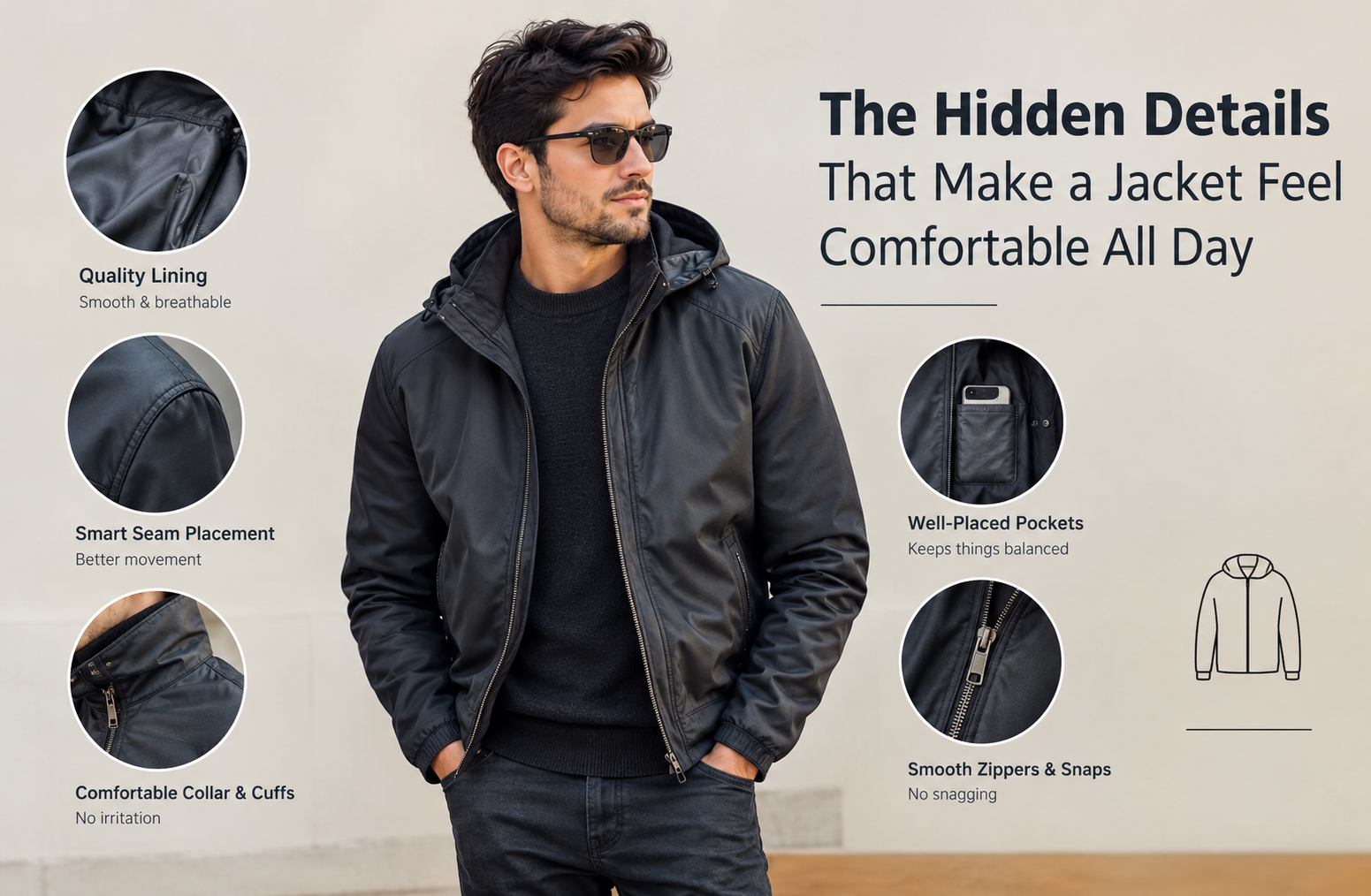
The Hidden Details That Make a Jacket Feel Comfortable All Day
A jacket can look perfect in the mirror and still feel wrong three hours into wearing it. The shoulders start to pull, the collar rubs against your neck, or the lining bunches every time you reach for something. Comfort rarely comes from the obvious features. It comes from small construction choices most shoppers never think to check before buying.
This article looks past size charts and style trends to the details that actually decide how a jacket feels once it’s been on your back all day: the lining, the seams, the way the shoulders move, and the small adjustments that separate a jacket you forget you’re wearing from one you’re constantly fidgeting with. If you’ve ever wondered why one jacket feels effortless and another feels like a chore by lunchtime, the answer is almost always in these details.
Why Comfort Is Easy to Miss in a Store
Trying on a jacket for thirty seconds in front of a mirror tells you very little about how it will feel over a full day. Standing still hides problems that only show up when you’re walking, sitting, reaching overhead, or turning to look over your shoulder. A jacket that feels fine standing at a rack can pull tight across the back the moment you bend to pick something up.
This is why so many people end up with jackets they technically like but rarely wear. The fit looked right, but the day-to-day experience of wearing it never quite matched the store experience. Understanding what to check before buying prevents that mismatch.
The Lining Does More Work Than People Realize
The lining is one of the most overlooked parts of any jacket, yet it has an outsized effect on comfort.
- Smooth, breathable linings reduce friction against shirts and sweaters, so the jacket doesn’t cling or ride up when you move.
- Quilted linings add warmth without adding bulk, which matters if you’re wearing the jacket over multiple layers.
- Poor-quality linings tend to bunch near the shoulders and sleeves after repeated wear, creating pressure points that get more noticeable the longer the jacket is on.
A jacket with a rough or cheap lining can feel fine for the first hour and increasingly irritating after that, especially around the shoulders and underarms where movement is constant.
Seam Placement Changes How a Jacket Moves With You
Seams aren’t just structural. Where they sit, and how they’re finished, directly affects comfort.
Shoulder seams should sit exactly at the edge of your shoulder, not further out or in. A seam placed even slightly wrong restricts arm movement and creates a pulling sensation every time you lift your arms.
Underarm seams need enough room to allow a full range of motion. Tight underarm construction is one of the most common reasons a jacket feels restrictive during normal activity like driving or carrying a bag.
Flat-felled or bound seams lie smoother against the body than raw or overlocked seams, which matters most in areas that rub against skin or clothing throughout the day, like the underarms and lower back.
Weight Distribution Matters More Than Total Weight
Two jackets can weigh the same and feel completely different. What matters is how that weight is distributed.
A jacket that concentrates weight across the shoulders will feel heavier over time than one that distributes it evenly through the body and sleeves. This is particularly noticeable with leather, where uneven hide thickness can make one side of a jacket feel heavier than the other if the pattern wasn’t cut carefully.
Well-constructed leather jackets account for this by matching panel thickness and balancing heavier sections, like the back panel, with lighter cuts elsewhere. It’s a detail you won’t notice by looking at a jacket, but you’ll feel it within the first hour of wearing one that gets it wrong.
The Collar and Cuffs Decide Your Comfort in Small Moments
Collars and cuffs get touched, adjusted, and rubbed against more than almost any other part of a jacket, which makes their construction disproportionately important.
A stiff or poorly finished collar can chafe against the neck within a single wear, particularly in colder months when it’s zipped or buttoned higher. Cuffs that are too tight restrict wrist movement and cut off circulation during long days; cuffs that are too loose let in cold air and catch on things.
Adjustable snaps or buttons at the cuffs solve both problems by letting you fine-tune fit depending on what you’re wearing underneath, and they’re a detail worth checking on any jacket meant for daily use. On a well-made mens hooded leather jacket, the collar and hood are usually cut to work together rather than against each other, so the hood doesn’t stiffen the collar or restrict neck movement when it’s down and unused, which is a small thing that makes a noticeable difference over a full day of wear.
Pocket Placement Affects More Than Storage
Pockets are functional, but poorly placed ones create comfort problems most people don’t connect to the jacket itself. Pockets set too low pull down on the fabric and distort the jacket’s shape when loaded with keys or a phone. Pockets set too high crowd the chest and interfere with zipper movement.
Well-placed interior pockets, positioned close to the body’s center of gravity, keep weight balanced and prevent the jacket from shifting or sagging on one side as the day goes on.
Breaking In a Jacket the Right Way
Even a well-constructed jacket needs time to adjust to your body, particularly leather. The first few wears often feel slightly stiffer than they will after regular use, as the material gradually softens along natural movement points like the elbows and shoulders.
Wearing a new jacket for shorter stretches initially, rather than committing to a full day right away, helps it break in more evenly. Forcing a stiff jacket through a long day too early can create creasing in places that don’t match your natural movement, which affects both comfort and appearance later on.
What to Check Before You Buy
A few quick checks in the store can reveal a lot about how a jacket will feel over time:
- Raise both arms overhead and check for pulling across the back or shoulders
- Sit down and notice whether the jacket rides up or bunches at the waist
- Reach across your body to check underarm and sleeve room
- Run a hand along the interior seams to feel for rough or unfinished edges
- Test the zipper and any snaps for smooth movement without catching
These checks take less than a minute but reveal far more about daily comfort than looking in a mirror ever will. Brands that specialize specifically in leather outerwear, like The Leather Coats, tend to build with these day-to-day comfort details in mind rather than optimizing purely for how a jacket photographs, which is worth factoring in if you’re comparing options built to be worn regularly rather than occasionally.
FAQ
FAQ 1: Why does a jacket that fits well in the mirror still feel uncomfortable later in the day?
Standing still doesn’t reveal how a jacket performs during movement. Issues with seam placement, lining friction, or cuff tightness often only become noticeable after sitting, reaching, or wearing the jacket for several hours.
FAQ 2: Does a heavier jacket always feel less comfortable than a lighter one?
Not necessarily. How weight is distributed across the shoulders, back, and sleeves matters more than the jacket’s total weight. A well-balanced heavier jacket can feel more comfortable than a poorly constructed lighter one.
FAQ 3: How long does it take to break in a leather jacket?
Most leather jackets soften noticeably within the first few weeks of regular wear, though this varies by leather type and thickness. Wearing it in shorter stretches early on helps it break in more evenly.
FAQ 4: What’s the most overlooked comfort detail when buying a jacket?
Lining quality is frequently overlooked, even though it has a major effect on how a jacket feels against clothing and skin throughout the day, particularly around the shoulders and underarms.
FAQ 5: Are adjustable cuffs actually necessary, or just a nice extra?
They’re more functional than decorative. Adjustable cuffs let you customize fit depending on layering, which affects both temperature regulation and how restrictive the jacket feels during movement.
Conclusion
The jackets that feel comfortable all day are rarely the ones that simply look good on a hanger. They’re the ones where the lining, seams, weight distribution, and small adjustable details were considered with actual daily wear in mind, not just first impressions. Next time you’re evaluating a jacket, spend less time in front of the mirror and more time moving in it. That’s where real comfort shows up, and it’s the difference between a jacket you wear once and one you reach for every day.