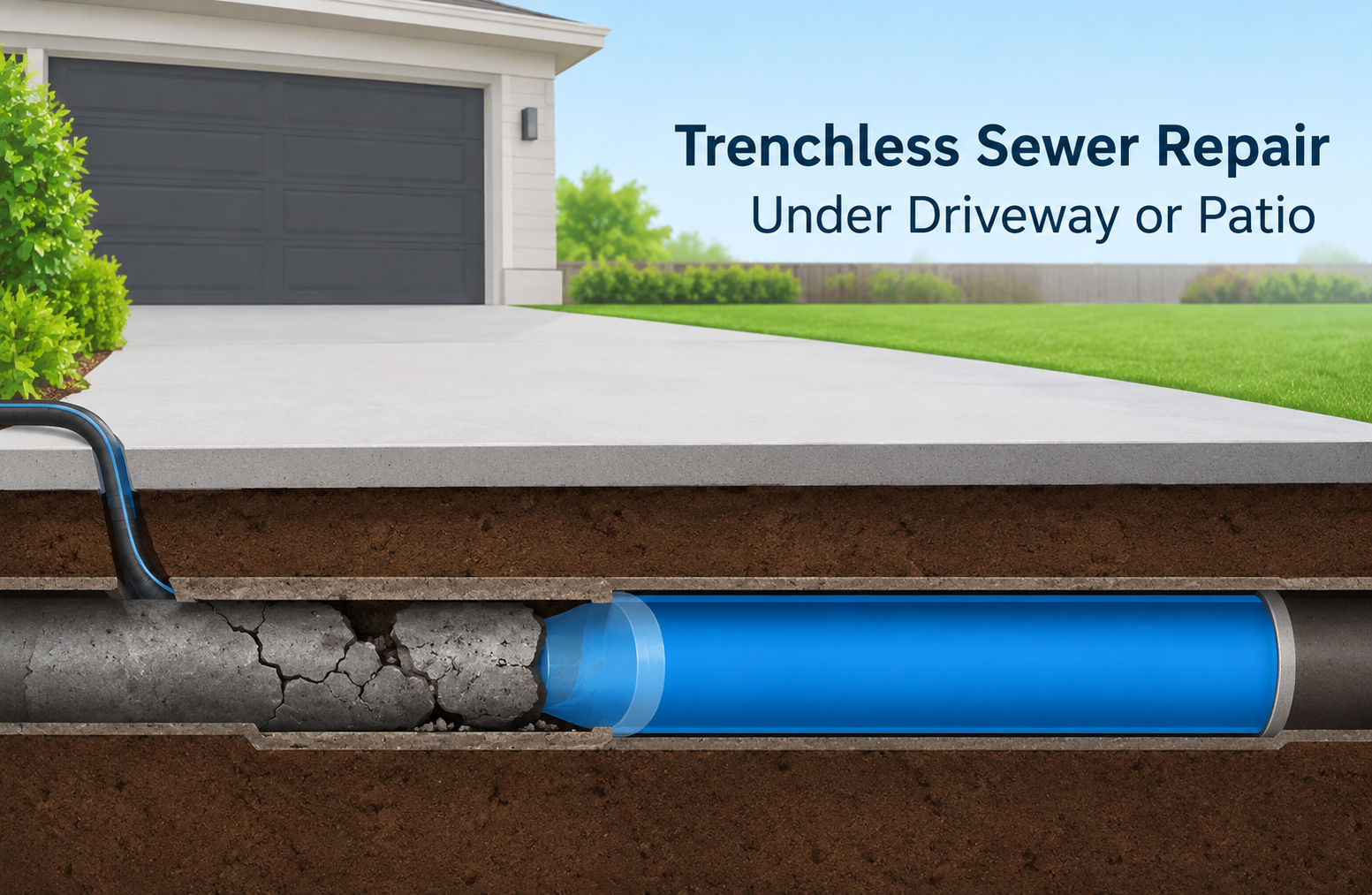
Trenchless Sewer Repair Under Driveway | Things Homeowners Need to Know
A homeowner’s worst nightmare is a sewer pipe that breaks under their driveway or right in their backyard. The thought of having to rip up that beautiful new concrete drive just to fix it is even worse. Fortunately, many trenchless methods can fix underground pipes without damaging surrounding surfaces and landscaping.
A sewer camera inspection tells you if trenchless repair is possible at all and what methods might be used.
Here’s how trenchless sewer repair in Toronto, under a driveway or patio works; a brief look at options and the realities of the methods, why trenchless repair makes sense for many drives and patios, and a few other things you should know.
How Does Trenchless Sewer Repair Work Under Driveway and Patios?
There are a couple of different ways that trenchless sewer repair restores pipes that are under drives, sidewalks, grass, or other landscaping. Pipe lining makes existing pipes whole again by slipping a new liner inside the old pipe and allowing it to cure. Pipe bursting is another method that literally busters the old pipe and pulls a new one through the debris.
Both of these methods are good options for repairing sewer pipes under the driveway and avoid the need to completely replace the driveway.
Sewer Pipe Lining Under Driveways & Sidewalks
Cured-in-place pipe (CIPP) lining is most useful in cases where the pipeline structure remains mostly intact. It involves sliding a liner impregnated with vinyl resins into the damaged pipeline and pushing it until it reaches the other side.
The resins cure to form a brand new pipeline inside the old one, with no access pits, joints, or seams – features that often lead to the growth of tree roots and other pipeline blockages.
The cured-in-place method is often used for repairing cracked sewer pipes, leaking joints, and root intrusion issues. Pipe liner repair can be used on most aging underground pipes that are under driveways or patios, as long as the existing pipe is intact enough to feed a new liner through it.
This type of repair is especially valuable to homeowners with large investments in concrete, pavers, or other hard landscaping materials. There is no need to excavate a big section of their driveway to access the damaged underground pipe. Pipe liner repair can often fix most pipeline issues with little or no damage to sensitive landscaping.
Pipe Bursting Under Driveway or Sidewalks
Like pipe lining, pipe-bursting is another trenchless method of repairing pipelines without disrupting landscaping or pavement with large-scale excavation. This procedure is appropriate in some instances where an existing pipeline system may have reached the end of its useful life.
During the bursting process, technicians slide a cone-shaped bursting head through the old pipeline. This breaks up the old pipe, excavates the materials present in the pipeline, and pulls up a new plastic pipe behind it. As with pipe lining, this technique requires minimal excavation.
Pipe bursting is generally less desirable than liner repair because it is more disruptive to landscaping and pavement. There are few existing pipes that cannot benefit from lining, but bursting is a viable option in many cases.
The choice to burst or liner must be made based on a full inspection of the current pipeline. Technicians must evaluate the distance between access points, the presence of other buried utility lines, depth requirements, and other site-specific concerns.
It’s not as simple as deciding which trenchless method is the best. Pipe bursting requires adequate clearance, and if the target pipeline is located near any other essential utilities, this method may not have a viable place in your sewer repair plans.
Trenchless Repair Makes Practical Sense
If your sewer pipe under the driveway runs near a strip of grass, it should be fairly simple to open up that square of lawn and begin repairs on the pipe. That’s not the case when the sewage line runs underneath solid concrete or interlocking pavers.
Avoiding the Expense and Hassle of Destroying Driveways
It can be expensive and time consuming to break up and replace sections of concrete driveway.
After the repair work is completed the pitting and erosion might not even be worth the time and money to restore.
The same goes for interlocking patios, or any surface with an uneven base. Technicians repairing sewage lines can easily remove individual stones or paver bricks. But, it takes more time and effort to replace those bricks and bring back the old level once the replacement pipe is installed.
Trenchless repair can eliminate some surface preparation work and reduce restoration time.
On the other hand, trenchless line repair costs about the same as traditional sewer repair. Excavation work for drives makes this kind of repair much more expensive than work done across bare dirt. For most drives and sidewalks repaired using pipe linings, it doesn’t take much longer to complete the repair job.
Avoiding Unnecessary Damage to Landscaping During Driveway Repairs
Large excavations made during the course of repair work can be especially disheartening when they come through flower beds, shrubs, trees, or other landscaping features. When working around landscaping, trenchless methods disturb much less of the surrounding soil, making them particularly valuable on older properties where plantings have been established for many years.
Few homeowners consider all the different ways that a repair company can access a broken sewer line. The repair option should meet the needs of everyone involved. That means weighing the benefits to each party as well as the financial implications of a given repair plan.
How Do You Know When a Sewer Line Repair is Needed?
Since underground piping isn’t something that you can see very often, a broken seam or hairline crack can go unnoticed for quite some time. Roots can grow into cracks in the piping and cause significant damage to your sewage system. Over the course of the damage, debris can collect along the line, slowing or blocking up the flow of sewage.
If more than one fixture is backing up regularly, if a single drain remains consistently clogged despite drain cleaning attempts, or when strange patches of grass appear near your basement or plumbing fixtures, it’s worth calling in a professional to determine if there are serious issues in your sewage system.
Why Camera Inspections Are Necessary Before Sewer Repair Begins
Before a crew can determine which type of repair will work best to restore your broken pipeline, a camera inspection should be completed to determine the condition of your line.
Using a sewer inspection camera, technicians can peer inside existing pipelines and get a general sense of the damage.
The inspection can reveal the presence of root growth inside pipes, cracks in the pipeline material, misplaced joints, or other possible causes for sewage backup or damage.
At this point in the process, the technician may not be able to determine whether pipe lining techniques will work. They may need to conduct further studies to follow up on what they saw during the initial inspection.
When Is a Trenchless Sewer Repair Method Not an Option?
There are a handful of situations in which a trenchless sewer repair technique simply can’t work. Sewer pipes aren’t usually in convenient places or in ideal conditions that are conducive to any kind of repair. The repair technique depends on the overall shape of the line, its proximity to other structures, and the general health of the pipeline. Here are some scenarios in which a trenchless method might not work:
- Sewer pipes that are completely collapsed are often not repairable using a trenchless method
- Technicians may be able to excavate a section of the pipe to stabilize the pipeline structure before any kind of liner repair can be attempted.
- Sewer belts are another special condition that can render some types of trenchless sewer repair unproductive. A sewer belly is a dip in a pipeline that results in the stagnation of sewage flow due to improper grade.
Can No-Dig Pipe Repair Fix a Sewer Belly?
Unfortunately, a belly condition in a sewage line is usually not amenable to any kind of repair using a pipe liner that avoids extensive excavation.
Any kind of excavation or surface disruption must be discussed with the technician. If a belly is the reason that your sewage is backing up, repairing it may be a complex and involved process. In most cases, technicians will want to dig up the belly and regrade the section of piping in question, instead of attempting to bypass the problem with a pipe liner or other repair.
What Should You Expect From a Trenchless Sewer Repair?
The repair process will be different for different techniques. The technician will use the camera inspection and all previous discussion with the homeowner to select the most appropriate method of repair.
- The technician inspects the existing line to determine where the repair should be made, whether there are viable access points to carry out this repair, and whether any obstructions need to be cleared before the repair can begin.
- The technician then cleans the pipeline to prepare it for repair. This procedure may involve additional excavation to remove any blockages from the pipeline.
- The technician will install and cure a repair liner to restore the sewer pipeline to its former condition.
- The technician will inspect the newly repaired pipeline to ensure that it is ready to be put into use, and any connections affected by the repair will be restored.
You should ask to review the final inspection video before the technician leaves your home.
Final Notes on Repair of Sewer Lines Under Driveways
Discovering a broken sewer line running under your driveway can be a distressing experience for any homeowner. But, it doesn’t have to be as stressful or expensive as it seems.
Thanks to the innovations in trenchless repair technology, it’s now possible to make repairs in many circumstances with little or no destruction of the driveway or surrounding landscaping. That’s a tremendous benefit for homeowners who have invested in a high-quality paved driveway or an intricate patio.
A thorough investigation can help you decide if no dig repair really is appropriate for your driveway repair circumstance.
After all, it’s not enough for you to avoid the inconvenience and expense associated with excavating a section of your driveway.
The new repair needs to stand the test of time, and you need to be confident that the kind of piping that you have won’t end up requiring another repair down the road.