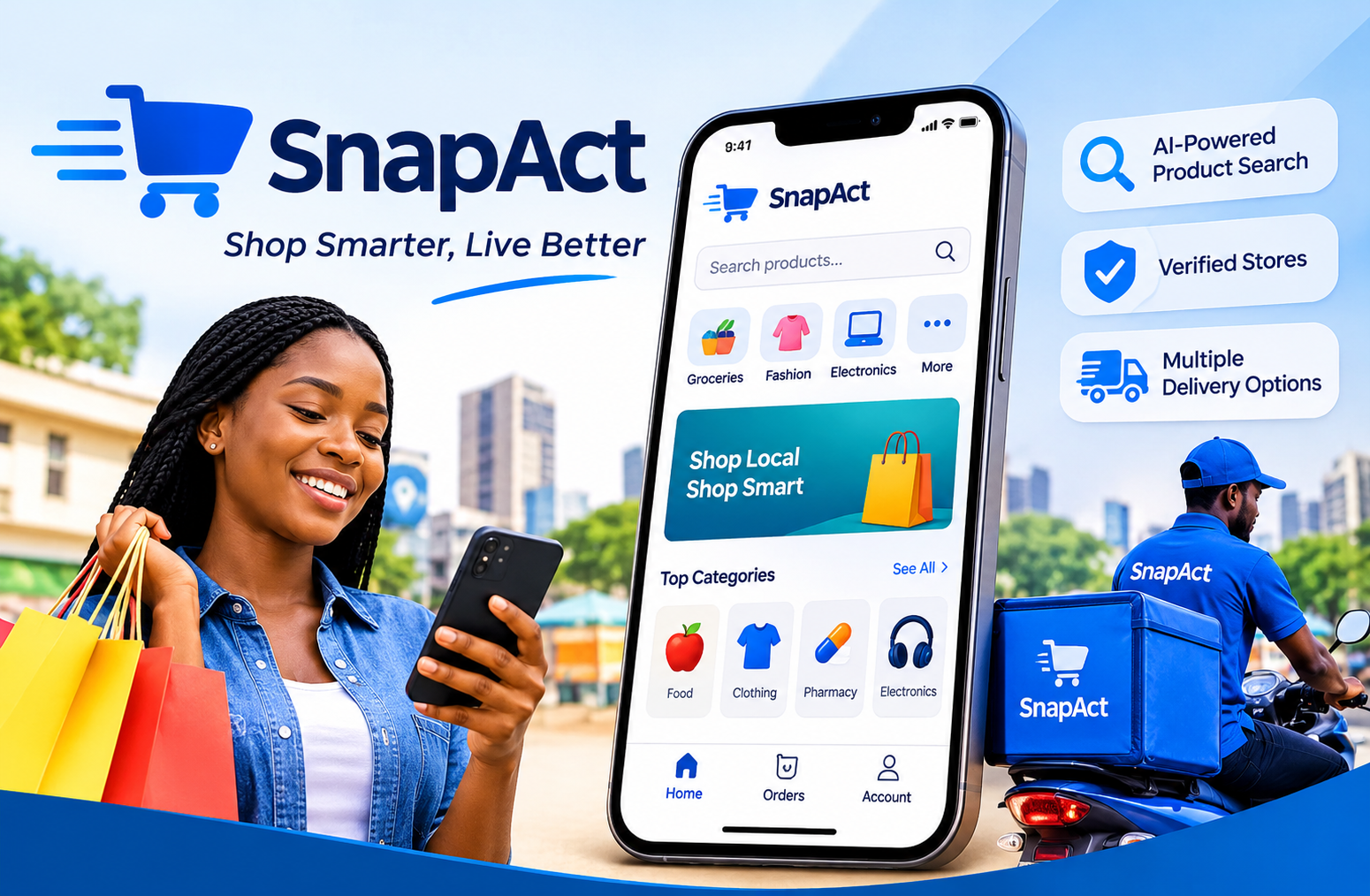
SnapAct: How It Is Changing Local Online Shopping
Online shopping has made it easier to find products, compare prices, and place orders. However, finding reliable local sellers, checking product availability, and arranging delivery can still be difficult. SnapAct aims to address these challenges by bringing customers, verified merchants, product discovery, and delivery coordination together in one digital platform. Built around local commerce, it offers a connected shopping experience designed to make everyday purchases more organized and convenient.
Unlike a traditional online store that focuses mainly on displaying products, SnapAct combines several activities within one ecosystem. Customers can search for products, scan barcodes, discover nearby businesses, save reminders, and follow eligible orders. Merchants can use separate business tools to manage products, inventory, orders, and fulfilment.
The platform is particularly focused on Nigeria’s local retail market, with Lagos identified as its current live marketplace location. Its approach is interesting because it connects digital shopping with the existing network of neighborhood shops and independent businesses.
Understanding how the platform works, what it offers, and where its limitations may exist can help customers and business owners decide whether it meets their needs.
What Is SnapAct?
SnapAct is an AI-powered commerce and delivery platform designed to connect customers with verified local businesses. It provides digital tools that help shoppers discover products and merchants while giving businesses a way to manage their catalogues, inventory, orders, and fulfilment operations.
The platform is built around a simple idea: shopping should involve fewer disconnected steps.
For example, someone who needs groceries might usually search several websites, contact different shops, ask whether products are available, and arrange delivery separately. SnapAct aims to bring much of this process into one coordinated experience.
Its buyer application supports several discovery methods, including:
- Searching for products by name.
- Browsing local merchant categories.
- Taking pictures of products to find similar items.
- Scanning product barcodes.
- Setting reminders for frequently purchased items.
- Ordering from participating businesses.
- Tracking eligible deliveries.
- Confirming completed deliveries through digital proof.
The platform also provides a separate merchant portal. Businesses can use this environment to prepare product listings, review orders, monitor inventory, and coordinate available delivery methods.
It is important to understand that SnapAct is not simply a delivery company or a conventional online marketplace. It combines marketplace discovery with business management and fulfilment coordination.
The technology connects different participants, while actual delivery and payment processing can involve separate service providers.
How Does SnapAct Work?
The platform is designed to make the journey from discovering a product to receiving an order more straightforward.
Although customers and merchants use different interfaces, their activities are connected through the same commerce ecosystem.
1. Customers Discover Products
The first step is finding something to purchase.
Customers can explore available product categories or search for particular items. Depending on participating merchants and local availability, these categories can include:
- Groceries and household supplies.
- Restaurants and prepared food.
- Pharmacy products.
- Fashion and clothing.
- Electronics and accessories.
- Local retail products.
- Packages and shipping services.
Instead of depending entirely on large national retailers, the marketplace focuses on helping customers discover participating local businesses.
This approach can be useful when someone wants to purchase something from a nearby shop rather than wait for a product to arrive from another region.
However, the available selection depends on the merchants participating in the marketplace and the customer’s location.
2. Customers Choose a Merchant
After finding an item, customers can explore the available merchant and storefront information.
Merchant verification is an important part of the platform’s approach. A verified storefront gives shoppers an additional indication that a business has completed the platform’s verification process.
This does not mean every product is automatically guaranteed to be perfect or that every transaction is free from risk. Customers should still review product descriptions, prices, quantities, and order information before confirming a purchase.
The benefit is greater visibility into who is selling the product.
3. Customers Place an Order
Once a customer chooses a merchant and product, the next step is placing an order.
The checkout process depends on the merchant, product, destination, and available fulfilment options.
Customers should review the following details before confirming:
- Product name and description.
- Quantity and displayed price.
- Merchant information.
- Delivery or collection method.
- Applicable delivery charges.
- Estimated preparation or delivery window.
- Available payment method.
These checks are useful on any online marketplace, especially when buying from independent local businesses.
4. The Order Moves to Fulfilment
After an order is placed, the merchant prepares it and selects an eligible fulfilment option.
SnapAct supports several fulfilment arrangements rather than requiring every order to use the same delivery network.
This flexibility is one of the platform’s important features.
5. Customers Follow the Order
For eligible deliveries, customers can receive order and rider updates.
The platform also supports digital proof of delivery, which helps create a clearer record of the handover.
This can be valuable when a customer needs to confirm whether an order has been completed or report a problem.
Main Features of SnapAct
SnapAct combines customer-facing shopping tools with merchant management features. Understanding these capabilities helps explain why it differs from a basic online shopping application.
AI-Powered Product Discovery
One of the more interesting capabilities is its image-based product discovery feature.
Customers do not always know the exact name of something they want to purchase. They might see an item in a photograph, on a social media page, or in a physical store.
Typing a detailed description can be inconvenient, particularly when the product has an unfamiliar name.
SnapAct offers a photo-based discovery method called Snap.
A customer can take a picture of an item, allowing the system to search for that product or a close match among participating nearby stores.
This can be useful for:
- Finding clothing styles.
- Identifying household products.
- Discovering accessories.
- Looking for visually similar retail items.
- Finding alternatives when an exact product is unavailable.
The important distinction is that image matching does not necessarily guarantee an exact product match. Customers should inspect the suggested listing before purchasing.
Barcode Scanning
Barcode scanning provides another way to identify products.
Instead of manually entering a product name, a customer can scan its barcode to search for the corresponding item.
This is particularly useful for repeat purchases.
For example, someone who regularly buys a particular household product can scan its packaging rather than remember its full product name.
Barcode scanning may help with:
- Identifying packaged products.
- Finding repeat purchases.
- Reducing manual searches.
- Locating products from participating merchants.
The accuracy of results depends on product information and catalogue availability.
Restock Reminders
Remembering when household essentials need replacement is a common challenge.
People frequently run out of products because they forget to purchase them before supplies are exhausted.
SnapAct includes restock reminders intended to help customers organize recurring shopping needs.
Examples include:
- Milk and other groceries.
- Household cleaning products.
- Cooking supplies.
- Frequently purchased personal-care items.
- Other regularly used products.
These reminders can help customers plan their purchases rather than making unexpected trips to the store.
They are particularly useful for households that purchase similar products every week or month.
However, a reminder should not be confused with an automatic order. Customers still need to review the product and complete the purchase when required.
Verified Merchant Storefronts
Trust is a major concern in online shopping.
Customers may hesitate to purchase from an unfamiliar business because they cannot easily determine whether the seller is legitimate.
SnapAct addresses this concern through merchant verification and verified storefronts.
The platform allows participating businesses to establish digital storefronts where shoppers can discover their products.
A verified storefront can improve transparency by giving customers a clearer view of the business behind an order.
For merchants, this also creates an opportunity to build an online presence without relying entirely on social media pages or informal messaging.
Nevertheless, verification should not replace normal purchasing precautions. Customers should still check listings and report inaccurate products or transaction problems.
Live Order and Delivery Tracking
Delivery visibility is another important part of the shopping experience.
After placing an eligible order, customers may receive updates about its fulfilment progress.
Where supported, live rider tracking can help customers understand when an order is being collected and delivered.
This can reduce uncertainty, especially when purchasing food, groceries, or other products that customers need within a particular period.
The available tracking information depends on the selected fulfilment method and the participating service provider.
Digital Proof of Delivery
A delivery is not fully complete simply because a rider reaches the destination.
Both the customer and merchant benefit from knowing whether the order was successfully handed over.
SnapAct supports digital delivery confirmation, which can include proof of the completed handover.
This feature can help:
- Reduce uncertainty about completed orders.
- Improve delivery records.
- Support order investigations.
- Provide greater visibility for merchants.
- Create a clearer fulfilment history.
For businesses handling multiple orders, reliable delivery records can be especially valuable.
Merchant Inventory Management
The platform also focuses on the operational challenges faced by local retailers.
Many small businesses manage products through notebooks, spreadsheets, messaging applications, or basic point-of-sale systems.
These methods can become difficult to manage as product numbers and customer orders increase.
SnapAct provides merchant tools that help businesses organize catalogues and inventory.
Its inventory scanning capabilities allow merchants to use photographs, videos, and existing media to prepare product catalogue drafts.
AI can assist with structuring product information, but merchants are expected to review and confirm details such as product identity, prices, and visible quantities before publishing listings.
This review process is important because inaccurate product information can create problems for customers and sellers.
How SnapAct Helps Customers
The main benefit for customers is the ability to combine product discovery, shopping, and order coordination within one ecosystem.
However, the practical value depends on the availability of participating merchants and fulfilment services.
Less Time Spent Searching
Customers often need to visit several online platforms before finding a particular product.
A local marketplace can simplify this process by bringing multiple participating businesses into one discovery environment.
Rather than searching each merchant separately, users can explore available products through a shared interface.
This may be especially helpful for people who regularly purchase products from neighborhood shops.
Easier Repeat Shopping
Barcode scanning and restock reminders address two common problems: remembering product names and forgetting when to buy essential items.
These features can make repeat shopping more organized.
For example, someone who regularly purchases the same grocery items can use reminders to plan ahead and barcode scanning to find familiar products.
Better Visibility Into Orders
Order updates and delivery confirmation can make online purchases easier to follow.
Customers do not have to depend entirely on informal messages to understand whether an order has been prepared, collected, or delivered.
The exact information available will depend on the fulfilment method.
Access to Local Businesses
One of the most valuable ideas behind the platform is its focus on local commerce.
Smaller retailers sometimes struggle to compete with larger online marketplaces because they lack the resources to develop their own shopping applications.
A shared marketplace can give participating shops another way to reach potential customers.
This can create value for both sides: shoppers gain access to more local options, while merchants gain another digital sales channel.
More Organized Shopping Habits
Shopping is not always about purchasing something immediately.
Sometimes customers discover a product and want to remember it for later.
Search, scanning, and reminder tools can help organize these small decisions.
This is a practical benefit because it connects product discovery with future shopping needs.
How SnapAct Helps Small Businesses and Merchants
SnapAct is not designed exclusively for shoppers. Its merchant environment is an important part of the overall service.
Small retailers face several operational challenges that can limit their growth.
These include maintaining accurate stock records, managing incoming orders, communicating with customers, and arranging reliable deliveries.
The merchant tools aim to bring several of these activities together.
Creating Digital Product Catalogues
A merchant needs accurate product listings to sell online.
Preparing these listings manually can take considerable time, especially when a business has many products.
SnapAct offers catalogue preparation tools that use photographs, video, and scanning to create reviewable product drafts.
This can reduce some of the manual work involved in organizing product information.
However, AI-generated suggestions should always be checked by the merchant.
A wrong product name, incorrect price, or inaccurate stock quantity can create confusion and customer complaints.
Managing Incoming Orders
Businesses need a reliable way to monitor orders.
A merchant dashboard can help organize information such as pending orders, active listings, and sales activity.
Instead of depending entirely on separate communication channels, merchants can use a central environment for relevant marketplace operations.
This can be particularly helpful when several employees handle different parts of the business.
Managing Inventory
Inventory management is one of the most important aspects of retail operations.
If a customer orders a product that is unavailable, the merchant may need to cancel the order or suggest an alternative.
Keeping catalogue quantities accurate helps reduce these problems.
SnapAct’s inventory tools are intended to make product organization and updates easier.
Merchants should still establish a routine for reviewing stock levels and confirming product availability.
Reaching More Customers
A local business may have a loyal group of regular customers but limited visibility beyond its immediate neighborhood.
An online storefront creates another opportunity to reach people who are searching for particular products.
SnapAct supports two sales channels:
- Marketplace listings inside the buyer application.
- A merchant’s own public web storefront.
This approach allows businesses to maintain a shared catalogue while reaching customers through different digital channels.
Connecting Existing E-Commerce Systems
Businesses that already operate online stores may not want to rebuild their entire product catalogue.
SnapAct provides integrations for Shopify and WooCommerce.
These integrations are intended to help merchants connect existing commerce operations with the platform.
Importantly, merchants can preview catalogue changes before applying them and can revoke access.
This is useful because businesses should retain control over their existing product information and digital operations.
Understanding SnapAct’s Four Fulfilment Options
Delivery is one of the most complicated parts of local commerce.
Different products require different delivery arrangements. A restaurant order, a clothing purchase, and a nationwide packaged shipment may not be suitable for the same delivery service.
SnapAct addresses this through four fulfilment options.
1. SnapAct Express
SnapAct Express uses eligible SnapAct riders for local delivery within active service zones.
This option is intended for merchants and customers located in areas where the service is available.
Its main advantage is the ability to coordinate local deliveries through the platform’s own rider network.
However, Express availability should not be assumed everywhere.
2. Merchant Private Fleet
Some businesses already have their own delivery employees or riders.
For these merchants, using a third-party delivery service for every order may not be necessary.
SnapAct supports approved merchant-operated delivery teams.
The merchant’s own riders can fulfil eligible orders while using the platform’s tracking and delivery confirmation features.
This arrangement gives businesses greater flexibility over their delivery operations.
3. Nationwide Courier
Not every order is a short-distance delivery.
Some customers need products shipped between different cities or regions.
For eligible packaged shipments, SnapAct can coordinate with integrated third-party courier providers.
The available delivery service and price depend on the courier quotation, destination, and package requirements.
This option can help businesses serve customers outside their immediate local delivery area.
4. Store Pickup
Sometimes the simplest delivery option is no delivery at all.
Store pickup allows customers to collect approved orders directly from a merchant’s location.
This can be useful when:
- A customer lives close to the store.
- Delivery charges are unnecessary.
- The customer prefers collecting an order personally.
- A merchant does not have an eligible rider.
- The product is more convenient to collect.
The important point is that customers can select only the fulfilment methods supported for the particular order.
Is SnapAct Safe and Trustworthy?
Safety is an important consideration when using any online shopping platform.
Customers need confidence in the merchant, product information, payment process, and delivery arrangement.
SnapAct includes several features intended to improve transaction visibility.
These include verified storefronts, order tracking, and digital proof of delivery.
However, it is important to understand the difference between platform verification and a complete guarantee of transaction safety.
Merchant Verification
Verified storefronts provide an additional layer of confidence by showing that a business has completed the platform’s verification process.
Customers should still review the seller and product information before purchasing.
Third-Party Payment Processing
An important detail is that SnapAct does not describe itself as a bank or payment processor.
Online checkout and approved refunds are handled through integrated third-party payment providers.
This distinction matters because payment processing, order coordination, and customer support are separate responsibilities.
Customers should review the payment provider’s checkout information and use the payment method displayed during the transaction.
Delivery Confirmation
Digital proof of delivery helps establish whether an eligible order was handed over.
This can provide useful documentation if a customer or merchant needs to investigate a delivery issue.
Reporting Problems
According to the platform’s published information, customers can report problems through the order screen.
For issues involving incorrect or damaged orders, the platform instructs customers to use its reporting process within 24 hours.
Customers should retain relevant order information and provide clear details when submitting a complaint.
Understanding Privacy
Shopping applications may require access to information such as location, personal details, and device-related permissions.
Location access can be relevant because the marketplace uses merchant proximity and delivery coverage to determine available options.
Customers should review the application’s privacy policy and permission settings before using it.
The Google Play listing also provides information about the categories of data the developer declares it may collect or share. These details should be reviewed directly because app privacy disclosures can change.
Where Is SnapAct Available?
Availability is one of the most important things to understand before signing up.
SnapAct identifies Lagos, Nigeria, as its current live marketplace location.
The company states that additional cities are expected to become available as the network expands.
This means the platform should not be treated as a worldwide local-shopping service with identical coverage everywhere.
Its scanning and reminder features may have broader practical uses, but local marketplace access depends on participating merchants and active service areas.
For customers, this means checking whether the application shows relevant businesses and delivery options for their location.
For merchants, it means confirming that their business location and fulfilment requirements are supported before investing time in setting up a storefront.
People outside Nigeria should not assume that local ordering and delivery services are available in their country.
How to Get Started With SnapAct
Getting started depends on whether someone wants to shop, operate a business, or work as a delivery rider.
Each group has a separate experience within the ecosystem.
Getting Started as a Customer
Customers can follow these general steps:
Step 1: Find the official application
Visit the official SnapAct website or locate its buyer application through the relevant app store.
Check the developer information before downloading anything.
Step 2: Complete the onboarding process
Follow the application’s registration instructions and provide the information required to create an account.
Step 3: Explore available categories
Browse participating stores and product categories.
Check whether merchants are available in your service area.
Step 4: Search or scan for products
Use the search function when you know the product name.
If you have a physical product, you can explore barcode scanning or image-based discovery where supported.
Step 5: Review the merchant and listing
Check the product description, quantity, price, and seller information.
Do not assume that a visually similar product is identical to the item you originally wanted.
Step 6: Select an available fulfilment method
Review the delivery or pickup options shown during checkout.
Step 7: Follow the order
Use the order information and available tracking updates to monitor fulfilment.
Getting Started as a Merchant
Businesses can use the separate SnapAct Partner portal.
The general process involves:
- Visiting the merchant registration portal.
- Submitting business verification details.
- Waiting for account approval.
- Preparing product catalogue information.
- Reviewing inventory and product quantities.
- Configuring eligible fulfilment methods.
- Publishing the storefront after completing the required checks.
Merchants should make sure their prices, stock information, and product descriptions are accurate before accepting orders.
Getting Started as a Rider
The platform also offers a dedicated rider experience.
Potential riders can apply through its rider portal.
Published requirements include a valid identification document, a working motorcycle, a smartphone, and completion of the onboarding process.
Rider eligibility and delivery opportunities depend on the platform’s operational requirements and available service areas.
SnapAct Pricing: What Should Users Expect?
Pricing is an important factor when deciding whether to use an online marketplace.
However, it is necessary to distinguish between the costs faced by customers, merchants, and riders.
Customer Costs
Customers should review the total checkout amount before confirming an order.
The final cost may depend on:
- Product prices.
- Merchant pricing.
- Delivery charges.
- Courier quotations.
- Applicable service fees.
- The selected fulfilment method.
The actual amount is displayed through the applicable ordering and checkout process.
It would be inaccurate to suggest that every order has the same delivery price.
Merchant Costs
SnapAct’s published merchant information states that product listing is free and that the platform charges a commission on fulfilled orders rather than a monthly listing subscription.
Businesses should review the current merchant terms to understand the applicable commission and payment arrangements.
This is important because a free listing does not necessarily mean that every part of selling through the marketplace is free.
Merchants should calculate their product margins after considering platform commissions, delivery expenses, and other operating costs.
Rider Earnings
The platform’s rider information describes weekly payments for approved delivery earnings and allows riders to retain their tips.
However, potential riders should check the current eligibility requirements, payment terms, and local availability before applying.
Advantages and Disadvantages of SnapAct
Every digital platform has strengths and limitations.
Evaluating both sides provides a more realistic understanding of its usefulness.
Advantages
- Multiple product discovery methods
Search, barcode scanning, and image-based discovery give customers different ways to find products.
- Local business visibility
The marketplace provides participating retailers with an additional digital channel.
- Verified storefronts
Merchant verification adds a layer of transparency to the shopping experience.
- Multiple fulfilment options
The platform supports Express delivery, merchant fleets, third-party couriers, and store pickup where eligible.
- Inventory management tools
Merchants can use catalogue and inventory features to organize their products.
- Order tracking
Eligible orders can provide customers with useful fulfilment updates.
- Restock reminders
Customers can organize repeat purchases and remember essential items.
- Existing commerce integrations
Shopify and WooCommerce integrations can help merchants connect existing online operations.
Disadvantages and Limitations
- Geographic availability
The local marketplace is focused on Nigeria, with Lagos identified as its current live location.
This limits its usefulness for customers in unsupported regions.
- Merchant participation matters
A marketplace is only as useful as the businesses and products available through it.
If a particular neighborhood has limited participating shops, customers may have fewer choices.
- Delivery options vary
Not every merchant or order qualifies for every fulfilment method.
- AI matching requires human judgment
Image recognition and catalogue suggestions can be helpful, but they do not guarantee perfect product identification.
- Stock information needs regular updates
Incorrect inventory information can lead to cancellations and customer dissatisfaction.
- Third-party payment dependencies
Payment processing depends on integrated external providers.
This means customers should understand which provider processes their payment and how refunds are handled.
- A developing marketplace needs time
Expanding a local-commerce network requires more merchants, reliable delivery partners, and consistent customer adoption.
The quality of the experience can therefore vary as the network develops.
Real-World Applications of SnapAct
The value of a commerce platform becomes clearer when its features are considered in everyday situations.
Here are several examples of how its tools could be useful.
Shopping for Household Essentials
Imagine a household that purchases groceries and cleaning supplies regularly.
Instead of remembering every product manually, customers can use restock reminders to organize their shopping needs.
When they need a familiar packaged item, barcode scanning can make searching easier.
They can then check available merchants and select a suitable fulfilment method.
Finding a Product From a Photograph
Suppose someone sees a particular handbag or clothing style in a photograph.
They may not know the product’s name or the correct search terms.
Image-based discovery provides another way to look for visually similar products from participating merchants.
The customer can compare the suggested listings and select an appropriate item.
Running a Neighborhood Grocery Store
A small grocery business may want to reach customers beyond its physical shop.
Using merchant tools, the business can prepare product listings, manage orders, and coordinate delivery.
A shared storefront also gives potential customers another way to discover the shop.
Managing a Restaurant
A restaurant can use a digital catalogue to display its available products and receive marketplace orders.
Its delivery arrangement can depend on whether SnapAct Express, an approved private fleet, or another eligible fulfilment method is available.
This can help organize order handling without assuming that every restaurant must operate its own technology infrastructure.
Shipping Products Between Cities
A clothing merchant may receive an order from a customer located outside its immediate neighborhood.
If the product and destination qualify, an integrated nationwide courier option may be available.
The courier quotation and shipment requirements determine the practical delivery arrangement.
These examples demonstrate how the platform connects product discovery with different retail and delivery situations.
SnapAct Compared With Traditional Online Shopping
Traditional online shopping platforms usually focus on product listings, search, checkout, and delivery.
SnapAct takes a somewhat broader approach by combining buyer discovery tools with merchant inventory and fulfilment operations.
The difference can be understood through several areas.
| Area | Traditional Online Shopping | SnapAct |
| Product search | Mainly text-based search and categories | Search, image discovery, and barcode scanning |
| Merchant access | Depends on marketplace sellers | Focuses on verified local merchants |
| Repeat shopping | Often relies on saved carts or lists | Includes restock reminders |
| Merchant tools | Varies by marketplace | Dedicated partner environment |
| Inventory | Depends on seller integrations | Catalogue and inventory management tools |
| Delivery | Depends on available shipping partners | Multiple eligible fulfilment methods |
| Order confirmation | Varies by platform | Supports digital proof of delivery |
| Local commerce | Depends on marketplace coverage | Designed around local retail networks |
This comparison does not mean SnapAct is automatically better than every established marketplace.
A traditional platform may offer a larger catalogue, more geographic coverage, or more mature customer services.
The difference is its emphasis on local discovery and connecting the activities of customers, merchants, and fulfilment providers.
Practical Tips for Using SnapAct Effectively
Getting the most value from a shopping platform requires more than installing an application.
A few simple habits can help customers and merchants avoid common problems.
Tips for Customers
Check the merchant before ordering.
Review the available storefront and product information before confirming a purchase.
Compare product details.
When using image search, check whether the suggested product matches your expectations.
Confirm the total price.
Review product costs and delivery charges before completing checkout.
Choose the correct fulfilment method.
A local rider, courier shipment, and store pickup serve different purposes.
Use reminders for recurring products.
Set reminders for frequently purchased essentials rather than relying entirely on memory.
Keep order records.
Retain relevant order details and delivery information in case a problem needs to be reported.
Review privacy permissions.
Understand why the application requests access to location, photographs, or other device information.
Tips for Merchants
Maintain accurate product information.
Incorrect descriptions and prices can damage customer trust.
Review AI-generated catalogue drafts.
Never publish product information without checking its accuracy.
Update inventory regularly.
Avoid accepting orders for unavailable products.
Choose suitable fulfilment options.
Select delivery arrangements that match the product, destination, and business capabilities.
Monitor order performance.
Review pending orders and fulfilment progress regularly.
Understand the commission structure.
Calculate product margins after accounting for marketplace charges and delivery expenses.
The Future Potential of SnapAct
Local commerce is an important part of everyday economic activity.
Independent stores, neighborhood markets, restaurants, pharmacies, and small retailers provide products that people need regularly.
However, many of these businesses do not have the resources to build advanced digital systems.
A platform that combines product catalogues, inventory management, customer discovery, and delivery coordination could help reduce some of these barriers.
SnapAct’s approach is interesting because it does not treat online commerce as a simple process of displaying products and accepting payments.
Instead, it attempts to connect several operational activities.
Opportunities for Local Retailers
More digital visibility could help independent retailers reach customers who might otherwise never discover their businesses.
A shared marketplace can also reduce the need for each merchant to build a separate shopping application.
Better Product Discovery
Image recognition and barcode scanning provide alternative ways to find products.
As these tools improve, they may make online shopping more convenient for people who struggle to describe what they want through text searches.
However, reliable product information will remain essential.
More Connected Delivery Networks
Supporting several fulfilment methods allows businesses to use delivery arrangements that match their operations.
A retailer with its own riders does not necessarily need to use the same service as a merchant shipping packaged products across the country.
Opportunities for Small Business Growth
Digital catalogues, order management, and customer discovery may help smaller businesses organize their operations and reach additional buyers.
The real impact will depend on how effectively the platform attracts merchants, maintains service quality, and expands its coverage.
It is too early to assume that these potential benefits will be achieved equally across every location.
Is SnapAct Worth Using?
Whether SnapAct is worth using depends on what someone expects from the platform.
For customers in supported Nigerian service areas, it offers a combination of local shopping, product discovery, reminders, and delivery coordination.
Its image search and barcode scanning features provide alternatives to conventional product searches, while verified storefronts and order tracking aim to improve transaction visibility.
For merchants, the platform offers a digital environment for product catalogues, inventory, orders, and multiple fulfilment arrangements.
The strongest potential benefit is the connection between local retailers and customers through a shared commerce system.
However, geographic coverage, merchant participation, product availability, and delivery eligibility remain important considerations.
Customers outside active marketplace areas should not assume they can use the same local ordering services.
Overall, SnapAct represents an interesting approach to making local commerce more organized. Its usefulness will depend less on the number of advertised features and more on the quality, reliability, and availability of the services customers and merchants can actually access.
Frequently Asked Questions About SnapAct
1. What is SnapAct used for?
SnapAct is used for discovering local businesses, searching and scanning products, setting shopping reminders, placing eligible orders, and coordinating fulfilment. It also provides merchants with tools for managing catalogues, inventory, and orders.
2. Is SnapAct a shopping application?
Yes. Its buyer application functions as a local shopping marketplace where customers can discover products from participating merchants. It also includes features such as barcode scanning, image-based discovery, and restock reminders.
3. Is SnapAct available worldwide?
The platform’s local marketplace currently focuses on Nigeria, with Lagos identified as its live location. Marketplace and delivery availability depend on participating merchants and active service areas.
4. Can merchants sell products through SnapAct?
Yes. Businesses can apply through the separate SnapAct Partner portal. Approved merchants can create product catalogues, manage inventory, receive orders, and use eligible fulfilment options.
5. Does SnapAct provide its own delivery service?
SnapAct supports SnapAct Express within active service zones, as well as approved merchant delivery fleets, integrated third-party nationwide couriers, and store pickup. The available option depends on the merchant, product, and destination.
6. Is SnapAct free to use?
The platform’s published merchant information states that listing products is free and that merchants pay a commission on fulfilled orders. Customer costs depend on the products, applicable delivery charges, and checkout arrangements. Users should check the current terms for accurate pricing.
Conclusion
SnapAct is a local-commerce platform that brings product discovery, merchant management, and delivery coordination into one connected environment. Its features are designed to address practical challenges faced by both customers and independent businesses.
Customers can benefit from search, image-based discovery, barcode scanning, restock reminders, verified storefronts, and eligible order tracking. Merchants gain tools for managing catalogues, inventory, orders, and different fulfilment arrangements.
The platform’s focus on local retail makes it particularly relevant to businesses and shoppers in its supported Nigerian markets. However, its usefulness depends on merchant participation, accurate product information, delivery coverage, and the reliability of its integrated service providers.
Rather than viewing it as just another shopping application, it is more useful to understand SnapAct as an attempt to connect the different parts of local commerce through digital technology. Its long-term value will depend on how well it delivers that experience as its merchant and delivery network grows.