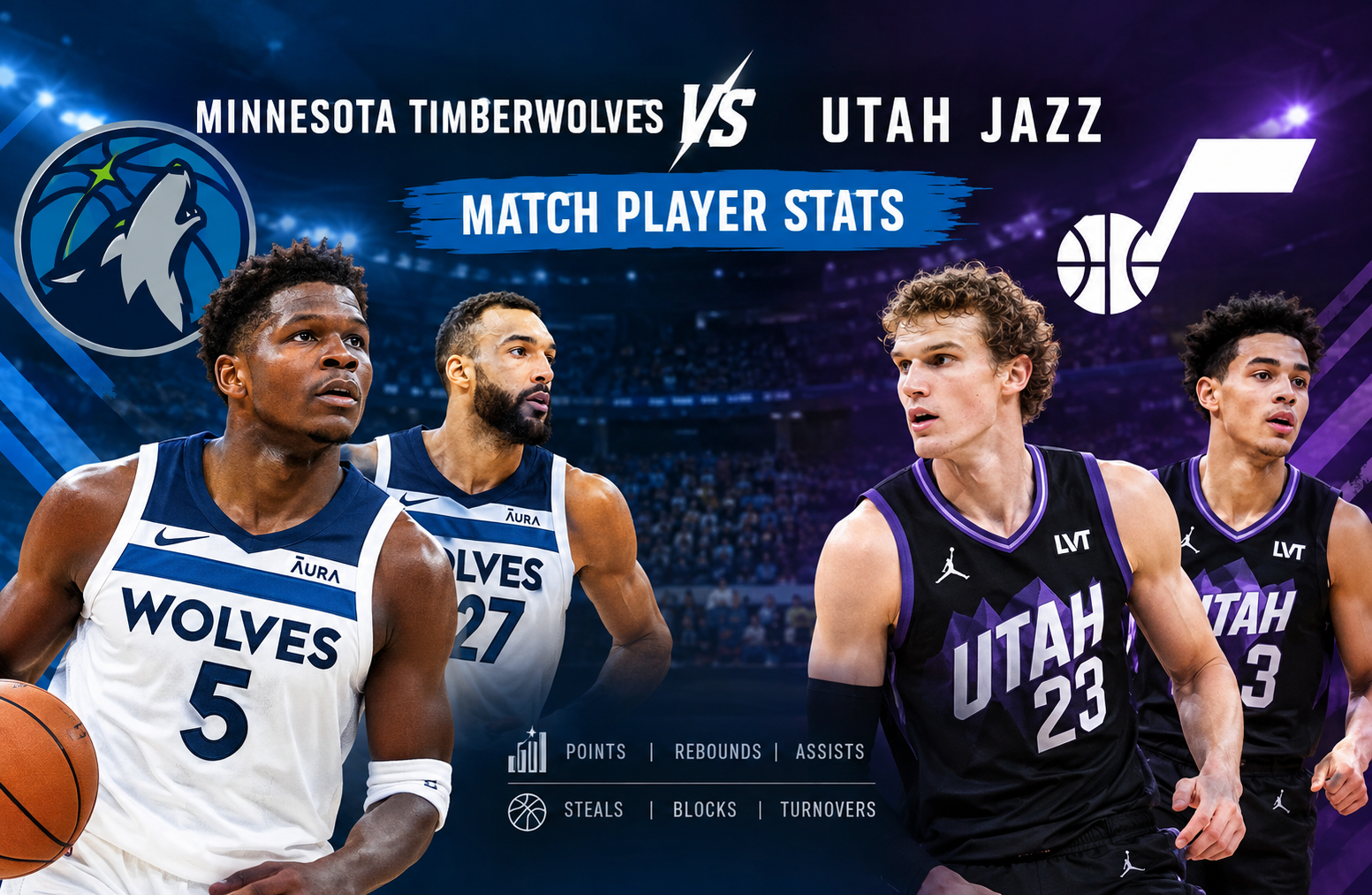
Timberwolves vs Utah Jazz Match Player Stats
The timberwolves vs utah jazz match player stats from Minnesota’s 120-113 victory over Utah provide a useful example of how a close game can turn on efficiency, ball security, and a dominant third quarter rather than one isolated statistic. Played at Delta Center in Salt Lake City, the matchup featured 35 points from Anthony Edwards, a near triple-double type of all-around contribution from Julius Randle, and a strong interior performance from Rudy Gobert. Utah answered with 27 points from Keyonte George and 21 from Lauri Markkanen, but Minnesota’s second-half execution proved decisive.
The game was officially recorded by the NBA as November 10, 2025, although some schedules and listings displayed the game under November 11 because of time-zone differences. The Timberwolves entered the game at 6-4 and improved to 7-4 with the win, while Utah fell to 3-7. Minnesota also made it two wins over Utah in four days after beating the Jazz 137-97 in the previous meeting.
Timberwolves vs Utah Jazz Match Player Stats: Game Overview
The final score was Minnesota Timberwolves 120, Utah Jazz 113 at Delta Center.
The scoreboard does not fully explain how the game developed. Utah actually won the opening quarter 30-26, and the Jazz remained competitive through halftime. Minnesota then changed the game’s rhythm in the third quarter, scoring 40 points while holding Utah to 25.
That 15-point third-quarter advantage effectively created the separation Minnesota needed.
| Category | Timberwolves | Jazz |
| Final Score | 120 | 113 |
| Field Goals | 42-89 | 38-95 |
| Field Goal % | 47% | 40% |
| Three-Pointers | 10-33 | 17-52 |
| Three-Point % | 30% | 33% |
| Free Throws | 26-28 | 20-24 |
| Free Throw % | 93% | 83% |
| Total Rebounds | 42 | 50 |
| Assists | 25 | 30 |
| Turnovers | 10 | 15 |
| Steals | 8 | 5 |
| Blocks | 5 | 5 |
| Offensive Rebounds | 7 | 16 |
| Defensive Rebounds | 35 | 34 |
| Fouls | 21 | 24 |
The most important contrast is efficiency.
Utah attempted six more field goals than Minnesota and collected eight more total rebounds, including nine more offensive rebounds. Yet Minnesota still won because it converted its possessions more efficiently and protected the basketball better.
The Timberwolves shot 47% from the field compared with 40% for Utah. They also went 26-for-28 at the free-throw line, while Utah finished 20-for-24.
That combination mattered more than the Jazz’s advantage on the glass.
Anthony Edwards Leads Minnesota With 35 Points
Anthony Edwards was the primary offensive force in this matchup.
He finished with:
- 35 points
- 13-for-25 shooting
- 5-for-9 from three-point range
- 4-for-4 from the free-throw line
- 6 rebounds
- 6 assists
- 1 turnover
- 1 block
Edwards’ 35 points came on efficient shooting rather than extreme volume. His 13 made field goals on 25 attempts produced a 52% field-goal rate, while his five three-pointers gave Minnesota an important source of perimeter scoring.
His six assists also show why simply looking at his points would undersell his performance.
One of the clearest turning points came in the third quarter. Minnesota opened the period with a major scoring surge, and Edwards was directly involved in the run through scoring and playmaking. The NBA’s official recap noted that Minnesota eventually built a 22-point lead during the third quarter before Utah fought back.
Edwards also extended a remarkable scoring run against Utah. The NBA reported that this was his ninth consecutive game against the Jazz with at least 30 points.
That context makes the 35-point performance more meaningful. It was not simply a high-scoring night. It continued a sustained pattern of production against this opponent.
Julius Randle Provides the Complete Supporting Performance
Julius Randle was arguably Minnesota’s most complete all-around contributor.
His final line was:
- 27 points
- 7-for-16 field goals
- 1-for-4 from three
- 12-for-13 free throws
- 8 rebounds
- 7 assists
- 3 steals
- 2 turnovers
Randle’s shooting efficiency from the free-throw line was especially important.
He made 12 of 13 attempts, giving Minnesota 12 points without requiring a field-goal attempt. Against a Utah team that generated plenty of offensive rebounds, Randle’s ability to score efficiently helped stabilize Minnesota’s offense.
His seven assists were also significant.
The Timberwolves finished with 25 team assists, meaning Randle accounted for a substantial portion of their assisted offense. His seven assists demonstrate that his impact extended beyond scoring.
Defensively, his three steals were tied for the Minnesota team lead. That combination of scoring, rebounding, passing, and defensive activity is why his box score deserves more attention than his 27 points alone.
Rudy Gobert Controls the Interior
Rudy Gobert did not lead Minnesota in scoring, but his interior presence remained important.
He recorded:
- 14 points
- 7-for-8 field goals
- 12 rebounds
- 1 assist
- 2 turnovers
- 2 blocks
Gobert’s 7-for-8 shooting was one of the most efficient individual shooting performances among Minnesota’s primary players.
His 12 rebounds also led the Timberwolves.
Utah actually won the overall rebounding battle 50-42 and grabbed 16 offensive rebounds. That means Gobert did not single-handedly solve Minnesota’s rebounding problem. However, his 12 boards and two blocks helped prevent the Jazz from turning their size advantage into an even larger scoring advantage.
His defensive value also forced Utah to account for him around the basket. Even when he did not block a shot, his presence could influence where opposing players attempted to finish.
Jaden McDaniels Adds Efficient Secondary Scoring
Jaden McDaniels finished with 16 points on 6-for-13 shooting.
He also recorded:
- 6 rebounds
- 3 assists
- 2 steals
- 1 turnover
- 1-for-2 from three
- 3-for-3 from the free-throw line
McDaniels provided a useful balance between scoring and defensive activity.
His two steals were especially valuable in a game where Minnesota forced Utah into 15 turnovers. He did not need a large offensive workload to influence the game.
For Minnesota, that type of contribution matters because the offense can remain centered around Edwards and Randle without requiring every starter to create his own shot.
Donte DiVincenzo’s Impact Was Mixed
Donte DiVincenzo scored 14 points, but his shooting line was less efficient than his point total might suggest.
He went:
- 4-for-11 from the field
- 1-for-8 from three
- 5-for-5 from the free-throw line
- 1 rebound
- 2 assists
- 1 steal
- 1 block
The biggest weakness was his three-point shooting.
Going 1-for-8 from beyond the arc means he converted only 12.5% of his attempts from distance. Yet his perfect 5-for-5 free-throw performance helped offset some of that inefficiency.
This is an important lesson when reading player statistics. A player’s scoring total should not be evaluated without looking at how those points were generated.
Naz Reid and Minnesota’s Bench Production
Naz Reid finished with seven points on 3-for-10 shooting, including 1-for-7 from three.
He also contributed:
- 5 rebounds
- 3 assists
- 1 steal
- 1 block
The shooting was inefficient, but his five rebounds and defensive contribution added value.
Mike Conley recorded five points, two rebounds, and two assists.
Jaylen Clark added two points, one rebound, and one steal, while Rob Dillingham recorded one rebound and one assist.
The bigger picture is that Minnesota did not need a major scoring performance from every rotation player. Edwards and Randle carried much of the offensive responsibility while Gobert supplied efficient interior scoring and rebounding.
Keyonte George Leads Utah With 27 Points
Keyonte George was Utah’s leading scorer and one of the biggest reasons the Jazz remained competitive.
He finished with:
- 27 points
- 9-for-18 field goals
- 3-for-11 three-pointers
- 6-for-6 free throws
- 6 rebounds
- 6 assists
- 3 turnovers
- 1 block
George started the game extremely well. The NBA recap noted that he scored 12 points in the first quarter on 5-for-6 shooting.
That helped Utah take a 30-26 lead after the opening period.
His overall shooting line was solid at 50% from the field. However, the 3-for-11 mark from three shows that much of his efficiency came from inside the arc and the free-throw line.
George’s six assists also demonstrate that Utah’s offense relied on him for more than scoring.
Lauri Markkanen Gives Utah a Reliable Scoring Option
Lauri Markkanen finished with 21 points, eight rebounds, and three assists.
His shooting numbers were:
- 6-for-15 from the field
- 4-for-7 from three
- 5-for-6 from the free-throw line
The four made three-pointers were particularly important for Utah.
Markkanen’s 57.1% three-point shooting gave the Jazz a highly efficient perimeter scoring source, even though Utah as a team shot only 33% from three.
His eight rebounds also helped Utah maintain its overall advantage on the glass.
The official NBA game information lists Markkanen at 21 points, which is the figure used here.
Jusuf Nurkic Wins the Rebounding Battle
Jusuf Nurkic collected 10 rebounds, including four offensive boards.
His complete line included:
- 6 points
- 2-for-11 field goals
- 1-for-3 from three
- 1-for-4 free throws
- 10 rebounds
- 3 assists
- 1 steal
Nurkic’s biggest contribution was on the glass.
Utah’s 16 offensive rebounds were a major reason the Jazz created extra possessions. Nurkic’s four offensive rebounds were a key part of that effort.
The problem was converting those additional opportunities into efficient offense.
His 2-for-11 shooting meant that his rebounding advantage did not translate into enough scoring.
Utah’s Supporting Players
Svi Mykhailiuk scored 11 points and made three three-pointers on 11 attempts from beyond the arc.
Ace Bailey recorded 10 points, seven rebounds, two assists, two turnovers, and three steals.
Kevin Love added 10 points, while Kyle Filipowski scored seven.
Brice Sensabaugh contributed 10 points on 4-for-6 shooting.
Walter Clayton Jr. scored six points and recorded two blocks.
Isaiah Collier had five points, three rebounds, and seven assists. His seven assists made him Utah’s team leader in that category, an important correction to any stat table that lists another Jazz player as the assists leader.
The Jazz’s bench had several useful contributions, but Minnesota’s combination of star scoring and efficient shooting proved difficult to overcome.
How the Game Changed After Halftime
The quarter-by-quarter scoring tells the story clearly:
- First quarter: Utah 30, Minnesota 26
- Second quarter: Minnesota 27, Utah 25
- Third quarter: Minnesota 40, Utah 25
- Fourth quarter: Utah 33, Minnesota 27
At halftime, Utah held a narrow 55-53 advantage.
The third quarter changed everything.
Minnesota scored 40 points in the period, its best scoring quarter of the game. The Timberwolves also defended more effectively during the stretch, creating the separation that ultimately decided the result.
The NBA recap described a 15-0 Minnesota run that began near the end of the second quarter and carried into the third. That sequence gave the Timberwolves control of the game.
Utah did respond in the fourth quarter, scoring 33 points. But the deficit was too large to erase.
This is one of the most useful lessons from the game. Looking only at the final score makes the contest appear relatively close. Looking at the quarter splits shows that Minnesota’s third-quarter dominance was the decisive factor.
Why Minnesota Won Despite Losing the Rebounding Battle
This game is a good example of why total rebounds do not automatically determine the winner.
Utah finished with 50 rebounds compared with Minnesota’s 42.
The Jazz also collected 16 offensive rebounds.
Normally, that would be a major warning sign for the opposing team.
Yet Minnesota won because it performed better in other possession and efficiency categories.
The Timberwolves:
- Shot 47% from the field
- Made 26 of 28 free throws
- Turned the ball over only 10 times
- Recorded 25 assists
- Scored 54 points in the paint
Utah:
- Shot 40% from the field
- Made 20 of 24 free throws
- Turned the ball over 15 times
- Recorded 30 assists
- Scored 36 points in the paint
The five-turnover difference was especially important.
Extra possessions only become valuable if a team converts them efficiently. Utah’s offensive rebounding advantage created opportunities, but Minnesota’s better shooting and lower turnover count reduced the impact of those extra possessions.
Shooting Efficiency Was the Biggest Statistical Difference
The field-goal percentage gap was seven percentage points.
Minnesota shot 42-for-89, or approximately 47%.
Utah shot 38-for-95, or 40%.
That difference meant Minnesota made four more field goals despite attempting six fewer shots.
This is a classic example of efficiency beating volume.
Utah did take more shots because of its offensive rebounding and possession generation, but Minnesota made a greater percentage of its attempts.
Free-throw shooting widened the gap.
Minnesota made 93% of its free throws, while Utah converted 83%.
Minnesota therefore gained another six made free throws while taking only four more attempts.
The Three-Point Battle Was Closer Than It Looks
Utah made 17 three-pointers compared with Minnesota’s 10.
At first glance, that appears to be a major Jazz advantage.
But Utah needed 52 attempts to make those 17 threes.
Minnesota needed only 33 attempts to make 10.
Utah shot 33% from three, while Minnesota shot 30%.
The Jazz therefore had more three-point volume, but not enough efficiency to turn that volume into a decisive advantage.
This distinction is important when analyzing basketball statistics. A team can make more three-pointers and still lose because it depends too heavily on low-efficiency attempts.
Turnovers Helped Minnesota Control the Game
Minnesota committed only 10 turnovers.
Utah committed 15.
That five-turnover difference is meaningful because every turnover removes a potential scoring opportunity.
The Timberwolves also recorded eight steals, compared with five for Utah.
Randle led Minnesota with three steals, while McDaniels added two.
For Utah, Ace Bailey recorded three steals.
Minnesota’s ability to create defensive activity while limiting its own mistakes helped offset Utah’s offensive-rebounding advantage.
What the Player Stats Reveal About Both Teams
The deeper lesson from these numbers is that the two teams won different statistical battles.
Utah won:
- Total rebounds
- Offensive rebounds
- Total assists
- Three-pointers made
- Three-point attempts
Minnesota won:
- Field-goal percentage
- Free-throw percentage
- Turnovers
- Steals
- Paint scoring
- Final score
That contrast explains why a team can lose while leading several conventional box-score categories.
Minnesota’s offense was more efficient, and its defense did enough to prevent Utah’s extra possessions from becoming decisive.
The Most Important Individual Matchup
The Edwards versus George comparison is one of the clearest ways to understand the game.
Edwards produced 35 points, six rebounds, and six assists.
George produced 27 points, six rebounds, and six assists.
Both players contributed in multiple areas.
The major difference was shooting efficiency and team context.
Edwards shot 13-for-25 from the field and 5-for-9 from three. George shot 9-for-18 from the field and 3-for-11 from three.
George had the better field-goal percentage at 50%, but Edwards created more total scoring pressure and converted five three-pointers.
Randle’s 27 points, eight rebounds, and seven assists then gave Minnesota another major offensive creator.
That two-player combination made Minnesota harder to defend.
The Randle and Gobert Connection
Randle’s seven assists and Gobert’s 7-for-8 shooting point toward an important aspect of Minnesota’s offense.
When Randle creates from the frontcourt, Gobert can operate around the basket instead of needing to create difficult shots.
That relationship gives Minnesota different ways to attack.
If defenders collapse toward Edwards, Randle can facilitate.
If defenders focus on Randle, Gobert can benefit near the basket.
If the defense stays home on shooters, Edwards can attack one-on-one.
This type of offensive balance is more difficult to capture in a basic points-only table.
What Utah Can Take From the Game
Utah did several things well.
The Jazz moved the ball effectively, finishing with 30 assists.
They also generated 16 offensive rebounds and made 17 three-pointers.
Those numbers show that the Jazz were capable of creating opportunities.
The major problem was conversion.
A 40% overall field-goal rate combined with 15 turnovers made it difficult to capitalize on the extra possessions.
Utah also allowed Minnesota to score 54 points in the paint.
That was a significant disadvantage.
The Jazz did enough offensively to score 113 points, but they needed greater defensive resistance during Minnesota’s third-quarter surge.
What Minnesota Can Take From the Game
For Minnesota, the biggest positive was balance.
Edwards delivered the headline scoring performance.
Randle provided efficient scoring and playmaking.
Gobert controlled the defensive glass for his team and finished efficiently.
McDaniels added two-way production.
The Timberwolves also avoided excessive turnovers and converted free throws at a very high rate.
The main concern was rebounding.
Allowing 16 offensive rebounds is difficult to sustain against stronger opponents. Minnesota’s defense also allowed Utah to score 33 points in the fourth quarter.
The final result was positive, but the game still exposed an area the Timberwolves would want to tighten.
Season Series Context
This was Minnesota’s second victory over Utah in four days.
The previous meeting ended with Minnesota winning 137-97.
After the 120-113 victory, the Timberwolves led the season series 2-0.
That means Minnesota had already established a clear advantage in the matchup before the teams moved toward their next scheduled meeting.
The repeated success also adds context to Edwards’ scoring streak against Utah.
Rather than treating the game as an isolated result, the two meetings together show a consistent Minnesota advantage during this stretch of the season.
Player Stats Summary
Minnesota Timberwolves
| Player | PTS | FG | 3PT | REB | AST | STL | BLK |
| Anthony Edwards | 35 | 13-25 | 5-9 | 6 | 6 | 0 | 1 |
| Julius Randle | 27 | 7-16 | 1-4 | 8 | 7 | 3 | 0 |
| Jaden McDaniels | 16 | 6-13 | 1-2 | 6 | 3 | 2 | 0 |
| Rudy Gobert | 14 | 7-8 | 0-0 | 12 | 1 | 0 | 2 |
| Donte DiVincenzo | 14 | 4-11 | 1-8 | 1 | 2 | 1 | 1 |
| Naz Reid | 7 | 3-10 | 1-7 | 5 | 3 | 1 | 1 |
| Mike Conley | 5 | 1-3 | 1-2 | 2 | 2 | 0 | 0 |
| Jaylen Clark | 2 | 1-2 | 0-0 | 1 | 0 | 1 | 0 |
| Rob Dillingham | 0 | 0-1 | 0-0 | 1 | 1 | 0 | 0 |
Utah Jazz
| Player | PTS | FG | 3PT | REB | AST | STL | BLK |
| Keyonte George | 27 | 9-18 | 3-11 | 6 | 6 | 0 | 1 |
| Lauri Markkanen | 21 | 6-15 | 4-7 | 8 | 3 | 1 | 0 |
| Svi Mykhailiuk | 11 | 4-13 | 3-11 | 3 | 2 | 0 | 0 |
| Ace Bailey | 10 | 4-9 | 0-3 | 7 | 2 | 3 | 0 |
| Kevin Love | 10 | 3-6 | 2-5 | 3 | 1 | 1 | 1 |
| Brice Sensabaugh | 10 | 4-6 | 1-3 | 4 | 1 | 0 | 0 |
| Kyle Filipowski | 7 | 2-6 | 1-4 | 3 | 3 | 0 | 1 |
| Jusuf Nurkic | 6 | 2-11 | 1-3 | 10 | 3 | 1 | 0 |
| Walter Clayton Jr. | 6 | 2-8 | 2-5 | 3 | 2 | 0 | 2 |
| Isaiah Collier | 5 | 2-3 | 0-0 | 3 | 7 | 0 | 0 |
Who Was the Player of the Game?
Anthony Edwards is the clearest choice.
His 35 points led everyone in scoring, and he added six rebounds and six assists while shooting 52% from the field and 5-for-9 from three.
However, Julius Randle deserves serious consideration because his contribution was unusually broad.
Randle finished with 27 points, eight rebounds, seven assists, and three steals. His 12-for-13 free-throw shooting was also a major efficiency boost.
If the award is based on scoring impact, Edwards gets the edge.
If the question is which player influenced the most areas of the box score, Randle has a strong argument.
Who Led Each Major Statistical Category?
For Minnesota:
- Points: Anthony Edwards, 35
- Rebounds: Rudy Gobert, 12
- Assists: Julius Randle, 7
- Steals: Julius Randle, 3
- Blocks: Rudy Gobert, 2
For Utah:
- Points: Keyonte George, 27
- Rebounds: Jusuf Nurkic, 10
- Assists: Isaiah Collier, 7
- Steals: Ace Bailey, 3
- Blocks: Walter Clayton Jr. had 2
These leaders illustrate why the complete box score is more useful than focusing only on the leading scorer.
What the Numbers Mean for Fantasy Basketball Analysis
For fantasy basketball purposes, this game offered several useful signals.
Edwards delivered elite scoring while also producing six rebounds and six assists.
Randle’s seven assists and eight rebounds increased his value beyond his 27-point scoring total.
Gobert’s 12 rebounds and two blocks provided the traditional big-man categories fantasy managers look for.
On the Utah side, George’s combination of 27 points, six rebounds, and six assists showed strong multi-category production.
Collier’s seven assists were particularly notable despite his lower scoring total.
The important takeaway is that box-score value is not limited to points.
A player contributing across four or five statistical categories can provide more overall value than a scorer who produces points without rebounds, assists, steals, or blocks.
Frequently Asked Questions
Who won the Timberwolves vs Utah Jazz game?
The Minnesota Timberwolves defeated the Utah Jazz 120-113 at Delta Center.
Who scored the most points in the game?
Anthony Edwards led all scorers with 35 points for Minnesota. Keyonte George led Utah with 27 points.
Who led the Timberwolves in rebounds?
Rudy Gobert led Minnesota with 12 rebounds.
Who led the Jazz in assists?
Isaiah Collier led Utah with seven assists.
How did Minnesota win despite Utah having more rebounds?
Minnesota shot more efficiently, committed fewer turnovers, and converted 26 of 28 free throws. Utah had 50 rebounds to Minnesota’s 42, but the Timberwolves were more efficient with their possessions.
What was the biggest turning point?
The third quarter was the decisive period. Minnesota scored 40 points while Utah scored 25, turning a close game into a more comfortable Timberwolves advantage.
Conclusion
The timberwolves vs utah jazz match player stats show that Minnesota’s 120-113 win was built on more than Anthony Edwards’ 35-point performance.
Edwards supplied the headline production, while Julius Randle added 27 points, eight rebounds, seven assists, and three steals. Rudy Gobert contributed 14 points, 12 rebounds, and two blocks, giving Minnesota a strong interior presence.
Utah had several statistical advantages, particularly on the glass. The Jazz grabbed 50 rebounds and 16 offensive rebounds while recording 30 assists. Keyonte George led the team with 27 points, Lauri Markkanen added 21, and Isaiah Collier finished with seven assists.
The difference came through efficiency and execution. Minnesota shot 47% from the field, limited turnovers to 10, and converted 93% of its free throws. Most importantly, the Timberwolves produced a 40-point third quarter that changed the game’s direction.
For anyone studying the timberwolves vs utah jazz match player stats, the main lesson is clear: individual scoring numbers matter, but the strongest analysis comes from connecting those numbers with shooting efficiency, possession control, playmaking, rebounding, and quarter-by-quarter momentum.
The result also gave Minnesota a 2-0 advantage in the season series at that point, following the earlier 137-97 victory over Utah.