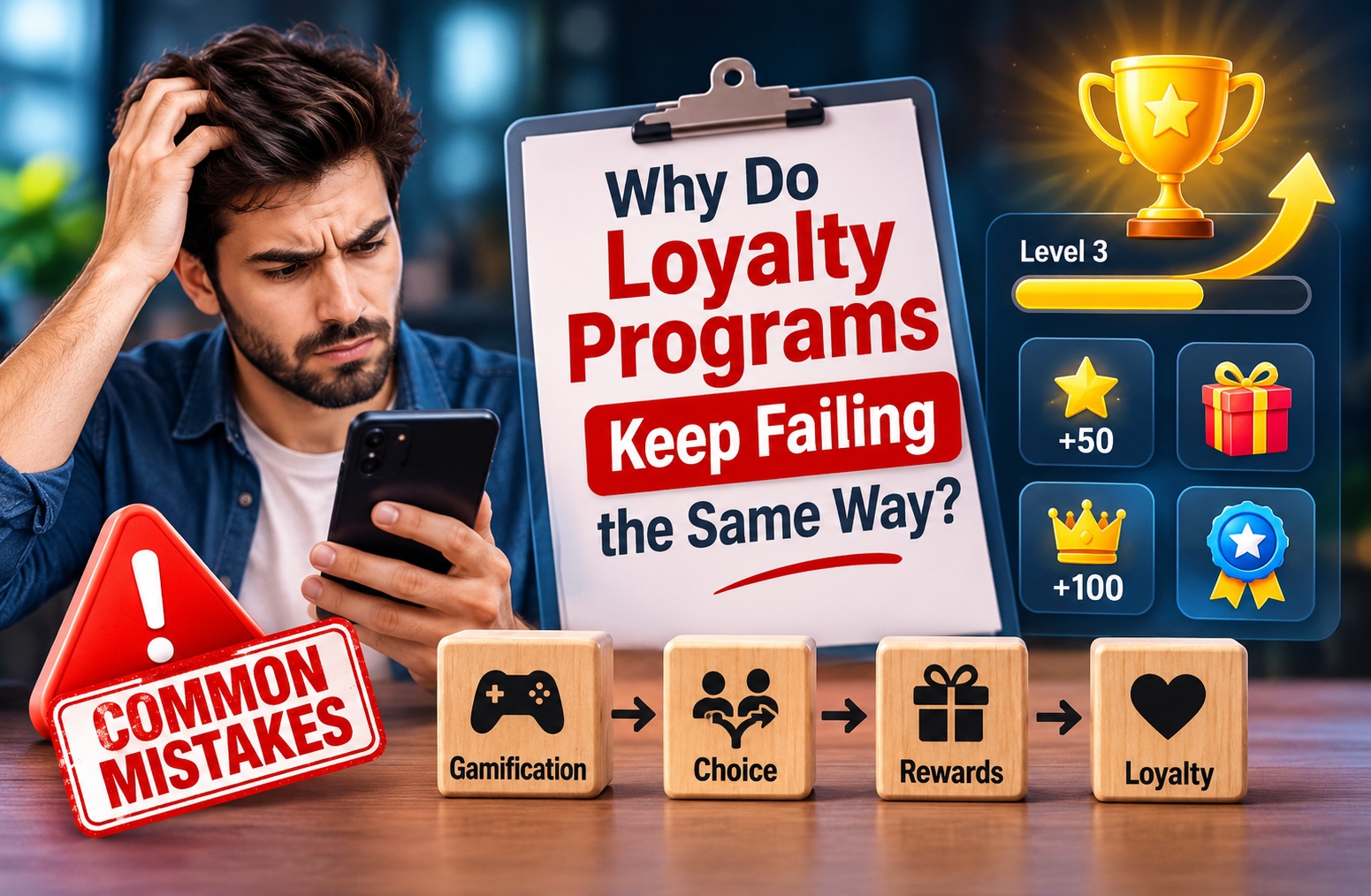
Why Do Loyalty Programs Keep Failing the Same Way?
Gamification embeds game mechanics into non-game experiences to shape behaviour. Points, progress bars, achievement badges, choice nodes, consequence visibility. The concept is simple.
Execution is where brands keep getting it wrong.
Most brands treat gamification as decoration. They finish building a transactional loyalty program, bolt on a badge system, and call it engaging.
A badge you earn for making three purchases is just a receipt with a star on it.
The poker world figured this out faster than most lifestyle categories. Players don’t stay loyal to a platform because of points. They stay because every session presents micro-decisions with visible consequences.
That architecture is the real design principle.
The Architectural Mistake Brands Keep Making
The standard model: build a commerce experience, add gamification on top. Earn points per dollar. Redeem for a discount.
Maybe a leaderboard. This is gamification as wallpaper.
The model that works: design the customer journey as a progression system first, then layer commerce on top. Every interaction should present a choice node – a micro-decision with a visible consequence. The consequence doesn’t have to be large. It has to be visible.
Here is the difference in practice:
- Wallpaper model: Buy a jacket, earn 50 points. Points accumulate invisibly. Redeem sometime. No decision was made. No consequence felt.
- Progression model: Choose between two reward paths at checkout. One gives faster tier advancement. One gives a one-time discount. The customer makes a decision and feels the consequence next session. Engagement follows from agency, not accumulation.
Game elements like progress bars, achievement tiers, and point systems tap into intrinsic motivation drivers that traditional marketing cannot reach. But only when the mechanics are structural, not cosmetic.
A Checklist for Diagnosing Your Program
Work through this in order. A “no” answer shows where your program is leaking loyalty.
- Does every interaction present a visible choice?
If customers move through your journey on autopilot, no decision architecture exists. Gamification requires agency. A progress bar with no fork in the road is just a loading screen. - Is the consequence of each choice immediately visible?
Delayed feedback kills motivation. A customer who chooses today but sees the result in a monthly statement never closes the psychological loop. Consequences must appear in the same session, or close to it. - Does your tier system reflect behaviour, not just spending?
Tiers tied only to purchase volume reward the wrong variable. Winning brands reward engagement patterns: frequency, variety of interaction, community participation. Spending is a lagging indicator of loyalty, not a driver of it. - Are your rewards intrinsic to the experience, not adjacent to it?
A coffee brand giving away airline miles rewards customers with something disconnected from why they showed up. Gamified loyalty programs work best when customers can learn poker-style progression: unlock benefits that deepen the core experience, not vouchers for unrelated products. - Does your program create social consequence, not just personal reward?
Leaderboards, community challenges, and visible tier badges create social stakes. A customer who reaches a named tier has a status to protect. That is a retention mechanism no points multiplier can replicate. - Is your progression system reversible?
Loss aversion is a stronger motivator than gain. If customers can drop a tier, they will work to maintain it. Brands that only offer upward progression remove half the motivational architecture. Use it carefully, but use it.
The Misconception That Kills Most Programs
The most common mistake: assuming engagement follows reward size. Brands increase point multipliers, add bigger prizes, and wonder why retention doesn’t improve.
Reward size is not the variable. Reward timing and agency are.
A small reward tied to a specific decision – and delivered immediately – outperforms a large reward that arrives passively after accumulated spend.
Gamification makes loyalty programs effective not by making rewards bigger, but by making the customer feel like an active participant in earning them.
GGPoker’s Ocean Rewards program is a useful structural example. Players earn Tide Points and GEMs through active play, and rakeback scales by tier. The consequence of engagement is visible and proportional.
The program doesn’t offer a flat reward for showing up. Behaviour drives tier. Tier drives reward.
That transparency is what closes the motivational loop.
What to Fix First
If your program scores “no” on more than two checklist items, don’t add more badges. Redesign the choice architecture first.
Start with one interaction in your customer journey. Add a fork: two paths, visible consequence, immediate feedback. Measure engagement on that interaction before touching anything else.
Brands that win at gamified loyalty don’t build elaborate systems overnight. They find one moment where agency can be introduced. Then they build outward from there.
For brands studying how digital-native categories apply these principles, the wsop online qualifier ecosystem is worth examining. Satellite structures give players repeated entry points and visible progression toward a defined goal. Players face meaningful choices at each stage – progression-first design with commerce layered on top, not the reverse.
The brands failing at loyalty are not failing because gamification doesn’t work. They are failing because they applied it to the wrong layer.