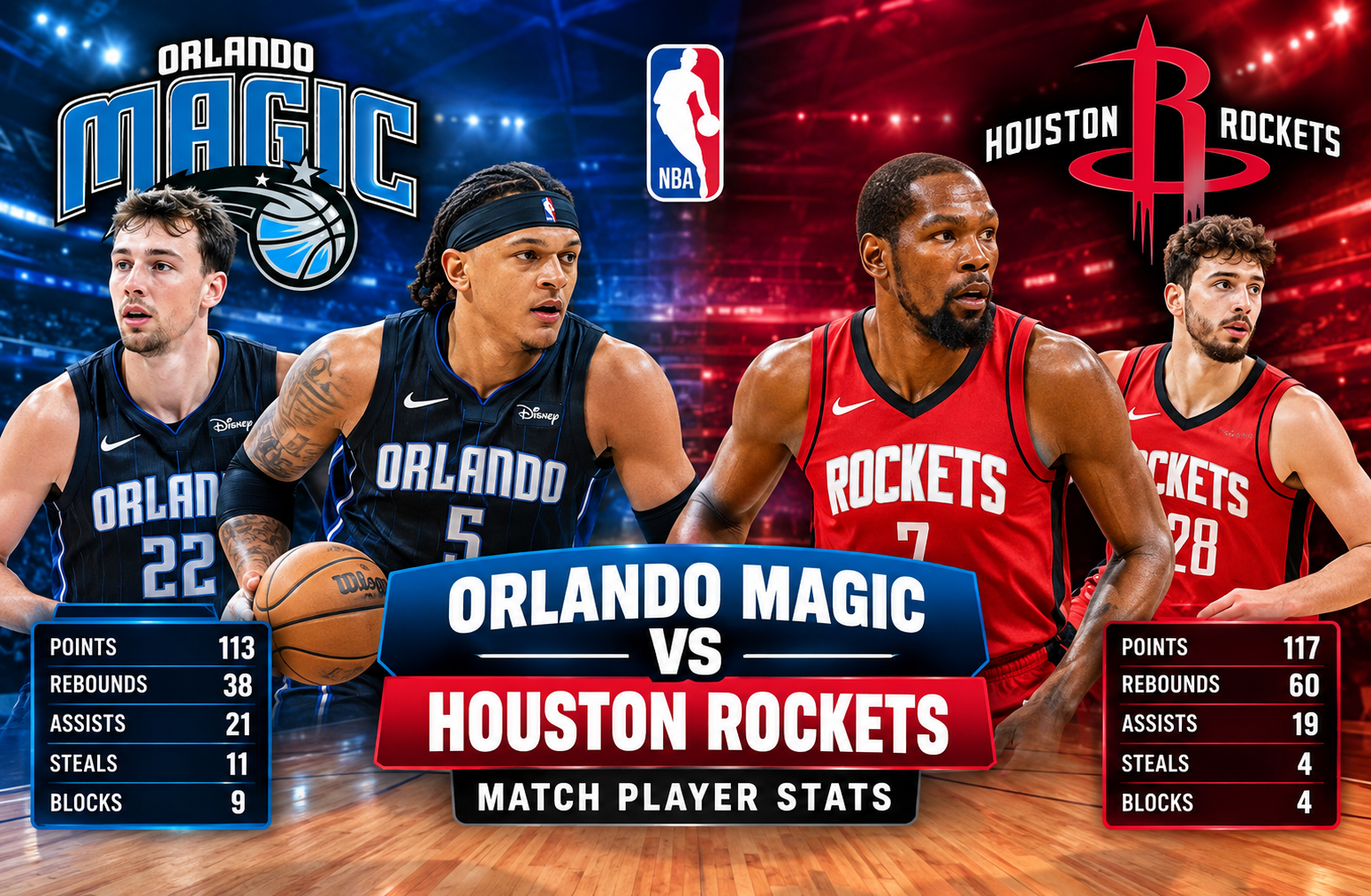
Orlando Magic vs Houston Rockets Match Player Stats
The orlando magic vs houston rockets match player stats from November 17, 2025, tell the story of a closely contested game that ultimately turned on Houston’s dominance on the glass. The Houston Rockets defeated the Orlando Magic 117-113 in overtime at Toyota Center, with Kevin Durant scoring 35 points and Alperen Sengun adding 30 points and 12 rebounds. Franz Wagner led Orlando with 29 points, while Desmond Bane contributed 26.
The final score does not fully explain why Houston won. Both teams shot 42 percent from the field, and Orlando actually committed only eight turnovers compared with Houston’s 14. The decisive statistical difference was rebounding. Houston collected 60 rebounds against Orlando’s 38, giving the Rockets a massive 22-rebound advantage.
That gap created additional possessions, particularly through Houston’s work on the offensive glass. Steven Adams alone grabbed 13 rebounds, including eight offensive boards, while Sengun collected 12 and Jabari Smith Jr. and Amen Thompson each added 10.
The game also highlighted two different offensive approaches. Orlando received major scoring contributions from Wagner, Bane, Anthony Black, Wendell Carter Jr. and Tristan da Silva. Houston, meanwhile, leaned heavily on Durant and Sengun, with Reed Sheppard providing another efficient scoring option.
Orlando Magic vs Houston Rockets Match Player Stats: Complete Game Overview
The November 17 meeting was played at Toyota Center in Houston, Texas, in front of 18,055 fans. The Rockets entered the contest with a 9-3 record and a 5-1 home mark, while Orlando was 7-7 overall and 3-4 on the road.
Houston eventually won 117-113 after overtime.
The game was particularly interesting because neither side dominated conventional shooting efficiency. Both teams finished at 42 percent from the field. The Rockets made more field goals because they attempted 100 shots, compared with 91 for Orlando.
That nine-shot difference is important.
Houston did not necessarily shoot better overall, but it created more opportunities. The 60-38 rebounding advantage was the clearest explanation for that difference in volume.
Final Score by Quarter
| Period | Orlando Magic | Houston Rockets |
| 1st Quarter | 30 | 23 |
| 2nd Quarter | 25 | 23 |
| 3rd Quarter | 25 | 31 |
| 4th Quarter | 22 | 25 |
| Overtime | 11 | 15 |
| Final | 113 | 117 |
Orlando actually started the game better, taking a 30-23 advantage after the opening period. Houston responded in the second quarter, but the Rockets still trailed 55-46 at halftime.
The third quarter changed the momentum.
Houston scored 31 points while holding Orlando to 25, cutting into the deficit. The Rockets then outscored Orlando again in the fourth quarter, 25-22, forcing overtime.
Houston controlled the extra period 15-11 to complete the comeback.
Kevin Durant Leads Houston With 35 Points
Kevin Durant was the biggest individual scoring factor in the game.
Durant finished with:
- 35 points
- 13-of-24 field goals
- 2-of-8 three-pointers
- 7-of-7 free throws
- 5 rebounds
- 6 assists
- 5 turnovers
- 1 block
His 13 made field goals were the most on either team, and his 35 points represented the game’s highest individual scoring total.
What stands out about Durant’s performance is that he did not need an exceptional three-point shooting night to score efficiently. He made only two of eight attempts from beyond the arc, but he converted 13 of 24 overall field goals and went a perfect seven for seven at the free-throw line.
His scoring also complemented Sengun rather than replacing him.
That distinction matters when evaluating the Houston offense. The Rockets had two players reach 30 points, giving Orlando a difficult matchup problem throughout the game.
Durant also contributed six assists. Although his five turnovers were costly, his ability to create scoring opportunities for teammates helped Houston maintain offensive pressure.
For player evaluation purposes, this was much more than simply a 35-point performance. Durant combined high-volume scoring with playmaking and rebounding while playing a central role in Houston’s overtime victory.
Alperen Sengun Produces a 30-Point, 12-Rebound Performance
Alperen Sengun was Houston’s second major offensive weapon and one of the most influential players on the floor.
His line was:
- 30 points
- 11-of-31 field goals
- 0-of-1 from three-point range
- 8-of-10 free throws
- 12 rebounds
- 8 assists
- 5 turnovers
- 2 blocks
The field-goal percentage was not particularly efficient, as Sengun needed 31 attempts to reach 30 points. However, his overall impact extended far beyond shooting.
He collected 12 rebounds and delivered eight assists, giving Houston another playmaking hub in the frontcourt.
His two blocks also contributed defensively.
Sengun’s rebounding was particularly valuable because Orlando had several players capable of scoring inside and attacking the paint. By securing 12 rebounds, he helped Houston control possessions after missed shots.
His eight assists also demonstrate why looking only at points can be misleading when evaluating the orlando magic vs houston rockets match player stats.
Sengun was involved in several areas of the game, including scoring, rebounding, passing and rim protection.
Franz Wagner Leads Orlando With 29 Points
Franz Wagner was Orlando’s top scorer with 29 points.
His complete statistical line was:
- 29 points
- 8-of-21 field goals
- 3-of-8 three-pointers
- 10-of-13 free throws
- 5 rebounds
- 4 assists
- 2 turnovers
- 2 steals
Wagner was especially effective at getting to the free-throw line. He made 10 of 13 attempts, which helped him maintain a strong scoring output despite making only eight field goals.
His three three-pointers also provided Orlando with important perimeter production.
The four assists show that Wagner was not simply operating as a scorer. He contributed to Orlando’s ball movement and helped create opportunities for teammates.
Defensively, two steals added another dimension to his performance.
Wagner’s 29 points were just six short of Durant’s game-high total, making him the primary offensive force for Orlando throughout the contest.
Desmond Bane Adds 26 Points for Orlando
Desmond Bane gave Orlando another strong scoring performance with 26 points.
His statistics included:
- 26 points
- 9-of-20 field goals
- 2-of-7 three-pointers
- 6-of-6 free throws
- 4 rebounds
- 4 assists
- 3 turnovers
- 1 steal
- 1 block
Bane’s nine made field goals were second among Orlando players, behind Wagner’s eight only because Bane took fewer overall attempts.
His perfect six-for-six free-throw shooting was also important.
The combination of Wagner and Bane gave Orlando 55 points from two players. That was enough to keep the Magic competitive, but Houston’s rebounding advantage prevented those scoring performances from translating into a win.
Bane also contributed four assists, meaning both of Orlando’s leading scorers were involved in playmaking.
Anthony Black Provides 18 Points
Anthony Black finished with 18 points on 7-of-14 shooting.
His line included:
- 18 points
- 7-of-14 field goals
- 1-of-5 three-pointers
- 3-of-5 free throws
- 3 rebounds
- 4 assists
- 2 turnovers
- 1 steal
- 1 block
Black’s 50 percent shooting from the field made him one of Orlando’s more efficient scorers.
His four assists were also tied with Wagner and Bane for the most among Orlando’s listed leading contributors.
Although his three-point shooting was limited, his ability to convert seven field goals helped maintain Orlando’s offensive balance.
Wendell Carter Jr. Makes an Impact on Both Ends
Wendell Carter Jr. recorded 15 points and delivered one of Orlando’s most notable defensive performances.
His statistics:
- 15 points
- 5-of-11 field goals
- 2-of-4 three-pointers
- 3-of-4 free throws
- 6 rebounds
- 2 assists
- 1 turnover
- 1 steal
- 4 blocks
The four blocks were particularly notable.
Carter Jr. also shot 50 percent from three-point range, making two of four attempts. That perimeter shooting helped stretch Houston’s defense.
His six rebounds tied Tristan da Silva for Orlando’s highest individual rebounding total.
Carter Jr.’s performance illustrates why box-score analysis should include defensive statistics. His 15 points were useful, but his four blocks added substantial defensive value.
Tristan da Silva Adds Efficient Scoring and Defensive Activity
Tristan da Silva finished with 13 points, six rebounds and three steals.
His line was:
- 13 points
- 5-of-10 field goals
- 2-of-6 three-pointers
- 1-of-2 free throws
- 6 rebounds
- 2 assists
- 3 steals
- 1 block
Da Silva was one of Orlando’s more active defensive players.
His three steals were the highest total among the players listed in the provided statistics. He also contributed a block, giving him four combined steals and blocks.
The six rebounds were equally important, although Orlando ultimately could not match Houston’s overall work on the boards.
Houston’s Rebounding Advantage Decided the Game
The single most important number in the orlando magic vs houston rockets match player stats is 60-38.
Houston outrebounded Orlando by 22.
That is an enormous difference in a game decided by only four points.
Houston’s 60 rebounds came from contributions throughout the roster:
- Steven Adams: 13
- Alperen Sengun: 12
- Jabari Smith Jr.: 10
- Amen Thompson: 10
- Reed Sheppard: 7
- Other Houston players: 8 combined
Steven Adams deserves special attention because eight of his 13 rebounds came on the offensive glass.
Offensive rebounds are particularly valuable because they extend possessions. A team that retrieves its own missed shots can create additional opportunities even when its initial offensive attempt fails.
Houston’s 14 turnovers were not ideal, but the Rockets compensated by creating additional possessions through rebounding.
That is why the final result cannot be explained by shooting percentage alone.
Both teams shot 42 percent. Houston simply generated more opportunities.
Steven Adams Controls the Offensive Glass
Steven Adams finished with only three points, but his contribution was much more significant than his scoring total suggests.
His line was:
- 3 points
- 1-of-8 field goals
- 1-of-2 free throws
- 13 rebounds
- 8 offensive rebounds
- 5 defensive rebounds
- 2 turnovers
The eight offensive rebounds are arguably the most important part of the line.
Adams repeatedly gave Houston second chances.
A player does not need to score 20 points to have a major impact on a basketball game. Adams’ rebounding helped create additional possessions for Durant, Sengun and the rest of the Rockets.
This is one of the clearest examples from the game of why advanced basketball analysis should look beyond points.
Jabari Smith Jr. and Amen Thompson Add 10 Rebounds Each
Jabari Smith Jr. and Amen Thompson both finished with 10 rebounds.
Smith Jr. recorded:
- 10 points
- 4-of-9 field goals
- 2-of-4 three-pointers
- 10 rebounds
- 1 turnover
- 1 steal
- 1 block
Thompson finished with:
- 12 points
- 4-of-13 field goals
- 4-of-4 free throws
- 10 rebounds
- 2 assists
- 1 turnover
Their double-digit rebounding performances were a major reason Houston built such a substantial advantage on the glass.
Smith Jr. also shot 50 percent from three-point range, while Thompson was perfect from the free-throw line.
Together, they contributed 22 rebounds and 22 points.
Reed Sheppard Provides Efficient Support
Reed Sheppard scored 16 points on 6-of-11 shooting.
His statistics included:
- 16 points
- 6-of-11 field goals
- 2-of-4 three-pointers
- 2-of-2 free throws
- 7 rebounds
- 2 assists
- 1 steal
Sheppard’s 7 rebounds were valuable for a guard-sized contributor, especially in a game where rebounding became the defining factor.
He also shot 50 percent from three-point range and made both free throws.
His efficiency helped Houston avoid relying exclusively on Durant and Sengun.
Aaron Holiday Gives Houston Efficient Minutes
Aaron Holiday scored 10 points while going 3-of-4 from the field, 2-of-2 from three-point range and 2-of-2 from the free-throw line.
That is a highly efficient scoring profile.
His statistical line also included one rebound and zero turnovers.
The zero turnovers are worth noting because Houston finished with 14 turnovers overall. Holiday avoided adding to that total while providing reliable perimeter shooting.
Team Shooting Comparison
The shooting numbers were surprisingly close.
| Category | Orlando | Houston |
| Field Goals | 38-91 | 42-100 |
| Field-Goal % | 42% | 42% |
| Three-Pointers | 12-37 | 8-20 |
| Three-Point % | 32% | 40% |
| Free Throws | 25-34 | 25-29 |
| Free-Throw % | 74% | 86% |
Orlando attempted 37 three-pointers compared with Houston’s 20.
That tells us the teams generated offense in different ways.
Orlando relied more heavily on perimeter attempts, while Houston took 100 total shots and benefited from its enormous rebounding advantage.
Houston also had the better free-throw percentage.
The Rockets made 25 of 29 free throws, an 86 percent success rate. Orlando made 25 of 34, or 74 percent.
That nine-percentage-point difference mattered in a four-point game.
Rebounding, Assists and Turnovers
| Category | Orlando | Houston |
| Rebounds | 38 | 60 |
| Assists | 21 | 19 |
| Turnovers | 8 | 14 |
| Steals | 11 | 4 |
| Blocks | 9 | 4 |
This table reveals an interesting contrast.
Orlando was better at protecting the ball and creating defensive events. The Magic committed only eight turnovers and recorded 11 steals and nine blocks.
Houston, however, dominated the category that most directly affected possession volume: rebounding.
Houston had 22 more rebounds despite committing six more turnovers.
That is a strong example of how one statistical advantage can overwhelm several smaller disadvantages.
How Houston Came Back From the Halftime Deficit
Orlando scored 30 points in the first quarter and another 25 in the second, entering halftime with a nine-point lead.
Houston needed to change the game’s rhythm.
The Rockets did exactly that in the third quarter.
Houston scored 31 points while Orlando managed 25. The six-point swing reduced Orlando’s lead from nine to three.
The fourth quarter continued the trend.
Houston scored 25 while Orlando scored 22.
That tied the game and forced overtime.
The extra period then belonged to Houston.
The Rockets scored 15 overtime points compared with Orlando’s 11, producing the final 117-113 result.
This progression is important because the final margin was not created by one explosive quarter. Houston gradually changed the game after halftime.
Orlando’s Strong Start Was Not Enough
Orlando’s 30-point first quarter showed that the Magic could generate efficient offense against Houston.
Wagner and Bane eventually combined for 55 points, while Black, Carter Jr. and da Silva provided meaningful secondary production.
The problem was maintaining possession control on the boards.
Orlando finished with only 38 rebounds.
Even with just eight turnovers, the Magic could not overcome Houston’s second-chance opportunities.
This is a useful lesson when analyzing close NBA games: ball security and rebounding are separate forms of possession management.
Orlando protected the ball well.
Houston controlled the missed-shot battle.
The latter proved more influential in this matchup.
What the Player Stats Say About the Game
The orlando magic vs houston rockets match player stats reveal several clear themes.
1. Houston won through possession volume
The 60-38 rebounding advantage gave Houston opportunities that Orlando did not receive.
2. Durant and Sengun formed a powerful scoring combination
Durant scored 35 and Sengun scored 30.
Together they produced 65 points, more than half of Houston’s regulation-plus-overtime total.
3. Orlando had strong individual scoring
Wagner scored 29, Bane 26 and Black 18.
That trio accounted for 73 points.
4. Orlando defended aggressively
The Magic recorded 11 steals and nine blocks.
Carter Jr. alone had four blocks.
5. Houston’s efficiency at the free-throw line mattered
The Rockets shot 86 percent from the line compared with Orlando’s 74 percent.
6. Overtime magnified the small differences
After four quarters, the game was tied. In those five extra minutes, Houston scored 15 points and Orlando scored 11.
Key Statistical Takeaways for Basketball Analysts
For readers who track NBA box scores for fantasy basketball, team analysis, historical research or performance evaluation, several numbers stand out.
Durant’s scoring efficiency
Durant’s 13-of-24 shooting resulted in a strong field-goal percentage of roughly 54.2 percent.
His three-point percentage was only 25 percent, but his overall shooting remained effective because he generated a large share of his offense from inside the arc and converted all seven free throws.
Sengun’s all-around production
Sengun’s 30 points, 12 rebounds and eight assists show how much offensive responsibility he carried.
His 11-of-31 shooting was inefficient, but his rebounding and passing substantially increased his overall impact.
Wagner’s balanced contribution
Wagner produced 29 points, five rebounds, four assists and two steals.
His ability to score while contributing in several other categories made him Orlando’s most complete offensive performer.
Carter Jr.’s defensive influence
Carter Jr.’s four blocks were a major defensive contribution.
His 15 points and six rebounds also made his performance valuable on offense.
Adams’ rebounding value
Adams’ 13 rebounds, including eight offensive boards, were among the most influential numbers of the night.
His three points were insignificant compared with the number of possessions his rebounding created.
Why the 22-Rebound Gap Matters More Than the Four-Point Margin
A four-point final margin can make a game look almost perfectly balanced.
The underlying numbers tell a different story.
Houston finished with 60 rebounds compared with 38 for Orlando.
That 22-rebound difference is more than five times the final margin.
It does not mean every rebound directly produced points, but it demonstrates the scale of Houston’s possession advantage.
The Rockets also attempted nine more field goals.
That difference is consistent with a team receiving more opportunities after missed shots.
The relationship between rebounds and field-goal attempts is one of the most useful lessons from this game.
If two teams shoot at the same overall percentage, the team that creates more attempts has a strong opportunity to score more points.
Houston did precisely that.
Official Context and Basketball Data
For readers who want to compare this game with official league information, the NBA official website is a useful authoritative reference for league-level basketball information, schedules and statistics.
When publishing statistical articles, it is important to distinguish between verified box-score data and interpretation. The player statistics and game figures used in this article are based on the game data provided for this matchup.
Frequently Asked Questions
Who was the top scorer in the Orlando Magic vs Houston Rockets game?
Kevin Durant was the game’s leading scorer with 35 points for Houston. Alperen Sengun scored 30, while Orlando’s Franz Wagner led the Magic with 29.
What was the final score of the Orlando Magic vs Houston Rockets game?
Houston defeated Orlando 117-113 in overtime on November 17, 2025, at Toyota Center.
Who had the most rebounds in the game?
Steven Adams led all players with 13 rebounds. Alperen Sengun followed with 12, while Jabari Smith Jr. and Amen Thompson each recorded 10.
Why did Houston beat Orlando?
The biggest statistical difference was rebounding. Houston outrebounded Orlando 60-38, a 22-rebound advantage. Houston also shot 86 percent from the free-throw line compared with Orlando’s 74 percent.
How many points did Franz Wagner score?
Franz Wagner scored 29 points on 8-of-21 shooting. He also made three three-pointers and 10 free throws.
Did the game go to overtime?
Yes. The teams were tied after regulation. Houston outscored Orlando 15-11 in overtime to win 117-113.
Conclusion
The orlando magic vs houston rockets match player stats provide a strong example of why a basketball game cannot be understood through the final score alone.
Houston won 117-113, but the most important story was its 60-38 rebounding advantage. The Rockets created more opportunities despite committing 14 turnovers and recording fewer steals and blocks than Orlando.
Kevin Durant led all scorers with 35 points, while Alperen Sengun added 30 points, 12 rebounds and eight assists. Their combined scoring gave Houston the offensive foundation it needed during the comeback.
Orlando also received outstanding individual performances. Franz Wagner scored 29 points, Desmond Bane added 26 and Anthony Black contributed 18. Wendell Carter Jr. supplied four blocks, while Tristan da Silva recorded three steals.
The game ultimately came down to possession control. Orlando protected the basketball better, but Houston controlled the boards. Steven Adams’ eight offensive rebounds were especially important, and the combined rebounding efforts of Sengun, Smith Jr. and Thompson helped Houston maintain pressure throughout the second half.
The 15-11 overtime advantage completed a comeback after Orlando had led 55-46 at halftime.
For anyone studying the orlando magic vs houston rockets match player stats, the clearest lesson is that shooting percentages alone do not determine a close NBA game. Rebounding, second chances, free-throw efficiency, turnovers and late-game execution can collectively decide the outcome.