Moss Agate: Meaning, Properties, Benefits, Uses, and Care
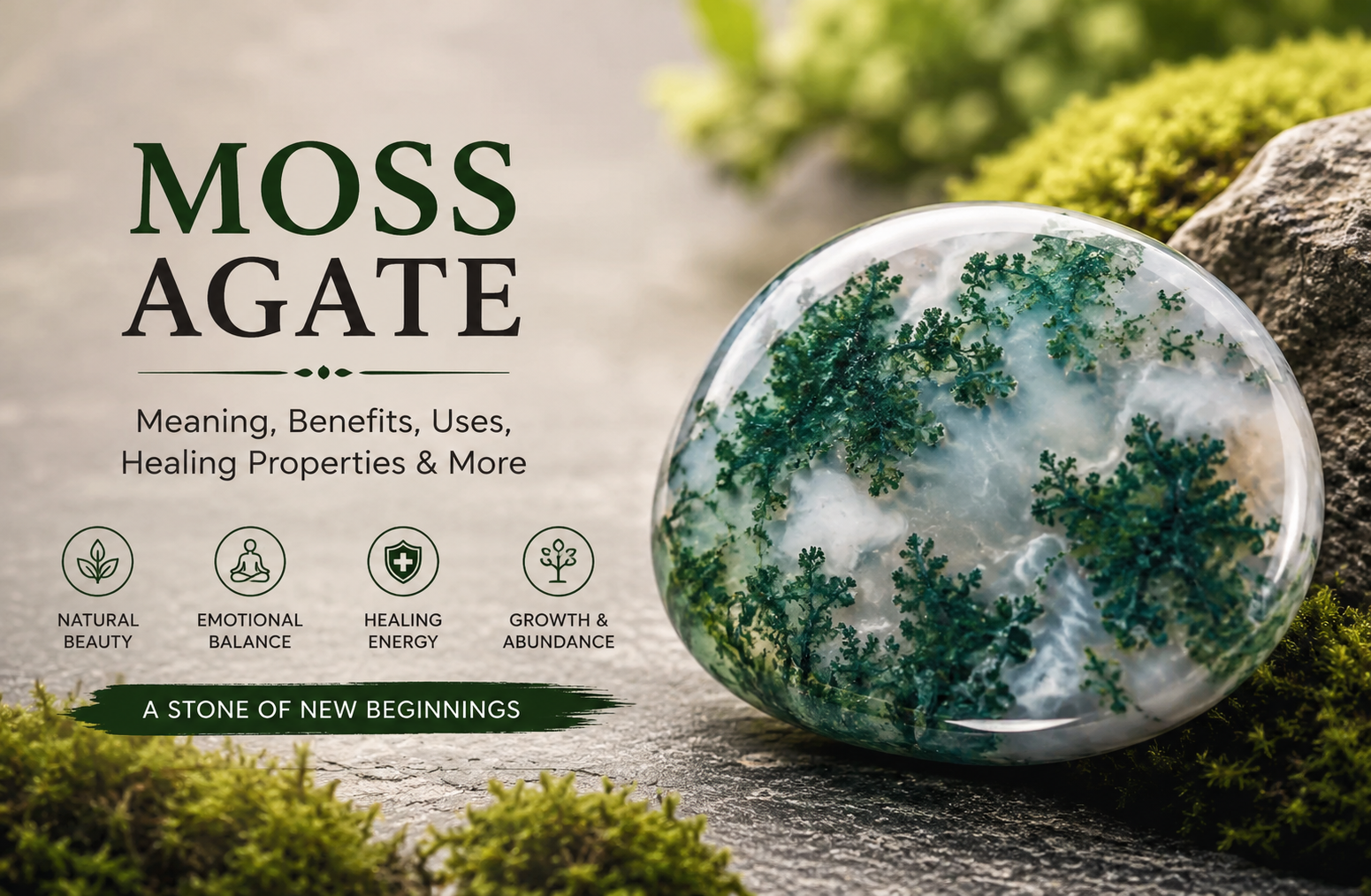
Moss Agate is a beautiful variety of chalcedony known for its natural green, moss-like patterns, earthy appearance, and connection with nature. Unlike many gemstones that are valued for their bright colors or sparkling surfaces, this stone attracts attention through its delicate internal designs. Its green inclusions often resemble tiny trees, forest landscapes, flowing plants, or moss growing across a natural surface. These patterns make every piece visually distinctive.
Beyond its appearance, this gemstone has a long-standing place in jewelry, decorative objects, mineral collecting, and crystal traditions. People are interested in its natural formation, spiritual symbolism, physical properties, durability, value, and practical uses. Some also associate it with growth, emotional balance, abundance, and a closer connection to the natural world.
However, understanding this stone requires separating established mineralogical facts from traditional beliefs. Its geological characteristics can be examined scientifically, while its spiritual meanings belong to cultural and personal interpretations rather than proven medical or scientific effects.
This guide explores everything worth knowing, from its formation and identification to its jewelry applications, traditional symbolism, buying considerations, and proper care. Whether you are considering purchasing a piece, studying minerals, or simply curious about its unusual appearance, understanding these details will help you appreciate it more fully.
What Is Moss Agate?
Moss Agate is a translucent to semitranslucent variety of chalcedony, a microcrystalline form of quartz. It is recognized by its characteristic green, brown, black, or occasionally reddish inclusions that create patterns resembling vegetation.
Although its name includes the word agate, its appearance differs from the familiar banded patterns found in many traditional agates. Instead of displaying clearly defined concentric bands, it usually contains irregular, branching, or cloud-like inclusions distributed throughout the stone.
The green patterns are commonly associated with mineral inclusions, particularly iron-bearing minerals. These inclusions create the appearance of moss, leaves, roots, or miniature landscapes trapped inside the translucent material.
One important detail is that the green designs are not actual plants or biological material. They are mineral structures formed through geological processes over long periods.
The stone is generally valued for three main reasons:
- Natural appearance: Its organic-looking patterns make it visually different from many other gemstones.
- Jewelry versatility: It can be cut, polished, and shaped into pendants, rings, bracelets, and other accessories.
- Decorative appeal: Its landscape-like appearance makes it popular among mineral collectors and people who appreciate nature-inspired objects.
Its appearance can vary significantly from one specimen to another. Some pieces contain delicate green branches against a nearly clear background, while others have dense inclusions that cover most of the visible surface.
This variation is one of the main reasons collectors appreciate individual specimens rather than expecting every piece to look identical.
Geological Formation and Natural Composition
Understanding how this gemstone develops explains why its patterns are so unusual.
Chalcedony forms when silica-rich solutions deposit microscopic quartz material within cavities, fractures, or other spaces in rocks. As these deposits develop, they can trap or surround other minerals.
In specimens displaying moss-like patterns, mineral inclusions become incorporated into the silica-rich material. Their distribution and shape produce the characteristic organic designs.
How Does It Form?
The formation process can be understood through several geological stages.
- Creation of cavities in rocks
Small openings and cavities develop within host rocks through geological activity. These spaces may result from volcanic processes, fractures, or changes in surrounding rock material.
- Movement of mineral-rich fluids
Water containing dissolved silica moves through these openings. Depending on local geological conditions, the fluids may also carry other dissolved substances.
- Deposition of chalcedony
Silica gradually deposits along the cavity walls or throughout available spaces. Over time, microscopic quartz crystals develop into chalcedony.
- Development of inclusions
Other minerals may become incorporated into the growing material. Iron-bearing minerals are commonly associated with the green or brown patterns found in these specimens.
- Natural solidification
As mineral deposition continues, the material becomes more solid. Later geological changes and erosion may expose the stone, making it available for collection and processing.
The exact conditions responsible for individual patterns can differ. This is why two specimens from similar geological environments may still have noticeably different appearances.
What Gives It Its Green Color?
The green appearance is one of its most recognizable features.
Green patterns are generally associated with mineral inclusions rather than the primary silica material itself. Depending on the specimen, these inclusions may contain iron-rich minerals such as chlorite or other minerals responsible for green coloration.
The distribution of these materials creates the branching, cloudy, or moss-like structures visible inside the stone.
Not every specimen has the same shade of green. Common variations include:
- Pale sage green
- Deep forest green
- Olive green
- Yellowish green
- Green mixed with brown
- Dark green against a translucent background
Some specimens also contain black, red, orange, or brown areas. These colors depend on the minerals present and the geological conditions during formation.
Is It a True Agate?
This is a common mineralogical question.
Traditional agate is generally recognized by its characteristic banding. The moss-like variety, however, often lacks the obvious layered structure associated with ordinary banded agate.
It is more accurately understood as a patterned variety of chalcedony. The term agate remains widely used because of its established commercial and mineral-collecting identity.
The important distinction is that its appearance is produced mainly by mineral inclusions rather than the regular bands found in many other agates.
Physical and Mineralogical Properties
The physical characteristics of a gemstone determine how it behaves during cutting, polishing, jewelry production, and everyday use.
Moss Agate shares many characteristics with other forms of chalcedony because both belong to the quartz mineral family.
| Property | General characteristics |
| Mineral group | Quartz |
| Mineral variety | Chalcedony |
| Chemical composition | Silicon dioxide (SiO₂) |
| Crystal structure | Microcrystalline |
| Crystal system | Trigonal |
| Mohs hardness | Approximately 6.5 to 7 |
| Luster | Waxy to vitreous |
| Transparency | Translucent to semitranslucent, sometimes opaque |
| Fracture | Uneven to conchoidal |
| Cleavage | None |
| Common appearance | Green branching or moss-like inclusions |
These properties explain why the stone can be polished to a smooth finish and used in different jewelry designs.
Hardness and Durability
Its hardness of approximately 6.5 to 7 on the Mohs scale makes it reasonably suitable for jewelry.
However, hardness should not be confused with toughness.
Hardness describes resistance to scratching, while toughness relates to resistance to breaking, chipping, or cracking. Although chalcedony is relatively hard, it can still become damaged by strong impacts.
This distinction matters when choosing jewelry.
For example:
- Pendants generally experience less direct impact than rings.
- Bracelets may repeatedly contact hard surfaces.
- Rings can be exposed to accidental knocks during daily activities.
- Loose stones need appropriate storage to prevent contact with harder gemstones.
A well-made setting and sensible handling can help preserve its appearance for many years.
Transparency and Surface Appearance
The stone can range from nearly transparent to mostly opaque.
Its background may appear clear, milky white, pale gray, or slightly colored. The internal inclusions provide most of its distinctive visual character.
After polishing, the surface generally develops a smooth, glossy finish. This allows the internal patterns to become more noticeable.
The final appearance depends on the cutting direction, thickness, polishing quality, and distribution of inclusions.
A properly cut specimen can reveal patterns that are difficult to appreciate when the material is still rough.
Moss Agate Meaning and Symbolism
Moss Agate has a strong association with nature, growth, renewal, and stability.
Its branching green patterns resemble vegetation, forests, and natural landscapes. These visual similarities have contributed to its symbolic connection with the natural world.
In modern crystal traditions, it is frequently described as a stone associated with personal development, patience, emotional balance, and abundance.
It is important to understand that these meanings are symbolic. There is no reliable scientific evidence that wearing or holding the stone directly changes someone’s emotions, financial circumstances, physical health, or personal future.
Nevertheless, symbolic objects can have personal meaning. Someone may use a gemstone as a reminder of a goal, a meaningful experience, or a value they want to maintain.
Symbol of Growth and New Beginnings
One of its most common symbolic associations is growth.
Its green patterns resemble new leaves, branches, and developing plants. Because of this appearance, people often connect it with fresh opportunities and positive changes.
It may be chosen as a personal reminder to:
- Develop new skills.
- Begin a meaningful project.
- Build healthier habits.
- Stay patient during difficult periods.
- Appreciate gradual progress.
The symbolism is particularly relevant to people who enjoy nature-inspired jewelry or prefer objects with personal significance.
Connection With Nature
The natural appearance of the stone makes it a popular symbol of environmental connection.
Its patterns resemble miniature forests, making it visually appealing to people who enjoy gardening, outdoor activities, plants, and natural landscapes.
Some people keep polished specimens on desks, shelves, or bedside tables as decorative reminders of their appreciation for nature.
This connection does not require any spiritual belief. Its organic appearance alone provides a meaningful aesthetic link to the natural world.
Symbolism of Stability and Patience
Plants do not grow instantly. They develop through consistent changes over time.
This natural process provides a useful symbolic interpretation of the stone. It can represent patience, steady effort, and the importance of allowing personal development to happen gradually.
For someone working toward a long-term goal, it may serve as a small physical reminder that progress does not always need to be immediate to be meaningful.
Abundance and Prosperity
In crystal traditions, this gemstone is sometimes associated with abundance, business growth, and financial opportunity.
These interpretations are based on traditional symbolism rather than scientific findings.
There is no established evidence that a gemstone attracts money or guarantees business success. Financial progress depends on practical factors such as planning, skills, informed decisions, and consistent effort.
Its symbolic association with abundance can still make it a meaningful gift for someone starting a business, beginning a new career, or entering a different stage of life.
Benefits and Practical Reasons People Choose This Gemstone
The popularity of this gemstone comes from a combination of natural beauty, versatility, and symbolic meaning. Its benefits are best understood by separating practical advantages from traditional crystal interpretations.
1. Unique Natural Appearance
One of its strongest advantages is that no two natural specimens need to look exactly alike.
The mineral inclusions create patterns that can resemble forests, branches, roots, leaves, or abstract natural artwork. This makes it particularly attractive to people who prefer unusual gemstones over standardized designs.
Unlike manufactured decorative materials, naturally formed inclusions develop through geological processes. Their irregular appearance is part of the stone’s appeal.
2. Suitable for Different Jewelry Styles
Its moderate hardness and ability to accept a smooth polish make it useful for several types of jewelry.
Common applications include:
- Rings with polished cabochon settings.
- Necklaces featuring oval or round stones.
- Bracelets made with polished beads.
- Earrings with small natural specimens.
- Statement pendants featuring larger patterns.
- Handmade jewelry incorporating irregular stone shapes.
Its green and earthy colors work well with silver, gold, bronze, and neutral-colored materials.
3. A Nature-Inspired Decorative Material
Not everyone purchases gemstones for jewelry. Some people prefer keeping natural minerals as decorative objects.
Its internal patterns make it suitable for:
- Decorative desk accessories.
- Small display collections.
- Polished mineral specimens.
- Carved ornaments.
- Decorative bowls and gemstone arrangements.
The natural patterns can create an interesting focal point without requiring additional decoration.
4. Personal and Symbolic Meaning
For people who appreciate crystal symbolism, it can represent growth, renewal, patience, and stability.
Some individuals use it as a personal reminder to remain focused on their goals or maintain a connection with nature.
These are personal and cultural interpretations rather than measurable physical benefits.
5. A Collectible Natural Mineral
Mineral collectors often appreciate specimens with unusual inclusion arrangements.
A piece with clearly visible branching structures, attractive transparency, and balanced coloration may be more interesting than a larger specimen with less distinctive patterns.
Collectors may also value pieces that demonstrate unusual geological characteristics or have reliable information about their origin.
Traditional Healing Properties and Crystal Beliefs
Moss Agate has a prominent place in modern crystal practices. It is often described as a grounding or balancing stone, with traditional associations involving emotional well-being, physical vitality, and prosperity.
These claims should be approached carefully.
There is no established scientific evidence that this gemstone can treat illnesses, regulate bodily systems, remove negative energy, or replace medical care. Its traditional healing associations should not be presented as proven health benefits.
That distinction does not prevent people from appreciating the stone as part of personal reflection, meditation, or decorative practices.
Emotional Healing Associations
In crystal traditions, it is commonly associated with emotional balance and inner stability.
People who use crystals for personal reflection may associate it with:
- Remaining calm during stressful situations.
- Developing patience.
- Letting go of unhelpful habits.
- Building confidence during personal changes.
- Maintaining a positive outlook.
A practical way to use this symbolism is to connect the stone with a specific intention.
For example, someone beginning a new career might keep a small polished specimen on a desk as a reminder to approach challenges patiently and consistently.
The psychological value, if any, comes from the individual’s personal practice and interpretation, not from a demonstrated energy emitted by the mineral.
Physical Healing Claims
Some alternative crystal traditions associate the stone with general physical wellness, vitality, and the body’s natural balance.
However, these claims have not been established through reliable clinical evidence.
It should never be used instead of:
- Prescribed medication.
- Medical diagnosis.
- Professional treatment.
- Evidence-based healthcare.
- Advice from a qualified healthcare professional.
Holding a gemstone or wearing it as jewelry is generally a personal choice, but it should not create unrealistic expectations about physical recovery.
Meditation and Mindfulness
Its nature-inspired appearance makes it a popular choice among people who enjoy meditation and mindfulness.
A simple practice involves holding a polished stone while focusing on breathing or reflecting on a personal goal.
The process can be approached without making supernatural claims.
For example:
- Find a comfortable and quiet place.
- Hold the stone or place it nearby.
- Take several slow, comfortable breaths.
- Think about one goal or concern.
- Reflect on a practical step you can take.
- Finish by writing down that step.
The gemstone acts as a physical reminder during the exercise. Any benefit comes from the mindfulness practice rather than a proven mineral-based healing mechanism.
Different Types and Color Variations
Although green is the most familiar appearance, this gemstone can display several color combinations.
The background material, mineral inclusions, and their distribution determine the final appearance.
Green Moss Agate
The most recognizable variety
Kross Studio: KS 05 Titanium Moss Agate | WatchTime
Green specimens are especially popular because their inclusions resemble leaves, moss, and small branches.
Some have delicate green lines against a nearly transparent background. Others feature dense green formations that cover much of the surface.
The contrast between the pale chalcedony and green inclusions is often the main attraction.
Tree-Like and Dendritic Patterns
モスアゲート マングローブの森 40.9cts./ ルース・カボション – Stone marble – 天然石と鉱物のギャラリー・ショップ
Some specimens have branching patterns that resemble miniature trees.
The word dendritic describes branching structures. It is used in mineralogy to describe patterns that resemble the branching growth of plants.
Although these patterns can look like tiny trees, they are mineral formations rather than preserved plant material.
Red and Brown Moss Agate
Scenic Moss Agate Cabochon 32x22x6mm High Quality 35 ct | eBay
Red and brown varieties contain inclusions or coloration associated with iron-bearing minerals.
Their appearance can range from rusty orange to deep reddish brown.
Some pieces combine green, brown, and red patterns, producing a more complex natural design.
White and Clear Moss Agate
These specimens have a lighter background that allows their internal structures to remain clearly visible.
They can be especially attractive when the inclusions are relatively sparse and widely distributed.
The contrast between translucent chalcedony and delicate mineral patterns gives these pieces a subtle appearance.
Dark Moss Agate
Green Agate: Complete Guide (2026) | Healing Crystals Co.
Darker specimens contain dense inclusions or darker background material.
They are sometimes selected for statement jewelry because their deeper colors create a bold appearance.
When buying dark pieces, examine them under natural light to understand the actual color and visibility of the inclusions.
Moss Agate vs. Other Similar Gemstones
Several gemstones have green colors or organic-looking patterns. However, their mineral composition, appearance, and physical characteristics are different.
Understanding these differences helps prevent confusion when purchasing natural stones.
Moss Agate vs. Tree Agate
Large Moss Agate Freeform Cabochon Loose Gemstone for Jewelry Making Supplies 50x33x5mm – Etsy
Moss Agate
Usually translucent with visible internal green or dark inclusions.
Toutes les pierres blanches et leurs vertus en lithothérapie
Tree Agate
Generally opaque white or pale material with green branching patterns.
These two materials are closely related in appearance, but they are not identical.
Moss agate commonly has a translucent chalcedony background. Tree agate is generally more opaque and often has green patterns distributed through a white or pale base.
The distinction is useful when comparing specimens, although commercial naming practices are not always consistent.
Moss Agate vs. Dendritic Agate
100% Natural Green Moss Agate OVAL Cabochon 51.00CT 32x41x4mm Top Loose Gemstone | eBay
Moss Agate
Typically green or multicolored moss-like inclusions.
Dendritic Agate : Properties, Formation, Inclusions, Localities – Geology Science
Dendritic Agate
Often displays dark, fern-like or tree-like branching patterns.
Both can contain dendritic structures, and their commercial descriptions sometimes overlap.
The distinction generally relates to the appearance and coloration of their inclusions. Dendritic patterns are commonly black or brown, while moss-like patterns are often green.
Moss Agate vs. Green Aventurine
▷ AGAT MSZYSTY – PŁASKI OTOCZAK – 41 mm cena, oryginał, unikat • Sklep internetowy Magia Kamieni
Moss Agate
Distinct internal branching mineral patterns.
★グリーンアベンチュリン★18.8ct/25.0mm★天然石砂金水晶 ★アベンチュレッセンス★カボションルース裸石鉱物 天然石 space-stone 通販 19476521|Creema(クリーマ)
Green Aventurine
Usually green quartz with a granular or subtly sparkling appearance.
Green aventurine is a quartz variety that often contains reflective mineral inclusions, producing a glittering effect known as aventurescence.
Moss agate is recognized for its irregular, moss-like internal structures rather than a sparkling surface.
Moss Agate vs. Jade
Natural Moss Agate Green Cabochon 34×23 Mm Oval Loose Gemstone S20728 | Gemexi
Moss Agate
Microcrystalline quartz with mineral inclusions.
Verified Supplier Cabochon Jadeite Customizable Green Jade | Alibaba.com
Jade
A different mineral material, usually jadeite or nephrite.
Jade is not a form of chalcedony. It refers mainly to two different minerals: jadeite and nephrite.
Although both materials can be green, their mineral composition and internal structure are different.
A seller should never describe one as the other simply because their colors appear similar.
Common Uses in Jewelry and Everyday Life
The versatility of this gemstone makes it useful in both traditional jewelry and contemporary decorative designs.
Its internal patterns can be highlighted through different cutting techniques, allowing designers to create pieces ranging from subtle accessories to large statement items.
Rings
Natural Green Moss Agate Leaf Engagement Ring in Sterling Silver – Aquamarise
Rings are among the recognizable jewelry applications.
Oval, round, and irregular cabochons are commonly used because these shapes provide a broad surface for displaying internal patterns.
The main consideration is protection. Rings are exposed to accidental impacts, so a protective setting with a secure bezel can be a sensible choice.
Necklaces and Pendants
Sterling Silver Green Moss Agate Pendant – Solstice
Pendants are particularly suitable for specimens with attractive internal patterns.
A larger stone can display more of its natural design, while a smaller pendant offers a subtle everyday accessory.
Silver settings complement its green tones, while gold can create a warmer contrast.
Bracelets
Polished beads are frequently used in bracelets.
Individual beads may display different patterns, making each bracelet visually distinctive.
When selecting one, check for chipped surfaces, uneven drilling, and weak connecting components.
Earrings
Moss Agate Drop Earrings | Made in Earth Australia
Smaller pieces work well in earrings.
Matching pairs may be difficult because natural specimens rarely have identical patterns. Some jewelry designers use intentionally contrasting stones instead of attempting to create a perfectly identical pair.
Home Decoration
5.5″ Polished, Free-Standing Moss Agate – Oregon (#246262) For Sale – FossilEra.com
Larger pieces can be displayed as natural decorative objects.
Common examples include polished slices, freeform specimens, small carved objects, and mineral collection pieces.
These objects can be displayed individually or alongside other natural minerals.
Where Is Moss Agate Found?
Chalcedony occurs in many parts of the world, and moss-like varieties are associated with several geological regions.
India and the United States are recognized sources of moss agate material. Other chalcedony-producing areas also contain specimens with similar inclusion patterns.
India
India has a long history of chalcedony collection, cutting, and gemstone processing.
Indian material is widely encountered in the international gemstone trade, particularly in beads, cabochons, and decorative products.
United States
Several American regions produce different forms of chalcedony and agate.
The availability and appearance of specimens vary by location. Some collectors value locally collected material because it provides information about a particular geological environment.
Other International Sources
Chalcedony and agate deposits occur in numerous countries, including Brazil, Uruguay, and other parts of the world.
However, it is important not to assume that every chalcedony-producing country is a major source of moss agate specifically.
The country of origin alone does not establish a specimen’s quality. Its internal patterns, transparency, condition, cutting, and natural appearance are more relevant to many buyers.
How to Identify Genuine Moss Agate
Identifying a natural specimen requires more than looking for green patterns.
Some imitation materials and treated stones can look convincing in photographs. A careful examination can reduce the risk of purchasing something that has been incorrectly described.
1. Examine the Internal Patterns
Natural moss-like inclusions usually have irregular structures.
Look for:
- Branching or cloud-like mineral formations.
- Different levels of transparency.
- Natural variations in pattern density.
- Uneven distribution of internal inclusions.
- Patterns that appear embedded within the stone.
Perfectly repeated patterns or suspiciously uniform designs deserve closer inspection.
However, natural specimens can sometimes have unusually regular appearances, so pattern alone cannot prove authenticity.
2. Check the Background Material
The base material is usually translucent to semitranslucent chalcedony, although opaque examples also exist.
Examine whether the inclusions appear to sit inside the stone rather than simply being printed or painted onto its surface.
A magnifying loupe can help reveal the relationship between the inclusions and the surrounding material.
3. Observe the Stone Under Different Lighting
Lighting can change the appearance of internal patterns.
Try examining the specimen under:
- Indirect daylight.
- Soft indoor lighting.
- Light passing through the stone, if it is sufficiently translucent.
A strong internal pattern may become easier to understand when light passes through the material.
Avoid relying on photographs taken with heavy color filters or excessive saturation.
4. Look for Artificial Color
Some chalcedony materials are dyed to produce stronger or more uniform colors.
Warning signs can include:
- Unusually intense green coloration.
- Color concentrated around cracks or surface openings.
- Suspiciously uniform color distribution.
- Inconsistent appearance between the surface and interior.
These signs are not conclusive. Some natural specimens are strongly colored, and professional testing may be necessary.
5. Request Accurate Seller Information
A trustworthy seller should be able to explain:
- Whether the material is natural.
- Whether it has been dyed or otherwise treated.
- Whether it has been assembled or enhanced.
- What is known about its geographical origin.
- Whether the description refers to natural mineral inclusions.
If the seller cannot verify a specific origin, that should be disclosed rather than replaced with an unsupported location claim.
6. Consider Professional Gemological Testing
For an expensive purchase, professional identification is a sensible option.
Gemologists can examine optical properties, internal characteristics, and other identifying features.
A simple home scratch test is not recommended. It can permanently damage the specimen and does not provide a reliable identification.
For additional technical information about chalcedony, its composition, inclusions, and identifying characteristics, consult this JDMIS Gem Reference on Chalcedony.
How Much Is Moss Agate Worth?
The value depends on several factors rather than a single fixed price.
Unlike rare precious gemstones with established grading systems, ordinary moss agate generally has a broad commercial market. Prices can differ considerably depending on size, cutting, appearance, workmanship, and seller.
A small polished stone may be inexpensive, while a large, visually impressive specimen or carefully designed piece of jewelry can command a higher price.
Factors That Influence Its Value
- Pattern Quality
The internal pattern is one of the most important aesthetic considerations.
Specimens with attractive branching formations, good contrast, and balanced distribution may be more desirable.
- Transparency
A translucent background can help highlight the internal inclusions.
However, opaque pieces can also be attractive when their patterns and colors are distinctive.
- Color
Natural green, dark green, brown, and multicolored patterns can all have visual appeal.
Color preference is subjective, so a darker specimen is not automatically more valuable than a lighter one.
- Size and Weight
Larger specimens generally require more raw material and may cost more, particularly when they have attractive patterns and good condition.
However, size alone does not determine quality.
- Cutting and Polishing
A well-cut stone can reveal its internal structure more effectively.
Poorly polished surfaces, uneven shapes, visible chips, and unnecessary material loss can reduce its appeal.
- Jewelry Setting and Craftsmanship
For finished jewelry, the price also includes the metal, design, setting, labor, and brand.
A handmade silver pendant may cost considerably more than an unmounted stone of similar size.
- Natural or Treated Status
Natural color and untreated material may matter to some collectors.
Dyeing does not automatically make a gemstone worthless, but sellers should clearly disclose treatments so customers can make informed decisions.
Is Expensive Moss Agate Always Better?
No.
A high price does not guarantee exceptional mineral quality.
Before purchasing, compare the actual stone rather than relying on descriptions such as premium, rare, luxury, or spiritually powerful.
Ask yourself:
- Are the internal patterns attractive?
- Is the surface properly polished?
- Are there visible cracks or chips?
- Does the actual color match the seller’s photographs?
- Is the treatment status disclosed?
- Does the price reflect the craftsmanship and material?
A reasonably priced specimen that matches your preferences may be a better purchase than an expensive piece promoted through exaggerated claims.
How to Choose the Right Specimen
Choosing a gemstone should involve both visual preferences and practical considerations.
The best specimen is not necessarily the biggest or most expensive. It is the one that meets your intended purpose and has been accurately described.
Choose According to Your Purpose
If you want jewelry, consider the shape, setting, and durability.
For mineral collecting, focus more on the uniqueness of the inclusion patterns and the quality of the specimen.
For decoration, consider its overall size, stability, and appearance under the lighting where it will be displayed.
Pay Attention to the Cut
Cabochon cuts are popular because their smooth, curved surfaces allow internal patterns to remain visible.
Flat slices can reveal broader patterns, while beads provide a more rounded appearance.
Choose a cut that allows you to appreciate the stone’s natural structure.
Check for Surface Damage
Inspect the stone carefully before purchasing.
Look for:
- Chips around the edges.
- Deep fractures.
- Scratches.
- Uneven polishing.
- Damaged drill holes in beads.
- Weak or loose jewelry settings.
Small internal inclusions are part of its natural character. However, structural cracks can create practical problems.
Buy From Transparent Sellers
A good seller provides clear photographs, accurate descriptions, and honest treatment information.
If purchasing online, request photographs in natural lighting and ask whether the images show the exact specimen being sold.
This is particularly important because natural pattern variations mean that two pieces from the same batch can look completely different.
How to Clean and Care for Moss Agate
Proper care helps maintain its polished surface and prevents avoidable damage.
Although chalcedony is relatively durable, it is not indestructible.
Everyday Cleaning
The simplest cleaning method is usually sufficient.
Follow these steps:
- Prepare a bowl of lukewarm water.
- Add a small amount of mild soap.
- Gently clean the stone with a soft cloth.
- Use a soft brush for areas around the jewelry setting.
- Rinse carefully with clean water.
- Dry with a soft, lint-free cloth.
Avoid harsh cleaning chemicals and abrasive materials.
Avoid Strong Impacts
Do not throw the stone into a jewelry box or allow it to collide with harder objects.
Although its hardness provides reasonable scratch resistance, strong impacts can cause chips or fractures.
Store individual pieces separately when possible.
Protect It From Harsh Chemicals
Household cleaning products, strong acids, and other aggressive chemicals should be avoided.
These substances may affect the surface, treatments, or materials used in a jewelry setting.
Be Careful With Heat
Prolonged exposure to high temperatures can affect certain chalcedony materials and may alter some colors or treatments.
Avoid placing jewelry near direct heat sources or using high-temperature cleaning methods without confirming that the entire piece can tolerate them.
Store Jewelry Properly
A practical storage routine includes:
- Keeping each piece in a separate soft pouch.
- Avoiding contact with sharp metal objects.
- Storing jewelry in a dry environment.
- Checking clasps and settings regularly.
- Removing rings before activities that may cause impacts.
Should You Use Ultrasonic Cleaners?
Although ultrasonic cleaning can be suitable for some solid, untreated chalcedony, it is not automatically safe for every finished gemstone item.
Fractures, dyes, stabilizing treatments, and loose settings can create additional risks.
For valuable or treated jewelry, ask a qualified jeweler before using ultrasonic or steam cleaning.
Moss Agate in Modern Jewelry and Interior Design
The growing interest in natural materials has made organic-looking gemstones appealing in contemporary design.
Its patterns offer something different from the uniform appearance of many manufactured decorative products.
Minimalist Jewelry
A simple polished stone set in silver or gold can create an elegant accessory without requiring elaborate decoration.
The natural inclusions provide the visual interest.
Nature-Inspired Designs
Designers sometimes combine the stone with leaf-shaped settings, botanical details, or earthy metal finishes.
These designs reinforce its association with forests and natural landscapes.
Handmade Accessories
Artisans use it in pendants, earrings, rings, bracelets, and decorative objects.
The variation between individual stones makes handmade pieces especially interesting because each design can have its own appearance.
Interior Decoration
Larger specimens can be used as display pieces in homes, offices, and personal collections.
They work particularly well in spaces that incorporate natural materials, plants, wood, and neutral colors.
The key is to display them in a way that protects their polished surfaces and prevents accidental falls.
Common Myths and Misunderstandings
There are several misconceptions about this gemstone, particularly in online crystal markets.
Understanding the difference between established facts and commercial claims helps buyers make better decisions.
Myth 1: It Contains Real Moss
The green patterns can look remarkably similar to tiny plants.
However, they are mineral inclusions, not preserved moss or living vegetation.
Myth 2: Every Specimen Is Bright Green
Natural pieces can contain green, brown, black, red, and other colors.
Some specimens have very subtle inclusions, while others have dense and dramatic patterns.
Myth 3: It Automatically Attracts Wealth
This belief comes from traditional crystal symbolism.
There is no reliable scientific evidence that owning the stone produces financial success.
Myth 4: It Can Replace Medical Treatment
No gemstone should be considered a substitute for professional healthcare.
Traditional healing associations are not proof of medical effectiveness.
Myth 5: All Green Stones Sold Under This Name Are Natural
Some products may be dyed, treated, assembled, or made from imitation materials.
Buyers should examine seller descriptions and request treatment disclosures.
Myth 6: A Higher Price Always Means Better Quality
Price depends on multiple factors, including design, craftsmanship, and retail positioning.
A more expensive specimen is not necessarily more attractive or suitable for your needs.
Is Moss Agate a Good Choice for Everyday Wear?
It can be a practical choice for everyday jewelry when properly cut and securely mounted.
Its hardness of approximately 6.5 to 7 provides reasonable resistance to everyday scratching, although it remains vulnerable to impacts and poor handling.
Pendants and earrings are generally easier to protect than rings because they experience fewer direct knocks.
If you prefer wearing gemstone rings daily, look for:
- A protective bezel setting.
- A secure mounting.
- A stone without significant structural fractures.
- A design that does not leave the edges unnecessarily exposed.
Remove jewelry before heavy manual work, sports, or activities that may damage the stone.
With sensible care, a well-made piece can retain its appearance for a long time.
Is It Suitable as a Gift?
Its natural appearance and symbolic associations make it a thoughtful gift for different occasions.
People commonly choose it for someone who enjoys gemstones, nature-inspired accessories, handmade jewelry, or mineral collecting.
It can be particularly meaningful for occasions involving change or personal development.
Examples include:
- Graduation.
- Starting a new job.
- Moving into a new home.
- Beginning a business.
- Celebrating a personal achievement.
- Birthdays and anniversaries.
When selecting a gift, consider the recipient’s preferred jewelry style rather than assuming they share particular crystal beliefs.
A simple pendant, polished specimen, or handmade bracelet can be appreciated for its appearance alone.
Frequently Asked Questions About Moss Agate
1. What is Moss Agate made of?
It is primarily made of silicon dioxide (SiO₂) and belongs to the chalcedony variety of microcrystalline quartz. Its characteristic green, brown, or dark patterns are created by mineral inclusions within the translucent material.
2. What does Moss Agate symbolize?
It is traditionally associated with growth, renewal, abundance, patience, stability, and a connection with nature. These meanings come from crystal traditions and personal symbolism rather than scientifically established effects.
3. Is Moss Agate a real gemstone?
Yes. It is a natural ornamental gemstone made from chalcedony. Its unusual patterns result from mineral inclusions rather than actual moss or plant material.
4. Can Moss Agate be worn every day?
Yes, it can be suitable for everyday jewelry because its Mohs hardness is approximately 6.5 to 7. However, it can still chip or fracture after strong impacts, so protective settings and proper care are recommended.
5. How can you tell if Moss Agate is genuine?
Examine its internal mineral patterns, translucency, surface quality, and natural color distribution. However, visual inspection alone cannot guarantee authenticity. Professional gemological testing is recommended when purchasing an expensive specimen.
6. Does Moss Agate attract money or good luck?
Some crystal traditions associate it with prosperity and good fortune. However, there is no reliable scientific evidence that it directly attracts money, changes financial circumstances, or guarantees success.
Conclusion
Moss Agate is an interesting natural gemstone that combines geological beauty, distinctive mineral inclusions, and meaningful cultural symbolism. Its translucent chalcedony structure and branching green patterns make it different from many other decorative stones.
Its value comes from several characteristics, including its natural appearance, pattern quality, durability, versatility, and suitability for jewelry and mineral collections.
Understanding its mineral composition also helps distinguish scientific facts from traditional crystal beliefs. Although it is associated with growth, emotional balance, prosperity, and nature, these symbolic meanings should not be confused with scientifically proven healing properties.
For anyone considering purchasing this gemstone, the most important factors are natural appearance, treatment disclosure, cutting quality, condition, and trustworthy seller information.
Whether appreciated as a piece of jewelry, a decorative mineral, or a personal symbol of growth, this gemstone offers a distinctive combination of natural patterns and timeless appeal.