San antonio spurs vs Cleveland cavaliers match player stats
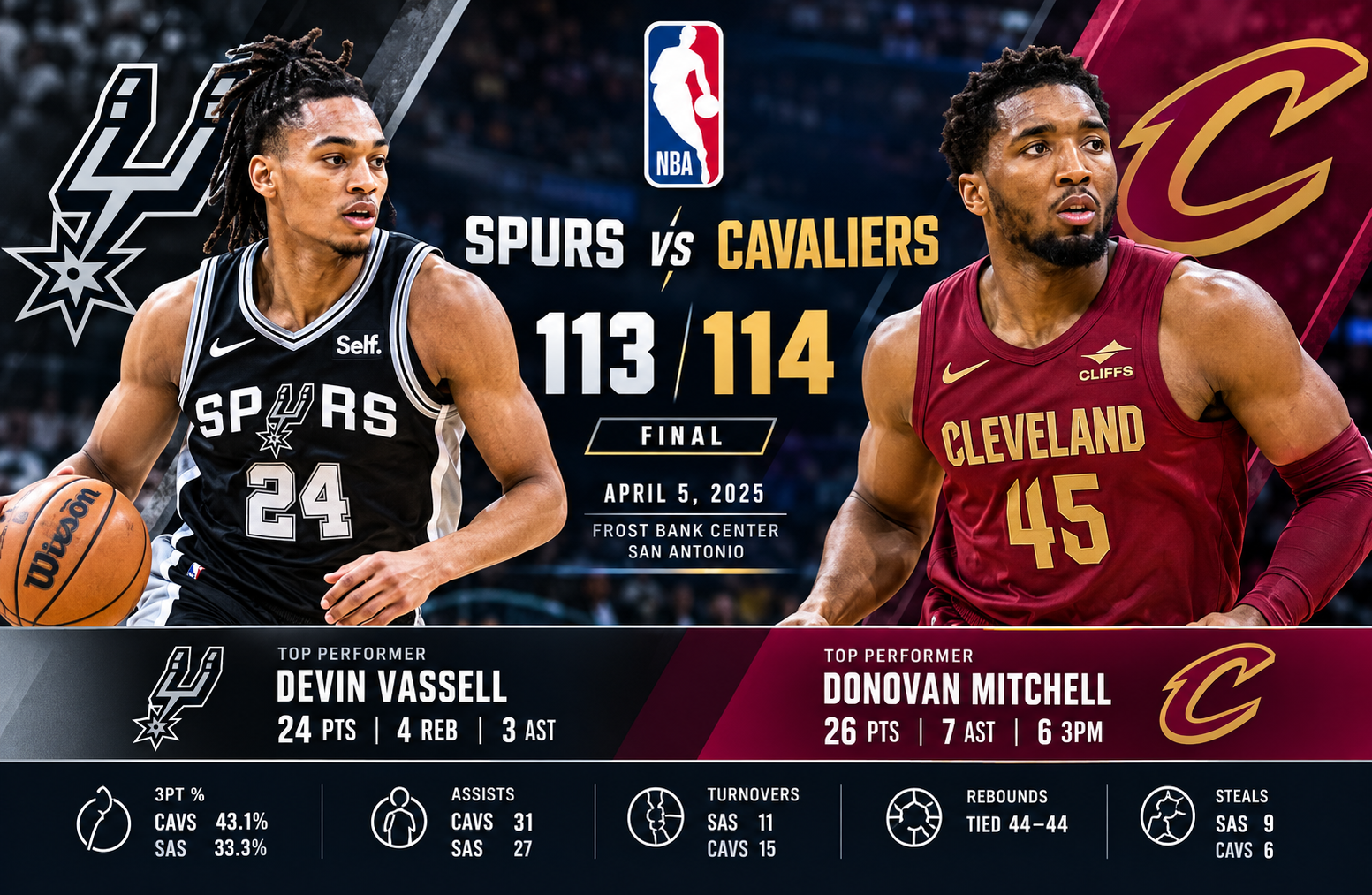
The san antonio spurs vs cleveland cavaliers match player stats from the April 5, 2025 game tell the story of a close contest that Cleveland nearly let slip away. The Cavaliers defeated the Spurs 114-113 at Frost Bank Center after building a 23-point advantage and then surviving a dramatic San Antonio comeback. Donovan Mitchell led Cleveland with 26 points, while Evan Mobley delivered 25 points and 12 rebounds. Devin Vassell paced San Antonio with 24 points, and Stephon Castle controlled the offense with 11 assists.
The game was particularly interesting because the final score did not fully reflect how different the two teams looked across four quarters. Cleveland dominated the opening half, San Antonio responded strongly after halftime, and the fourth quarter became a test of execution under pressure. The Cavaliers finished with better three-point shooting and more assists, while the Spurs generated nine steals, committed fewer turnovers, and nearly completed the comeback.
The official NBA record lists the game as April 4 in its primary game-page timestamp, while the game information identifies it as Saturday, April 5, at 12:00 AM. The contest took place at Frost Bank Center in San Antonio, with an announced attendance of 17,819.
Game Overview
| Category | Cleveland Cavaliers | San Antonio Spurs |
| Final Score | 114 | 113 |
| Record After Game | 62-15 | 32-45 |
| Venue | Frost Bank Center | Frost Bank Center |
| Field Goals | 41-87 | 41-94 |
| Field Goal % | 47.1% | 43.6% |
| Three-Pointers | 22-51 | 16-48 |
| Three-Point % | 43.1% | 33.3% |
| Free Throws | 10-14 | 15-19 |
| Free Throw % | 71.4% | 78.9% |
| Rebounds | 44 | 44 |
| Assists | 31 | 27 |
| Turnovers | 15 | 11 |
| Steals | 6 | 9 |
| Blocks | 4 | 4 |
The official NBA box score confirms the 114-113 final, Cleveland’s 41-for-87 shooting, San Antonio’s 41-for-94 shooting, and the major team-level statistical differences.
san antonio spurs vs cleveland cavaliers match player stats
The most useful way to understand this matchup is to move beyond the final score and examine how individual performances affected the game.
Donovan Mitchell was Cleveland’s leading scorer with 26 points. He shot efficiently from outside, connecting on six of his 11 three-point attempts, and also contributed seven assists. Evan Mobley supplied another major scoring and rebounding performance with 25 points and 12 rebounds.
For San Antonio, Devin Vassell produced 24 points while shooting 50% from the field and 60% from three-point range. Harrison Barnes added 23 points, giving the Spurs two high-level scoring performances on the wing.
Stephon Castle stood out in another category. His 11 assists were the most by any player in the game and helped San Antonio repeatedly create scoring opportunities during its second-half comeback.
Bismack Biyombo was important around the basket, finishing with 10 rebounds and three blocks. Chris Paul contributed nine points and eight assists while also finishing with a +15 plus/minus rating.
Cleveland’s leading individual performances
Donovan Mitchell
- 26 points
- 8-for-17 field goals
- 6-for-11 three-pointers
- 4-for-4 free throws
- 7 assists
- 1 block
Mitchell’s shooting efficiency was one of the biggest reasons Cleveland created separation early. His six made three-pointers accounted for 18 of his 26 points.
Evan Mobley
- 25 points
- 12 rebounds
- 5 assists
- 3 blocks
- 10-for-13 shooting
- 4-for-6 from three-point range
Mobley’s performance was arguably the most efficient offensive display on the Cleveland roster. He made 10 of 13 shots, including four three-pointers.
Darius Garland
- 19 points
- 7 assists
- 4 three-pointers
- 3 turnovers
Garland’s seven assists tied Mitchell for the Cleveland team lead. His fourth-quarter floater with 1:55 remaining became especially important because Cleveland scored only one other field goal during the closing stretch. The official NBA recap specifically identifies Garland’s floater as Cleveland’s late-game basket during the Spurs’ 14-2 run.
De’Andre Hunter
- 18 points
- 7 rebounds
- 3 assists
- 4-for-8 from three-point range
Hunter provided another perimeter scoring option, helping Cleveland maintain offensive spacing around Mitchell and Mobley.
San Antonio’s leading individual performances
Devin Vassell
- 24 points
- 9-for-18 shooting
- 6-for-10 three-point shooting
- 4 steals
- 3 assists
- +15 plus/minus
Vassell was the Spurs’ leading scorer and one of the most efficient perimeter shooters in the game. His 60% shooting from three was particularly valuable because San Antonio needed efficient offense while trying to erase Cleveland’s early advantage.
Harrison Barnes
- 23 points
- 7-for-14 shooting
- 4-for-8 from three
- 5-for-6 free throws
- 1 assist
- +6 plus/minus
Barnes was crucial during the final stages. His three-pointer with 29 seconds remaining cut Cleveland’s lead to one point, setting up an extremely tense finish. The NBA’s recap confirms that Barnes’ late three made it 114-113.
Stephon Castle
- 11 assists
- 8 points
- 3 rebounds
- 2 steals
Castle’s scoring numbers were modest compared with Vassell and Barnes, but his playmaking was significant. Eleven assists indicate how frequently San Antonio used him to create opportunities for teammates.
Bismack Biyombo
- 10 rebounds
- 6 points
- 3 blocks
- 1 assist
- +5 plus/minus
Biyombo provided physical interior play and was the Spurs’ leading rebounder.
How Cleveland Built Its Early Lead
The game was essentially divided into two stories.
The first story belonged to Cleveland.
The Cavaliers scored 38 points in the opening quarter compared with 28 from San Antonio. They then added another 29 points in the second quarter while limiting the Spurs to 22.
That produced a 67-50 halftime advantage.
Cleveland’s 17-point halftime lead was not simply the result of getting more possessions. The Cavaliers were also extremely effective from three-point range. The official NBA recap notes that Cleveland made 15 of 30 three-point attempts in the first half.
That shooting efficiency created an immediate problem for San Antonio.
When a team makes half of its three-point attempts over a two-quarter stretch, defensive possessions become extremely difficult to survive. San Antonio had to respect Cleveland’s perimeter shooters, which created more room for Mobley and the Cavaliers’ interior players.
First-quarter advantage
Cleveland’s 38-point opening quarter was the strongest offensive period of the game for either team.
Mobley was particularly active early. He scored efficiently around the basket and also demonstrated his perimeter shooting ability.
Mitchell provided the outside pressure.
Garland helped organize the offense.
That combination gave San Antonio multiple problems rather than a single scoring threat.
Second-quarter separation
The second quarter continued in Cleveland’s favor.
The Cavaliers added 29 points while San Antonio managed 22.
At halftime, Cleveland had a 17-point advantage.
From an analytical perspective, this was the clearest indication of the difference between the teams that night. Cleveland was not merely winning individual possessions. It was consistently converting its offensive opportunities at a higher rate.
San Antonio’s Second-Half Response
The Spurs changed the tone after halftime.
They scored 32 points in the third quarter, eight more than Cleveland.
Then they scored another 31 in the fourth.
That meant San Antonio outscored Cleveland 63-47 over the second half.
The comeback was built on several factors.
First, San Antonio improved its overall offensive rhythm.
Second, the Spurs generated nine steals for the game.
Third, they protected the basketball better than Cleveland, committing only 11 turnovers compared with 15 by the Cavaliers.
Fourth, San Antonio continued receiving production from Vassell and Barnes.
The result was a game that looked comfortable for Cleveland at halftime but became a one-possession contest by the final seconds.
The Fourth-Quarter Collapse and Late Spurs Push
The fourth quarter deserves special attention because it explains why a 17-point halftime lead ended as a one-point victory.
San Antonio outscored Cleveland 31-23 in the final period.
According to the NBA recap, Cleveland still held a 13-point lead with 3:26 remaining. From there, San Antonio went on a 14-2 run.
That sequence transformed the game.
Cleveland struggled to generate clean offense late. The Cavaliers made only one field goal during the closing stretch, with Garland hitting the decisive floater with 1:55 remaining.
San Antonio kept attacking.
Barnes then knocked down a three-pointer with 29 seconds left to make the score 114-113.
Cleveland had opportunities to extend its advantage but could not convert them.
The Spurs ultimately had a final chance when Barnes attempted a driving hook shot at the buzzer.
It missed.
Cleveland survived.
Why Three-Point Shooting Mattered So Much
One of the clearest statistical differences in this matchup was three-point efficiency.
Cleveland:
- 22-for-51
- 43.1%
San Antonio:
- 16-for-48
- 33.3%
That difference represented 18 additional points from made three-pointers for Cleveland.
The Spurs actually attempted only three fewer three-pointers, so this was not primarily a volume issue. It was an efficiency issue.
Cleveland converted 43.1% of its attempts from outside.
San Antonio converted 33.3%.
Over a one-point game, that difference becomes enormous.
The Cavaliers’ ability to make threes from several positions also helped explain the early lead. Mitchell, Mobley, Garland, Hunter and other Cleveland contributors all helped stretch the floor.
Mobley’s four made threes were particularly noteworthy because his shooting forced San Antonio’s interior defenders to account for him beyond the paint.
Rebounding Was Completely Even
The rebounding battle ended 44-44.
That is important because it removes one common explanation for the final result.
Neither team dominated the glass.
San Antonio’s Biyombo led the Spurs with 10 rebounds, while Mobley grabbed 12 for Cleveland.
Mobley’s rebounding was especially valuable because it combined with his scoring and defensive work. A player who can score efficiently while also securing double-digit rebounds gives his team several ways to maintain control.
San Antonio, however, did enough on the glass to prevent Cleveland from turning its shooting advantage into a larger possession advantage.
Turnovers Tell a Different Story
The turnover numbers favored San Antonio.
Cleveland committed 15 turnovers.
San Antonio committed 11.
That four-turnover difference helped the Spurs generate additional opportunities during their comeback.
San Antonio also recorded nine steals compared with Cleveland’s six.
This is an important reminder that the winning team does not necessarily lead every statistical category.
Cleveland shot better and assisted more.
San Antonio protected the ball better and forced more turnovers.
Those competing advantages helped produce a one-point finish.
Assists and Offensive Organization
Cleveland finished with 31 assists.
San Antonio recorded 27.
The four-assist difference reflects Cleveland’s stronger overall offensive efficiency.
Mitchell and Garland each recorded seven assists, giving the Cavaliers two primary creators capable of initiating offense.
For San Antonio, Castle’s 11 assists were the standout playmaking statistic.
His passing helped the Spurs create enough offense to overcome a substantial halftime deficit.
This is one of the most useful lessons from the game when analyzing player statistics: assist totals should not be viewed only as a measure of passing skill. They can also indicate how much responsibility a player carries within the team’s offensive structure.
Castle’s 11 assists showed that he was heavily involved in creating shots for teammates.
Plus/Minus Provides Another Layer
Plus/minus is not a perfect individual evaluation tool, but it can add useful context when combined with other statistics.
Vassell and Chris Paul each finished at +15 for San Antonio.
That is striking because the Spurs lost the game.
Their positive plus/minus suggests that San Antonio performed particularly well during their minutes on the floor, even though the overall team result was negative.
For Cleveland, Jarrett Allen led the team at +9.
This is a good example of why plus/minus should not be interpreted as a standalone ranking.
A player can have a positive plus/minus in a losing game because his team played better during his minutes. Conversely, a player can have a negative number despite producing strong individual statistics.
The best analysis combines plus/minus with scoring, efficiency, rebounds, assists, turnovers and game context.
Comparing the Main Scoring Performers
| Player | Team | Points | Rebounds | Assists | FG | 3PT |
| Donovan Mitchell | Cavaliers | 26 | 7 | 8-17 | 6-11 | |
| Evan Mobley | Cavaliers | 25 | 12 | 5 | 10-13 | 4-6 |
| Darius Garland | Cavaliers | 19 | 2 | 7 | 6-16 | 4-9 |
| De’Andre Hunter | Cavaliers | 18 | 7 | 3 | 7-16 | 4-8 |
| Devin Vassell | Spurs | 24 | 4 | 3 | 9-18 | 6-10 |
| Harrison Barnes | Spurs | 23 | 0 | 1 | 7-14 | 4-8 |
| Bismack Biyombo | Spurs | 6 | 10 | 1 | 3-4 | 0-0 |
| Stephon Castle | Spurs | 8 | 3 | 11 | 3-11 | 0-4 |
The table shows why Cleveland had more offensive balance.
Mitchell and Mobley combined for 51 points.
San Antonio’s Vassell and Barnes combined for 47.
The difference was not huge, but Cleveland received strong additional production from Garland and Hunter.
The Role of Evan Mobley
Mobley’s performance deserves special attention because it combined several statistical dimensions.
- He scored 25 points on 10-for-13 shooting.
- He collected 12 rebounds.
- He added five assists.
- He blocked three shots.
- He also made four three-pointers.
That combination made him difficult to defend.
If San Antonio defended him primarily as an interior player, Mobley could step outside and shoot.
If defenders moved toward him on the perimeter, he had the size and mobility to attack closer to the basket.
His 12 rebounds also helped Cleveland maintain stability despite San Antonio’s second-half pressure.
Donovan Mitchell’s Scoring Efficiency
Mitchell’s 26 points came from 17 field-goal attempts.
His 8-for-17 shooting translated to 47.1% from the field.
More importantly, he made six of 11 three-point attempts and all four of his free throws.
That combination allowed him to produce high-value scoring without requiring an unusually large number of possessions.
His seven assists also showed that his role extended beyond scoring.
The NBA recap identifies Mitchell as the game’s leading scorer and notes that he also tied for the team lead in assists.
Devin Vassell’s Efficient Scoring
Vassell gave San Antonio exactly what it needed from a perimeter scorer.
He scored 24 points on 9-for-18 shooting.
His three-point shooting was even better.
He made six of 10 attempts from deep.
That is 60% from three.
He also recorded four steals and finished +15.
Although San Antonio lost, Vassell’s individual performance was one of the strongest on either side.
His production helped the Spurs remain competitive after the game appeared to be slipping away during the first half.
Harrison Barnes and the Final Possession
Barnes had a major role in the comeback.
His 23 points came on 7-for-14 shooting.
He also made four of eight three-point attempts and five of six free throws.
Most importantly, his late three-pointer reduced Cleveland’s lead to one point.
The final possession then came down to Barnes.
His driving hook shot failed to fall as time expired.
That sequence illustrates how small the margin was between victory and defeat.
San Antonio did not lose because it lacked a chance.
The Spurs created a legitimate opportunity to win after trailing by 17 points at halftime.
Season Series: Cleveland Won Both Meetings
The 2024-25 season series ended with Cleveland winning both games.
The first meeting took place on March 28, 2025, when Cleveland defeated San Antonio 124-116.
The second meeting was the 114-113 result discussed in this article.
That means Cleveland finished the season series with a 2-0 record against San Antonio.
The two games were also different in character.
The March meeting produced a higher-scoring eight-point Cleveland victory.
The April meeting was much tighter and required the Cavaliers to survive a late Spurs rally.
What the Two Games Reveal
Looking at the season series rather than only one game provides a more useful perspective.
Cleveland consistently demonstrated an ability to generate efficient offense against San Antonio.
The Cavaliers also showed enough offensive firepower to build substantial leads.
San Antonio, however, demonstrated resilience.
In the April meeting, the Spurs did not allow the early deficit to decide the game.
They improved their offensive production after halftime, created turnovers and reduced Cleveland’s advantage possession by possession.
For anyone studying the matchup through player statistics, that context matters.
The final score says Cleveland won.
The quarter-by-quarter numbers explain how.
The player statistics explain why the game became competitive again.
Key Statistical Takeaways
1. Cleveland won through shooting efficiency
The Cavaliers shot 47.1% overall and 43.1% from three.
San Antonio shot 43.6% overall and 33.3% from three.
The three-point difference was the clearest statistical advantage.
2. San Antonio won the turnover battle
The Spurs committed four fewer turnovers.
They also recorded three more steals.
That helped fuel their second-half comeback.
3. Rebounding was even
Both teams finished with 44 rebounds.
Neither side gained a meaningful overall advantage on the glass.
4. Cleveland shared the ball better
The Cavaliers finished with 31 assists compared with 27 for San Antonio.
Mitchell and Garland each recorded seven.
Castle led everyone with 11.
5. Mobley provided an all-around impact
His 25 points, 12 rebounds, five assists and three blocks made him one of the most complete performers in the game.
6. The fourth quarter nearly changed everything
San Antonio outscored Cleveland 31-23 in the fourth.
The Spurs went from being comfortably behind to having the final shot.
Full Team Statistical Perspective
Cleveland’s 114 points came from a balanced offensive profile.
The Cavaliers made 41 field goals and 22 three-pointers.
San Antonio also made 41 field goals but needed 94 attempts to reach that number, compared with Cleveland’s 87.
That six-shot difference is important.
The teams made the same number of field goals, but Cleveland needed fewer attempts to do it.
This is another way to see the Cavaliers’ efficiency advantage.
At the free-throw line, San Antonio was more accurate.
The Spurs made 15 of 19 attempts, or 78.9%.
Cleveland made 10 of 14, or 71.4%.
Yet San Antonio’s free-throw advantage was not enough to overcome Cleveland’s three-point shooting.
Why the Matchup Was So Close Despite the Statistical Edge
A box score can sometimes make a game look simpler than it was.
- Cleveland had the stronger shooting numbers.
- Cleveland had more assists.
- Cleveland won the game.
But San Antonio had several counterweights.
The Spurs:
- Turned the ball over less often
- Recorded more steals
- Matched Cleveland in rebounds
- Shot better from the free-throw line
- Received +15 plus/minus performances from Vassell and Paul
- Outscored Cleveland by 16 points after halftime
These factors explain why the final margin was only one point.
The game was not a case of one team controlling every statistical category.
It was a case of Cleveland building a major early advantage and San Antonio finding enough ways to erase almost all of it.
What Readers Should Look For in Similar Player Stat Matchups
When evaluating an NBA game through player statistics, it is easy to focus only on the highest scorer.
A better process is to examine several layers.
Start with scoring
Identify the leading scorers, but also examine how many shots they needed.
A 25-point performance on 10-for-13 shooting tells a different story from 25 points on 25 attempts.
Check three-point efficiency
Three-point shooting can quickly create large differences in close games.
Compare both attempts and percentage.
Examine playmaking
Assists show which players created opportunities for teammates.
Castle’s 11 assists were important even though he was not among the game’s leading scorers.
Look at possession control
Turnovers and steals can explain momentum shifts.
San Antonio’s four-turnover advantage was meaningful.
Review rebounding
Rebounds determine whether a team is creating extra possessions and ending opponents’ opportunities.
Here, the teams were tied.
Use plus/minus carefully
Plus/minus can add context, but it should not replace the rest of the box score.
The positive +15 figures for Vassell and Paul are a useful example.
Official Source for the Box Score
For readers who want to verify the numbers, the official NBA box score and game record provides the player-by-player statistics, team totals, game information and play-by-play record.
Frequently Asked Questions
What was the final score between the Spurs and Cavaliers?
The Cleveland Cavaliers defeated the San Antonio Spurs 114-113 at Frost Bank Center.
Who scored the most points in the game?
Donovan Mitchell led all scorers with 26 points for Cleveland.
Who led the Spurs in scoring?
Devin Vassell led San Antonio with 24 points.
Who had the most assists?
Stephon Castle led the game with 11 assists. Donovan Mitchell and Darius Garland each had seven for Cleveland.
Who led the game in rebounds?
Evan Mobley led all players with 12 rebounds. Bismack Biyombo was San Antonio’s top rebounder with 10.
Did Cleveland win the season series?
Yes. Cleveland won both meetings with San Antonio during the 2024-25 regular season, taking the first game 124-116 and the second 114-113.
Conclusion
The san antonio spurs vs cleveland cavaliers match player stats show why this game was much more competitive than the halftime score suggested.
Cleveland’s advantage came from efficient shooting, especially from three-point range. Donovan Mitchell led the team with 26 points, while Evan Mobley produced an outstanding all-around performance with 25 points and 12 rebounds. Darius Garland and De’Andre Hunter also provided important secondary scoring.
San Antonio’s response was driven by Devin Vassell, Harrison Barnes and Stephon Castle. Vassell scored 24 points on efficient shooting, Barnes added 23 and hit the late three-pointer that made the game 114-113, while Castle finished with 11 assists.
The most important statistical contrast was efficiency versus possession pressure. Cleveland shot better and assisted more, while San Antonio committed fewer turnovers and generated more steals. Both teams collected 44 rebounds, making the perimeter efficiency gap even more important.
Ultimately, Cleveland’s 17-point halftime lead proved just large enough. San Antonio outscored the Cavaliers by 16 points after halftime and had a chance to win on the final possession, but Barnes’ last-second attempt did not fall.
For anyone studying san antonio spurs vs cleveland cavaliers match player stats, this game is a useful example of why a complete box-score analysis should go beyond points. Shooting efficiency, assists, turnovers, rebounds, steals, plus/minus and quarter-by-quarter performance all contributed to understanding how a one-point game developed.
The Cavaliers finished the season series 2-0, but the April contest showed that San Antonio had the ability to turn a seemingly decisive deficit into a final-possession battle.