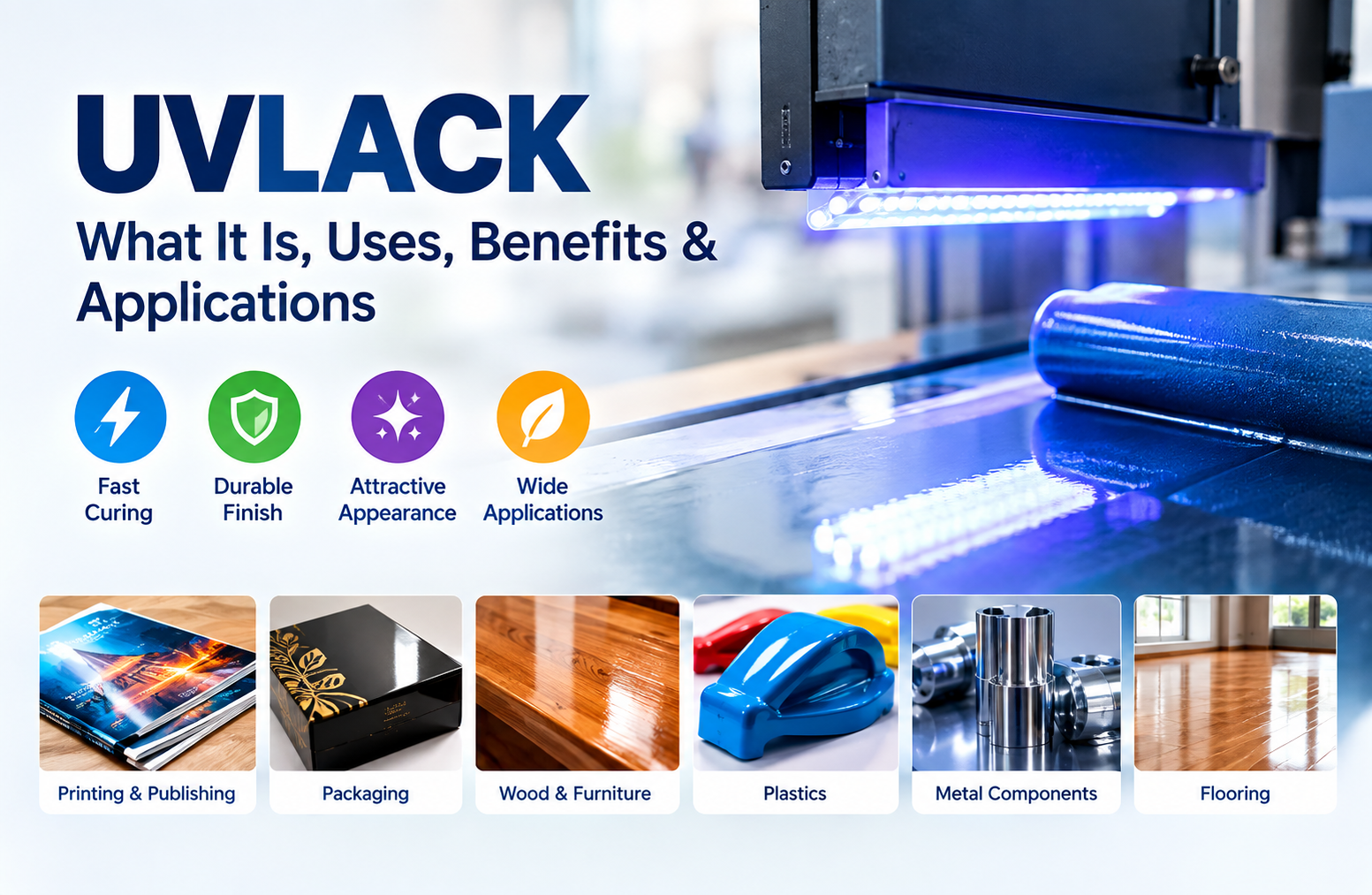
UVLACK: What It Is, Uses, Benefits & Applications
UVLACK is a term most commonly associated with UV-curable lacquer, varnish, or surface coating technology. In practical terms, it describes a liquid finishing material that is hardened by ultraviolet light instead of relying only on conventional air drying or heat. The technology is particularly useful where manufacturers and printers need a fast curing process, a durable surface, and a controlled visual finish. Although the word may look like the name of a specific product or modern technology, its meaning is more closely connected with the broader field of UV-curable coatings.
Understanding this distinction matters because the term appears in different contexts online. Some references use it when discussing printing and packaging, while others connect it with wood finishing, plastics, industrial components, and decorative surfaces. The underlying principle remains similar: a specially formulated coating is exposed to ultraviolet energy, triggering a chemical reaction that converts the liquid film into a solid, crosslinked layer.
This guide explains what UVLACK means, how the curing process works, where it is used, what advantages it can provide, where its limitations appear, and how to evaluate it before choosing a coating system. The goal is not simply to define the word, but to explain the practical decisions behind UV coating technology.
What Is UVLACK?
UVLACK is generally understood as a UV-curable lacquer or coating. The term can be interpreted by separating it into two parts. “UV” refers to ultraviolet radiation, while “Lack” is a European term associated with lacquer, varnish, or coating.
In English-speaking technical environments, similar materials are more often described as UV coating, UV varnish, UV lacquer, or UV-curable finish. The terminology can vary by country, industry, supplier, and application.
The important point is that UVLACK is not necessarily one universal chemical formula.
A coating designed for a glossy brochure may have very different properties from one formulated for a wooden cabinet, plastic component, or industrial part. The resin system, additives, photoinitiator package, viscosity, curing requirements, and surface characteristics all influence the final result.
The United States Environmental Protection Agency describes UV-curable coatings as materials containing components such as oligomers, monomers, and photochemical initiators that react when exposed to ultraviolet radiation. EPA technical information on UV-curable coatings
That technical explanation provides a useful foundation for understanding the term. UV curing is not simply ordinary drying under a bright lamp. It is a chemical curing process.
How Does UVLACK Work?
The basic process is easier to understand than the chemistry behind it.
A UV-curable coating begins as a liquid. It is applied to a prepared surface at a controlled thickness. The coated material then passes beneath a suitable ultraviolet light source.
The light activates photoinitiators within the formulation. These initiate polymerization and crosslinking reactions. Molecules within the liquid formulation join together to create a solid polymer network.
The transformation can happen extremely quickly.
The Basic Curing Process
A typical process follows these stages:
- Surface preparation: The substrate is cleaned and prepared for coating.
- Coating application: A controlled quantity of liquid coating is applied.
- UV exposure: The coated surface passes beneath a UV source.
- Photochemical activation: Photoinitiators absorb the required UV energy.
- Polymerization: Reactive components begin forming polymer chains and crosslinks.
- Final cure: The coating develops its intended hardness and performance characteristics.
- Quality inspection: The finished surface is checked for gloss, adhesion, coverage, curing, and defects.
The exact curing time is not identical for every system. It depends on lamp intensity, wavelength, coating chemistry, film thickness, line speed, substrate, pigmentation, and equipment settings.
This is one reason professional UV finishing cannot be reduced to the simple idea that “UV light makes it dry.” Proper curing requires the coating and the curing system to be compatible.
Why Is UV Curing Different From Conventional Drying?
One of the biggest differences is what happens to the coating at the molecular level.
Many traditional coatings rely heavily on evaporation, oxidation, or heat to reach their final state. UV-curable systems instead use radiation to initiate a chemical reaction.
That difference creates several practical advantages.
A conventional coating may need time before the finished item can be handled, stacked, packed, or processed again. A properly cured UV coating can become ready for subsequent operations very quickly.
This can be especially valuable in commercial printing and manufacturing environments where production speed directly affects output.
However, speed should never be confused with automatic quality. A coating that passes under a UV lamp is not necessarily fully cured. Insufficient energy, excessive coating thickness, poor lamp performance, contamination, or incompatible formulation can all cause curing problems.
Main Benefits of UVLACK
The appeal of UV-curable finishing comes from a combination of appearance, speed, durability, and process control.
Rapid Curing
Fast curing is one of the most important advantages.
Once the coating receives the appropriate UV energy, the chemical reaction can occur very quickly. This allows production lines to move finished material through additional stages without waiting for lengthy natural drying.
For high-volume operations, that can simplify production planning.
Attractive Surface Finish
UV-curable finishes can be formulated to create different appearances.
Depending on the formulation, the finished surface can be:
- High gloss
- Matte
- Satin
- Clear
- Textured
- Selectively glossy
- Smooth and polished
This flexibility makes UV coating useful for both functional and decorative purposes.
Surface Protection
A properly selected and cured coating can improve resistance to everyday surface damage.
Depending on the formulation and application, this can include resistance to:
- Abrasion
- Scuffing
- Staining
- Moisture exposure
- Certain chemicals
- General handling
The level of protection should always be confirmed through the manufacturer’s technical data and testing. No coating should be assumed to provide universal chemical or abrasion resistance.
Efficient Production
Because curing can take place rapidly, UV systems can support high-throughput production.
This is particularly useful where a manufacturer wants to minimize waiting time between coating and the next production stage.
The benefit becomes more meaningful when the entire production line is designed around UV curing rather than treating UV equipment as an isolated addition.
Lower Process Temperatures
Some UV-curing processes can operate without the high drying temperatures required by certain conventional systems.
This can be useful for substrates that are sensitive to heat.
However, “low temperature” does not mean that the process is automatically suitable for every heat-sensitive material. The coating formulation and UV equipment still need to be matched to the substrate.
Strong Surface Performance
UV-curable formulations can produce highly crosslinked films.
The resulting structure can provide useful hardness, chemical resistance, and physical durability when the coating is correctly formulated and cured.
This is one reason UV finishing has become relevant across multiple industrial applications rather than remaining limited to decorative printing.
Where Is UVLACK Used?
UV-curable coating technology is used across a broad range of industries.
The exact application depends on the coating chemistry and the surface being treated.
Printing and Publishing
Printing is one of the easiest places to understand the value of UV coating.
It can be used on:
- Business cards
- Brochures
- Book covers
- Greeting cards
- Catalogs
- Marketing materials
- Labels
- Premium packaging
- Printed promotional products
A coating may cover the entire sheet or only selected areas.
Packaging
Packaging is another major application area.
Brands often need packaging that looks attractive while surviving handling, transportation, and repeated contact.
A suitable UV finish can add visual depth and surface protection to cartons, labels, and other printed packaging.
The finish can also be used strategically. For example, a designer might keep most of a package matte while adding a glossy coating to a logo or product name.
Wood and Furniture
UV-curable finishes can also be used for wood and furniture surfaces.
These systems can provide a controlled finish while supporting rapid production.
Commercial furniture manufacturing benefits from predictable finishing because large numbers of panels or components may need to move through production in a limited amount of time.
Flat surfaces are particularly practical for many UV processes because UV energy generally needs a clear path to the coating.
Flooring
UV-curable finishes have applications in flooring and related surface treatments.
Here, the emphasis is often on durability and resistance to everyday wear.
The correct formulation matters greatly because flooring can experience repeated abrasion, cleaning chemicals, foot traffic, and changes in environmental conditions.
Plastics
Plastic components can sometimes be finished using UV-curable coatings.
Potential applications include decorative components, consumer products, automotive parts, and industrial pieces.
Plastic presents a special challenge because different polymers have different surface energies, flexibility, heat behavior, and adhesion characteristics.
A coating that performs well on one plastic may perform poorly on another.
Metal Components
UV-curable technology can also be applied to selected metal finishing applications.
The substrate may require appropriate cleaning, pretreatment, primer systems, or surface preparation before coating.
The final result depends on both coating chemistry and substrate preparation.
UVLACK in Printing and Packaging
The printing industry provides a particularly clear example of how UV coating can change the feel and appearance of a product.
Imagine two otherwise identical brochures.
One has ordinary printed paper.
The second has a carefully selected UV finish.
The second may feel smoother, look more polished, and offer greater resistance to everyday handling.
The difference is not only visual.
A coating can influence how light interacts with the printed surface. A high-gloss finish reflects light strongly, while a matte finish scatters light and creates a softer appearance.
Full-Surface Coating
A full coating covers most or all of the intended surface.
This approach is useful when the designer wants a consistent finish across the entire printed piece.
Spot UV Coating
Spot coating is more selective.
Instead of covering everything, the finish is applied to particular areas.
Common targets include:
- Logos
- Product names
- Images
- Headlines
- Decorative patterns
- Important design elements
The contrast between matte and glossy areas can create a premium visual effect without covering the entire sheet.
Why Thickness Matters
More coating is not automatically better.
Excessive film thickness can create appearance problems, curing challenges, cracking issues, or compatibility concerns during later processing.
The correct film thickness depends on the formulation, application method, substrate, and desired performance.
Professional production therefore focuses on controlled application rather than simply maximizing coating volume.
Types of UVLACK Finishes
There is no single finish that fits every project.
Gloss Finish
Gloss coatings create a reflective, polished appearance.
They can make colors appear more vibrant and can emphasize selected design elements.
Gloss is often chosen when visual impact is a major objective.
Matte Finish
Matte coatings reduce surface reflection.
They can provide a softer appearance and may improve readability in situations where excessive glare would be undesirable.
Matte finishes can also create a more understated visual style.
Satin Finish
Satin sits between gloss and matte.
It provides some reflection without the highly reflective appearance associated with a full gloss finish.
Textured Finish
Some specialized formulations can create tactile or structured surfaces.
These can be used to add physical interest to packaging, printed materials, or decorative products.
The texture must be selected carefully because it can affect cleaning, handling, appearance, and downstream processing.
What Are the Main Challenges?
UV-curable technology offers useful advantages, but it is not a universal solution.
Understanding its limitations is essential.
Equipment Cost
UV systems require specialized equipment.
A production line may need UV lamps or LED curing systems, reflectors, shielding, cooling, controls, coating equipment, and appropriate safety measures.
This creates a higher initial investment than some simpler coating methods.
Formulation Compatibility
The coating must match the substrate.
A formulation designed for paper may not be appropriate for a flexible plastic.
Similarly, a coating intended for rigid furniture panels may not perform well on a material that bends repeatedly.
Adhesion Problems
A coating can look excellent immediately after curing and still have poor adhesion.
Surface contamination, low surface energy, inadequate preparation, unsuitable primers, and incompatible chemistry can all contribute to adhesion failure.
A proper adhesion test is therefore more reliable than judging the finish by appearance alone.
Incomplete Curing
Incomplete curing is a serious technical issue.
Possible signs include:
- Soft or tacky surfaces
- Poor abrasion resistance
- Unusual odor
- Reduced chemical resistance
- Surface marking
- Adhesion problems
- Unexpected transfer during stacking
Curing should be verified using appropriate production and quality-control methods.
Line-of-Sight Limitations
UV curing generally works best where the light can reach the coating.
Complex three-dimensional shapes, recessed areas, deep cavities, and shadowed sections can create difficulties.
This is why flat panels and accessible surfaces are often easier to process.
Higher Material Costs
UV formulations can cost more than certain conventional alternatives.
The financial calculation should therefore consider the entire process, not only the price per kilogram or liter.
Faster production, reduced drying time, lower space requirements, and improved productivity may offset some of the additional material and equipment costs.
UVLACK vs Traditional Varnish
The most important difference is the curing mechanism.
Traditional varnishes may rely on evaporation, oxidation, heat, or combinations of these processes.
UV-curable varnishes use ultraviolet energy to initiate polymerization.
That difference affects production speed, equipment requirements, formulation design, and final performance.
| Feature | UV-Curable Finish | Traditional Varnish |
| Main curing method | UV radiation | Depends on formulation |
| Production speed | Often very fast | Often slower |
| Equipment | Specialized UV system | Usually simpler |
| Surface options | Gloss, matte, textured, and others | Multiple options |
| Initial equipment investment | Often higher | Often lower |
| Process control | Requires UV and coating control | Depends on drying system |
| Suitable applications | Printing and many industrial uses | Broad range of applications |
There is no universal winner.
The correct choice depends on the substrate, production volume, required appearance, durability target, budget, equipment, and regulatory requirements.
UVLACK vs Lamination
UV coating and lamination are also different technologies.
Lamination involves bonding a separate film to the surface.
UV coating involves applying a liquid formulation and curing it in place.
Lamination can provide specific barrier, protection, or tactile characteristics that may not be achievable through a thin UV coating.
UV coating, on the other hand, can offer a fast finishing process without requiring a separate plastic film.
For printed products, the choice often comes down to the desired balance of appearance, durability, flexibility, cost, and production requirements.
Is UVLACK Environmentally Better?
This question needs a careful answer.
UV-curable coatings can have environmental advantages in certain production situations, particularly because some formulations can contain very high solids and may reduce reliance on solvent evaporation.
The EPA has documented rapid curing, lower process temperatures, and potentially low VOC characteristics among the advantages associated with UV-curable coatings.
However, it would be misleading to describe every UV coating as automatically environmentally friendly.
Environmental performance depends on the complete system.
Important factors include:
- Coating formulation
- VOC content
- Energy source
- Lamp efficiency
- Production speed
- Waste generation
- Substrate
- Equipment efficiency
- End-of-life considerations
- Worker exposure controls
A responsible comparison should therefore examine the entire manufacturing process rather than relying on the label “UV.”
How to Choose the Right UV Coating
Choosing a coating should begin with the application, not the product name.
Step 1: Identify the Substrate
Determine exactly what will be coated.
Is it:
- Paper?
- Cardboard?
- Wood?
- Plastic?
- Metal?
- Composite material?
The substrate determines many of the technical requirements.
Step 2: Define the Desired Finish
Decide whether the product needs:
- High gloss
- Matte
- Satin
- Texture
- Spot effects
- Maximum clarity
- Strong tactile properties
This helps narrow the formulation.
Step 3: Define Performance Requirements
Ask what the finished surface must survive.
For example:
- Frequent handling
- Scratching
- Cleaning
- Moisture
- Chemicals
- Folding
- Bending
- Outdoor exposure
- Heat
- Transportation
A decorative coating and a heavy-duty industrial coating may need completely different performance characteristics.
Step 4: Check Curing Requirements
The supplier should provide information about:
- Required UV wavelength
- Lamp intensity
- Recommended line speed
- Film thickness
- Exposure requirements
- Suitable curing equipment
Without this information, production consistency becomes much harder to achieve.
Step 5: Test Before Full Production
A small production trial can prevent expensive problems.
Test the coating on the actual substrate using the intended production process.
Then examine:
- Adhesion
- Appearance
- Hardness
- Scratch resistance
- Chemical resistance
- Flexibility
- Curing
- Color interaction
- Surface defects
Step 6: Evaluate Total Cost
Do not compare coatings using material price alone.
Consider:
- Equipment
- Labor
- Energy
- Production speed
- Waste
- Maintenance
- Rework
- Downtime
- Quality failures
A more expensive coating can sometimes produce a lower total manufacturing cost if it significantly improves throughput and reduces rework.
Practical Quality-Control Checks
Good UV finishing depends on repeatability.
A production team should monitor the process rather than inspecting only the finished appearance.
Useful checks can include:
Surface Cleanliness
Dust, grease, silicone contamination, and other residues can interfere with coating adhesion.
Coating Thickness
The applied film should remain within the intended range.
Too little coating may fail to provide the desired appearance or protection.
Too much coating may create curing or processing problems.
UV Energy
The curing system should deliver consistent energy.
Lamp aging, contamination, incorrect positioning, or equipment faults can reduce curing performance.
Adhesion
The coating should remain securely attached to the substrate.
Testing should be appropriate for the application and substrate.
Final Hardness
Hardness can provide useful information about whether the coating has achieved the intended performance, although hardness alone does not establish complete cure.
Visual Inspection
Inspect for:
- Pinholes
- Bubbles
- Uneven gloss
- Orange peel
- Scratches
- Fish eyes
- Poor coverage
- Cloudiness
- Incomplete cure
Quality control becomes especially important when production volumes are high because a small process error can affect a large quantity of finished material.
Common Mistakes When Using UV-Curable Coatings
Several mistakes appear repeatedly in coating projects.
Choosing Based Only on Gloss
A beautiful glossy finish does not automatically mean the coating is appropriate.
The real requirements may involve flexibility, chemical resistance, adhesion, or abrasion resistance.
Ignoring the Substrate
A coating should never be selected independently of the material underneath it.
Assuming Faster Is Always Better
Very high production speeds can reduce UV exposure.
If curing is incomplete, increasing line speed may create quality problems.
Skipping Testing
A coating that works on one supplier’s paper or plastic does not necessarily perform identically on another material.
Treating UV Equipment as a Set-and-Forget System
Lamp output and system performance can change over time.
Regular maintenance and monitoring are essential for consistent curing.
Safety Considerations
UV-curing systems involve ultraviolet radiation and chemical materials that require appropriate controls.
Operators should follow the equipment manufacturer’s safety procedures, use required shielding, and avoid direct exposure to UV radiation.
Coating suppliers should provide safety data and handling instructions for their formulations.
Good ventilation and workplace controls may also be necessary depending on the formulation and process.
Safety should be based on the actual equipment and coating system rather than assumptions about the word “UV.”
What Should Buyers Ask a Supplier?
Before purchasing a UV-curable coating, ask practical technical questions.
A useful supplier discussion can include:
- What substrates is the formulation designed for?
- What UV wavelength does it require?
- What energy level is recommended?
- What film thickness should be applied?
- What production speed is supported?
- What finish options are available?
- What adhesion testing is recommended?
- What chemical and abrasion resistance can be expected?
- Is the coating suitable for folding or bending?
- What storage conditions are required?
- What safety precautions apply?
- What regulatory or migration information is available for the intended application?
These questions are more useful than simply asking whether a product is “strong” or “high quality.”
The Future of UV-Curable Coating Technology
UV curing continues to develop as manufacturers look for faster production, better surface performance, lower energy requirements, and improved formulation options.
One important area is UV LED curing.
LED systems can provide more controlled wavelengths and can offer operational advantages compared with some traditional lamp systems. However, the coating must be formulated to respond to the available wavelength and energy profile.
Another area is the development of more advanced resin systems.
Researchers and industry groups continue to investigate materials that combine rapid curing with improved flexibility, hardness, adhesion, sustainability, and specialized performance.
There is also growing interest in bio-based raw materials and more efficient curing processes. These developments show that UV technology is not static. The chemistry and equipment continue to evolve.
The most important trend, however, is not simply faster curing. It is better matching between formulation, substrate, equipment, and end-use requirements.
How Businesses Can Get Better Results
Businesses considering UV finishing should approach the technology as a complete process.
Start by identifying the production problem.
- If the problem is long drying time, rapid curing may be valuable.
- If the problem is poor surface durability, the focus should be on formulation and performance testing.
- If the problem is appearance, the business may need a particular gloss level or selective finish.
- If the problem is production cost, the entire manufacturing workflow should be evaluated.
This approach prevents companies from purchasing expensive equipment simply because UV technology sounds advanced.
The best results usually come from solving a specific production need.
Why the Term Can Be Confusing
The spelling UVLACK can create confusion because it looks like a brand name.
In technical discussions, however, similar wording may simply refer to UV lacquer or UV varnish.
This is why context matters.
- If the word appears on a printing specification, it is likely describing a coating or finishing process.
- If it appears on a manufacturer’s product label, it may identify a specific commercial formulation.
- If it appears in a technical document, the surrounding information should reveal the intended meaning.
The safest approach is to look beyond the name and examine the technical specifications.
Key Takeaways
UVLACK is best understood in the context of UV-curable coating technology.
The most important points are:
- It generally refers to a UV-curable lacquer, varnish, or coating.
- The coating begins as a liquid and becomes solid through UV-initiated polymerization.
- UV curing can provide very fast production cycles.
- Different formulations can create gloss, matte, satin, or textured finishes.
- Applications include printing, packaging, wood, plastics, flooring, metal components, and other surfaces.
- Performance depends heavily on formulation, substrate, film thickness, and curing conditions.
- Specialized equipment increases initial investment.
- Incomplete curing can cause significant quality problems.
- UV coating is not automatically the best choice for every application.
- Proper testing is essential before full-scale production.
- Environmental performance should be assessed across the complete process.
- Supplier technical data is more reliable than judging a coating by its name alone.
FAQs About UVLACK
What is UVLACK?
UVLACK generally refers to a UV-curable lacquer, varnish, or coating that hardens after exposure to ultraviolet light.
How does UVLACK work?
The liquid coating contains reactive components and photoinitiators. UV energy activates the curing reaction, causing the material to polymerize and form a solid film.
Where is UVLACK used?
It can be used in printing, packaging, wood finishing, flooring, plastics, metal components, decorative products, and other industrial applications.
Is UVLACK the same as UV coating?
In many contexts, the terms are used to describe closely related technology. However, the exact formulation and application can vary, so the technical specification should be checked.
Is UVLACK durable?
A properly formulated and cured UV coating can provide strong surface hardness and resistance to abrasion, stains, and certain chemicals. Actual performance depends on the formulation and application.
Does UVLACK work on every material?
No. Different substrates require different coating systems. Adhesion, surface energy, flexibility, curing requirements, and chemical compatibility all need to be considered.
Conclusion
UVLACK is most useful when understood as part of the wider UV-curable coating industry rather than as a mysterious standalone technology.
Its central principle is straightforward. A specially formulated liquid coating is applied to a suitable surface and then exposed to ultraviolet energy. Photoinitiators trigger a chemical reaction that transforms the liquid into a solid, crosslinked film.
That process can provide major production advantages. Rapid curing can reduce waiting time, while carefully engineered formulations can provide attractive finishes and useful resistance to abrasion, staining, moisture, and chemicals.
At the same time, UV curing has limitations. Equipment costs can be significant, formulations must match their substrates, curing conditions must be controlled, and complex shapes can present exposure challenges. A coating that performs well on one material may not perform well on another.
For that reason, the most reliable way to evaluate UVLACK is to focus on the complete application. Identify the substrate, define the required appearance, establish the performance target, confirm the curing requirements, conduct practical testing, and compare the total production cost.
When those factors are evaluated together, UV-curable finishing becomes easier to understand and much easier to apply correctly.