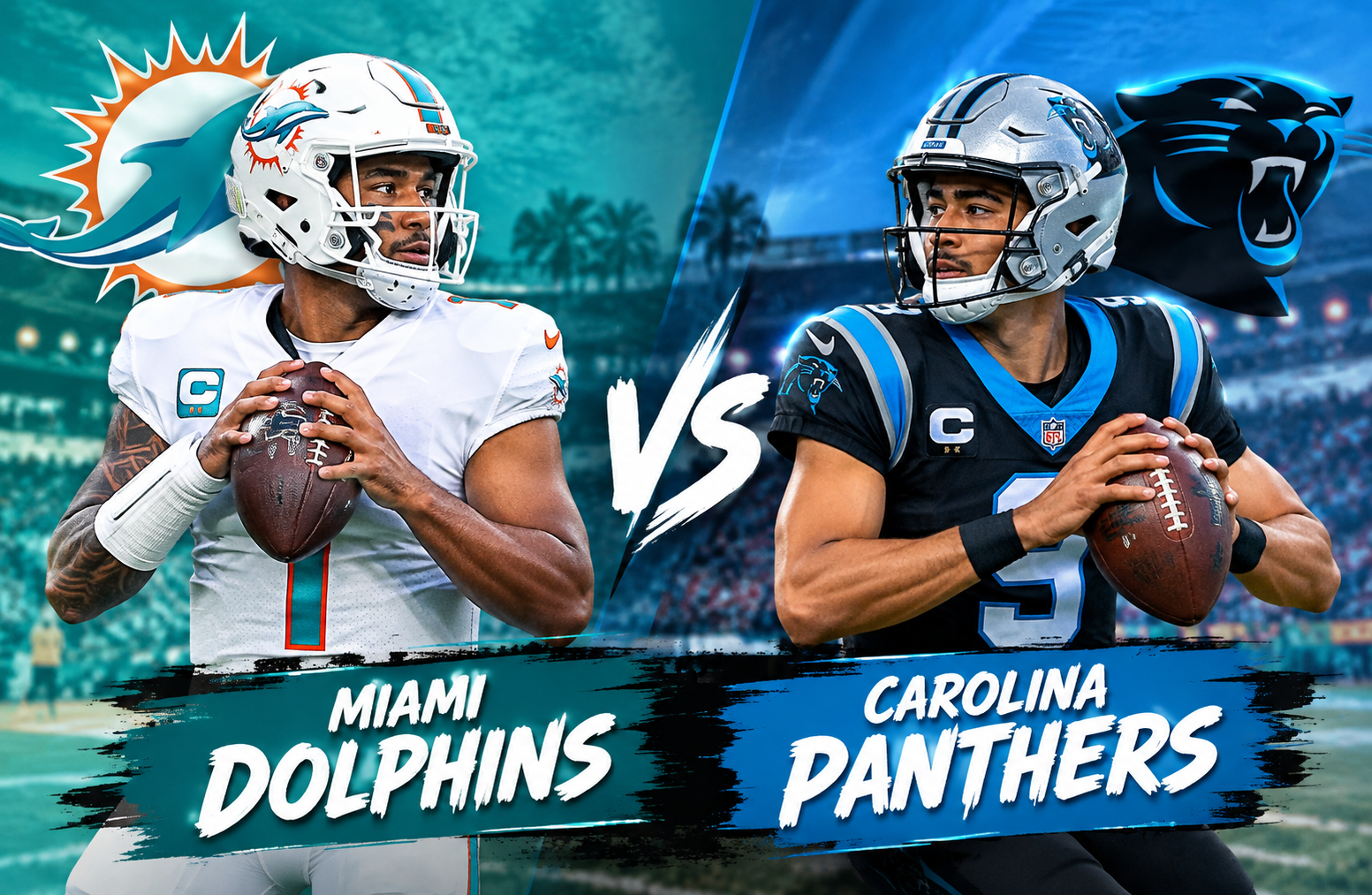
Miami Dolphins vs Carolina Panthers Match Player Stats
The Miami Dolphins vs Carolina Panthers match player stats from October 5, 2025 tell the story of a game that changed completely after halftime. Miami built a 17 point lead and appeared to have control, but Carolina responded with a powerful rushing attack, timely defensive plays, and a late touchdown drive to win 27-24. Tua Tagovailoa completed 27 of 36 passes for 256 yards and three touchdowns without an interception, while Bryce Young finished with 19 completions on 30 attempts for 198 yards, two touchdowns, and one interception. The biggest statistical difference came on the ground, where Carolina produced 239 rushing yards compared with only 19 for Miami.
The final score alone does not explain why the game unfolded the way it did. Miami moved the ball effectively through the air, and Jaylen Waddle produced 110 receiving yards with a 46 yard touchdown. Darren Waller and De’Von Achane also caught touchdown passes. Carolina, however, created a completely different type of offensive advantage through Rico Dowdle, who rushed for 206 yards and a touchdown on 23 carries.
This detailed breakdown examines the passing, rushing, receiving, defensive, special teams, and situational statistics from the game. It also explains which numbers mattered most and how the individual performances connected to the Panthers’ comeback.
Miami Dolphins vs Carolina Panthers Match Player Stats at a Glance
The game was played on October 5, 2025, with Carolina hosting Miami. The Panthers won 27-24 after trailing 17-0 during the second quarter. ESPN’s official game record identifies the contest as Game ID 401772852.
| Category | Miami Dolphins | Carolina Panthers |
| Final Score | 24 | 27 |
| First Quarter | 3 | 0 |
| Second Quarter | 14 | 10 |
| Third Quarter | 0 | 3 |
| Fourth Quarter | 7 | 14 |
| Total Yards | 248 | 418 |
| Passing | 229 team yards | 179 team yards |
| Rushing | 19 yards | 239 yards |
| Total Plays | 53 | 65 |
| Yards Per Play | 4.7 | 6.4 |
| First Downs | 15 | 26 |
| Third Down | 5/13 | 5/11 |
| Fourth Down | 1/1 | 2/2 |
| Turnovers | 0 | 2 |
| Time of Possession | 28:46 | 31:14 |
The most striking number is the 190 yard difference in rushing production. Miami averaged only 1.4 yards per rushing attempt, while Carolina averaged 7.5. ESPN’s team statistics also show that Carolina ran 65 plays to Miami’s 53, giving the Panthers more opportunities to exploit that advantage.
Miami Dolphins vs Carolina Panthers Match Player Stats: Passing
Tua Tagovailoa’s Passing Performance
Tua Tagovailoa delivered one of the stronger statistical passing performances in the game. He completed 27 of 36 attempts, giving him a completion rate of 75 percent.
His passing line was:
- 27 completions
- 36 attempts
- 256 passing yards
- 7.1 yards per attempt
- 3 touchdown passes
- 0 interceptions
- 3 sacks
- 27 sack yards lost
- 122.0 passer rating
- 78.4 QBR
Those numbers show that Miami’s passing game was not the main reason the Dolphins lost.
Tagovailoa was especially effective when Miami reached scoring territory. His three touchdown passes went to three different players: De’Von Achane, Darren Waller, and Jaylen Waddle. The variety was important because it prevented Carolina from relying on one receiving target.
The first touchdown came on a 10 yard pass to Achane in the second quarter. Later in the same quarter, Tagovailoa found Waller for a 4 yard score. His final touchdown was arguably the most explosive play of Miami’s afternoon, a 46 yard strike to Waddle that temporarily gave Miami a 24-20 lead in the fourth quarter.
Bryce Young’s Passing Performance
Bryce Young completed 19 of 30 attempts for 198 yards, two touchdowns, and one interception.
His line included:
- 19 completions
- 30 attempts
- 198 passing yards
- 6.6 yards per attempt
- 2 touchdown passes
- 1 interception
- 3 sacks
- 19 sack yards lost
- 90.7 passer rating
- 40.9 QBR
Young’s numbers were less efficient than Tagovailoa’s, particularly early in the game. He turned the ball over on Carolina’s first two possessions, including a lost fumble after being sacked by Bradley Chubb. Yet his performance improved as the Panthers established their rushing attack.
The most important part of Young’s performance came late. With Carolina trailing 24-20, he completed a 17 yard pass to Jimmy Horn Jr. on fourth-and-5, keeping the final touchdown drive alive. He then connected with Mitchell Evans for the four yard touchdown that gave Carolina the lead with 1:59 remaining.
That sequence illustrates why quarterback statistics should not always be evaluated independently from game situation. Young’s final passing numbers were modest compared with Tagovailoa’s, but his late completions directly influenced the winning drive.
Rushing Statistics Tell the Biggest Story
If one statistical category explains the outcome of this game better than any other, it is rushing.
Miami finished with only 19 rushing yards on 14 attempts. Carolina gained 239 yards on 32 attempts. ESPN’s team statistics show that the Panthers averaged 7.5 yards per carry while Miami averaged just 1.4.
That is an enormous difference.
De’Von Achane
Achane was Miami’s leading rusher, but his production was limited:
- 10 carries
- 16 yards
- 1.6 yards per carry
- 0 rushing touchdowns
- 6 yard long
Achane did contribute significantly as a receiver, which helped compensate for his lack of rushing production. His six catches produced 30 receiving yards and one touchdown.
Still, Miami needed more balance from its running game. When a team produces only 19 rushing yards, the offense becomes heavily dependent on passing efficiency and successful third down situations.
Tua Tagovailoa
Tagovailoa added five rushing yards on one carry.
That was a small contribution statistically, but it was enough to make him Miami’s second leading rusher in terms of total rushing yardage.
Ollie Gordon II
Ollie Gordon II had three carries for minus two yards. His longest run was three yards.
The combined Miami rushing production was therefore extremely limited, with no Dolphins running back reaching even 20 rushing yards.
Rico Dowdle’s Breakout Performance
Rico Dowdle was the defining individual player in the rushing statistics.
He finished with:
- 23 carries
- 206 rushing yards
- 9.0 yards per carry
- 1 rushing touchdown
- 53 yard long
The 206 yard performance was nearly the entire difference between the two teams’ rushing outputs.
Dowdle’s explosiveness became especially important in the second half. ESPN reported that he produced runs of 53 and 43 yards after halftime, helping Carolina turn a 17 point deficit into a comeback victory.
His one yard touchdown run with 6:10 remaining in the fourth quarter put Carolina ahead 20-17. Although Miami immediately responded with the Waddle touchdown, Dowdle’s running continued to put Carolina in favorable positions.
Other Carolina Rushers
Trevor Etienne added:
- 4 carries
- 22 yards
- 5.5 yards per carry
- 12 yard long
Jimmy Horn Jr. recorded:
- 2 carries
- 10 yards
- 5.0 yards per carry
- 5 yard long
Bryce Young contributed:
- 3 carries
- 1 yard
- 0.3 yards per carry
- 4 yard long
Together, those players helped Carolina reach 239 rushing yards as a team.
Receiving Statistics
Jaylen Waddle Leads Miami
Jaylen Waddle was Miami’s leading receiver by yardage.
His final line was:
- 6 receptions
- 9 targets
- 110 yards
- 18.3 yards per reception
- 1 touchdown
- 46 yard long
The 46 yard touchdown in the fourth quarter was one of the most important offensive plays of the game. With Miami trailing 20-17, Tagovailoa connected with Waddle for a deep touchdown that restored Miami’s lead to 24-20.
Waddle’s 110 yards also represented more than 40 percent of Miami’s passing yardage.
Darren Waller
Darren Waller was another major part of the Dolphins’ passing attack.
He finished with:
- 5 receptions
- 5 targets
- 78 yards
- 15.6 yards per reception
- 1 touchdown
- 34 yard long
Waller’s production was particularly useful because Miami was playing without Tyreek Hill, who had suffered a season-ending knee injury before this game. ESPN’s recap notes that this was Miami’s first game after Hill’s injury.
His 78 yards gave Miami another substantial downfield receiving option alongside Waddle.
De’Von Achane as a Receiver
Achane caught:
- 6 passes
- 7 targets
- 30 yards
- 5.0 yards per reception
- 1 touchdown
- 10 yard long
His touchdown came on a 10 yard reception from Tagovailoa in the second quarter.
This receiving contribution was particularly important because Achane struggled to generate yardage as a runner. Miami effectively used him in two different phases of the offense.
Other Miami Receivers
Julian Hill caught four passes for 22 yards on five targets.
Tanner Conner recorded two receptions for 16 yards on two targets.
Malik Washington caught four passes, but his receiving yardage was listed at zero despite a long reception of eight yards. The supplied statistics reflect the official game data and should be retained when reproducing the complete player table.
Alec Ingold was targeted once without a reception.
Miami finished with 27 receptions for 256 receiving yards and three receiving touchdowns in the supplied player statistics.
Carolina Panthers Receiving Statistics
Carolina’s receiving production was more distributed.
Tetairoa McMillan
Tetairoa McMillan led Carolina with:
- 6 receptions
- 8 targets
- 73 yards
- 12.2 yards per reception
- 29 yard long
- 0 touchdowns
McMillan provided consistent intermediate and downfield production. His 29 yard reception helped establish Carolina’s passing attack even though the Panthers ultimately leaned heavily on their rushing game.
Xavier Legette
Legette finished with:
- 2 receptions
- 3 targets
- 31 yards
- 15.5 yards per reception
- 1 touchdown
- 24 yard long
His touchdown was a seven yard reception from Young in the second quarter. It cut Miami’s lead from 17-0 to 17-7 and helped Carolina stabilize after a difficult opening stretch.
Rico Dowdle
Dowdle also contributed as a receiver.
He caught three passes for 28 yards on four targets, giving him 234 total yards from scrimmage.
That combined production is important when assessing his overall impact. He was not simply a runner who benefited from a large workload. Carolina also used him in the passing game.
Jimmy Horn Jr.
Horn caught two passes for 21 yards and added 10 rushing yards.
His most important reception came late in the fourth quarter. Facing fourth-and-5, Young found Horn for 17 yards, extending Carolina’s final touchdown drive.
Mitchell Evans
Mitchell Evans made only one reception, but it was the most important catch of his afternoon.
His four yard touchdown reception from Young with 1:59 remaining put Carolina ahead 27-24.
This is a useful reminder that receiving volume and receiving importance are not always the same thing.
Defensive Player Stats
Miami recorded 73 total tackles, including 36 solo tackles, three sacks, three tackles for loss, two passes defended, and eight quarterback hits.
Jordyn Brooks led Miami with 13 total tackles and four solo tackles.
Minkah Fitzpatrick also recorded an interception and returned it seven yards.
Bradley Chubb made one of the game’s notable defensive plays when he sacked Young and forced a fumble that he recovered himself. That turnover gave Miami possession and helped the Dolphins build their early advantage.
Carolina Defense
Carolina recorded:
- 65 total tackles
- 39 solo tackles
- 3 sacks
- 9 tackles for loss
- 1 pass defended
- 3 quarterback hits
Christian Rozeboom led the Panthers with nine total tackles and five solo tackles.
The Panthers did not intercept Tagovailoa, but their defense still made enough plays late in the game to protect the lead.
The decisive defensive moment came after Carolina’s final touchdown. Miami got the ball back with enough time to attempt a comeback, but Patrick Jones II sacked Tagovailoa for a seven yard loss on third down. Miami then punted with 1:10 remaining.
That sack effectively ended Miami’s realistic opportunity to continue the final drive.
Turnovers and Ball Security
Turnovers played a complicated role.
Miami finished the game without a turnover. Carolina committed two turnovers according to the team statistics, including one lost fumble and Young’s interception.
At first glance, that should have strongly favored Miami.
Instead, Carolina overcame the turnover disadvantage through superior rushing production and more sustained offensive possessions.
The game therefore provides a useful statistical lesson: winning the turnover battle does not guarantee a victory when another team dominates a major area such as rushing efficiency.
Third Down and Fourth Down Efficiency
Miami converted five of 13 third downs.
Carolina converted five of 11.
The difference was not dramatic on third down, but Carolina was perfect on fourth down, converting both of its attempts.
Miami also converted its only fourth down attempt.
Carolina’s fourth down efficiency became especially important late in the game. The fourth-and-5 completion to Jimmy Horn Jr. kept the final scoring drive alive and eventually led to the winning touchdown.
This is one of the clearest examples of how a single situational statistic can carry more significance than its raw volume suggests.
Red Zone Performance
Miami entered the red zone three times and scored twice.
Carolina reached the red zone five times and scored three times.
That difference reflects Carolina’s ability to turn long drives into scoring opportunities.
The Panthers’ running game was especially valuable inside scoring range because it reduced the amount of pressure placed on Young to make difficult throws on every possession.
Miami, meanwhile, scored touchdowns through its passing game rather than through rushing production.
Time of Possession and Offensive Volume
Carolina possessed the ball for 31:14, compared with Miami’s 28:46.
The difference of roughly two and a half minutes is not massive by itself, but it becomes more meaningful when combined with the play count.
Carolina ran 65 plays.
Miami ran 53.
That means the Panthers had 12 more offensive plays to generate yards and points. ESPN’s team statistics show that Carolina also produced 26 first downs compared with Miami’s 15.
The Panthers were therefore not simply winning because of one explosive run. Their offense consistently generated more opportunities.
Why the 17 Point Lead Disappeared
Miami led 17-0 during the second quarter.
That lead came from a field goal followed by touchdown receptions from Achane and Waller.
Carolina gradually changed the game’s structure.
The Panthers scored a touchdown through Legette, added a field goal before halftime, and then continued to attack through Dowdle.
The third quarter ended with Carolina only four points behind at 17-13.
Dowdle’s fourth quarter touchdown then gave Carolina its first lead at 20-17.
Miami responded almost immediately. Tagovailoa found Waddle for a 46 yard touchdown, putting the Dolphins back ahead 24-20.
Carolina’s response was decisive.
Young led an 83 yard touchdown drive that ended with the four yard Evans reception. The drive included the fourth down conversion to Horn that kept the possession alive.
The final sequence shows how quickly the game’s statistical balance shifted.
Fourth Quarter Player Impact
The fourth quarter featured several of the game’s most important individual plays.
Rico Dowdle
Dowdle’s one yard touchdown gave Carolina its first lead.
Jaylen Waddle
Waddle’s 46 yard touchdown immediately restored Miami’s advantage.
Jimmy Horn Jr.
Horn’s 17 yard reception on fourth-and-5 extended Carolina’s winning drive.
Mitchell Evans
Evans caught the four yard touchdown that put Carolina ahead for good.
Patrick Jones II
Jones recorded the late sack that stopped Miami’s final meaningful possession.
The final quarter was therefore decided by a combination of offensive explosiveness and situational execution rather than one player dominating every snap.
Special Teams Statistics
Miami’s kicking production came from Riley Patterson.
Patterson finished:
- 1/1 field goals
- 43 yard long
- 3/3 extra points
- 6 total points
Carolina kicker Ryan Fitzgerald finished:
- 2/2 field goals
- 49 yard long
- 3/3 extra points
- 9 total points
Fitzgerald’s two successful field goals provided six points before Carolina’s final touchdown and helped keep the Panthers within reach during the comeback.
Kick Returns
Miami’s kick return production included:
- Malik Washington: 4 returns, 98 yards, 24.5 average, 40 yard long
- Dee Eskridge: 1 return, 24 yards
Miami’s team total was 122 yards on five returns.
Carolina’s DeeJay Dallas recorded five kick returns for 113 yards, averaging 22.6 yards per return.
Punting
Jake Bailey punted six times for Miami for 312 yards, averaging 52.0 yards per punt. Three punts were placed inside the 20 yard line.
Sam Martin punted three times for Carolina for 161 yards, averaging 53.7 yards.
Special teams did not decide the game by itself, but Carolina’s ability to consistently combine field position, rushing production, and offensive execution helped the Panthers control the later stages.
What the Player Stats Reveal About the Game
The most interesting feature of these Miami Dolphins vs Carolina Panthers match player stats is the contrast between passing efficiency and overall offensive effectiveness.
Miami’s quarterback statistics were superior.
Tagovailoa:
- Completed 75 percent of his passes
- Threw three touchdowns
- Threw no interceptions
- Posted a 122.0 passer rating
Yet Carolina won.
The reason becomes clearer when the full statistical picture is considered.
Carolina:
- Ran for 239 yards
- Averaged 7.5 yards per carry
- Ran 65 offensive plays
- Produced 26 first downs
- Converted both fourth downs
- Held the ball for 31:14
Miami:
- Ran for 19 yards
- Averaged 1.4 yards per carry
- Ran 53 offensive plays
- Produced 15 first downs
- Converted one of one fourth downs
- Held the ball for 28:46
This is why analyzing only quarterback numbers can produce an incomplete interpretation of an NFL game.
The Importance of Rico Dowdle’s 206 Rushing Yards
Dowdle’s performance deserves special attention because it was not merely a high-volume performance.
He averaged 9.0 yards per carry and produced a 53 yard run.
ESPN’s recap reported that he came within five yards of the Panthers’ franchise single-game rushing record. It also noted that he was making his first start for Carolina in place of the injured Chuba Hubbard.
His performance was especially significant because Carolina was playing without three injured offensive linemen, according to the game recap.
That context makes the rushing output even more notable from a football analysis perspective. Carolina did not need Young to throw 300 yards to generate 418 total yards. The rushing attack created explosive plays and kept Miami’s defense under sustained pressure.
The Meaning of Tua Tagovailoa’s Numbers
Tagovailoa’s 256 passing yards and three touchdowns should not be dismissed because Miami lost.
His performance was statistically efficient.
The problem was that Miami had very little support from its ground game.
The Dolphins produced only 19 rushing yards, meaning Tagovailoa had to carry much of the offensive workload through the air. Carolina also sacked him three times.
The final sack by Patrick Jones II was particularly costly because it occurred during Miami’s final attempt to regain possession after Carolina took the lead.
The overall lesson is that an efficient passing day can still end in defeat when an offense cannot create rushing efficiency or consistently sustain drives.
How Jaylen Waddle Became Miami’s Biggest Receiving Threat
Waddle’s 110 receiving yards were the highest total among Miami players.
His 18.3 yards per reception indicate that Miami was not simply using him as a short-area possession receiver.
The 46 yard touchdown was the clearest example.
With Miami trailing 20-17, Waddle and Tagovailoa connected on a deep scoring play that immediately changed the scoreboard.
His nine targets also show that Miami deliberately involved him heavily.
Without Hill available, Waddle’s role became even more important. He provided the explosive receiving element that Miami needed to generate points quickly.
How Carolina’s Supporting Cast Contributed
Dowdle was the headline player, but Carolina’s comeback required contributions from several players.
McMillan provided 73 receiving yards.
Legette scored a touchdown.
Horn produced a crucial fourth down reception.
Evans caught the game-winning touchdown.
Etienne added 22 rushing yards and 7 receiving yards.
Fitzgerald converted both field goal attempts.
This distribution made Carolina harder to defend as the game progressed.
Miami could not simply focus on stopping one player because Carolina had multiple ways to move the ball.
A Closer Look at the Final Two Minutes
The final two minutes provide one of the best examples of situational football in the game.
At 1:59 remaining, Young threw the touchdown pass to Evans, putting Carolina ahead 27-24.
Miami then received the kickoff.
Tagovailoa’s first two passes were incomplete, both targeting Waddle.
On third down, Patrick Jones II sacked Tagovailoa for seven yards.
Miami punted at 1:10.
Carolina then used its rushing attack to consume the remaining time. A defensive pass interference penalty against Miami on a third-down play also gave Carolina a first down and helped seal the victory.
That closing sequence is important because Carolina did not need another offensive explosion after taking the lead. It simply needed to protect the advantage and prevent Miami from receiving another meaningful possession.
Miami Dolphins vs Carolina Panthers Match Player Stats: Key Takeaways
Several conclusions stand out from the complete statistical profile.
1. Passing favored Miami statistically
Tagovailoa had more passing yards, more touchdowns, a higher completion percentage, and no interceptions.
2. Rushing heavily favored Carolina
The Panthers gained 239 rushing yards compared with Miami’s 19.
3. Dowdle was the game’s leading offensive force
His 206 rushing yards and touchdown gave Carolina the physical advantage it needed.
4. Waddle produced Miami’s biggest explosive play
His 46 yard touchdown temporarily gave Miami the lead in the fourth quarter.
5. Carolina executed better in critical moments
The fourth down conversion to Horn and touchdown to Evans were decisive.
6. Miami could not close the game
The Dolphins had the lead twice in the fourth quarter, first at 20-17 after Dowdle’s score and later at 24-20 after Waddle’s touchdown, but Carolina answered both times.
Frequently Asked Questions
What was the final score of Dolphins vs Panthers on October 5, 2025?
The Carolina Panthers defeated the Miami Dolphins 27-24. Carolina trailed 17-0 before completing a 17 point comeback.
How many yards did Rico Dowdle rush for against Miami?
Rico Dowdle rushed for 206 yards on 23 carries, averaging 9.0 yards per carry, and scored one touchdown. His longest run was 53 yards.
How did Tua Tagovailoa perform against the Panthers?
Tagovailoa completed 27 of 36 passes for 256 yards and three touchdowns with no interceptions. He was sacked three times for 27 yards. His passer rating was 122.0.
Who was Miami’s leading receiver?
Jaylen Waddle led Miami with six receptions for 110 yards and one touchdown. He averaged 18.3 yards per reception and recorded a 46 yard touchdown.
Who scored the game-winning touchdown for Carolina?
Mitchell Evans caught a four yard touchdown pass from Bryce Young with 1:59 remaining in the fourth quarter. The touchdown gave Carolina a 27-24 lead.
Why did Carolina win despite Miami having better passing numbers?
The biggest statistical difference was rushing. Carolina gained 239 rushing yards at 7.5 yards per carry, while Miami produced only 19 rushing yards at 1.4 yards per carry. Carolina also ran 12 more offensive plays and produced 11 more first downs.
Conclusion
The Miami Dolphins vs Carolina Panthers match player stats from October 5, 2025 show how different areas of an NFL box score can tell different stories.
Miami received an efficient passing performance from Tua Tagovailoa, a 110 yard receiving game from Jaylen Waddle, 78 yards from Darren Waller, and three passing touchdowns. The Dolphins also finished without a turnover.
Carolina’s advantage came from its physical offensive production. Rico Dowdle rushed for 206 yards, the Panthers finished with 239 rushing yards, and the team produced 418 total yards compared with Miami’s 248. Carolina also converted both fourth down attempts and generated 26 first downs.
The final quarter captured the entire game in miniature. Miami took a 24-20 lead on Waddle’s 46 yard touchdown, but Carolina responded with an 83 yard touchdown drive that ended with Mitchell Evans’ game-winning catch. Young’s fourth down completion to Jimmy Horn Jr. was a critical part of that drive.
For anyone studying the Miami Dolphins vs Carolina Panthers match player stats, the most important lesson is that quarterback efficiency does not exist in isolation. Miami’s passing numbers were impressive, but Carolina’s rushing dominance, offensive volume, fourth down execution, and late-game plays ultimately shaped the result.





One Comment