Green Book Quant: A Practical Guide for Quant Interview Prep
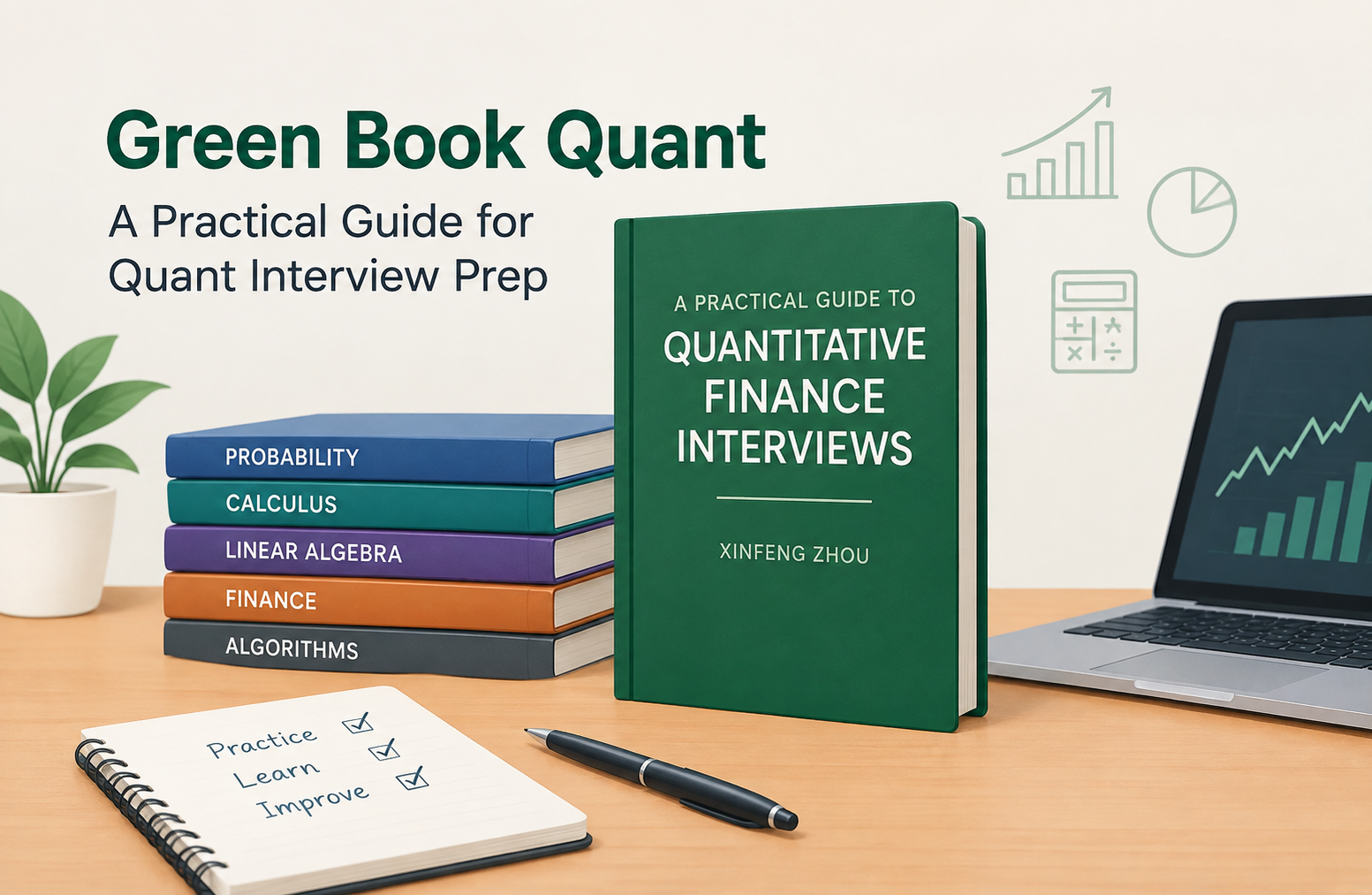
If you are searching for green book quant, you are most likely looking for the quantitative finance interview preparation book commonly associated with the nickname “Green Book.” The name can be confusing because several quant interview resources are described informally by color-based nicknames. In current discussions, A Practical Guide to Quantitative Finance Interviews by Xinfeng Zhou is widely referred to as the Green Book, although some communities use the term differently. Harvard’s Mignone Center for Career Success also identifies Zhou’s book as one of the well-known resources commonly called the Green Book.
For a student, aspiring quantitative analyst, trader, researcher, or developer, the value of this book is not simply the number of problems it contains. Its real value comes from exposing you to the type of mathematical reasoning that can appear under interview pressure. Probability, brainteasers, calculus, linear algebra, stochastic processes, finance, algorithms, and numerical thinking all require a different style of reasoning.
The important point is that reading the book from beginning to end is not the same as preparing effectively. Quantitative finance interviews test how you think, communicate, estimate, derive, and respond when you do not immediately know the answer. This guide explains what the Green Book is, what it teaches, how to study it, where it can fall short, and how to turn its problems into practical interview preparation.
What Is Green Book Quant?
Green Book quant generally refers to the use of the Green Book as a quantitative finance interview preparation resource.
The book most commonly associated with this term is A Practical Guide to Quantitative Finance Interviews, written by Xinfeng Zhou. It was first published in 2008 and became known informally as the Green Book because of its distinctive cover. The book was designed around technical questions encountered in quantitative finance interviews rather than functioning as a conventional university textbook. (Harvard Career Services)
That distinction matters.
A traditional textbook might spend several pages developing a theorem before giving you exercises. An interview preparation book has a different purpose. It asks you to recognize a problem, identify the relevant mathematical structure, and reach a defensible solution within limited time.
This makes the book particularly useful for candidates who already have some mathematical background but need practice applying that knowledge quickly.
The Green Book should therefore be viewed as a problem-solving and interview preparation resource, not as a complete education in quantitative finance.
It can help you practice:
- Probability
- Expected value
- Conditional probability
- Combinatorics
- Brainteasers
- Calculus
- Linear algebra
- Stochastic processes
- Stochastic calculus
- Options and derivatives
- Financial mathematics
- Algorithms
- Numerical methods
The exact organization and problem counts reported online can vary between editions, summaries, and secondary resources, so candidates should rely on their own edition for the definitive chapter and problem structure. The broad subject coverage, however, is consistently described across academic and quant preparation resources. (QuantPrep)
Why Is the Green Book Important for Quant Interviews?
Quantitative finance interviews are unusual because knowing a formula is often not enough.
Suppose an interviewer asks a probability question. They may not simply want the numerical answer. They may want to see whether you can:
- Define the sample space.
- Identify independent and dependent events.
- Break a difficult problem into smaller cases.
- Explain your assumptions.
- Check whether your answer makes sense.
- Adjust your approach when the interviewer changes a condition.
This is where the Green Book becomes useful.
The problems encourage a habit of approaching unfamiliar questions systematically. That habit can be more valuable than memorizing individual solutions.
A candidate who memorizes 100 answers may perform poorly when the interviewer changes one detail.
A candidate who understands why those answers work can often reconstruct the solution.
That difference is fundamental to green book quant preparation.
What Does the Green Book Cover?
The strongest feature of the book is its breadth.
Quantitative finance is not one narrow mathematical discipline. Different roles emphasize different combinations of mathematics, programming, statistics, finance, and problem solving.
Probability and Expected Value
Probability is one of the most important foundations for quantitative interviews.
You should be comfortable with concepts such as:
- Conditional probability
- Independence
- Bayes’ theorem
- Expected value
- Variance
- Covariance
- Random variables
- Discrete distributions
- Counting techniques
- Conditional expectation
Many interview questions appear simple on the surface but become difficult because the candidate chooses the wrong way to represent the problem.
For example, an expected-value question may initially look like a calculation problem. In reality, the key challenge may be recognizing that you can condition on the first event and construct a recurrence.
That is an important lesson from interview preparation generally: the difficult part is often not the arithmetic.
The difficult part is finding the right representation.
Brainteasers and Logic Problems
Brainteasers are another major component of quant interview preparation.
These questions can involve:
- Coins
- Dice
- Cards
- Games
- Sequences
- Puzzles
- Optimization
- Logic
- Estimation
- Combinatorial reasoning
The purpose is not necessarily to discover whether you have seen the exact puzzle before.
A good interviewer can modify a familiar problem.
For example, if you know the standard solution to a coin puzzle, the interviewer can change the number of coins, introduce an additional condition, or ask you to optimize the strategy.
The useful skill is therefore recognizing structure.
Calculus and Linear Algebra
Quantitative finance uses mathematics extensively, so calculus and linear algebra naturally appear in technical interviews.
Relevant areas include:
- Differentiation
- Integration
- Optimization
- Partial derivatives
- Matrices
- Vectors
- Eigenvalues
- Eigenvectors
- Linear transformations
- Systems of equations
For derivatives-related positions, calculus is especially important because pricing and risk concepts frequently involve sensitivities.
Linear algebra becomes increasingly important when working with statistical models, optimization, factor models, machine learning, and numerical methods.
A candidate preparing for a modern quantitative role should not treat these chapters as isolated interview trivia.
They form part of the mathematical foundation used throughout quantitative work.
Stochastic Processes and Stochastic Calculus
This is where preparation can become significantly more advanced.
Stochastic processes deal with systems that evolve over time while containing randomness.
Important ideas include:
- Random walks
- Markov processes
- Brownian motion
- Martingales
- Stopping times
- Stochastic differential equations
- Ito’s lemma
You do not necessarily need to become an expert in stochastic calculus simply because you are reading an interview preparation book.
Your required depth depends heavily on the role.
A quantitative researcher working on derivatives models may need much stronger stochastic mathematics than a candidate interviewing for a role focused primarily on statistical modeling.
This is one reason you should not study every chapter with identical intensity.
Finance and Derivatives
The financial sections connect mathematical reasoning to actual markets and financial instruments.
Depending on the problem, preparation can involve concepts such as:
- Options
- Calls
- Puts
- Put-call parity
- Black-Scholes concepts
- Greeks
- Hedging
- Portfolio relationships
- Arbitrage
- Fixed income concepts
The important goal is understanding rather than formula memorization.
For example, if you know the Black-Scholes equation but cannot explain what volatility represents or why option sensitivity changes when market conditions change, your mathematical knowledge may not translate into strong interview performance.
Quantitative interviews often reward candidates who can connect equations with intuition.
Algorithms and Numerical Methods
Programming and computational thinking are also relevant to quantitative work.
Problems may involve:
- Algorithm design
- Complexity
- Recursion
- Dynamic programming
- Numerical approximation
- Optimization
- Computational efficiency
This section should be supplemented with actual programming practice.
One limitation of relying heavily on an older interview book is that modern quantitative roles increasingly involve practical programming and data work. Harvard’s career guidance for STEM PhDs entering quant finance specifically emphasizes programming, data work, research ability, and interview practice. (Harvard Career Services)
Therefore, book-based algorithm practice should not be treated as a replacement for writing code.
Who Should Use the Green Book?
The book can be useful for several types of candidates, but the way you use it should change depending on your background.
Undergraduate Students
If you are studying mathematics, statistics, computer science, engineering, physics, economics, or a related quantitative discipline, the book can help you understand what technical interviews may feel like.
However, students who have not yet studied probability or calculus may find some problems difficult for reasons unrelated to interview ability.
In that situation, build the mathematical foundation first.
Master’s Students
Students in financial engineering, mathematical finance, statistics, computer science, applied mathematics, and related programs may find the book particularly relevant.
At this stage, the main challenge is often not learning basic concepts.
It is learning how to apply them quickly.
Quant Trader Candidates
Trading interviews often place substantial emphasis on probability, expected value, mental mathematics, games, estimation, and decision making.
The Green Book can therefore provide useful practice.
But trader candidates should also practice thinking aloud.
An interviewer needs to understand your reasoning, not simply see a final number.
Quant Research Candidates
Researchers usually need broader technical preparation.
The Green Book can provide interview-style practice, but it should be combined with:
- Statistics
- Machine learning
- Programming
- Data analysis
- Research methodology
- Optimization
- Mathematical modeling
The modern quantitative research environment extends well beyond traditional interview puzzles.
Quant Developer Candidates
Candidates targeting quantitative development roles should pay particular attention to algorithms, programming, data structures, numerical methods, and software engineering.
The book can help with mathematical interview questions, but it should not be your only preparation resource.
How to Study the Green Book Effectively
The biggest mistake is treating the book like a normal reading assignment.
Do not simply read a question, look at the answer, and move to the next page.
That creates familiarity without necessarily creating problem-solving ability.
Instead, use a deliberate process.
Step 1: Attempt Every Problem Before Reading the Solution
Give yourself a reasonable amount of time.
For an easy problem, that may be several minutes.
For a difficult problem, you may need considerably longer.
Write down your assumptions and approach.
Even if your solution is wrong, the attempt creates useful information about where your reasoning breaks down.
Step 2: Explain Your Reasoning Out Loud
This is one of the most valuable changes you can make.
Quant interviews are conversations.
You need to communicate mathematical ideas clearly while solving the problem.
Instead of silently writing:
Probability = 1/3
practice saying:
I will condition on the first event because the remaining problem has the same structure after that event.
The second approach demonstrates reasoning.
Step 3: Study the Solution for the Idea
Do not focus only on the final answer.
Ask:
- Why did this method work?
- What assumption made it possible?
- Was there a simpler approach?
- Could I solve it another way?
- What would change if one condition were removed?
- Can I generalize the result?
This transforms one problem into several lessons.
Step 4: Record Your Mistakes
Create a simple error log.
Useful categories include:
| Mistake Type | Example |
| Probability setup | Incorrect sample space |
| Algebra | Calculation error |
| Concept | Misunderstood conditional probability |
| Strategy | Used a complicated approach |
| Communication | Could not explain the reasoning |
| Time management | Spent too long on one path |
After several weeks, patterns will appear.
You may discover that you are not actually weak at probability. You may simply be choosing inefficient approaches.
That is valuable information.
A Better Way to Think About Green Book Problems
Instead of asking:
“How do I solve this question?”
ask:
“What type of problem is this?”
This small change can dramatically improve preparation.
For example, a problem may initially appear to involve cards.
But the underlying concept could actually be conditional probability.
Another problem may appear to be a complicated game.
Its mathematical structure might be a recurrence.
A market question may actually be testing expected value.
An optimization question may be testing symmetry.
The surface story changes.
The underlying structure often does not.
That is one of the most transferable skills you can develop through green book quant practice.
Common Mistakes Candidates Make
Memorizing Solutions
Memorization can help with formulas, but it is dangerous when applied to problem solving.
Interviewers can easily modify a known question.
Understanding is more durable than memorization.
Reading Too Many Problems
Quantity can become misleading.
Solving 30 problems superficially may teach you less than solving 10 problems deeply.
A useful practice session should include:
- Independent attempt
- Explanation
- Solution review
- Error analysis
- Variation of the problem
- Reattempt later
Ignoring Basic Probability
Some candidates want to jump immediately into stochastic calculus or advanced finance.
That can be inefficient.
Many interview questions are built on simple ideas used carefully.
Conditional probability and expected value can be more useful in an interview than knowing a complicated theorem without being able to apply it.
Neglecting Mental Mathematics
Some quant interviews require quick numerical reasoning.
You should practice:
- Percentages
- Fractions
- Approximation
- Expected values
- Squares
- Multiplication
- Ratios
- Basic probability
You do not need to turn every calculation into mental arithmetic.
The goal is to become comfortable enough with numbers that basic computation does not interrupt your reasoning.
Ignoring Communication
A correct solution presented poorly can still create problems in an interview.
Practice stating:
- What you know
- What you need to find
- Your assumptions
- Your approach
- Your intermediate result
- Your final conclusion
Clear communication makes mathematical reasoning easier to evaluate.
Is the Green Book Still Useful?
The answer depends on what you expect it to accomplish.
As an interview problem collection, it remains relevant because many fundamental mathematical concepts do not become obsolete.
Probability is still probability.
Expected value is still expected value.
Linear algebra is still linear algebra.
However, quantitative finance itself has changed significantly since the book was first published.
Modern quant roles can involve large datasets, machine learning, sophisticated programming environments, alternative data, cloud infrastructure, and increasingly complex research workflows.
Harvard’s career guidance makes this point clearly by emphasizing that modern finance roles commonly involve substantial data and programming work. It also notes that the Green Book remains useful for understanding the types of mathematical questions candidates may encounter while acknowledging that the book is dated in areas such as machine learning. (Harvard Career Services)
Therefore, the right conclusion is not that the book is either completely current or completely outdated.
It is more accurate to see it as a mathematical interview foundation that should be supplemented with modern technical preparation.
Green Book Quant Preparation by Role
Different roles require different study priorities.
Quantitative Trader
Focus heavily on:
- Probability
- Expected value
- Mental mathematics
- Games
- Logic
- Decision making
- Fast estimation
Then add role-specific market knowledge and trading simulations where appropriate.
Quantitative Researcher
Give more attention to:
- Probability
- Statistics
- Linear algebra
- Calculus
- Optimization
- Stochastic processes
- Programming
- Machine learning
Research candidates should also practice explaining previous research projects.
Quantitative Analyst
A balanced approach is usually appropriate.
Combine:
- Mathematical fundamentals
- Probability
- Finance
- Statistics
- Programming
- Derivatives
- Data analysis
The exact mix depends on the employer and position.
Quantitative Developer
Prioritize:
- Algorithms
- Data structures
- Programming
- Numerical methods
- Systems concepts
- Mathematics relevant to the role
The mathematical interview material remains useful, but coding practice should occupy a significant portion of preparation.
A Four-Week Green Book Study Strategy
A structured schedule can prevent random studying.
Week 1: Probability and Brainteasers
Focus on:
- Conditional probability
- Expected value
- Counting
- Logic
- Classic puzzles
Do not worry about completing every question.
Focus on recognizing structures.
Week 2: Mathematics
Study:
- Calculus
- Linear algebra
- Optimization
- Relevant mathematical techniques
For every difficult question, write down the underlying concept.
Week 3: Stochastic Processes and Finance
Review:
- Random processes
- Brownian motion
- Stochastic calculus
- Options
- Greeks
- Arbitrage
- Basic derivatives concepts
Candidates who do not need advanced stochastic mathematics for their target role can adjust the depth accordingly.
Week 4: Mixed Interview Practice
Stop studying chapters in isolation.
Mix the topics.
Give yourself random questions and limited time.
This is closer to an actual interview because you will not always know in advance whether the next question is about probability, calculus, finance, or algorithms.
How to Know When You Are Ready
Completing the book does not automatically mean you are interview-ready.
A stronger test is whether you can handle unfamiliar variations.
You should be able to:
- Start a problem without immediately seeing the solution.
- Explain your assumptions.
- Identify relevant mathematical concepts.
- Work through calculations accurately.
- Detect unreasonable results.
- Recover after making a mistake.
- Explain an alternative approach.
- Solve familiar problem types under time pressure.
- Discuss your previous technical work clearly.
Most importantly, you should be comfortable saying:
“I am not sure yet, but I would approach it this way.”
That is much more useful than pretending to know an answer.
How to Use the Book With Other Preparation
The Green Book should usually sit inside a broader preparation system.
A useful framework is:
Mathematics + Probability + Programming + Finance + Interview Practice
Each component supports the others.
Mathematics gives you the tools.
Probability teaches you how to reason about uncertainty.
Programming lets you turn ideas into computational methods.
Finance provides the application context.
Interview practice teaches you how to communicate all of this under pressure.
If one part is missing, preparation can become unbalanced.
For example, a candidate may know stochastic calculus but struggle with simple probability puzzles.
Another may be an excellent programmer but have difficulty explaining financial intuition.
A strong preparation plan identifies these gaps rather than assuming that finishing one book will solve everything.
Green Book Quant and Real-World Quantitative Work
There is an important distinction between solving interview problems and doing quantitative work.
Interview problems are deliberately compressed.
Real research is messy.
Real financial datasets can contain:
- Missing observations
- Bad data
- Structural changes
- Transaction costs
- Survivorship bias
- Look-ahead bias
- Overfitting
- Non-stationary relationships
A perfect mathematical answer to an artificial problem does not automatically translate into a profitable or reliable financial strategy.
That is why interview preparation should eventually move beyond puzzles.
After developing mathematical fluency, candidates should practice applying their knowledge to real datasets and realistic research questions.
For example, instead of only solving an expected-value puzzle, you could investigate how expected returns behave under different assumptions.
Instead of only studying optimization mathematically, you could examine how constraints affect portfolio construction.
Instead of memorizing option formulas, you could study how Greeks change under different market conditions.
This transition turns abstract knowledge into practical understanding.
The Biggest Lesson From Green Book Preparation
The most valuable lesson is not a particular formula.
It is the ability to remain structured when a problem looks unfamiliar.
Strong quantitative reasoning often follows a simple pattern:
Understand → Simplify → Model → Solve → Check → Explain
First, understand exactly what is being asked.
Then simplify the problem without changing its essential structure.
Build a mathematical model.
Solve it.
Check whether the result is reasonable.
Finally, explain your reasoning clearly.
This process works far beyond interviews.
It is useful in research, programming, statistics, financial modeling, and analytical decision making.
Should Beginners Start With the Green Book?
Beginners can use it, but they should understand what they are getting into.
If you have never studied probability, calculus, or linear algebra, some sections may feel unnecessarily difficult.
That does not necessarily mean the material is beyond you.
It may simply mean you need foundational study first.
A better sequence for a complete beginner could be:
- Learn basic probability.
- Learn introductory calculus.
- Learn linear algebra.
- Develop basic programming ability.
- Study introductory statistics.
- Learn basic financial concepts.
- Begin Green Book problems.
- Add timed interview practice.
For someone with a strong mathematics or engineering background, the sequence can be much shorter.
How to Get More Value From Difficult Problems
When you encounter a problem you cannot solve, avoid immediately checking the answer.
Try three levels of assistance.
First Attempt
Work independently.
Write everything you know.
Second Attempt
Ask yourself what concept might apply.
For example:
- Conditional probability?
- Symmetry?
- Recursion?
- Expected value?
- Invariant?
- Optimization?
- Linear algebra?
Third Attempt
Only then review the solution.
Once you understand it, close the solution and reproduce the reasoning yourself.
Then create a variation.
Change one parameter or condition and solve it again.
This final step is particularly powerful because it tests whether you learned the method rather than the answer.
Green Book Quant: What You Should Remember
The Green Book is best understood as an interview training resource rather than a complete quant finance curriculum.
Its strongest contribution is exposure to mathematical problem solving across several areas.
The most useful preparation approach is active rather than passive.
Do not simply read.
Attempt.
Explain.
Review.
Generalize.
Repeat.
The book can help candidates become more comfortable with the mathematical style of quant interviews, but it should be combined with role-specific preparation. A researcher, trader, analyst, and developer can all benefit from the material while requiring different additional skills.
It is also important to recognize the age of the material. The mathematical foundations remain valuable, but modern quantitative careers involve considerably more programming, data analysis, and computational research than an interview book published in 2008 can fully represent. Harvard’s career guidance similarly recommends combining mathematical interview preparation with coding, data, and research skills. (Harvard Career Services)
Ultimately, the goal should not be to say that you have completed the Green Book.
The better goal is to reach the point where an unfamiliar quantitative problem no longer causes you to freeze.
You should be able to slow down, identify the structure, make reasonable assumptions, test an approach, communicate your reasoning, and adjust when the problem changes.
That is the deeper skill behind green book quant preparation.
Frequently Asked Questions
What does green book quant mean?
Green book quant usually refers to using Xinfeng Zhou’s A Practical Guide to Quantitative Finance Interviews for quantitative finance interview preparation. The book is commonly known by the nickname “Green Book.” (Harvard Career Services)
Is the Green Book good for quant interview preparation?
It can be useful for building practice with probability, brainteasers, mathematics, stochastic concepts, finance, algorithms, and related interview problems. It should be supplemented with programming, statistics, finance, and role-specific preparation.
Is the Green Book suitable for beginners?
It can be used by beginners, but people without a foundation in probability, calculus, and linear algebra may benefit from studying those subjects first.
Which topics should I focus on first?
Probability, expected value, conditional probability, brainteasers, and core mathematical reasoning are sensible starting points for many candidates. The exact priority should depend on the role you are targeting.
Does the Green Book teach everything needed for a quant job?
No. It is an interview preparation resource rather than a complete quant finance curriculum. Modern candidates may also need strong programming, statistics, data analysis, machine learning, financial knowledge, and research skills.
How should I study Green Book problems?
Attempt each problem before viewing the solution, explain your reasoning aloud, study the underlying idea, record mistakes, and later solve variations of the problem. This is more useful than simply memorizing answers.
Conclusion
Green book quant preparation is ultimately about developing a disciplined way to approach difficult quantitative problems.
The book can introduce you to probability puzzles, mathematical reasoning, finance questions, stochastic concepts, algorithms, and other areas that commonly appear in quantitative interview preparation. Its greatest benefit comes when you use those problems actively rather than treating them as pages to complete.
A candidate who understands the structure behind a problem is in a stronger position than someone who only remembers its solution.
The Green Book also works best as one part of a broader preparation process. Mathematical ability should be supported by programming, statistics, financial knowledge, data analysis, and communication skills. The right balance depends on whether you are targeting quantitative trading, research, analysis, or development.
Most importantly, measure progress by how you think, not by how many pages you finish.
If an unfamiliar problem appears and you can calmly define the problem, identify useful assumptions, construct a model, work through the mathematics, check the result, and explain your reasoning, then your preparation is doing what it is supposed to do.