Houston Rockets vs Cleveland Cavaliers Match Player Stats
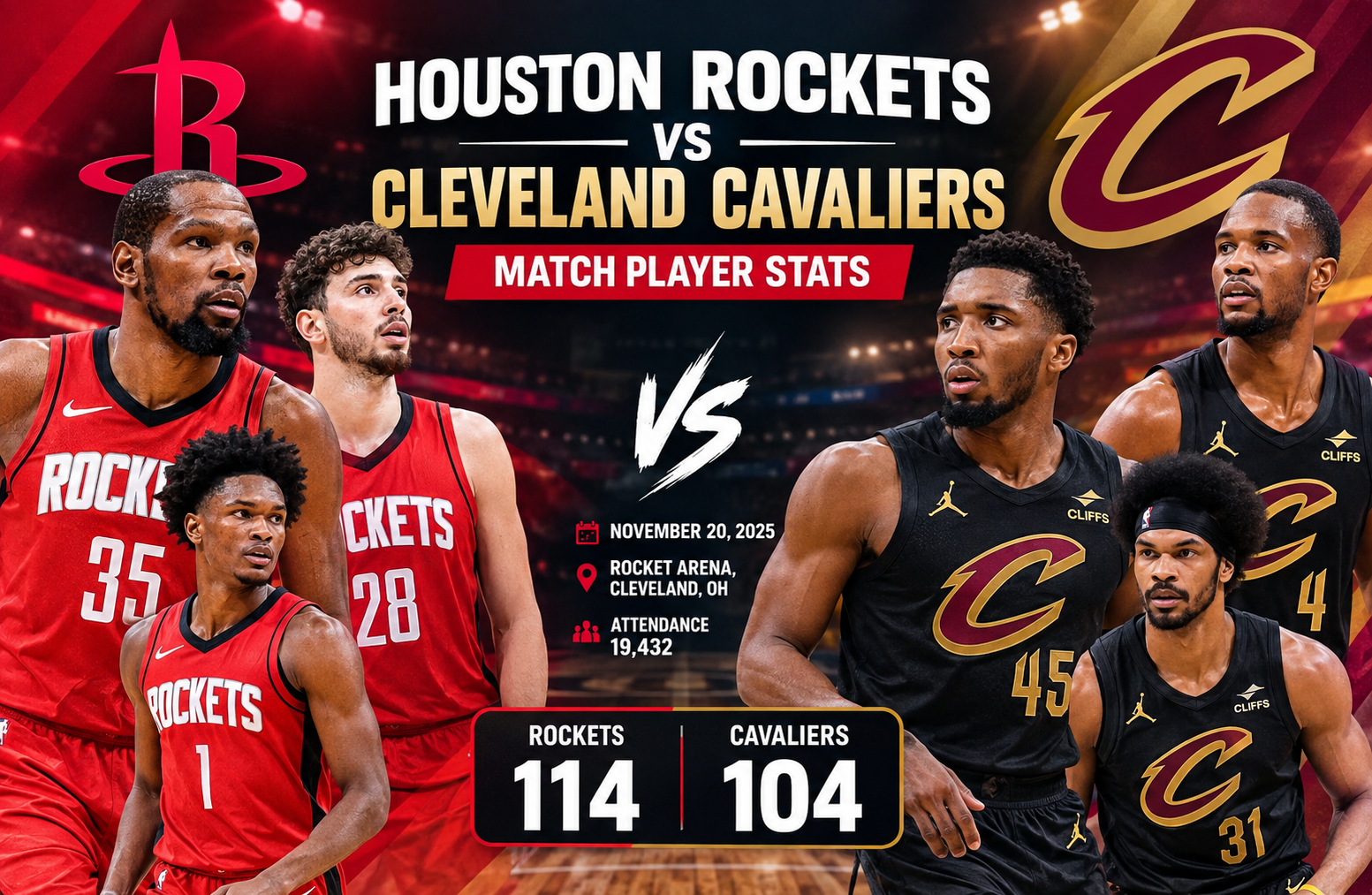
The Houston Rockets vs Cleveland Cavaliers match player stats from the Rockets’ 114-104 victory reveal a game that was decided by much more than the final scoring margin. Houston built a commanding early advantage, survived a major Cleveland comeback, and then regained control in the fourth quarter behind Alperen Sengun, Kevin Durant, and a decisive scoring burst from Aaron Holiday. Sengun finished with 28 points, 11 rebounds, and 7 assists, while Durant added 20 points. For Cleveland, De’Andre Hunter led all Cavaliers scorers with 25 points, followed by Donovan Mitchell with 21 and Evan Mobley with 18.
The final score was Houston 114, Cleveland 104 at Rocket Arena. The result moved Houston to 10-3 and Cleveland to 10-6, according to the game record. Houston also extended its winning streak to five games.
What makes this matchup particularly interesting is the contrast between the teams’ performances. Houston controlled the glass, generated 16 offensive rebounds, shot 85.2% from the free-throw line, and received important production from its supporting cast. Cleveland shot 12-for-39 from three-point range and rallied strongly after halftime, but the Rockets managed to answer the comeback when the game became tight.
Houston Rockets vs Cleveland Cavaliers Match Player Stats at a Glance
The most important individual numbers from the game were:
| Player | Team | Points | Rebounds | Assists | FG |
| Alperen Sengun | Rockets | 28 | 11 | 7 | 10-17 |
| Kevin Durant | Rockets | 20 | 3 | 3 | 6-18 |
| Aaron Holiday | Rockets | 18 | 0 | 0 | 5-7 |
| Jabari Smith Jr. | Rockets | 14 | 9 | 2 | 5-12 |
| Amen Thompson | Rockets | 12 | 9 | 6 | 6-14 |
| Reed Sheppard | Rockets | 12 | 2 | 2 | 5-11 |
| Steven Adams | Rockets | 6 | 11 | 3 | 2-6 |
| De’Andre Hunter | Cavaliers | 25 | 4 | 2 | 6-11 |
| Donovan Mitchell | Cavaliers | 21 | 3 | 2 | 8-17 |
| Evan Mobley | Cavaliers | 18 | 6 | 0 | 7-13 |
| Craig Porter Jr. | Cavaliers | 9 | 7 | 5 | 4-6 |
| Jarrett Allen | Cavaliers | 8 | 7 | 3 | 4-9 |
| Lonzo Ball | Cavaliers | 7 | 2 | 2 | 2-8 |
| Dean Wade | Cavaliers | 4 | 7 | 3 | 1-5 |
The official NBA box score confirms Houston’s 41-for-90 shooting, 9-for-24 three-point shooting, 23-for-27 free-throw shooting, 51 rebounds, 23 assists, 9 steals, and 13 turnovers.
Final Score and Game Summary
Houston won 114-104, but the score does not fully explain how the game developed.
The Rockets started exceptionally well. They scored 33 points in the opening quarter while limiting Cleveland to 19. Houston then added 24 points in the second quarter, giving the visitors a 57-40 halftime advantage. NBA’s game recap notes that Durant scored 13 first-half points while Sengun contributed 10 points and six rebounds during the opening two quarters.
The third quarter changed the momentum.
Houston scored only 17 points, while Cleveland produced 30. The Cavaliers used that period to cut deeply into the deficit, turning what had looked like a comfortable Rockets victory into a competitive fourth-quarter game.
Houston eventually led 69-47 midway through the third quarter before Cleveland finished the period with a 23-5 run. That surge brought the Cavaliers within four points entering the final period.
Cleveland continued its comeback early in the fourth. Donovan Mitchell hit a three-pointer that brought the Cavaliers as close as 77-76.
That was the point where Houston’s response mattered most.
Sengun and Amen Thompson answered with consecutive baskets, and Aaron Holiday later delivered a major fourth-quarter scoring burst. Holiday scored 14 of his 18 points in the final period, providing the type of bench production that can be difficult to account for in a conventional box-score comparison.
Houston ultimately scored 40 points in the fourth quarter, compared with 34 from Cleveland, and closed out the 10-point victory.
Houston Rockets Player Stats Breakdown
Alperen Sengun: 28 Points, 11 Rebounds, 7 Assists
Alperen Sengun was the statistical centerpiece of Houston’s performance.
He finished with 28 points on 10-of-17 shooting, along with 11 rebounds and 7 assists. He also made 8 of his 10 free throws. The combination of scoring, rebounding, and playmaking made his performance considerably more valuable than his scoring total alone suggests.
Sengun’s 7 assists are especially important when examining the Rockets’ offensive structure. A center who can create scoring opportunities for teammates changes how the defense has to defend the paint. Cleveland could not simply focus on stopping him as a scorer because he also had the ability to distribute the ball.
His 11 rebounds also helped Houston maintain control of the possession battle.
From a statistical perspective, Sengun produced a 28-point double-double while also approaching a triple-double. He was one assist short of becoming the only Houston player in this game with three major statistical categories at double-digit levels.
Kevin Durant: 20 Points
Kevin Durant scored 20 points despite shooting 6-for-18 from the field and 1-for-6 from three-point range.
That shooting line is not the most efficient offensive performance of Durant’s career, but his impact cannot be evaluated from field-goal percentage alone. He contributed 7-for-8 shooting from the free-throw line, 3 rebounds, and 3 assists.
Durant’s biggest value in the first half was helping Houston establish separation. The NBA recap specifically noted his 13 first-half points.
His scoring also forced Cleveland to respect another high-level offensive threat alongside Sengun.
That matters because Houston did not need Durant to score 30-plus points to win. Sengun carried a larger share of the offensive production, while Durant remained an important secondary scorer.
Aaron Holiday: 18 Points in 19 Minutes
Aaron Holiday provided one of the clearest examples of why bench scoring can decide a close NBA game.
Holiday played just 19:17 and finished with 18 points on 5-of-7 shooting. He also made 3 of his 5 three-point attempts and all five of his free throws.
The most significant detail is when those points came.
Holiday scored 14 of his 18 points in the fourth quarter. That means he supplied 14 of Houston’s 40 fourth-quarter points, accounting for 35% of the team’s scoring in the final period.
This was not simply efficient bench production. It was timely production.
When Cleveland had reduced the deficit to one point, Houston needed players capable of converting possessions without requiring an elaborate offensive sequence. Holiday’s shooting gave the Rockets another outlet.
Jabari Smith Jr.: 14 Points and 9 Rebounds
Jabari Smith Jr. recorded 14 points, 9 rebounds, and 2 assists while shooting 5-for-12 from the field and 3-for-6 from three.
His three-point shooting was particularly useful because Houston’s offense could stretch Cleveland’s defense around Sengun.
Smith also recorded 9 rebounds, giving Houston another large contributor on the glass.
His plus-minus was +10, the best mark among Houston’s starters. Plus-minus should not be treated as a standalone measure of individual performance, but in this particular game it supports the broader picture of Smith contributing during a winning Houston lineup.
Amen Thompson: 12 Points, 9 Rebounds, 6 Assists and 5 Steals
Amen Thompson produced one of the most complete stat lines of the game.
He recorded:
- 12 points
- 9 rebounds
- 6 assists
- 5 steals
- 6-for-14 shooting
The five steals were especially notable.
Thompson’s offensive production was not dominant, but his defensive activity and rebounding added value across multiple areas. His 6 assists also helped Houston maintain offensive balance.
He came within one rebound and four assists of a triple-double while producing five steals.
The NBA recap also highlights his 12 points, 9 rebounds, and five steals.
Steven Adams: 6 Points and 11 Rebounds
Steven Adams scored only 6 points, but his 11 rebounds were significant.
He shot 2-for-6 and added 3 assists. His rebounding helped Houston dominate the overall battle on the boards.
The Rockets finished with 51 total rebounds in the ESPN box score, although NBA and CBS box-score presentations also distinguish team rebounds in their totals. The individual numbers show that Adams and Sengun each collected 11 rebounds.
Adams therefore contributed in an area that does not always receive as much attention as scoring.
Reed Sheppard: 12 Points
Reed Sheppard finished with 12 points in 22:57.
He shot 5-for-11 overall and 2-for-5 from three-point range. His ability to provide perimeter scoring from the bench gave Houston another offensive option.
He also recorded 2 rebounds and 2 assists.
Clint Capela: 4 Points and 5 Rebounds
Clint Capela played 13:54 and finished with 4 points and 5 rebounds.
His shooting was efficient, as he went 2-for-3 from the field. He also recorded 2 blocks according to the supplied game data, while the official box score credits him with a block and a steal.
Houston’s Smaller Contributions
Josh Okogie finished with 0 points and 1 rebound in limited minutes.
Jae’Sean Tate also recorded 0 points in just over two minutes.
The key takeaway is that Houston did not require every rotation player to score. Its main contributors generated enough offense, while the team’s rebounding and defensive activity helped compensate for quieter individual performances.
Cleveland Cavaliers Player Stats Breakdown
De’Andre Hunter: 25 Points
De’Andre Hunter led Cleveland with 25 points.
He shot 6-for-11 from the field and made 5 of 8 three-point attempts. He also went 8-for-8 at the free-throw line.
That made Hunter one of Cleveland’s most efficient scoring options.
His five made threes were especially important because Cleveland needed perimeter production while trying to recover from the large first-half deficit.
Hunter’s 25 points were the highest scoring total by either team other than Sengun’s 28.
Donovan Mitchell: 21 Points
Donovan Mitchell finished with 21 points, 3 rebounds, and 2 assists.
His game had an unusual scoring pattern.
According to the NBA recap, Mitchell had only two points during the first three quarters on 1-of-7 shooting. He then exploded for 19 points in the fourth quarter.
That fourth-quarter surge was a major reason Cleveland came within one point.
Mitchell ultimately finished 8-for-17 from the field and 3-for-9 from three-point range.
The problem for Cleveland was that his strongest scoring stretch came after Houston had already built a substantial lead.
His fourth-quarter scoring demonstrated Cleveland’s ability to generate offense under pressure, but Houston’s response prevented the comeback from becoming a completed turnaround.
Evan Mobley: 18 Points and 6 Rebounds
Evan Mobley scored 18 points and grabbed 6 rebounds.
He shot 7-for-13 from the field but struggled at the free-throw line, making only 4 of 10 attempts.
Those missed free throws mattered because free throws become increasingly valuable during a comeback.
Mobley also scored eight points during Cleveland’s third-quarter surge, helping the Cavaliers turn a 22-point deficit into a much closer game.
Jarrett Allen: 8 Points and 7 Rebounds
Jarrett Allen finished with 8 points, 7 rebounds, and 3 assists on 4-for-9 shooting.
His rebounding numbers were solid, but Cleveland’s overall 39 rebounds were significantly below Houston’s total.
Allen’s 3 assists also show that his contribution was not limited to scoring and rebounding.
Craig Porter Jr.: 9 Points, 7 Rebounds and 5 Assists
Craig Porter Jr. produced an effective all-around line with:
- 9 points
- 7 rebounds
- 5 assists
- 4-for-6 shooting
- 1-for-2 from three
His 5 assists tied him for the highest assist total among Cleveland players.
That production became particularly relevant while Cleveland was trying to generate offense during the comeback.
Lonzo Ball: 7 Points
Lonzo Ball scored 7 points while shooting 2-for-8 from the field and 2-for-8 from three.
His perimeter shooting did not produce the efficiency Cleveland needed.
Ball did, however, contribute 2 rebounds and 2 assists.
Dean Wade: 4 Points
Dean Wade recorded 4 points, 7 rebounds, and 3 assists.
He shot 1-for-5 from the field and 1-for-4 from three.
His rebounding helped Cleveland, but the limited scoring efficiency made it harder for the Cavaliers to maintain offensive pressure across all four quarters.
Team Statistics That Explain the Result
The individual numbers become much easier to understand when placed beside the team statistics.
| Category | Houston | Cleveland |
| Points | 114 | 104 |
| Field Goals | 41-90 | 36-81 |
| Field Goal % | 45.6% | 44.4% |
| 3-Pointers | 9-24 | 12-39 |
| 3-Point % | 37.5% | 30.8% |
| Free Throws | 23-27 | 20-32 |
| Free Throw % | 85.2% | 62.5% |
| Total Rebounds | 51 | 39 |
| Offensive Rebounds | 16 | 10 |
| Assists | 23 | 20 |
| Turnovers | 13 | 12 |
| Steals | 9 | 4 |
| Blocks | 4 | 5 |
The official NBA and ESPN records support Houston’s 114-104 victory and the major statistical categories above.
The Rebounding Difference
The most obvious statistical advantage was rebounding.
Houston collected 51 rebounds compared with Cleveland’s 39 in the supplied and official box-score data. ESPN lists Houston with 16 offensive rebounds and 35 defensive rebounds.
That created additional possessions.
Houston’s 16 offensive rebounds were particularly valuable because offensive rebounds give a team another opportunity after a missed shot.
Sengun and Adams each grabbed 11 rebounds, while Smith and Thompson each added 9.
That is a major reason Houston could survive a shooting performance that was not dramatically better than Cleveland’s.
Free-Throw Efficiency
Houston made 23 of 27 free throws, an excellent 85.2%.
Cleveland made 20 of 32, or 62.5%.
The difference was 11.5 percentage points.
The contrast was particularly visible through individual performances. Sengun made 8 of 10, Durant made 7 of 8, and Holiday converted all five of his attempts.
For Cleveland, Mobley made only 4 of 10.
A team does not need to dominate every shooting category to win an NBA game, but efficient free-throw shooting can become crucial when the margin is tight.
Three-Point Shooting
Cleveland actually made more three-pointers.
The Cavaliers converted 12 of 39 attempts, while Houston made 9 of 24.
However, Cleveland shot only 30.8% from beyond the arc, compared with Houston’s 37.5%.
This is an important distinction.
Three-point volume alone does not indicate shooting success. Cleveland attempted 15 more threes than Houston but made only three more.
Hunter was the standout perimeter shooter, making 5 of 8.
Houston received three made threes from Holiday, three from Smith, and two from Sheppard.
Turnovers
Turnovers were relatively close.
Houston committed 13, while Cleveland committed 12.
That means the game was not primarily decided by Cleveland giving the ball away repeatedly.
Instead, Houston’s advantages came more clearly through rebounding, free-throw efficiency, and timely scoring.
Assists
Houston recorded 23 assists compared with Cleveland’s 20.
Sengun led Houston with 7 assists, while Thompson had 6.
For Cleveland, Porter Jr. led with 5.
The Rockets’ assist distribution demonstrates how much of their offense could run through frontcourt players.
How Houston Built the Early Lead
Houston’s 33-19 first quarter established the tone.
A 14-point advantage after one quarter does two things. It forces the trailing team to spend energy chasing the game, and it gives the leading team more flexibility with possessions.
Houston continued that pressure in the second quarter.
The Rockets won the quarter 24-21 and reached halftime ahead 57-40.
The game could have ended as a straightforward Houston victory if the Rockets had maintained that level of control.
Instead, Cleveland changed the game after halftime.
How Cleveland Nearly Completed the Comeback
The third quarter was Cleveland’s strongest stretch.
The Cavaliers outscored Houston 30-17.
That 13-point swing reduced the Rockets’ halftime advantage from 17 points to only four entering the fourth.
The comeback was not based on one player alone.
Mobley contributed eight points during the third-quarter rally, while Lonzo Ball added seven. Cleveland also increased its offensive pressure and converted enough possessions to turn the game into a one-possession contest.
Then Mitchell took over early in the fourth.
His three-pointer brought Cleveland within 77-76.
At that stage, Houston’s response became the defining sequence of the game.
Why the Fourth Quarter Decided the Game
Houston scored 40 points in the final period.
That is the highest single-quarter scoring total by either team in the game.
Cleveland still scored 34, but the Rockets’ offensive response prevented the Cavaliers from completing the comeback.
Sengun and Thompson immediately answered after Cleveland reached 77-76, and Holiday’s scoring became increasingly important.
Holiday scored 14 fourth-quarter points, making him one of the central figures in the closing stages.
This illustrates an important lesson when reading player statistics.
A player’s total points can hide when those points were scored.
Holiday’s 18 points were fewer than Sengun’s 28 or Hunter’s 25, but the timing of his scoring had a major influence on the game’s final result.
Most Important Statistical Takeaways
1. Sengun controlled multiple areas
Sengun’s 28 points, 11 rebounds, and 7 assists gave Houston a central offensive hub.
2. Houston won the possession battle
The Rockets’ offensive rebounding helped them create extra opportunities.
3. Cleveland’s comeback was real
The Cavaliers did not simply benefit from Houston taking its foot off the gas. Cleveland outscored Houston by 13 points in the third quarter and came within one point early in the fourth.
4. Houston answered at the right time
The Rockets scored 40 points in the fourth and closed the game instead of allowing Cleveland’s momentum to continue.
5. Free throws created a meaningful difference
Houston shot 85.2% from the line, while Cleveland shot 62.5%.
6. Hunter and Mitchell supplied Cleveland’s main scoring
Hunter finished with 25 points, while Mitchell scored 21. Mitchell’s fourth-quarter explosion was particularly notable.
7. Thompson’s defensive numbers stood out
Five steals, nine rebounds, and six assists made Thompson one of the game’s most versatile contributors.
Houston Rockets vs Cleveland Cavaliers Match Player Stats: What the Numbers Really Show
The most useful way to interpret these statistics is to look beyond the points column.
Houston did not win because every player shot efficiently. Durant, for example, shot 6-for-18. Houston also did not dominate the three-point volume battle.
Instead, the Rockets assembled enough advantages across several categories to withstand Cleveland’s comeback.
They rebounded the ball better.
They shot free throws more efficiently.
They created more offensive-rebound opportunities.
They received strong playmaking from Sengun and Thompson.
They also received an unexpected scoring lift from Holiday at exactly the moment the game became most competitive.
That combination explains why a team that led by 17 at halftime and watched that advantage disappear still finished with a 10-point victory.
Player Stat Leaders
Houston Leaders
Points: Alperen Sengun, 28
Rebounds: Alperen Sengun and Steven Adams, 11 each
Assists: Alperen Sengun, 7
Steals: Amen Thompson, 5
Three-pointers made: Aaron Holiday and Jabari Smith Jr., 3 each
Cleveland Leaders
Points: De’Andre Hunter, 25
Rebounds: Jarrett Allen, 7, and Dean Wade, 7
Assists: Craig Porter Jr., 5
Three-pointers made: De’Andre Hunter, 5
The NBA’s official game materials identify Sengun as Houston’s leading scorer and Hunter as Cleveland’s leading scorer.
What This Game Means for the Season Series
The victory gave Houston a 1-0 lead in the season series based on the supplied game data.
The result also moved Houston to 10-3 and Cleveland to 10-6.
For Houston, the victory extended its winning streak to five games and represented its 10th win in its previous 11 games according to the NBA and ESPN game coverage.
For Cleveland, the loss came during a six-game homestand. The Cavaliers had already faced injury absences involving Darius Garland and Jaylon Tyson at the time of the game, according to the NBA’s game recap.
Those circumstances are useful context, but they should not replace the actual box score when analyzing the game.
Frequently Asked Questions
Who led the Houston Rockets in scoring against the Cleveland Cavaliers?
Alperen Sengun led Houston with 28 points. He also recorded 11 rebounds and 7 assists.
Who led the Cleveland Cavaliers in scoring?
De’Andre Hunter led Cleveland with 25 points. He shot 6-for-11 from the field and made 5 of 8 three-point attempts.
What was the final score between Houston and Cleveland?
The Houston Rockets defeated the Cleveland Cavaliers 114-104 at Rocket Arena in Cleveland.
How many points did Kevin Durant score?
Kevin Durant scored 20 points. He shot 6-for-18 from the field, 1-for-6 from three-point range, and 7-for-8 from the free-throw line.
How many rebounds did Alperen Sengun have?
Sengun recorded 11 rebounds, giving him a double-double along with his 28 points.
How did Aaron Holiday perform?
Aaron Holiday scored 18 points in 19:17 of playing time. He shot 5-for-7 from the field, 3-for-5 from three-point range, and 5-for-5 from the free-throw line. He scored 14 of his 18 points in the fourth quarter.
Conclusion
The Houston Rockets vs Cleveland Cavaliers match player stats tell the story of a game that changed dramatically after halftime.
Houston controlled the opening half and entered the break with a 57-40 lead. Cleveland responded with a 30-point third quarter and eventually pulled within one point early in the fourth. The Rockets then restored control by scoring 40 points in the final period.
Alperen Sengun was the central figure with 28 points, 11 rebounds, and 7 assists. Kevin Durant added 20 points, while Aaron Holiday provided 18 points in limited minutes and became particularly important late in the game. Amen Thompson delivered an unusually broad statistical contribution with 12 points, 9 rebounds, 6 assists, and 5 steals.
Cleveland received 25 points from De’Andre Hunter, 21 from Donovan Mitchell, and 18 from Evan Mobley. Mitchell’s 19 fourth-quarter points were a major part of the Cavaliers’ comeback attempt.
The broader team numbers explain why Houston ultimately prevailed. The Rockets had more rebounds, more offensive rebounds, better free-throw efficiency, more steals, and a slight advantage in assists. Cleveland made more three-pointers, but Houston converted its three-point attempts at a better rate.
Taken together, the box score shows a Houston team that survived a major momentum swing and finished the game with enough rebounding, efficient free-throw shooting, playmaking, and late scoring to secure a 114-104 road victory.