Lakers vs Dallas Mavericks Match Player Stats
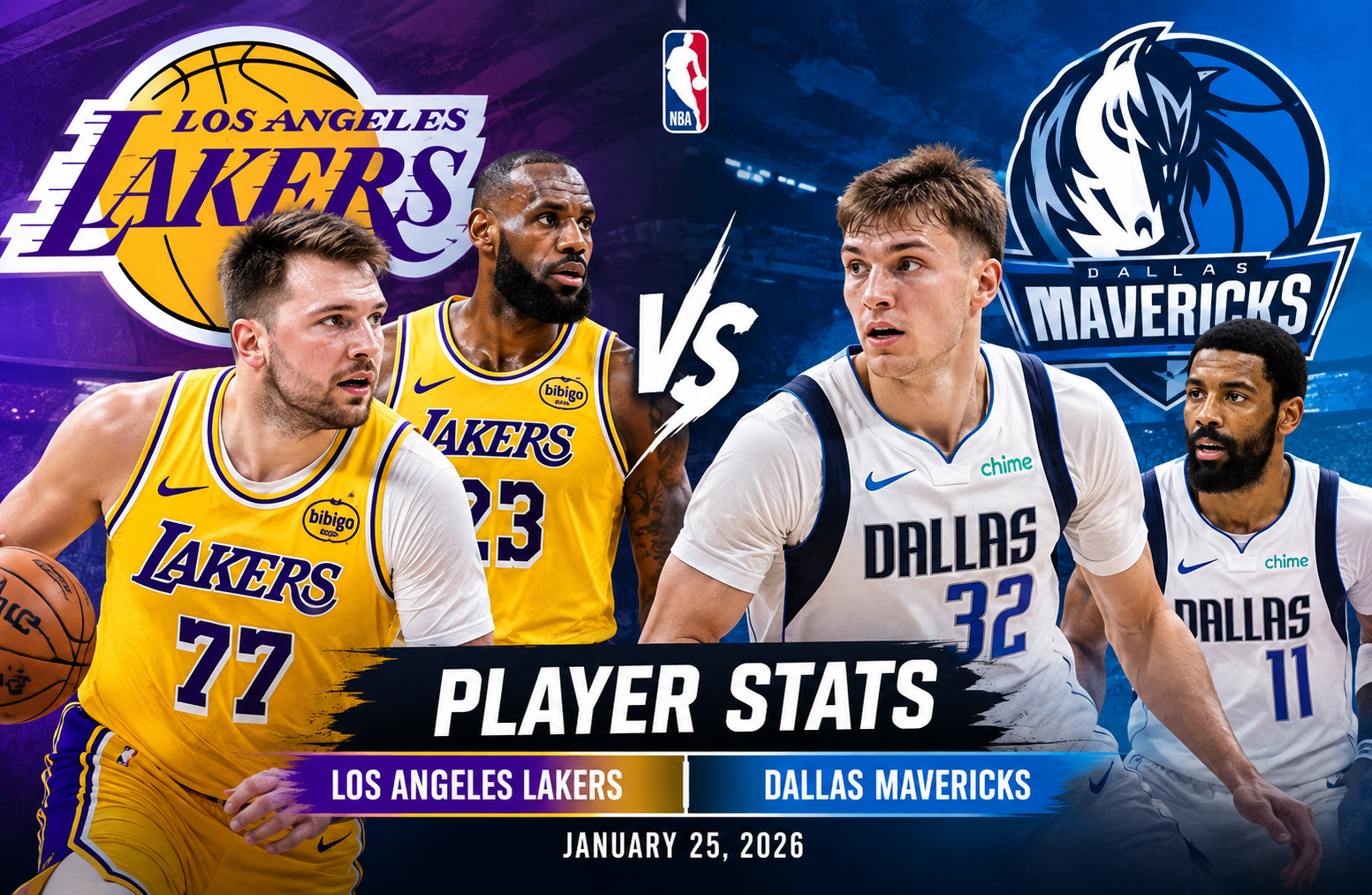
Lakers vs Dallas Mavericks Match Player Stats from the January 25, 2026 game provide a detailed look at how Los Angeles overcame a major second-half collapse to defeat Dallas 116-110 at American Airlines Center. Luka Dončić led the Lakers with 33 points, 8 rebounds, and 11 assists, while Max Christie scored 24 points for Dallas.
The final score does not fully explain how dramatic this game was. Los Angeles built a strong early advantage, struggled badly in the third quarter, fell behind by 15 points in the fourth, and then closed the game with a decisive late run. The Lakers finished the game on a 27-8 run.
This article breaks down the complete player production, team statistics, quarter-by-quarter scoring, shooting efficiency, rebounding, playmaking, turnovers, plus/minus numbers, and the key moments that shaped the result.
Lakers vs Dallas Mavericks Match Player Stats
The game was played at American Airlines Center in Dallas, Texas, with an announced attendance of 19,880. The game information records January 25, 2026, with Game ID 401810503.
| Category | Los Angeles Lakers | Dallas Mavericks |
| Final Score | 116 | 110 |
| Q1 | 37 | 28 |
| Q2 | 28 | 24 |
| Q3 | 14 | 35 |
| Q4 | 37 | 23 |
| Field Goals | 40-90 | 39-94 |
| FG Percentage | 44% | 41% |
| 3-Pointers | 14-34 | 10-29 |
| 3PT Percentage | 41% | 34% |
| Free Throws | 22-29 | 22-29 |
| FT Percentage | 76% | 76% |
| Rebounds | 57 | 43 |
| Assists | 26 | 22 |
| Turnovers | 14 | 11 |
| Steals | 7 | 10 |
| Blocks | 8 | 6 |
The numbers show an interesting contrast. Dallas committed fewer turnovers and produced more steals, but Los Angeles gained a substantial advantage on the glass and shot more effectively from three-point range.
Game Summary and Final Score
Los Angeles started the game with considerable offensive momentum.
The Lakers scored 37 points in the opening quarter while Dallas managed 28. Los Angeles then added another 28 points in the second quarter, taking a 65-52 halftime lead.
Dallas completely changed the rhythm after halftime.
The Mavericks scored 35 points in the third quarter while limiting Los Angeles to just 14. That 21-point difference transformed a 13-point Lakers halftime lead into a Dallas advantage heading into the fourth.
The fourth quarter produced another dramatic reversal.
Los Angeles scored 37 points while Dallas managed only 23. The Lakers erased a 15-point deficit during the final seven minutes and ended the contest on a 27-8 run.
That sequence explains why the final six-point margin does not accurately represent how quickly the game changed late.
How the Lakers Built Their Early Lead
Los Angeles established control through a combination of efficient shooting, rebounding, and offensive organization.
The Lakers finished the game at 44% from the field and 41% from three-point range. Dallas shot 41% overall and 34% from outside.
The difference from three-point territory was especially important.
Los Angeles made 14 of 34 attempts, while Dallas converted 10 of 29. That gave the Lakers four additional made three-pointers despite Dallas attempting only five fewer.
The Lakers also collected 57 rebounds compared with 43 for Dallas. That 14-rebound difference helped Los Angeles generate additional possessions and limit the Mavericks’ opportunities.
Luka Doncic Leads the Lakers
Luka Dončić delivered the most complete individual performance of the game.
He finished with:
- 33 points
- 8 rebounds
- 11 assists
- 1 steal
- 1 block
- 5 turnovers
- +18 plus/minus
Dončić shot 8-for-15 from the field, 3-for-8 from three-point range, and 14-for-15 at the free-throw line.
The 11 assists were particularly important because his influence went beyond scoring. He created opportunities for teammates while also carrying a large portion of the Lakers’ offensive workload.
His free-throw shooting was another major part of the performance. He made 14 of 15 attempts, which provided 14 points without requiring a field-goal attempt.
The victory also marked Dončić’s fourth consecutive win against his former team.
LeBron James Player Stats
LeBron James finished with:
- 17 points
- 8 rebounds
- 5 assists
- 1 steal
- 1 block
- 1 turnover
- -8 plus/minus
He shot 8-for-16 from the field and made one of his three three-point attempts.
His overall scoring total was not extraordinary by his usual standards, but his fourth quarter was important.
James scored 11 of his 17 points in the fourth quarter. That late scoring burst came while the Lakers were attempting to recover from their 15-point deficit.
This is an important example of why individual scoring totals should not always be evaluated without considering game context. A player can have a relatively quiet first three quarters and still have a major effect on the final outcome.
Rui Hachimura’s Efficient Contribution
Rui Hachimura produced one of the most efficient performances on the Lakers roster.
He recorded:
- 17 points
- 8 rebounds
- 1 assist
- 1 block
- +21 plus/minus
Hachimura shot 6-for-13 overall and 4-for-7 from three-point range.
His +21 was the best plus/minus on either team.
His fourth-quarter shooting was particularly significant. Hachimura’s four-point play and subsequent three-pointer were part of the sequence that gave Los Angeles the lead for good.
His contribution demonstrates how role-player efficiency can become decisive when a game reaches its closing possessions.
Other Lakers Player Stats
Jake LaRavia
LaRavia finished with:
- 13 points
- 6 rebounds
- 1 assist
- 1 block
- 4 turnovers
- +12
He shot 4-for-8 from the field and 2-for-6 from three-point range.
Marcus Smart
Smart recorded:
- 13 points
- 7 rebounds
- 3 assists
- 2 blocks
- 3 turnovers
- -2 plus/minus
He shot 4-for-10 overall and 2-for-4 from three-point range.
Deandre Ayton
Ayton contributed:
- 9 points
- 11 rebounds
- 1 block
- -12 plus/minus
He collected five offensive rebounds, helping the Lakers maintain second-chance opportunities.
Jarred Vanderbilt
Vanderbilt finished with:
- 8 points
- 4 rebounds
- 2 assists
- 1 steal
- -4 plus/minus
He shot 3-for-6 from the field and 2-for-3 from three-point range.
Jaxson Hayes
Hayes recorded:
- 6 points
- 1 rebound
- 1 assist
- 1 block
- +1 plus/minus
He was perfect from the field, going 3-for-3.
Gabe Vincent
Vincent did not score but contributed:
- 1 rebound
- 1 assist
- 2 steals
- +8 plus/minus
His defensive activity gave the Lakers useful production despite his lack of points.
Mavericks Player Stats
Dallas had several productive individual performances even though the team could not close the game.
Max Christie led the Mavericks in scoring with 24 points. Naji Marshall recorded 21 points and 11 rebounds, while Brandon Williams added 20 points. Cooper Flagg finished with 16 points, 7 rebounds, and 6 assists.
Max Christie
Christie finished with:
- 24 points
- 2 rebounds
- 3 assists
- 1 steal
- -9 plus/minus
He shot 8-for-18 from the field, 4-for-10 from three-point range, and 4-for-4 from the free-throw line.
His performance carried additional context because he was part of the Dallas roster after being involved in the trade that sent Dončić to Los Angeles.
Naji Marshall
Marshall posted one of Dallas’ most productive all-around lines:
- 21 points
- 11 rebounds
- 2 assists
- 1 steal
- -8 plus/minus
He shot 7-for-15 from the field and 7-for-10 at the free-throw line.
His 11 rebounds tied him with the Lakers’ Deandre Ayton for the game-high total.
Brandon Williams
Williams provided an important offensive spark:
- 20 points
- 4 rebounds
- 4 assists
- -24 plus/minus
He shot 8-for-17 from the field and 4-for-5 from the free-throw line.
The scoring total was impressive, but his -24 plus/minus was the lowest mark in the game. That contrast is useful when analyzing player performance because scoring alone does not capture everything that happened during a player’s minutes.
Cooper Flagg
Flagg recorded:
- 16 points
- 7 rebounds
- 6 assists
- 2 steals
- -4 plus/minus
He shot 7-for-20 overall, 1-for-5 from three-point range, and 1-for-2 at the free-throw line.
His six assists were second among Mavericks players and demonstrated his contribution as a playmaker rather than purely as a scorer.
Caleb Martin
Martin finished with:
- 17 points
- 3 rebounds
- 1 assist
- 1 steal
- 2 blocks
- +14 plus/minus
He shot 6-for-10 overall and 3-for-4 from three-point range.
His +14 was the best plus/minus on Dallas.
Klay Thompson
Thompson recorded:
- 6 points
- 3 rebounds
- 1 assist
- 2 steals
- +5 plus/minus
He made 2 of 5 field-goal attempts, including 2 of 5 from three-point range.
Dwight Powell
Powell did not score, but he collected:
- 7 rebounds
- 2 assists
- 2 steals
- 1 block
- +13 plus/minus
His +13 was the second-best plus/minus on Dallas.
Daniel Gafford
Gafford finished with:
- 2 points
- 2 rebounds
- 1 assist
- 2 blocks
- -5 plus/minus
P.J. Washington
Washington contributed:
- 2 points
- 3 rebounds
- 1 steal
- 1 block
- -9 plus/minus
Ryan Nembhard
Nembhard recorded:
- 2 points
- 2 assists
- +1 plus/minus
Quarter-by-Quarter Breakdown
First Quarter: Lakers 37, Mavericks 28
Los Angeles immediately established an offensive advantage.
The Lakers scored 37 points in the opening period, nine more than Dallas. The early scoring margin helped create the foundation for the 13-point halftime lead.
Second Quarter: Lakers 28, Mavericks 24
The Lakers remained in control during the second quarter.
They added another four points to their advantage, entering halftime ahead 65-52.
Third Quarter: Mavericks 35, Lakers 14
This was the turning point.
Dallas exploded for 35 points while holding Los Angeles to only 14. The Mavericks’ 21-point advantage in the quarter erased almost the entire Lakers lead.
Dallas entered the fourth quarter with a 14-point lead after its third-quarter surge.
Fourth Quarter: Lakers 37, Mavericks 23
Los Angeles responded when the game was at its most difficult stage.
The Lakers scored 37 points and allowed only 23. More importantly, they ended the game on a 27-8 run after falling 15 points behind during the final seven minutes.
The fourth quarter was therefore not simply about outscoring Dallas by 14 points. It was about completely reversing the momentum created during the third.
Shooting Efficiency Comparison
The shooting numbers provide one of the clearest explanations for the final result.
Los Angeles:
- 40-of-90 from the field
- 44% field-goal shooting
- 14-of-34 from three
- 41% three-point shooting
- 22-of-29 from the line
- 76% free-throw shooting
Dallas:
- 39-of-94 from the field
- 41% field-goal shooting
- 10-of-29 from three
- 34% three-point shooting
- 22-of-29 from the line
- 76% free-throw shooting
The free-throw numbers were identical, so that category did not separate the teams.
The more meaningful difference came from field goals and three-pointers. Los Angeles made one more field goal despite taking four fewer attempts and made four more three-pointers.
That efficiency mattered in a six-point game.
Rebounding Battle
The Lakers won the rebounding battle 57-43.
That is a 14-rebound advantage.
Deandre Ayton and Naji Marshall both collected 11 rebounds to lead all players. LeBron James, Luka Dončić, and Rui Hachimura each added eight for Los Angeles.
The Lakers also collected 16 offensive rebounds compared with 11 for Dallas.
That five-rebound offensive advantage helped provide additional scoring opportunities.
Ball Movement and Turnovers
Los Angeles recorded 26 assists compared with 22 for Dallas.
Dončić’s 11 assists represented a substantial portion of the Lakers’ total. Cooper Flagg led Dallas with six assists, while Brandon Williams added four.
Dallas did take better care of the ball.
The Mavericks committed 11 turnovers, compared with 14 for Los Angeles. They also recorded 10 steals against seven for the Lakers.
So the turnover battle favored Dallas, but it was not enough to offset Los Angeles’ advantages in shooting and rebounding.
Plus/Minus Analysis
Plus/minus needs to be interpreted carefully because it reflects the team’s scoring margin while a player is on the court, not an isolated measurement of individual quality.
Still, the numbers reveal several interesting patterns.
For Los Angeles, Rui Hachimura led at +21, followed by Luka Dončić at +18 and Jake LaRavia at +12.
For Dallas, Caleb Martin led at +14, followed by Dwight Powell at +13.
Brandon Williams had the lowest mark at -24, despite scoring 20 points.
That contrast is one of the most useful statistical lessons from this matchup: scoring volume and overall on-court impact are not interchangeable measurements.
The Fourth-Quarter Comeback
The comeback was the defining storyline of the game.
Dallas had turned the contest around during the third quarter and continued that momentum into the fourth. The Mavericks eventually led by 15 with less than seven minutes remaining.
Then Los Angeles changed the game.
LeBron James became more aggressive offensively, while Hachimura hit a four-point play and followed it with another three-pointer. That sequence moved the Lakers in front. Dončić then added a driving layup during the decisive stretch.
The Lakers finished the game on a 27-8 run.
That is the clearest numerical representation of how dramatically the game changed.
What the Stats Reveal About the Matchup
Several statistical themes stand out.
1. Los Angeles won through efficiency
The Lakers did not simply shoot more often. They shot better.
Their 44% field-goal percentage and 41% three-point percentage both exceeded Dallas’ corresponding numbers.
2. Rebounding created an important advantage
A 57-43 rebounding margin gave Los Angeles 14 more total rebounds.
The Lakers also held a 16-11 edge in offensive rebounds.
3. Dončić controlled multiple areas
His 33 points led all Lakers players, while his 11 assists led the entire game.
He also contributed eight rebounds, one steal, and one block.
4. Dallas had several strong individual performances
Christie scored 24, Marshall had 21, and Williams added 20.
The Mavericks were not lacking individual offensive production. Their challenge was sustaining that production while preventing the Lakers from recovering late.
5. The third and fourth quarters told opposite stories
Dallas won the third quarter 35-14.
Los Angeles won the fourth 37-23.
That 35-point third quarter and 37-point fourth quarter illustrate how quickly the game changed.
A Useful Way to Read These Player Stats
When evaluating a game like this, it is better to examine several categories together rather than relying only on the highest scorer.
A useful review process is:
- Check the final score.
- Compare shooting percentages.
- Examine three-point production.
- Check total and offensive rebounds.
- Compare assists and turnovers.
- Review the leading individual scorers.
- Examine plus/minus for additional context.
- Look at quarter-by-quarter scoring.
- Identify the late-game turning point.
Using that method makes it easier to understand why Los Angeles won even though Dallas produced a 35-point third quarter and finished with fewer turnovers.
Why the Box Score Matters
A box score gives readers more than a list of points.
It allows you to see how different forms of production contributed to the game.
For example, Dwight Powell scored zero points but recorded seven rebounds, two assists, two steals, one block, and a +13 plus/minus. Meanwhile, Brandon Williams scored 20 points but finished at -24.
Neither line should be evaluated using points alone.
Similarly, Dončić’s 33 points were important, but his 11 assists and eight rebounds show why his contribution extended beyond scoring.
This is why complete player statistics are especially useful when analyzing close games.
Frequently Asked Questions
Who led the Lakers in scoring against the Mavericks?
Luka Dončić led Los Angeles with 33 points. He also recorded eight rebounds and 11 assists.
Who led the Mavericks in scoring?
Max Christie led Dallas with 24 points. Naji Marshall scored 21, while Brandon Williams added 20.
What was the final score of Lakers vs Mavericks?
The Lakers defeated the Mavericks 116-110.
How many points did LeBron James score?
LeBron James scored 17 points and added eight rebounds and five assists. He scored 11 of his 17 points in the fourth quarter.
Which team had more rebounds?
The Lakers had 57 rebounds, compared with 43 for Dallas. Los Angeles therefore held a 14-rebound advantage.
How big was the Lakers’ fourth-quarter comeback?
Dallas led by 15 points with less than seven minutes remaining, but Los Angeles finished the game on a 27-8 run to win 116-110.
Conclusion
The Lakers vs Dallas Mavericks Match Player Stats show a game that changed direction several times.
Los Angeles controlled the first half, entering halftime with a 65-52 advantage. Dallas then produced a dominant third quarter, scoring 35 points while holding the Lakers to 14. That turnaround gave the Mavericks control entering the final period.
The fourth quarter produced the decisive response.
Luka Dončić finished with 33 points and 11 assists, LeBron James scored 11 fourth-quarter points, and Rui Hachimura delivered a highly efficient 17-point performance with a game-best +21 plus/minus. Dallas received strong scoring from Max Christie, Naji Marshall, and Brandon Williams, but the Mavericks could not preserve their late lead.
From a team-stat perspective, Los Angeles finished with advantages in field-goal percentage, three-point percentage, assists, rebounds, and blocks. Dallas had fewer turnovers and more steals, but those advantages did not overcome the Lakers’ shooting and rebounding edge.
The final 116-110 score therefore reflects more than one player’s scoring total. It represents a game in which momentum shifted dramatically, with Los Angeles ultimately producing the stronger closing stretch.