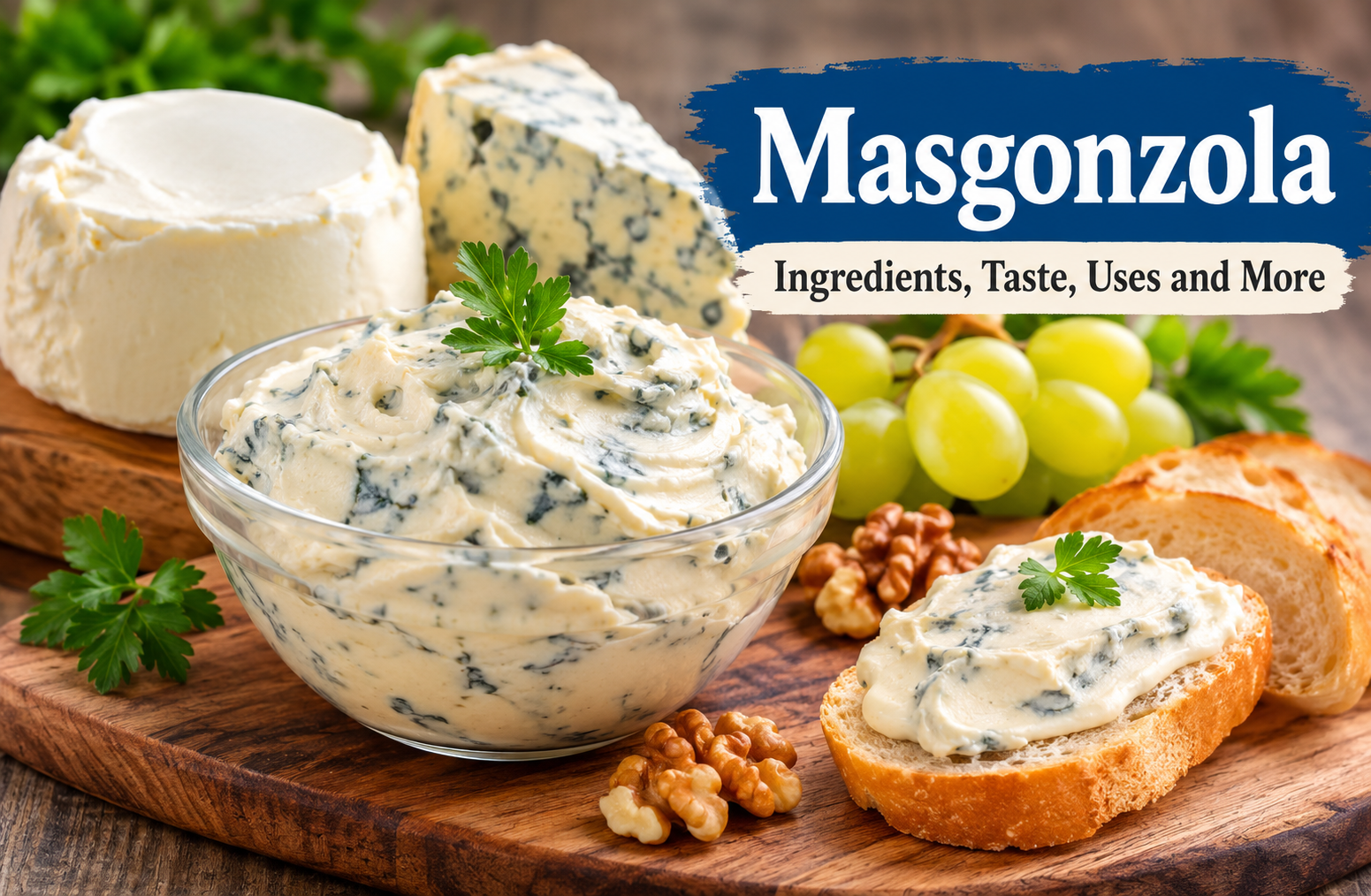
Masgonzola: What It Is, Taste, Uses, and Benefits
Masgonzola is an interesting cheese preparation that brings together two well-known Italian dairy products: mascarpone and Gorgonzola. The combination creates a rich, creamy texture with the distinctive tangy character of blue cheese. For people who enjoy creamy cheeses but find traditional blue cheese too strong, Masgonzola offers an appealing balance of flavors. Understanding Masgonzola means looking at its ingredients, taste, preparation, culinary uses, nutritional characteristics, and the differences between this cheese combination and traditional Italian cheeses.
Although the name sounds like an established Italian cheese variety, it is more accurate to describe it as a combination of mascarpone and Gorgonzola rather than a separately protected cheese. Products made with these two ingredients are available in different forms, including layered and blended preparations. However, the exact history of the shortened name is not firmly established.
Interest in this combination also raises practical questions. What does it taste like? How is it made? Can it be prepared at home? Which foods work best with it? Is it suitable for cooking, spreading, or serving on a cheese board? This guide explores these questions and explains what consumers should understand before purchasing or preparing it.
What Is Masgonzola?
Masgonzola is generally understood as a cheese preparation that combines mascarpone with Gorgonzola. Both ingredients come from Italian cheesemaking traditions, but they have very different characteristics.
Mascarpone is known for its smooth, creamy consistency and mild flavor. Gorgonzola, on the other hand, is a blue-veined cheese with a more noticeable salty, tangy, and sometimes sharp taste.
When these two ingredients are combined, their characteristics complement each other. Mascarpone softens the intensity of Gorgonzola, while the blue cheese contributes a more complex flavor to the creamy base.
The result is a rich cheese preparation that can be served with bread, crackers, fruit, and other foods. It can also be incorporated into sauces, pasta dishes, risotto, and several other recipes.
Understanding the Two Main Ingredients
To understand the preparation properly, it helps to examine the ingredients separately.
Mascarpone
Mascarpone is a fresh Italian dairy product traditionally made from cream. It has a smooth, thick, and spreadable consistency.
Its flavor is mild, slightly sweet, and buttery. Unlike strongly aged cheeses, mascarpone does not have an intense salty or sharp taste.
Common uses include:
- Tiramisu and other desserts.
- Creamy pasta sauces.
- Cheesecakes and dessert fillings.
- Spreads and dips.
- Risotto and savory dishes.
Mascarpone contributes richness and softness to the combination.
Gorgonzola
Gorgonzola is a traditional Italian blue cheese made from pasteurized whole cow’s milk under its protected production specification.
It is recognized by its blue-green or grey-blue veins, creamy interior, and distinctive flavor.
Depending on its type and maturation, Gorgonzola can taste mild and creamy or noticeably stronger and more tangy.
Its common culinary uses include:
- Pasta sauces.
- Risotto.
- Pizza toppings.
- Cheese boards.
- Salad dressings.
- Meat sauces and savory fillings.
Gorgonzola provides the characteristic blue-cheese flavor that makes the combination different from ordinary cream cheese.
How Does the Name Masgonzola Originate?
The most straightforward explanation is that the word combines parts of two ingredient names:
- Mas comes from mascarpone.
- Gonzola comes from Gorgonzola.
Together, they form Masgonzola.
This interpretation describes the ingredients associated with the preparation. However, there is no sufficiently reliable historical documentation identifying the person who created the term, its exact first appearance, or a specific date when it became established.
It is important to separate a reasonable explanation of a name from a verified historical record.
Some online descriptions present the preparation as an ancient Italian cheese with a long independent tradition. That claim should be treated cautiously. Gorgonzola has a documented history and protected identity, but the same historical status cannot automatically be assigned to its combination with mascarpone.
The more accurate description is a cheese specialty based on two established Italian dairy products.
What Does Masgonzola Taste Like?
The taste depends on the proportions of mascarpone and Gorgonzola, the particular Gorgonzola used, and whether the ingredients are mixed or layered.
Generally, the combination offers a balance between mild creaminess and the characteristic flavor of blue cheese.
The first impression is often rich and buttery. The Gorgonzola then contributes a gentle salty and tangy finish.
People who enjoy mild cheeses but want to explore blue cheese flavors may find this preparation easier to appreciate than eating a strongly flavored blue cheese on its own.
Flavor Characteristics
Several characteristics help explain its flavor profile.
Creaminess: Mascarpone provides a soft and rich mouthfeel.
Saltiness: Gorgonzola introduces a savory taste that balances the mild dairy flavor.
Tanginess: The blue cheese contributes a noticeable but potentially softened tang.
Butteriness: The cream content creates a rich and smooth impression.
Blue-cheese aroma: The Gorgonzola component contributes the recognizable aroma associated with blue-veined cheese.
The final result is not identical across all products. A preparation containing more Gorgonzola will generally taste stronger, while a higher mascarpone proportion will create a milder and creamier experience.
Does It Taste Like Traditional Blue Cheese?
Not exactly.
Traditional Gorgonzola has its own flavor, texture, and maturation characteristics. Combining it with mascarpone changes the overall balance.
The mascarpone reduces the intensity of the blue cheese in the finished preparation. This does not remove its distinctive character, but it can make the flavor more approachable.
People who already enjoy blue cheese may appreciate the extra creaminess. Those who dislike strong cheese aromas may prefer a preparation containing more mascarpone.
What Is Masgonzola Made Of?
The basic preparation uses two main ingredients, although commercial products may differ in their proportions and presentation.
1. Mascarpone Cheese
Mascarpone forms the creamy component.
It helps produce a soft consistency and balances the saltiness and tanginess of Gorgonzola.
Its mild flavor also makes it suitable for combining with different herbs, seasonings, and other ingredients.
2. Gorgonzola Cheese
Gorgonzola provides the blue-veined cheese component.
Its flavor contributes depth, saltiness, and a recognizable aroma.
The amount used can significantly affect the finished preparation. More Gorgonzola produces a stronger result, while less creates a gentler flavor.
Optional Ingredients
Depending on the recipe, additional ingredients may be included.
These can include:
- Black pepper.
- Fresh herbs.
- A small amount of lemon juice.
- Chopped walnuts.
- Honey.
- Olive oil.
These additions are recipe choices rather than defining ingredients.
A traditional two-cheese preparation does not require all of them.
How Is Masgonzola Prepared?
There is no single universal recipe or standardized preparation method. Products can be made by mixing the two cheeses or arranging them in separate layers.
Both approaches create a different eating experience.
Method One: Mixing the Cheeses
In this approach, mascarpone and Gorgonzola are combined until they form a consistent mixture.
The preparation is relatively simple and suitable for home cooking.
A typical method involves:
- Place softened mascarpone in a clean mixing bowl.
- Remove the rind from the Gorgonzola if necessary.
- Break the Gorgonzola into small pieces.
- Add the blue cheese gradually to the mascarpone.
- Mix gently until the desired consistency develops.
- Taste the mixture and adjust the proportions if needed.
- Transfer it to a suitable airtight container.
The amount of each cheese depends on personal preference.
For a milder preparation, use more mascarpone. For a stronger flavor, increase the amount of Gorgonzola.
Mixing gently is important because excessive handling can make the preparation overly soft.
Method Two: Layering the Cheeses
Another approach involves keeping the two cheeses in separate layers.
This creates a visually distinctive preparation in which the white mascarpone contrasts with the blue-veined Gorgonzola.
Layering also allows people to experience the individual flavors more clearly.
The process generally involves:
- Prepare a clean serving container.
- Add a layer of mascarpone.
- Place a layer of Gorgonzola over it.
- Repeat the process if the container allows.
- Smooth the top without completely mixing the ingredients.
- Cover and refrigerate appropriately.
The layered version is particularly useful for cheese boards and appetizer presentations.
Which Preparation Method Is Better?
Neither method is universally better.
The mixed version is useful when a consistent spread is required. The layered version works well when presentation and distinct cheese textures are important.
The best choice depends on how the preparation will be served.
Popular Culinary Uses of Masgonzola
One of the most practical reasons to use this cheese combination is its versatility.
Its creamy consistency makes it suitable for spreading, while its blue-cheese flavor provides enough character for savory recipes.
1. Pasta Sauces
Creamy cheese sauces are among the most natural applications.
The mascarpone provides richness, while Gorgonzola adds flavor.
To prepare a simple sauce:
- Warm a small amount of milk or cream in a saucepan.
- Add the cheese preparation gradually.
- Stir gently over low heat.
- Add black pepper if desired.
- Adjust the consistency with a little pasta water.
- Combine with freshly cooked pasta.
Avoid boiling the sauce aggressively because excessive heat can affect its texture.
It works particularly well with short pasta shapes that hold creamy sauces.
2. Risotto
Risotto is another suitable dish because its creamy texture complements the cheese preparation.
A small amount can be stirred into the rice near the end of cooking.
This creates a richer result with a savory flavor.
Mushrooms, walnuts, and roasted vegetables can provide additional texture and balance.
3. Cheese Boards
A cheese board offers an opportunity to serve the preparation without changing its original flavor.
It can be presented alongside:
- Crackers.
- Sourdough bread.
- Pear slices.
- Fresh figs.
- Grapes.
- Walnuts.
- Honey.
- Apple slices.
The combination of creamy cheese, fresh fruit, and crunchy ingredients creates an interesting contrast.
4. Sandwiches and Toasts
The spreadable texture makes it useful for sandwiches.
It can be applied to toasted bread and combined with vegetables, grilled chicken, or roasted mushrooms.
A small amount is usually sufficient because the blue-cheese component can become noticeable when paired with simple ingredients.
5. Pizza
It can also be used as a topping for homemade pizza.
Instead of using a large amount of cheese, add small portions across the surface.
Good complementary ingredients include:
- Mushrooms.
- Caramelized onions.
- Pear slices.
- Walnuts.
- Spinach.
These ingredients balance the richness and add different textures.
6. Dips and Appetizers
A smooth preparation can serve as the foundation for a savory dip.
It can be combined with fresh herbs, black pepper, or a small amount of lemon juice.
Serve it with vegetable sticks, bread, or crackers.
It is also suitable for small appetizer portions at family meals and gatherings.
7. Baked Potatoes
A spoonful of the cheese mixture can add richness to baked potatoes.
The warm potato softens the cheese and allows its flavor to spread throughout the dish.
Fresh chives, black pepper, and roasted vegetables make useful additions.
8. Meat and Vegetable Dishes
The combination can also complement roasted vegetables and certain meat dishes.
For example, a small amount can be served with grilled chicken or added to a mushroom sauce.
However, the quantity should be controlled. Rich cheese preparations can easily overpower delicate ingredients.
Best Foods to Pair With Masgonzola
Good food pairings help balance richness, saltiness, and tanginess.
The best combinations generally include ingredients that provide sweetness, freshness, acidity, or crunch.
Fruit Pairings
Fruit provides natural sweetness that can balance the savory flavor.
Useful options include:
- Pears.
- Apples.
- Figs.
- Grapes.
- Fresh berries.
Pears are particularly useful because their mild sweetness complements both mascarpone and Gorgonzola.
Nut Pairings
Nuts add texture and a slightly earthy flavor.
Walnuts are a particularly suitable option.
Other possibilities include almonds and hazelnuts.
They can be served whole, lightly toasted, or chopped over a cheese spread.
Bread and Crackers
Bread provides a neutral base.
Crusty bread, sourdough, toasted baguette, and plain crackers all work well.
Avoid using heavily seasoned crackers if you want the cheese flavor to remain the main feature.
Sweet Accompaniments
A small amount of honey or fig jam can balance the saltiness of the blue cheese.
These additions are especially suitable for appetizer boards.
The important point is moderation. Too much sweetness can hide the more delicate flavors of the cheese.
Is Masgonzola Healthy?
The nutritional value depends on the ingredients, proportions, and serving size.
Mascarpone and Gorgonzola are both dairy products, so the combination contains nutrients such as protein, fat, and calcium.
However, it can also be relatively high in calories and saturated fat.
It should therefore be considered a rich food rather than automatically described as a health food.
Nutritional Considerations
Protein: Both ingredients contribute protein, although the amount varies by product.
Calcium: Dairy ingredients provide calcium, which supports normal bone and tooth development.
Fat: Mascarpone is particularly rich in fat because it is made primarily from cream.
Sodium: Gorgonzola contributes salt, so the finished preparation may contain a considerable amount of sodium.
Calories: The combination can be energy-dense because of its dairy fat content.
Exact nutritional values cannot be provided reliably without knowing the specific product and ingredient proportions.
Can It Be Included in a Balanced Diet?
Yes, it can be included as part of a balanced diet when consumed in appropriate portions.
A practical approach is to:
- Use moderate serving sizes.
- Pair it with vegetables and fresh fruit.
- Avoid adding unnecessary salt.
- Check the product’s nutritional label.
- Consider the total fat and sodium content of the meal.
People who need to limit saturated fat or sodium should pay particular attention to portion sizes and their overall dietary requirements.
Is It Suitable for People With Lactose Intolerance?
It should not automatically be considered lactose-free.
The lactose content depends on the specific dairy products and manufacturing process.
People with lactose intolerance should check the packaging and consider their individual tolerance.
Is It Suitable for People With Milk Allergies?
No, it should not be assumed safe for people with milk allergies.
Both mascarpone and Gorgonzola are dairy products and contain milk proteins.
Anyone with a milk allergy should avoid this preparation unless a qualified healthcare professional confirms that a particular product is safe for them.
How to Choose Good Quality Masgonzola
Choosing a good cheese preparation requires more than looking at its appearance.
The ingredients, storage conditions, packaging, and producer information are all important.
Check the Ingredient List
Start by examining the ingredients.
A product described as a mascarpone and Gorgonzola preparation should identify both components clearly.
Pay attention to additional ingredients, preservatives, and allergens.
Examine the Texture
The preparation should have a texture appropriate to its style.
A mixed product should generally be creamy and spreadable.
A layered product should show the expected contrast between the two cheeses.
Unexpected separation, excessive liquid, or unusual changes in texture may indicate a quality or storage problem.
Look at the Packaging
Check that the packaging is intact and properly sealed.
Avoid products with damaged containers, broken seals, or unclear storage instructions.
Check the Expiration Date
Fresh dairy preparations require appropriate handling.
Always check the use-by date and follow the manufacturer’s refrigeration instructions.
Do not assume that a cheese preparation remains safe simply because it looks normal.
Consider the Producer
A reliable producer should provide clear information about:
- Product ingredients.
- Manufacturing details.
- Storage requirements.
- Allergen information.
- Expiration dates.
- Contact information.
Transparent labeling makes it easier for consumers to understand what they are buying.
How Should It Be Stored?
Because mascarpone is a fresh dairy product, proper refrigeration is important.
A cheese preparation containing mascarpone should be handled according to its packaging instructions.
For homemade preparations, follow these basic practices:
- Place the mixture in a clean, airtight container.
- Refrigerate it promptly after preparation.
- Avoid leaving it at room temperature for extended periods.
- Use clean utensils when serving.
- Follow appropriate food-safety guidance for refrigerated dairy products.
Do not rely only on smell or appearance to determine whether a dairy product is safe.
If the preparation develops an unexpected odor, unusual discoloration, or visible spoilage, discard it.
Freezing is not always recommended because it may change the texture of mascarpone and create separation after thawing. Check the manufacturer’s guidance before freezing a commercial product.
Masgonzola vs. Gorgonzola: What Is the Difference?
Although the names are related, the products are not identical.
Gorgonzola is a recognized Italian blue cheese with a protected designation of origin. Masgonzola is commonly used to describe a preparation combining Gorgonzola with mascarpone.
The distinction affects flavor, texture, preparation, and product identity.
Main Differences
| Feature | Masgonzola | Gorgonzola |
| Main ingredients | Mascarpone and Gorgonzola | Cow’s milk |
| Texture | Creamy and spreadable | Soft to creamy |
| Flavor | Generally milder and richer | Mild to strong |
| Blue veins | Depends on preparation | Characteristic blue-green veins |
| PDO status | No separate PDO identity established | Protected PDO cheese |
| Common uses | Spreads, sauces, appetizers | Cheese boards, sauces, pasta |
| Preparation | Blended or layered | Made under defined production rules |
The most important difference is that one is a cheese combination while the other is an established cheese with its own protected identity.
Readers interested in authentic Gorgonzola production can consult the official Gorgonzola PDO Consortium, which provides information about the cheese, its history, and its production standards.
Masgonzola vs. Mascarpone
Mascarpone is one of the main ingredients, but the two should not be confused.
Mascarpone has a mild, creamy flavor and does not have the characteristic blue-cheese taste associated with Gorgonzola.
Masgonzola introduces that stronger savory element through the addition of Gorgonzola.
The difference can be understood through their culinary uses.
Mascarpone is commonly used in desserts such as tiramisu. It also works in creamy sauces and fillings.
The combined preparation is more suitable when a recipe needs both creaminess and a noticeable savory cheese flavor.
Challenges and Limitations
Although this combination is versatile, there are several practical issues worth considering.
1. Strong Flavor Can Overpower a Dish
Even when softened by mascarpone, Gorgonzola has a distinctive taste.
Adding too much can dominate the other ingredients.
The best approach is to start with a small quantity and adjust according to the recipe.
2. Texture Can Change During Heating
Dairy-based cheese preparations can become separated or oily if heated too aggressively.
Use low or moderate heat and stir gently when preparing sauces.
3. Product Names Can Be Confusing
Consumers may not always find the exact word Masgonzola on packaging.
Similar preparations may be labeled as Gorgonzola e Mascarpone or Gorgonzola with Mascarpone.
Checking the ingredient list is more useful than relying only on the product name.
4. Nutritional Values Can Vary
There is no universal formula defining the proportions of the two cheeses.
As a result, nutritional information can differ between products.
Consumers who monitor calories, fat, or sodium should check the label rather than relying on general online estimates.
5. Storage Requires Care
The mascarpone component makes proper refrigeration especially important.
Incorrect storage can create food-safety risks.
Following the manufacturer’s instructions is essential.
Is Masgonzola an Official Italian Cheese?
This is one of the most important questions surrounding the name.
Gorgonzola has Protected Designation of Origin status. This means that products using the protected name must comply with defined production requirements and geographical rules.
Mascarpone is another established Italian dairy product.
However, their combination does not automatically receive the same protection.
No separate Masgonzola PDO specification has been established in the sources reviewed. Therefore, it is more accurate to describe it as a cheese preparation or specialty rather than an independently protected traditional cheese.
This distinction matters because protected food names carry specific legal and production requirements.
Consumers should be careful with descriptions that present the combination as an ancient, officially regulated cheese with its own established aging categories.
The ingredients have established identities, but the combined preparation does not necessarily share all their legal or historical characteristics.
Why Is Masgonzola Interesting to Food Lovers?
The combination is interesting because it demonstrates how two ingredients with different characteristics can create a balanced result.
Mascarpone offers richness and a soft consistency. Gorgonzola contributes a distinctive flavor and a savory finish.
Together, they provide several culinary possibilities.
It Makes Blue Cheese More Approachable
Some people enjoy creamy dairy products but find strong blue cheeses too intense.
Adding mascarpone can soften that experience.
This makes the preparation an interesting option for people exploring different cheese flavors.
It Offers Culinary Flexibility
The preparation can be served cold, spread on bread, incorporated into warm sauces, or used as part of an appetizer.
Its flexibility makes it useful in both simple home meals and more elaborate recipes.
It Creates an Interesting Texture
The contrast between creamy white mascarpone and blue-veined Gorgonzola gives layered preparations a distinctive appearance.
The texture can also be adjusted through mixing and ingredient proportions.
It Encourages Creative Pairings
Sweet fruit, nuts, honey, vegetables, and savory foods can all complement the combination.
This makes it useful for experimenting with different flavor balances.
Practical Tips for Using Masgonzola at Home
Getting the best results requires understanding how the two cheeses behave.
Here are some practical recommendations.
Start with small portions. The blue-cheese flavor can become dominant quickly, especially in recipes with mild ingredients.
Use room-temperature ingredients when mixing. Slightly softened cheeses are easier to combine evenly. Do not leave dairy products unrefrigerated for extended periods.
Avoid excessive heat. Add the preparation near the end of cooking when possible.
Balance the richness. Lemon juice, fresh herbs, vegetables, and fruit can help prevent a dish from becoming too heavy.
Choose complementary ingredients. Mushrooms, walnuts, pears, and caramelized onions are useful options.
Taste before seasoning. Gorgonzola already contains salt, so additional salt may not be necessary.
These small decisions can make a noticeable difference to the final dish.
Common Misconceptions About Masgonzola
Several misunderstandings can make it difficult to find reliable information about this preparation.
Misconception 1: It Is the Same as Gorgonzola
This is incorrect.
Gorgonzola is a specific Italian blue cheese. The combination includes mascarpone as an additional ingredient.
Misconception 2: It Has an Official Traditional Recipe
There is no single universally established formula.
Different producers and recipes can use different proportions and preparation methods.
Misconception 3: It Is Always Made in Separate Layers
Some versions are layered, while others are mixed into a smooth preparation.
The presentation depends on the product or recipe.
Misconception 4: It Is a Low-Fat Alternative
The presence of mascarpone does not make it a low-fat cheese.
Mascarpone is rich in cream, and the combination can be energy-dense.
Misconception 5: Its Historical Origin Is Fully Documented
The ingredient combination is understandable, but the exact origin of the shortened name is not firmly established.
Claims about a specific inventor, date, or ancient tradition should not be accepted without reliable historical evidence.
Frequently Asked Questions About Masgonzola
1. What is Masgonzola?
Masgonzola is commonly understood as a cheese preparation combining mascarpone and Gorgonzola. It offers a creamy texture with a mild, tangy blue-cheese flavor.
2. Is Masgonzola a real cheese?
The underlying cheese combination is real and is sold in different preparations. However, it is more accurately described as a cheese specialty rather than a separately protected traditional cheese variety.
3. What ingredients are used to make it?
The two main ingredients are mascarpone and Gorgonzola. Some recipes also include black pepper, herbs, honey, or other optional ingredients.
4. What does Masgonzola taste like?
It generally tastes creamy, buttery, mildly salty, and tangy. The exact flavor depends on the proportion and type of Gorgonzola used.
5. Can Masgonzola be used in pasta?
Yes. It can be melted gently into a creamy pasta sauce. Milk or cream and a little pasta water can help achieve a smooth consistency.
6. Is it the same as Gorgonzola?
No. Gorgonzola is an established Italian blue cheese, while the combined preparation includes mascarpone to create a richer and generally milder result.
7. Can I make it at home?
Yes. You can combine softened mascarpone and small pieces of Gorgonzola in a bowl. Adjust the proportions until you achieve your preferred flavor and texture.
8. Is it suitable for a cheese board?
Yes. It can be served with crackers, crusty bread, pears, figs, grapes, walnuts, and honey.
9. Does it need refrigeration?
Yes. Because it contains fresh dairy ingredients, it should be refrigerated and handled according to the product’s storage instructions.
10. Is Masgonzola protected by PDO status?
No separate PDO designation for this combination has been established in the sources reviewed. Gorgonzola itself has PDO protection, but that status does not automatically extend to a preparation containing mascarpone.
Conclusion
Masgonzola is an interesting example of how two established Italian dairy products can be combined to create a different culinary experience. By bringing together mascarpone and Gorgonzola, the preparation balances a smooth, creamy consistency with the salty and tangy characteristics of blue cheese.
Its main appeal is versatility. It can be used in pasta sauces, risotto, sandwiches, pizza, dips, baked potatoes, and cheese boards. It also pairs well with fruit, nuts, honey, bread, and roasted vegetables.
However, understanding its identity is just as important as understanding its flavor. It should not be confused with traditional Gorgonzola or presented as a separately protected Italian cheese. The combination is real, but its exact naming history and independent regulatory status are not firmly established.
For consumers, the most useful approach is to examine the ingredients, check the producer’s information, follow proper storage instructions, and select a preparation that matches their preferred flavor intensity.
Ultimately, this cheese combination offers a practical way to enjoy the richness of mascarpone alongside the distinctive character of Gorgonzola. Its appeal lies in that balance rather than in unsupported claims about an ancient or officially recognized cheese tradition.