Master Information Block: A Practical Guide to MIB in 4G and 5G
If you are searching for master information block, you are most likely trying to understand one of the first pieces of system information that a mobile device receives from a cellular network. In simple terms, the Master Information Block, commonly called MIB, provides a small but essential set of parameters that helps a User Equipment (UE) understand enough about a cell to continue acquiring system information.
The concept exists in both LTE and 5G NR, but the actual information carried and the way it is used are different between the two technologies. Understanding that difference is important because many online explanations mix LTE and 5G terminology, which can make the subject harder than it needs to be.
In 5G NR, the MIB is obtained through the PBCH as part of the SS/PBCH block after the UE has performed the necessary synchronization steps. It provides the initial information required for the UE to proceed toward SIB1 acquisition and eventually continue with cell access procedures. (3GLTEInfo)
This guide explains what the MIB is, why it matters, what information it contains, how a device obtains it, how it relates to PBCH and SIB1, and what engineers should look for when troubleshooting a cellular network.
What Is the Master Information Block?
The master information block is a broadcast system information message transmitted by a cellular network to provide a UE with essential information about the serving cell.
The key idea is that the MIB is not intended to contain every parameter needed for cellular communication. Instead, it provides a compact starting point.
A simplified sequence looks like this:
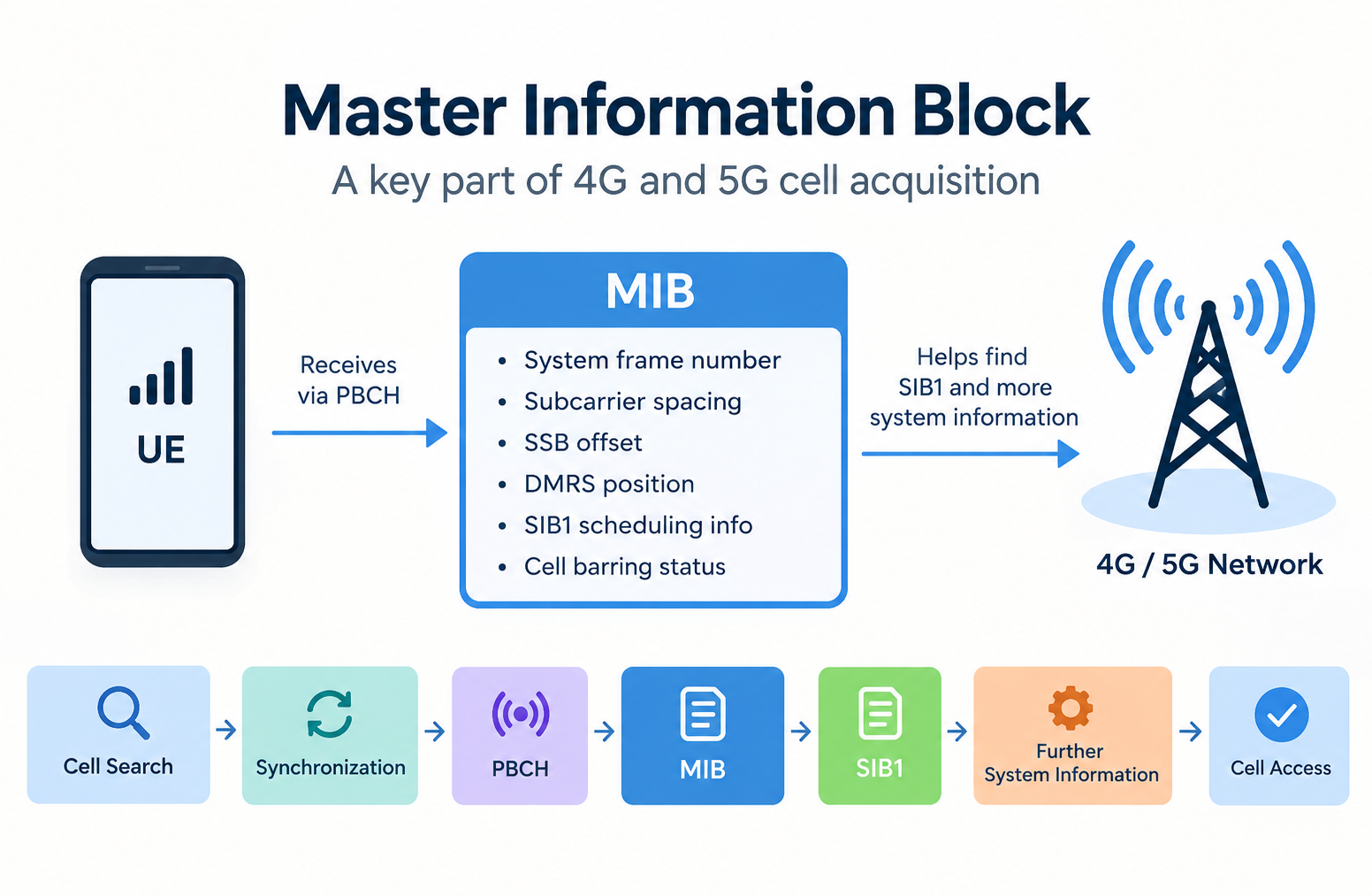
Cell detection → synchronization → PBCH reception → MIB decoding → SIB1 acquisition → further system information → access procedures
This makes the MIB an early step in the process through which a phone, modem, or other cellular device learns how to interact with a detected cell.
In 5G NR, the MIB is associated with the PBCH inside the SS/PBCH block. The UE first needs to detect and synchronize with the cell before it can successfully decode the PBCH and recover the MIB. (3GLTEInfo)
The MIB therefore acts as an initial information bridge between physical-layer cell detection and the wider system-information acquisition procedure.
Why the Master Information Block Matters
A mobile device cannot simply detect a radio signal and immediately begin normal network communication. It needs to determine how the cell is organized and where it can obtain additional information.
This is where the MIB becomes important.
The information supplied at this stage helps the UE understand parameters needed for continuing the acquisition process. In 5G NR, for example, MIB-related information helps the UE determine common subcarrier spacing, timing information, PBCH-related information, and the configuration needed to locate the control information associated with SIB1. (3GLTEInfo)
Without successfully obtaining the necessary system information, the UE cannot reliably progress through the normal cell-access sequence.
This is why engineers investigating cell acquisition problems often look at the MIB and PBCH stage before moving deeper into RRC or core-network procedures.
Master Information Block in 5G NR
The 5G NR version is particularly important because 5G introduced a different radio architecture and a different approach to system information compared with LTE.
In NR, the MIB is carried through the PBCH path associated with the SS/PBCH block. A UE generally reaches this stage after detecting the synchronization signals and establishing the timing and frequency relationship required for PBCH reception.
The overall process can be viewed as:
- The UE searches for a 5G NR cell.
- It detects synchronization signals.
- It establishes synchronization.
- It receives the SS/PBCH block.
- It decodes the PBCH.
- It obtains the MIB.
- It uses the information to continue toward SIB1.
- It acquires additional system information.
- It can then proceed with appropriate access procedures.
This sequence is why the MIB is often described as one of the first essential broadcast messages in NR. (3GLTEInfo)
What Information Does the 5G MIB Contain?
The exact details depend on the applicable 3GPP specification release and implementation, but important NR MIB fields include parameters such as:
- System frame number information
- Common subcarrier spacing
- SSB subcarrier offset information
- DMRS Type A position
- PDCCH configuration information associated with SIB1
- Cell barring status
- Intra-frequency reselection information
These parameters have different purposes, but together they provide the UE with enough information to continue the system-information acquisition process. (3GLTEInfo)
System Frame Number
The System Frame Number, or SFN, provides timing context within the radio frame structure.
In NR, the SFN is represented using 10 bits overall, with information distributed between the MIB and PBCH-related payload information. (Telcoma Global)
This is important because timing is fundamental to cellular communication. The UE needs a reliable understanding of where it is within the radio-frame sequence before it can correctly interpret subsequent transmissions.
Common Subcarrier Spacing
The common subcarrier spacing parameter tells the UE about the relevant numerology used for common channels and system information.
This matters because NR can use different subcarrier spacings depending on the operating configuration and frequency range.
A receiver that does not correctly understand the applicable numerology cannot correctly interpret subsequent physical-layer transmissions.
SSB Subcarrier Offset
The SSB subcarrier offset provides frequency-domain positioning information associated with the synchronization signal block.
This becomes especially important in situations where the relationship between the synchronization block and the common reference point needs to be determined accurately.
DMRS Type A Position
The DMRS Type A position identifies the applicable position used for demodulation reference signals.
Demodulation reference signals help the receiver estimate the radio channel so that transmitted information can be recovered correctly.
Therefore, this is not simply a descriptive parameter. It participates in the physical-layer process required for reliable signal decoding.
PDCCH Configuration for SIB1
One of the most practically important pieces of information is the configuration that helps the UE locate the control information associated with SIB1.
The UE needs to find the control information that tells it where and when the relevant system information is transmitted.
This creates an important relationship:
MIB → SIB1 scheduling information → SIB1 → further system information
This relationship is one reason why a successful MIB decode does not mean that the entire cell-access procedure has already succeeded.
Cell Barring
The MIB can indicate whether the cell is barred.
A barred cell is not simply treated as a normal candidate for access. The UE uses this information as part of determining how it should handle the detected cell.
Intra-Frequency Reselection
The MIB also includes information associated with intra-frequency cell reselection behavior.
This contributes to the UE’s understanding of how it should treat the detected cell in relevant mobility procedures.
How the MIB Is Transmitted
Understanding the transmission path makes the subject much easier to understand.
In 5G NR, the MIB is carried on the PBCH path within the SS/PBCH block.
The important relationship is:
SSB contains synchronization signals and PBCH
PBCH carries the information needed to recover the MIB
The UE therefore does not begin by looking for an ordinary higher-layer RRC message in the same way it would inspect later signaling. It first has to solve the physical-layer synchronization and PBCH decoding problem.
The MIB is associated with the BCCH-BCH information path, while subsequent system information such as SIB1 uses a different transport path. (3GLTEInfo)
This distinction is important when analyzing protocol traces.
MIB vs PBCH: What Is the Difference?
MIB and PBCH are closely connected, but they are not the same thing.
The MIB is system information.
The PBCH is a physical channel used to transmit the relevant broadcast information.
A useful analogy is a document and the delivery method used to carry it.
The MIB is the information being delivered, while PBCH is part of the radio mechanism used to deliver it.
In 5G NR, the PBCH also contains additional payload information beyond the MIB itself. Technical implementations therefore often discuss PBCH payload generation when explaining how the MIB reaches the receiver. (Giga Yasa Wireless)
This distinction becomes especially useful when debugging.
If a UE cannot decode the MIB, the problem may not necessarily be caused by an incorrect MIB configuration. The problem could occur earlier, such as synchronization failure, poor radio conditions, incorrect assumptions about the SSB, or unsuccessful PBCH decoding.
MIB vs SIB1
Another common source of confusion is the difference between the MIB and SIB1.
They are both system-information messages, but they serve different purposes.
The MIB provides the initial, limited information required for the UE to continue the acquisition process.
SIB1 provides a much broader set of information needed for the UE to understand how the cell can be used and how additional system information is obtained.
A simplified comparison is:
| Feature | MIB | SIB1 |
| Main purpose | Initial system-information anchor | Operational system-information context |
| Position in acquisition | Earlier | After MIB |
| 5G NR transmission path | PBCH | PDSCH through scheduled control |
| Information size | Compact | Larger |
| Used for continuing acquisition | Yes | Yes |
| Related to initial cell access | Directly | Directly |
The MIB and SIB1 therefore should not be treated as interchangeable.
A successful MIB decode is an important milestone, but it is only one stage in the overall process.
LTE Master Information Block
The concept is not unique to 5G.
LTE also uses a Master Information Block, but its contents and signaling details are different from NR.
In LTE, the MIB provides fundamental information such as downlink bandwidth, PHICH configuration, and system frame timing. It is transmitted through the BCH associated with the PBCH. (3GLTEInfo)
The LTE acquisition process can therefore be simplified as:
Cell search → synchronization → PBCH → MIB → SIB1 → additional SIBs → access procedures
The terminology is similar to NR, but engineers should avoid assuming that an LTE MIB and an NR MIB have identical fields or physical-layer behavior.
LTE MIB vs 5G NR MIB
The similarities are easy to see, but the differences are important.
Both technologies use the MIB as an early broadcast information mechanism. Both provide essential information before the UE proceeds to broader system-information acquisition.
However, NR redesigned several aspects of the radio interface.
In LTE, the MIB includes parameters such as downlink bandwidth and PHICH configuration. In NR, the MIB includes parameters more closely associated with NR numerology, SSB positioning, PBCH-related decoding, and SIB1 acquisition. (3GLTEInfo)
Therefore, when reading a protocol analyzer output, always confirm whether the message belongs to LTE or NR before interpreting individual fields.
The Role of the MIB During Cell Search
Cell search is one of the most important practical contexts for understanding this information block.
A UE may detect a potential cell before it has enough information to use that cell.
The receiver first needs to establish synchronization and identify the relevant radio structure. Once the necessary physical-layer steps have succeeded, it can attempt to decode the PBCH and obtain the MIB.
The MIB then helps the UE continue toward SIB1.
This creates a chain of dependencies:
Radio detection
↓
Synchronization
↓
SS/PBCH acquisition
↓
MIB decoding
↓
SIB1 acquisition
↓
System information processing
↓
Cell access
The important lesson is that MIB decoding is not an isolated event. It is part of a larger acquisition procedure.
What Happens If the MIB Cannot Be Decoded?
A failed MIB decode can prevent the UE from moving forward.
However, an engineer should not immediately conclude that the MIB itself is incorrectly configured.
Several different problems can produce a similar symptom.
Possible areas to investigate include:
- Weak signal conditions
- Poor signal quality
- Frequency offset
- Timing synchronization problems
- Incorrect SSB detection
- PBCH decoding problems
- Incorrect cell configuration
- SSB-related configuration problems
- Hardware or receiver implementation issues
- Interference
- Measurement or logging errors
The correct troubleshooting method is therefore to examine the acquisition sequence rather than looking at one message in isolation.
For example, if the UE never detects the relevant synchronization signals, investigating the MIB configuration may be premature.
If synchronization succeeds but PBCH decoding repeatedly fails, the investigation should move toward the PBCH and physical-layer path.
If the MIB is decoded successfully but SIB1 cannot be obtained, the next stage deserves attention.
Troubleshooting a MIB Decode Failure
A structured troubleshooting process is more useful than randomly changing parameters.
Step 1: Confirm Cell Detection
First establish whether the UE can actually detect the expected cell and synchronization signals.
If the cell cannot be detected reliably, MIB troubleshooting is not yet the primary issue.
Step 2: Check Synchronization
Verify that the receiver has established the required timing and frequency synchronization.
A receiver that is not synchronized correctly may fail to recover PBCH information even when the signal appears visible.
Step 3: Examine PBCH Reception
If synchronization is successful, inspect PBCH reception and decoding.
This helps distinguish a general cell-detection problem from a PBCH-specific problem.
Step 4: Validate the Decoded MIB
Once a MIB is recovered, inspect the decoded values.
Look for values that are inconsistent with the expected network configuration.
Important areas include:
- Common subcarrier spacing
- SSB-related parameters
- Frame-number information
- SIB1-related configuration
- Cell barring
- Reselection information
Step 5: Check SIB1 Acquisition
If the MIB appears valid but SIB1 cannot be decoded, examine the scheduling and control configuration used to locate SIB1.
This is an important diagnostic boundary.
A working MIB does not automatically prove that the SIB1 acquisition path is working.
Step 6: Compare Network and UE Logs
If possible, compare information from the network-side configuration with the UE-side decoded values.
This can help identify whether the problem is:
- Configuration-related
- Radio-related
- Implementation-related
- Measurement-related
A disciplined comparison is usually more productive than changing multiple parameters at once.
Why MIB Problems Can Be Misleading
One of the biggest practical challenges is that a failure observed at the MIB stage may have started somewhere else.
For example, poor radio conditions can prevent reliable PBCH decoding. An engineer viewing only the final result may describe this as a “MIB failure,” even though the underlying cause is radio reception.
Likewise, successful MIB decoding followed by SIB1 failure does not necessarily indicate a MIB problem.
This distinction matters in field testing.
A useful troubleshooting principle is:
Diagnose the first failed step, not simply the last visible symptom.
That approach can save considerable time when working through cellular signaling traces.
Master Information Block and Initial Access
Initial access involves more than decoding the MIB.
In simplified terms, the UE needs to acquire downlink synchronization and system information before it can proceed through the appropriate access procedure.
The MIB is an early component of that process.
In 5G NR, the UE eventually needs information that allows it to proceed toward random access and RRC procedures. The MIB itself does not establish an RRC connection or complete network registration.
This is an important distinction for people learning 5G signaling.
The MIB is an information-acquisition step, not the entire connection procedure.
Is the MIB Specific to One User?
No.
The MIB is broadcast system information rather than dedicated information intended for one specific subscriber.
That means multiple UEs in the coverage area can receive the same broadcast information from the cell.
This is fundamentally different from dedicated signaling exchanged with a particular UE after an individual connection has been established.
The broadcast nature of system information is one reason the MIB can serve as a common starting point for devices attempting to understand the cell.
Is the MIB Encrypted?
The MIB is part of broadcast system information and is not treated like user-specific protected signaling that requires an established dedicated security context.
A UE must be able to acquire the basic information necessary to understand the cell before normal higher-layer security procedures can provide protection for dedicated communication.
This is another reason the MIB belongs near the beginning of the access sequence.
Why Engineers Study the MIB
The MIB may be small, but it has significant diagnostic value.
Network engineers, modem developers, protocol analysts, and RF engineers can use MIB information when investigating:
- Cell acquisition
- PBCH decoding
- Initial access
- SSB configuration
- Numerology problems
- SIB1 acquisition
- Cell barring
- Reselection behavior
- UE interoperability
- Field-test measurements
A small set of fields can therefore provide a useful snapshot of whether the UE and network are aligned at the earliest stages of communication.
Understanding the MIB in Protocol Logs
When looking at a protocol analyzer or test tool, avoid reading individual fields without considering the complete sequence.
For example, suppose a trace shows:
SSB detected → PBCH decoded → MIB decoded → SIB1 not acquired
That tells a very different story from:
SSB detected → PBCH decode failed
The first scenario indicates that the receiver successfully passed the MIB stage and that investigation should continue toward SIB1 acquisition.
The second suggests that the problem occurs earlier.
This is why experienced engineers often read protocol traces as a sequence of dependent events rather than isolated messages.
A Simple Example
Imagine a 5G-capable phone searching for a network.
The phone detects an SS/PBCH block from a nearby cell.
It establishes the necessary synchronization.
It then decodes the PBCH and recovers the MIB.
The MIB tells the phone essential information about the radio configuration and how to proceed toward SIB1.
The phone then uses the appropriate control and data channels to obtain SIB1.
After acquiring the required system information, the device can continue with the procedures needed for cell access.
The important point is that the MIB does not contain everything the phone needs.
It provides the information needed to move to the next stage.
Common Misunderstandings About the Master Information Block
“The MIB contains all network information”
It does not.
The MIB is intentionally compact. Additional system information is provided through other SIBs.
“MIB and SIB1 are the same thing”
They are not.
They occur at different stages and serve different purposes.
“PBCH and MIB are identical”
They are closely related, but they represent different concepts.
PBCH is a physical channel, while MIB is system information carried through the broadcast mechanism.
“If the MIB fails, the network is definitely misconfigured”
Not necessarily.
Radio conditions, synchronization, PBCH reception, implementation issues, and other factors can prevent successful decoding.
“MIB decoding means the phone is connected”
No.
Decoding the MIB is an early step in cell acquisition. It does not mean the UE has completed registration or established normal connected-mode communication.
How to Learn the MIB Efficiently
If you are learning cellular protocols, trying to memorize every field first is usually not the most effective approach.
Instead, learn the acquisition chain.
Start with:
- Cell search
- PSS and SSS
- SS/PBCH block
- PBCH
- MIB
- SIB1
- Other system information
- Random access
- RRC procedures
Once you understand where the MIB sits in that chain, its individual parameters become much easier to understand.
You can then study each field based on the problem it solves.
For example, rather than memorizing “subCarrierSpacingCommon,” ask what the UE needs the information for and which later channels depend on it.
That approach creates a much stronger practical understanding.
Master Information Block in Network Testing
In network testing, MIB information can be useful as an early checkpoint.
A test engineer can ask:
- Was the cell detected?
- Was synchronization successful?
- Was PBCH successfully decoded?
- Was the MIB recovered?
- Are the MIB fields consistent with expectations?
- Was SIB1 successfully acquired?
- Where does the acquisition process stop?
These questions divide a complex problem into manageable stages.
This is especially useful when comparing devices or network configurations.
If two UEs observe the same cell but one progresses beyond MIB acquisition while another does not, the logs can help narrow the investigation.
The Relationship Between MIB, SIBs, and System Information
System information should be viewed as a hierarchy rather than one giant message.
The MIB provides the earliest essential information.
SIB1 provides additional information required for the UE to understand the cell and continue system-information acquisition.
Other SIBs provide additional system-level information depending on the technology and configuration.
This architecture avoids placing every possible parameter into one initial broadcast message.
It also gives the UE a staged acquisition process.
The practical advantage is that the receiver can first obtain a small amount of critical information and then use that information to locate and decode additional data.
What Makes the MIB Different in 5G?
One of the most important differences in 5G NR is the stronger relationship between the MIB, SS/PBCH block, NR numerology, and the mechanism used to locate SIB1.
The MIB is designed around the NR radio architecture rather than simply copying the LTE implementation.
For engineers moving from LTE to NR, this is an important conceptual shift.
The familiar name “MIB” remains, but its technical surroundings have changed.
A Practical Mental Model
A simple mental model can make the entire subject easier:
Synchronization tells the UE where the cell is.
PBCH gives it access to the first essential broadcast information.
MIB tells it enough to continue.
SIB1 provides more of the information needed to understand and use the cell.
Additional system information supports later procedures.
This model is more useful than memorizing isolated definitions.
Frequently Asked Questions
What does MIB stand for in telecom?
MIB stands for Master Information Block. It is a broadcast system-information message that provides a UE with essential information needed to continue acquiring information from a cellular cell.
What is the purpose of the Master Information Block?
Its purpose is to provide the UE with a compact set of essential system parameters so that it can continue the system-information acquisition process and move toward further procedures such as SIB1 acquisition.
Where is the MIB transmitted in 5G?
In 5G NR, the MIB is transmitted through the PBCH as part of the SS/PBCH block. The UE must first complete the required synchronization and PBCH reception steps to decode it. (3GLTEInfo)
What is the difference between MIB and SIB1?
The MIB provides the initial broadcast information required to continue system-information acquisition, while SIB1 provides additional essential information about the cell and helps the UE proceed with subsequent system-information and access procedures.
Does the MIB establish a connection?
No. Decoding the MIB is only an early stage of cell acquisition. It does not by itself establish an RRC connection, authenticate the subscriber, or complete network registration.
Is MIB used in both LTE and 5G?
Yes. LTE and 5G NR both use a Master Information Block concept, but their contents, physical-layer mechanisms, and surrounding procedures differ. LTE MIB information includes items such as downlink bandwidth and PHICH configuration, while NR uses fields suited to the 5G radio architecture. (3GLTEInfo)
Conclusion
The master information block is a small but fundamental part of cellular system information.
Its importance comes from where it appears in the communication process. Before a UE can progress through the complete cell-access sequence, it needs enough information to understand the basic structure of the detected cell and find additional system information.
In 5G NR, the MIB is obtained through the PBCH within the SS/PBCH block after the UE performs the required synchronization steps. It includes important parameters related to timing, common numerology, SSB positioning, SIB1 acquisition, and cell access behavior. (3GLTEInfo)
The most useful way to understand the MIB is not as an isolated message, but as one stage in a larger chain:
Cell search → synchronization → PBCH → MIB → SIB1 → additional system information → access procedures
This perspective is particularly valuable when troubleshooting. A failed MIB decode does not automatically mean the MIB configuration is wrong. Engineers need to determine where the first failure occurs and then work forward through the acquisition process.
The same basic concept exists in LTE, but LTE and NR should not be treated as technically identical. Their MIB contents and radio procedures reflect the architecture of their respective technologies.
For anyone working with 4G, 5G NR, modem logs, protocol analysis, RF testing, or cellular network troubleshooting, understanding the MIB provides a strong foundation for understanding what happens between detecting a cell and actually using it.