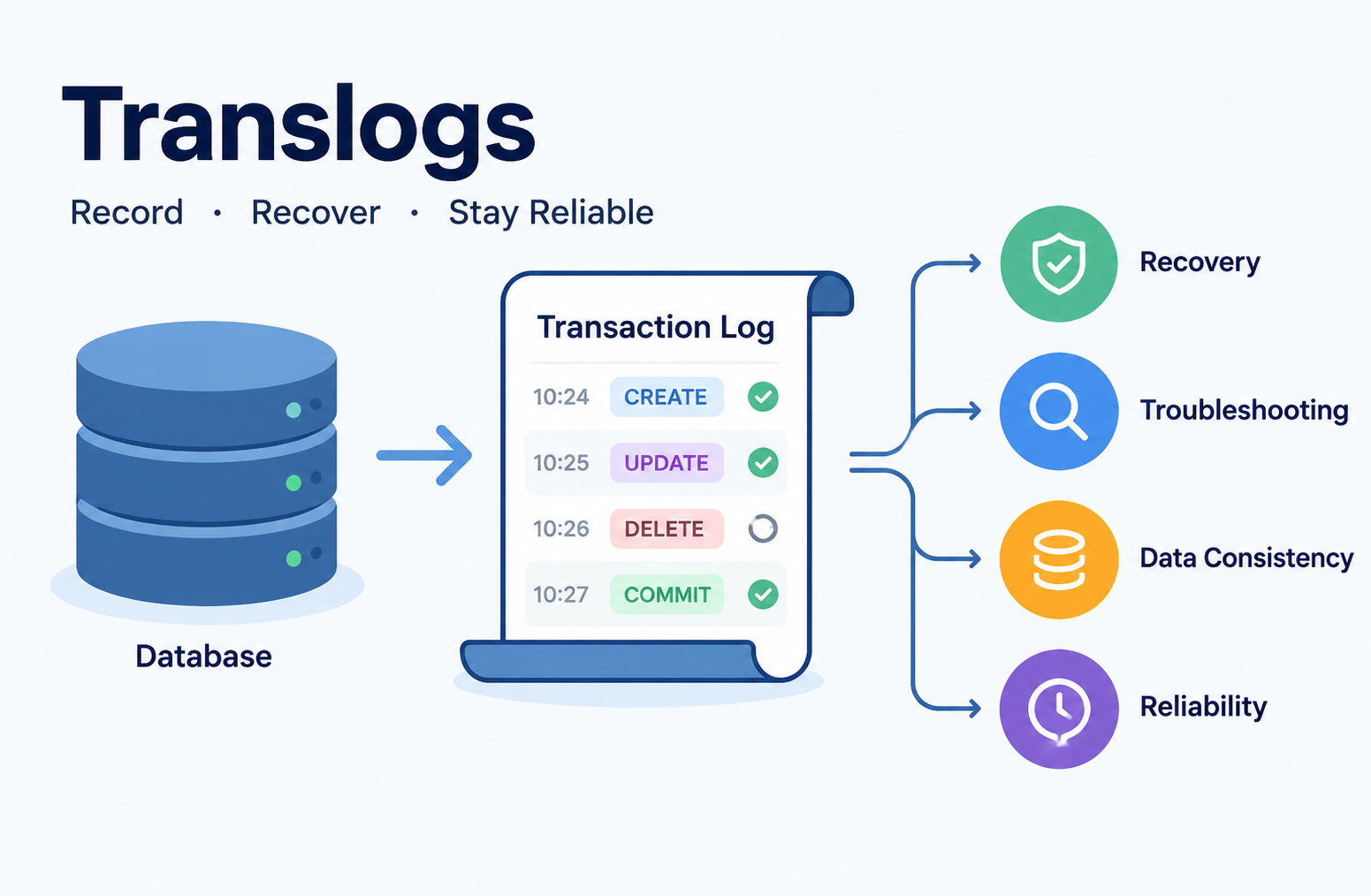
Translogs: Meaning, Uses, Benefits, and Best Practices
When people search for translogs, they may be looking for information about transaction logs, system activity records, database recovery, or the role of logs in modern data systems. The term is closely associated with the idea of recording changes before or alongside permanent data storage. Understanding how these records work is important because reliable logging can help systems recover from failures, preserve recent changes, support troubleshooting, and maintain data consistency.
The exact meaning of the term can vary by technical context. In database and distributed data systems, a transaction log is generally a sequential record of operations or changes. In some software environments, similar terminology is used for transaction records, activity logs, or write-ahead records. The underlying principle is similar: important changes are recorded so that a system has a reliable history it can use when something goes wrong.
This article explains the concept in practical terms, including how transaction logging works, why it matters, where it is used, what challenges organizations face, and how to design a more reliable logging strategy.
What Are Translogs?
At its simplest, a transaction log is a record of changes made to a system.
Instead of relying only on the final state of a database or application, a system can keep a record of the operations that produced that state. This gives the system additional information when it needs to recover after a crash, restart, hardware failure, interrupted process, or other unexpected event.
Imagine an application processing three actions:
- A customer places an order.
- The inventory count is reduced.
- The payment status is updated.
If the application fails after the first two operations but before the third is safely completed, the system needs a way to determine what happened.
A transaction log can provide that history.
Depending on the technology, the log may record information such as:
- The transaction or operation involved
- The affected record or data structure
- The type of change
- The previous value
- The new value
- The order in which operations occurred
- Whether a transaction was committed
- Whether a transaction was rolled back
- Additional metadata required for recovery
The purpose is not simply to create a historical diary. The log is part of the system’s reliability mechanism.
Why Translogs Matter in Modern Systems
Modern applications rarely consist of a single database running on one computer. Many systems involve multiple services, databases, servers, storage devices, queues, APIs, and distributed components.
That complexity creates more opportunities for partial failure.
A server can lose power. A process can terminate unexpectedly. A storage device can experience an error. A network connection can disappear halfway through an operation.
Without reliable records of recent changes, recovering the correct state can become difficult.
Transaction logging helps address this problem by maintaining information about changes that have occurred or are in progress.
One of its most important benefits is recovery.
If a system crashes after data has been changed in memory but before all changes have reached their final storage location, the recovery process may use the log to reconstruct the required state.
This is one reason logging is closely connected with durability and consistency in database systems.
How Transaction Logging Works
The exact implementation depends on the platform, but the general process is easier to understand than the underlying code.
1. An operation begins
A user or application performs an action.
For example, an online store may create a new order.
2. The system records the change
Information about the operation is written to a log.
The log entry can contain enough information for the system to understand what happened.
3. The transaction continues
Additional operations may be added to the same transaction.
For example, the application may:
- Create an order
- Reserve inventory
- Record payment information
- Update the customer’s order status
4. The transaction commits
When the required operations are completed successfully, the transaction is committed.
The system can then treat the transaction as successfully completed.
5. Recovery uses the log when necessary
If the system crashes, recovery mechanisms can inspect the log and determine which operations were completed, which transactions were committed, and which changes need to be replayed or undone.
This is why the ordering of log records matters.
A log is not merely a collection of unrelated messages. In systems designed for recovery, sequence and durability are critical.
The Relationship Between Logs and Data Storage
A common misunderstanding is that the log is simply another copy of the database.
It usually is not.
The main database or data structure contains the current state. The transaction log contains information about changes or operations that help the system reach or recover that state.
Think about a bank account.
The current balance might be $1,200.
The transaction history could show:
- Initial balance: $1,000
- Deposit: $500
- Withdrawal: $300
- Final balance: $1,200
The current balance tells you where you are.
The transaction history tells you how you got there.
In computing systems, the relationship can be more sophisticated, but the basic distinction is useful.
A well-designed logging mechanism provides an additional layer of reliability around the primary data.
Translogs and Crash Recovery
Crash recovery is one of the most important applications of transaction logging.
Suppose a database server is processing a transaction when the power suddenly fails.
Some information may already have been written to permanent storage. Other information may still have been held in memory.
When the server starts again, it needs to determine the correct state.
A recovery system can examine the transaction log and identify operations that were completed or committed.
Depending on the logging design, recovery may involve:
- Redoing committed operations
- Undoing incomplete operations
- Checking transaction boundaries
- Rebuilding internal state
- Validating the sequence of changes
The exact recovery algorithm differs between technologies, but the objective is consistent: restore a reliable and logically correct state.
This is especially important for systems where losing or partially applying a transaction could cause serious consequences.
Write-Ahead Logging
One of the most important concepts related to transaction logs is write-ahead logging.
The basic idea is that the system records the necessary log information before allowing certain corresponding data changes to be considered safely persisted.
Why does this matter?
Consider a system that modifies a database page first and records the corresponding recovery information afterward.
If the machine crashes between those two events, the system may have a changed data page without the information required to recover it correctly.
Writing the necessary log record first reduces this risk.
The exact rules vary between database technologies, but write-ahead logging is a foundational concept in reliable storage systems.
It reflects an important engineering principle:
Recovery information must be available before the system depends on the corresponding data change.
Benefits of Translogs
Transaction logging provides several practical benefits.
Data Recovery
The most obvious advantage is the ability to recover from unexpected failures.
A log can give recovery software information about recent operations that may not yet be completely represented in the main data files.
Improved Reliability
Systems with carefully designed logging mechanisms can provide stronger guarantees about what happens to data during failures.
This is particularly important for financial systems, customer records, inventory platforms, and other applications where incorrect state can cause operational problems.
Transaction Consistency
Logs can help systems determine which transactions completed successfully and which did not.
That distinction is essential when an operation contains multiple related changes.
Troubleshooting
Although transaction logs are primarily designed for system operation and recovery, they can also provide useful information when diagnosing problems.
Engineers may inspect records to determine when an operation occurred or identify unusual patterns.
Replication and Distributed Processing
Some systems use logs as part of replication or distributed processing mechanisms.
A sequence of changes can be transmitted to another system, allowing the receiving system to process those changes in order.
This can be useful for maintaining copies of data across different servers or locations.
Auditing Support
Logs can contribute to audit trails when they contain suitable information and are retained under appropriate controls.
However, a technical transaction log should not automatically be treated as a complete business audit record. Audit requirements often demand additional information, retention policies, access controls, and reporting capabilities.
Common Real-World Applications
Transaction logging is not limited to one type of application.
Banking and Financial Systems
Financial applications require extremely careful handling of transactions.
An account transfer, for example, may involve multiple related operations.
Money must not simply disappear from one account without being correctly reflected in another.
Reliable transaction mechanisms and logging help systems maintain consistency during failures.
E-Commerce
Online stores process orders, payments, inventory updates, shipping information, and customer records.
A single checkout operation can involve multiple systems.
Logging can help the underlying systems recover when something interrupts the process.
Enterprise Applications
Large business applications often handle thousands or millions of records.
Customer information, invoices, inventory, employee records, and operational data may all depend on reliable database transactions.
Distributed Systems
Modern applications frequently spread workloads across multiple machines.
Logs can become an important mechanism for tracking and replaying changes across components.
Search and Data Platforms
Some high-performance data platforms use transaction-like logs to protect changes that have not yet been incorporated into their final searchable or stored representation.
Research on distributed and search-oriented systems also demonstrates how logs can be used to preserve writes for recovery after process or hardware failures.
Translogs in Distributed Systems
Distributed systems introduce additional challenges because there may be several copies of data.
Imagine a primary server and several replicas.
A change made on the primary may need to reach other servers.
If the primary fails after accepting the change but before a replica receives it, the system needs a way to determine what happened.
A log can provide an ordered stream of changes.
The receiving system can then process those changes according to the architecture’s replication rules.
This is one reason logs are closely connected with concepts such as replication, durability, failover, and recovery.
However, a log does not automatically solve distributed consistency problems.
Engineers still need to consider:
- Network failures
- Replication delays
- Duplicate operations
- Ordering
- Conflicting updates
- Data corruption
- Storage failures
- Recovery after partial writes
Logging is an important building block, not a complete distributed-systems strategy.
The Difference Between Transaction Logs and Application Logs
These two concepts are often confused.
Transaction Logs
Transaction logs are generally designed around data changes and system recovery.
Their structure and contents are controlled by the database or storage system.
Their primary purposes may include:
- Recovery
- Durability
- Transaction management
- Replication
- Change processing
Application Logs
Application logs are normally created by software developers to record application events.
For example:
- User logged in
- Payment request failed
- API returned an error
- File upload completed
- Service started
- Configuration changed
Application logs are primarily used for monitoring, debugging, and operational analysis.
Both types of logging are useful, but they solve different problems.
A developer should not assume that application logs can replace a database’s transaction log.
Likewise, a database transaction log is not necessarily an appropriate substitute for an application observability system.
Common Problems With Transaction Logs
Logging provides significant benefits, but it also creates operational challenges.
Log Growth
Transaction logs can become large.
If logs are not managed correctly, they may consume significant amounts of storage.
This can eventually affect system performance or prevent other processes from writing data.
Poor Retention Policies
Keeping every log record forever may be unnecessary and expensive.
Deleting logs too aggressively can be equally dangerous if the system still needs them for recovery, replication, compliance, or troubleshooting.
Retention should therefore be based on the actual requirements of the system.
Slow Storage
Logging performance is closely related to storage performance.
If the system must wait for log information to become durable, slow storage can affect transaction latency.
This makes storage design an important part of database performance planning.
Log Corruption
A damaged log can complicate recovery.
This is why production systems need appropriate backup strategies, storage protections, monitoring, and recovery testing.
Lack of Monitoring
A log can be working correctly while still growing unexpectedly.
Without monitoring, administrators may discover a problem only after storage becomes critically low.
Treating Logs as Backups
A transaction log is not automatically a replacement for a complete backup strategy.
Backups and transaction logs can serve different purposes.
A backup provides a recoverable copy of data, while a transaction log may provide information about changes between recovery points.
A reliable disaster recovery plan should define how these components work together.
How to Manage Transaction Logs Effectively
Good log management starts with understanding the system rather than applying arbitrary rules.
Monitor Log Size
Track how much storage the log consumes over time.
Sudden growth may indicate:
- A long-running transaction
- Replication problems
- Backup problems
- An application issue
- An unusually large workload
Monitoring trends is more useful than checking the log only after an alert appears.
Identify Long-Running Transactions
A transaction that remains open for a long period can prevent normal log management operations.
This may cause the log to grow continuously.
Applications should therefore avoid unnecessary transactions that remain open while waiting for unrelated work.
Plan Storage Capacity
Production environments should reserve enough storage for normal workload fluctuations.
Capacity planning should consider peak workloads rather than only average usage.
Test Recovery
One of the most overlooked practices is recovery testing.
A logging system can appear healthy until a real failure occurs.
Regular recovery tests help verify that:
- Logs are available
- Backups are usable
- Recovery procedures are documented
- Staff understand the process
- Expected recovery times are realistic
A backup that has never been restored is not the same as a verified recovery capability.
Security Considerations
Logs can contain sensitive information.
Depending on the system, records may expose customer identifiers, account information, internal system details, or other confidential data.
For that reason, access to logs should be controlled.
Important considerations include:
- Restricting access to authorized personnel
- Encrypting sensitive data where appropriate
- Avoiding unnecessary personal information
- Protecting log storage
- Monitoring administrative access
- Defining retention periods
- Securely disposing of expired records
Logging more information is not always better.
A useful logging strategy captures the information required for reliability and troubleshooting without creating unnecessary exposure.
Performance Considerations
Logging can affect application performance because writing durable records requires resources.
The impact depends on factors such as:
- Transaction volume
- Storage speed
- Log record size
- Transaction duration
- Concurrency
- Replication requirements
- Database architecture
- Recovery requirements
The goal should not be to eliminate logging to gain speed.
Doing so can weaken durability and recovery capabilities.
Instead, engineers should measure the workload and design storage and database settings around the required guarantees.
Performance optimization should preserve the system’s reliability requirements.
How to Troubleshoot Rapid Log Growth
Unexpected log growth is a common operational problem.
The first step is to identify whether the growth is caused by normal workload or an abnormal condition.
A practical investigation can follow this sequence.
Step 1: Check Recent Workload
Look for unusually large imports, updates, migrations, or batch jobs.
A legitimate increase in workload can naturally create more log records.
Step 2: Check Long-Running Transactions
A transaction that remains open can prevent the system from reclaiming or reusing log space.
Step 3: Check Replication or Log Consumers
If another component depends on the log and stops consuming it, log retention can increase.
Step 4: Check Backup and Recovery Processes
Depending on the database architecture, backup or recovery configuration can influence log behavior.
Step 5: Check Available Storage
Do not wait until the storage volume reaches zero.
A log volume should be monitored independently when the system is business-critical.
Step 6: Investigate Before Deleting
Blindly deleting log files can make a recovery situation worse.
Administrators should understand why the log exists and whether another process depends on it before taking corrective action.
What Makes a Good Logging Strategy?
A strong logging strategy is based on clearly defined requirements.
Before changing logging settings, ask several questions.
What must the system recover from?
A small internal application may have different recovery requirements from a financial platform.
How much data can the organization afford to lose?
This affects recovery objectives and system architecture.
How quickly must service be restored?
Recovery time requirements influence backup, replication, storage, and operational procedures.
How long must records be retained?
Retention requirements may come from business operations, security policies, contracts, or regulations.
Who needs access?
Logging information should be available to the people who need it while remaining protected from unnecessary access.
These questions produce a more useful design than simply choosing a large retention period.
Translogs and Data Integrity
Data integrity means maintaining accurate and reliable data throughout its lifecycle.
Transaction logging supports integrity by preserving information about changes and transaction states.
However, logging alone cannot guarantee that the original data is correct.
For example, an application could successfully log an incorrect price.
The system may then recover that incorrect price perfectly.
This distinction is important.
A reliable transaction mechanism protects the consistency and durability of operations. It does not automatically validate the business logic behind those operations.
Data validation, application controls, database constraints, permissions, and testing remain necessary.
A Practical Example
Consider a warehouse system.
A customer orders five products.
The application needs to:
- Create the order.
- Reserve five units.
- Update available inventory.
- Record the transaction.
- Confirm the order.
Suppose the server crashes after inventory is updated but before the order is fully finalized.
Without reliable transaction handling, the warehouse system might show five fewer units even though the order was never completed.
With appropriate transaction management and logging, the recovery process has more information available to determine what happened and restore the correct state.
This illustrates the practical value of transaction logging.
It is not simply about storing technical information. It is about preserving the history required to maintain a dependable system.
Best Practices for Developers and Database Administrators
A practical approach to transaction logging includes several habits.
Understand the Database’s Logging Model
Different database technologies implement logging differently.
Do not copy settings from another platform without understanding their purpose.
Keep Transactions Focused
Long-running transactions can create unnecessary operational pressure.
Keep transaction boundaries around the work that actually needs to be atomic.
Monitor Continuously
Track log size, storage usage, transaction duration, replication health, and recovery-related metrics.
Automate Alerts
A production team should know about abnormal growth before storage becomes exhausted.
Test Recovery Procedures
Recovery should be treated as an operational process that requires practice.
Protect Log Data
Restrict access and apply suitable security controls.
Document Retention
Everyone responsible for the system should understand how long logs are kept and why.
Avoid Unnecessary Logging
More records mean more storage, more processing, and potentially more sensitive information.
Logging should be purposeful.
Common Misconceptions
Several misunderstandings can lead to poor system design.
“The log is just a backup.”
Not necessarily.
Logs and backups often work together but have different purposes.
“Deleting old log files is always safe.”
No.
Whether log information can be removed depends on the database system, recovery configuration, replication state, and retention requirements.
“Application logs are enough.”
They are not necessarily sufficient for database recovery.
Application logs and transaction logs typically serve different functions.
“More logging always means better reliability.”
Not automatically.
Useful logging requires the right information, appropriate durability, secure storage, monitoring, and recovery procedures.
“If recovery has never failed, the system does not need testing.”
A lack of previous failure is not proof that a recovery process works.
Testing provides evidence.
When Should a Business Review Its Logging Strategy?
A review is especially useful when:
- Database workloads increase rapidly
- A company moves to a larger production environment
- New replication is introduced
- Disaster recovery requirements change
- Storage costs increase
- Recovery procedures have never been tested
- Log volumes grow unexpectedly
- A major application migration is planned
- Security or compliance requirements change
A logging strategy should evolve with the system.
The configuration that worked for a small application may not remain appropriate after the application becomes a critical business platform.
How to Evaluate a Transaction Logging Setup
A practical review can be organized around five areas.
Reliability
Can the system recover after a crash?
Performance
Does logging create unacceptable transaction latency?
Capacity
Can the storage handle normal and peak workloads?
Security
Are log records protected from unauthorized access?
Recovery
Can the organization actually restore the system within its required recovery window?
These questions provide a more meaningful assessment than looking at log size alone.
The Future of Transaction Logging
As applications become more distributed, transaction logging continues to play an important role in data reliability.
Modern systems increasingly combine databases, distributed services, event streams, cloud infrastructure, and replicated storage.
This creates a greater need for clear records of state changes.
At the same time, organizations are becoming more conscious of the cost of storing and processing large amounts of operational data.
The future of logging is therefore unlikely to be about simply keeping everything forever.
Instead, effective systems will increasingly focus on selective retention, efficient storage, structured records, reliable recovery, security, and meaningful observability.
The underlying principle remains straightforward: systems need trustworthy information about important changes if they are expected to recover correctly when something goes wrong.
FAQs About Translogs
What are translogs?
Translogs generally refer to transaction logs or records of system changes used to support recovery, consistency, durability, replication, or related operations. The exact meaning depends on the technology using the term.
Why are transaction logs important?
Transaction logs help systems recover after failures by preserving information about changes and transaction states. They can also support replication and operational troubleshooting.
Are transaction logs the same as backups?
No. A transaction log records changes or operations, while a backup provides a recoverable copy of data. They can work together as parts of a broader recovery strategy.
Can transaction logs become too large?
Yes. Long-running transactions, heavy workloads, replication problems, or incorrect configuration can cause logs to grow significantly. Monitoring and appropriate retention management are important.
Can transaction logs improve data recovery?
Yes. Properly designed transaction logging can provide recovery information that helps restore a consistent state after crashes or other failures.
Should old transaction logs be deleted?
They should only be removed according to the database system’s recovery, backup, replication, and retention requirements. Deleting logs without understanding those dependencies can interfere with recovery.
Conclusion
Transaction logging is one of the less visible parts of modern computing, but it plays a major role in keeping data systems reliable. A database may appear to be nothing more than tables and records to an end user, yet behind those records are processes designed to handle failures, incomplete operations, concurrent changes, and recovery.
The key value of translogs is the history they preserve around important changes. That history can help a system determine what happened before a failure and what needs to happen during recovery.
A dependable logging strategy requires more than simply generating records. Organizations need suitable storage, monitoring, security controls, retention policies, transaction design, and tested recovery procedures.
The most important practical lesson is to treat logging as part of the system’s reliability architecture rather than as an afterthought. When logging is designed around actual business and technical requirements, it can support data durability, recovery, replication, troubleshooting, and long-term operational stability.