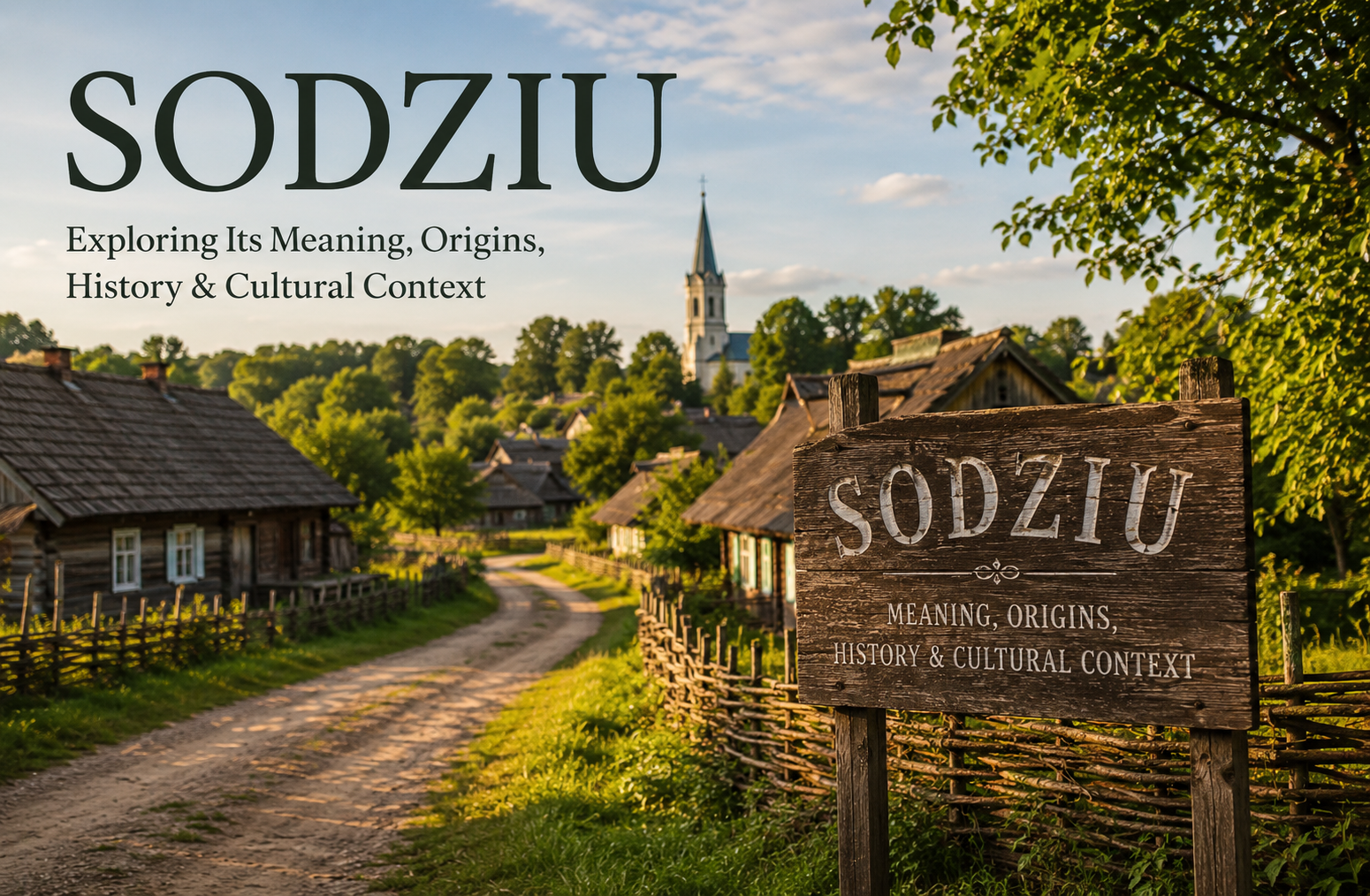
Sodziu: Meaning, Origins, History, and Cultural Context
Sodziu is a term that can be confusing when encountered online because it is often written without Lithuanian diacritical marks. In Lithuanian language and cultural contexts, the spelling can point readers toward the word sodžius, a historical term associated with a village or rural settlement. Understanding Sodziu properly therefore requires more than assigning it a single English translation. Its meaning becomes clearer when language, grammar, history, and Lithuanian rural culture are considered together.
The confusion is also increased by the fact that several Lithuanian words can look similar when special characters are removed. For example, sodžius is associated with a village or rural settlement, while žodžiu is a different Lithuanian form related to the word “word.” Treating these as identical can produce misleading explanations.
The historical meaning of sodžius is especially interesting because it refers not simply to a random collection of countryside houses. Lithuanian historical sources describe the sodžius as a particular type of rural settlement that developed during earlier periods of Lithuanian rural history. The form of these settlements changed over time, especially as agricultural organization and settlement planning evolved.
This article examines the meaning behind Sodziu, its linguistic background, historical importance, relationship to Lithuanian village life, common misunderstandings, and why the term still attracts interest today.
What Does Sodziu Mean?
The simplest way to approach Sodziu is to distinguish the unaccented online spelling from the Lithuanian form with its original characters.
The Lithuanian word sodžius has historically referred to a village or rural settlement. The Dictionary of the Lithuanian Language also records sodžius in connection with a peasant settlement and, in some contexts, a homestead.
The Lithuanian Encyclopedia provides a more specific historical explanation. It describes sodžius as a type of Lithuanian rural settlement that existed particularly during the medieval period, with its development connected to the organization of agricultural communities. These settlements could have homes distributed relatively irregularly rather than following the later, more standardized village layouts.
This distinction is important.
Sodziu should not automatically be treated as the name of a modern company, technology, food, fashion technique, or internet invention simply because some websites use the word in those contexts. A search result can create an apparent meaning through repetition, but repetition does not establish linguistic accuracy.
The safest interpretation is to examine the original Lithuanian spelling and the context in which the term appears.
Why Does Sodziu Appear Without Lithuanian Characters?
Lithuanian uses several letters that are not part of the basic English alphabet. One of them is ž.
As a result, Lithuanian words can sometimes appear online in simplified forms when people type without a Lithuanian keyboard or when websites remove diacritical marks.
This is one reason sodžius may appear as sodzius, while other grammatical forms may also lose their original characters.
The same issue occurs in many languages. Removing accents or special letters can make two words appear more similar than they actually are.
For readers researching Lithuanian terminology, this is an important lesson: spelling without diacritics should not automatically be interpreted as a separate word.
Sodziu and Sodžius Are Not Exactly the Same Thing
A major source of confusion is the assumption that every spelling variation represents a separate dictionary word.
The basic Lithuanian noun is sodžius. Depending on grammatical context, Lithuanian nouns change form. Therefore, a word that appears as sodžiu in a sentence may be a grammatical form of sodžius rather than a completely different vocabulary item.
This is similar to how English changes words according to context, although Lithuanian has a much richer system of grammatical cases.
The Dictionary of the Lithuanian Language records sodžius as a word associated with a peasant dwelling place or village and provides historical and dialectal examples of its use.
For someone searching the unaccented spelling Sodziu, this distinction can make the difference between an accurate explanation and an invented one.
A Simple Linguistic Comparison
| Form | General context |
| sodžius | Lithuanian noun associated with a village or rural settlement |
| sodžiu | A grammatical form related to sodžius, depending on sentence context |
| sodžius without diacritics | Often rendered online as sodzius |
| Sodziu | An unaccented search spelling that may require contextual interpretation |
| žodžiu | A different word form related to žodis, meaning “word” |
The table is deliberately simple because these forms should not be collapsed into one meaning.
The Historical Meaning of Sodžius
The historical background is where the term becomes much more interesting.
According to the Lithuanian Encyclopedia, sodžius was a type of rural settlement that existed in Lithuania during approximately the 12th to 16th centuries. It developed from earlier settlement arrangements as families became distributed across areas associated with agricultural communities.
This tells us something important about the word.
It was not merely a poetic label for countryside life. It could identify a particular form of settlement organization.
Historical sodžiai were apparently characterized by relatively scattered homesteads. Unlike later planned village arrangements, they did not necessarily have a neat linear street structure or uniform arrangement of buildings.
The physical organization reflected the agricultural environment in which people lived.
People needed access to land, water, paths, fields, and other resources. Settlement patterns therefore developed alongside the practical requirements of farming and community life.
Rural Settlement Was Closely Connected to Agriculture
Before modern transportation and industrial agriculture, the organization of a settlement had a direct relationship with how people produced food.
A household needed access to agricultural land.
Animals needed space.
Buildings had practical functions.
Paths connected homes to fields and neighboring communities.
Woodlands, waterways, pasture, and cultivated land all influenced daily life.
A rural settlement was therefore not simply a collection of houses. It was part of a larger economic and environmental system.
This helps explain why historical terminology for villages can carry much more meaning than a modern translation such as “village” might suggest.
How Lithuanian Village Life Changed
The historical form of the sodžius did not remain unchanged.
The Lithuanian Encyclopedia explains that the settlement type disappeared in Aukštaitija during the second half of the 16th century in connection with the Valakų reform, an important land and agricultural reorganization. Many earlier settlements were transformed into more regular street villages.
This transition is significant because it shows how settlement vocabulary can preserve evidence of social and economic change.
- When land is reorganized, communities change.
- When agricultural systems change, homes may be relocated or rearranged.
- When governments introduce new land-management systems, traditional settlement patterns can disappear.
A word can therefore remain in the language even after the physical settlement form it originally described has changed.
From Irregular Settlements to Planned Villages
Earlier rural settlements could have a scattered appearance.
Later village forms became more organized.
Instead of homes being distributed irregularly across the landscape, settlement planning increasingly produced recognizable village structures.
This was not merely an architectural change.
It affected how people interacted with neighbors, how agricultural land was arranged, how roads functioned, and how communities related to administrative systems.
The history of sodžius is therefore connected to the wider transformation of Lithuanian rural society.
Sodziu and Lithuanian Rural Identity
Although the historical definition should remain the priority, the cultural associations surrounding Lithuanian rural life are also worth understanding.
A village is more than its physical boundaries.
It can represent family history, agricultural traditions, local knowledge, community relationships, and memories of a particular landscape.
For many cultures, rural settlements have become important symbols of heritage because traditions often survive through families and local communities.
Lithuania is no exception.
Traditional countryside life has influenced architecture, food traditions, seasonal customs, crafts, folklore, and local identity. However, it is important not to claim that every one of these cultural elements is literally contained in the dictionary meaning of sodžius.
A better approach is to say that the word belongs to a historical vocabulary associated with rural settlement, while the wider cultural associations come from the social world surrounding those settlements.
Why the Term Can Be Difficult for English Speakers
There are several reasons English-speaking readers may struggle with Sodziu.
First, Lithuanian spelling contains characters unfamiliar to many English speakers.
Second, Lithuanian uses grammatical cases, meaning nouns can change their endings according to their role in a sentence.
Third, transliteration can remove the very characters that help distinguish words.
Fourth, online content sometimes repeats simplified definitions without checking the original linguistic context.
This creates a situation where a reader can encounter several explanations that appear authoritative but actually describe different words.
Context Matters More Than a Search Result
Suppose someone encounters “sodziu” in a travel article.
The surrounding text might make it clear that the author is discussing a village.
If the word appears in a Lithuanian sentence, grammar may reveal its precise form.
If it appears as a username or brand name, it may not have the historical meaning at all.
That is why context should always be considered before translating an unfamiliar word.
Sodziu Is Not the Same as Žodžiu
One of the most important corrections to make when researching this keyword concerns žodžiu.
Some online explanations associate Sodziu with meanings such as “in short,” “basically,” or “in a word.” That interpretation appears to come from the Lithuanian word žodžiu, which is related to žodis, meaning “word.”
That is a different linguistic item from sodžius, the historical term associated with a village.
The visual similarity becomes more confusing when Lithuanian characters are removed.
For example:
žodžiu
can become:
zodziu
when the diacritics are omitted.
Meanwhile:
sodžius
can become:
sodzius
These are not interchangeable merely because their spellings look similar.
Why This Distinction Matters
Imagine a reader searching for Sodziu because they found the word in a Lithuanian historical context.
If they are told that it means “basically,” they may misunderstand the entire passage.
Likewise, someone who encounters žodžiu in Lithuanian conversation could misunderstand it if they are told that it refers to a village.
Good language explanation requires precision.
The correct interpretation should come from the original spelling, grammatical form, sentence, and source.
What Did a Historical Sodžius Look Like?
There was no single architectural blueprint for every historical settlement.
The Lithuanian Encyclopedia describes the historical sodžius as an irregular type of settlement in which homesteads could be scattered rather than enclosed within a standardized village plan.
This is useful because modern readers often imagine a village as a cluster of houses arranged along one road.
Historical settlement patterns could be much less regular.
A home might stand in relation to farmland, natural features, and neighboring homesteads rather than fitting into a formally designed street plan.
The landscape itself played a major role.
Homes Were Part of Working Landscapes
In an agricultural society, the home and the farm were closely connected.
The settlement was part of an environment where people:
- cultivated land
- raised animals
- stored agricultural products
- gathered natural resources
- maintained tools and buildings
- exchanged goods with neighbors
- passed practical knowledge between generations
This makes rural settlement history especially valuable for understanding everyday life.
Grand political events tell us who ruled.
Settlement history can tell us how ordinary people actually lived.
The Role of Community
Another important aspect of historical villages was community.
People living close to one another depended on relationships that extended beyond individual households.
Agricultural work could involve cooperation.
Seasonal events created opportunities for social interaction.
Knowledge about weather, crops, animals, building methods, and local landscapes was passed between generations.
Village communities also developed their own customs and informal systems of cooperation.
It would be inaccurate to romanticize this lifestyle as universally peaceful or simple. Rural life could be physically demanding and economically difficult.
However, it is equally inaccurate to describe historical villages only through hardship.
They were complex communities shaped by work, family, environment, tradition, and changing political systems.
What Sodziu Can Teach Us About Language
The most interesting lesson may not be the word itself.
It is what the word demonstrates about language.
Words preserve history.
A term associated with a particular settlement type can survive after the settlement structure changes.
Language can therefore act as a record of social transformation.
When researchers study older vocabulary, they can learn about:
- settlement patterns
- agricultural practices
- family organization
- regional dialects
- social structures
- historical geography
- changes in land use
This is one reason dictionaries and historical encyclopedias are valuable resources.
They do more than translate words.
They preserve evidence about how people understood their world.
Common Misunderstandings About Sodziu
Because the unaccented keyword has appeared on many websites, several misconceptions are worth addressing.
Misunderstanding 1: Sodziu Is Automatically a Modern Slang Word
There is insufficient reason to treat the word as a universal Lithuanian slang expression.
Some websites associate an unaccented form with conversational meanings such as “basically” or “in short.” Those explanations are better understood as references to žodžiu, not as evidence that sodžius means the same thing.
Misunderstanding 2: Sodziu Is the Name of a Textile Technique
Some online pages have attached unrelated craft meanings to the term.
Those claims should be treated cautiously unless supported by reliable Lithuanian linguistic or cultural sources.
The established historical evidence points toward sodžius as a rural settlement term.
Misunderstanding 3: Every Use of Sodziu Refers to a Village
Not necessarily.
An unaccented sequence of letters can represent different original words.
A brand, username, website name, translation, or intentionally modified spelling may have its own meaning.
Context remains essential.
Misunderstanding 4: A Simple Translation Explains Everything
Even “village” is only part of the story.
The historical term refers to a specific settlement tradition and appears in sources describing the development of Lithuanian rural communities.
A good explanation should therefore distinguish dictionary meaning from historical context.
How to Research Sodziu Correctly
If you encounter Sodziu online and want to determine what it means, use a simple verification process.
Step 1: Look for the Original Spelling
Check whether the source originally uses:
- sodžius
- sodžiu
- žodžiu
- another similar Lithuanian form
This is often the most important step.
Step 2: Read the Sentence Around It
Never translate an unfamiliar word from a search snippet alone.
Read the complete sentence.
Then read the surrounding paragraph.
Grammar and context can reveal the intended meaning.
Step 3: Check a Reliable Lithuanian Source
For historical or linguistic questions, prioritize dictionaries, encyclopedias, academic publications, universities, museums, and recognized cultural institutions.
The Lithuanian Encyclopedia provides useful historical information about sodžius and its development as a settlement type.
Step 4: Separate Language From Interpretation
If a source says a word symbolizes simplicity, nostalgia, nature, or community, ask whether that is a dictionary definition or an author’s cultural interpretation.
Both can be interesting, but they are not the same thing.
Step 5: Avoid Repeating Unsourced Definitions
If several websites repeat the same unusual claim but provide no reliable source, repetition should not be mistaken for evidence.
This is particularly important when researching obscure keywords.
Why Sodziu Still Matters Today
Historical vocabulary can remain relevant even when the original social structure has changed.
People continue to study old settlement patterns because they help explain national history and rural development.
Researchers can use historical terminology when studying landscapes.
Language learners can encounter the word while reading Lithuanian literature or historical material.
Travelers may encounter related terminology while exploring Lithuanian countryside and heritage.
Families researching ancestry may also encounter old village terminology in historical documents.
The value of Sodziu therefore extends beyond translation.
It can serve as a doorway into the history of Lithuanian settlement and the transformation of rural society.
Sodziu in Historical and Cultural Research
For researchers, the word becomes particularly useful when combined with other evidence.
A settlement name alone cannot reconstruct an entire community.
Researchers may also examine:
- historical maps
- land records
- parish documents
- archaeological evidence
- architectural remains
- oral histories
- linguistic records
- agricultural records
Together, these sources can reveal how communities developed.
This approach is much stronger than assuming that one word provides a complete picture.
Why Original Sources Matter
Online articles can simplify historical terminology.
Academic and institutional sources usually provide more context.
The Lithuanian Encyclopedia, for example, connects sodžius with particular settlement developments and explains how the settlement type changed during land reforms.
That kind of source-based explanation is more useful than a generic statement that the word “represents village life.”
The Difference Between Historical Meaning and Cultural Symbolism
This distinction deserves special attention.
A dictionary definition answers:
“What does the word mean?”
Cultural interpretation asks:
“What does the concept represent to people?”
Those questions can have different answers.
Sodžius can refer to a village or rural settlement.
A writer might then use the concept to discuss family roots, nature, tradition, or nostalgia.
That second layer can be meaningful, but it should not be presented as the literal dictionary definition.
This distinction makes explanations more trustworthy.
A Practical Example of Context
Imagine you encounter the following situations.
Historical context:
A book discusses medieval Lithuanian rural settlements and uses a term related to sodžius.
Here, the settlement meaning is highly relevant.
Modern conversation:
A Lithuanian speaker uses a visually similar form in a sentence that concludes an explanation.
Here, you should check whether the original word is actually žodžiu.
Branding context:
A tourism company uses Sodziu as its name.
The company may be drawing inspiration from rural heritage, but the brand’s chosen meaning should be confirmed independently.
The spelling alone cannot tell you everything.
Is Sodziu a Place?
Not necessarily.
Sodziu is primarily useful as a linguistic search form rather than automatically identifying one specific modern location.
If someone uses it to refer to a particular village, the name and geographical context should be checked separately.
This is another common problem with obscure search keywords. A word can describe a category without being the proper name of one location.
Sodžius historically refers to a type of rural settlement, while individual villages have their own names and histories.
Is Sodziu Still Used?
The answer depends on which form and context are being discussed.
The historical term sodžius is documented in Lithuanian linguistic sources, including historical and dialectal material.
However, modern Lithuanian uses other common terms for village and settlement contexts, and historical terminology may carry regional, literary, dialectal, or historical associations.
Therefore, it is better to avoid claiming that Sodziu is one of the most common words in everyday modern Lithuanian without specific contemporary usage evidence.
Precision is more valuable than an exaggerated claim.
What Makes Lithuanian Particularly Interesting Here?
Lithuanian is especially valuable to language researchers because its grammatical and historical features preserve information that helps linguists study the development of Indo-European languages.
For a casual reader, however, the practical lesson is simpler.
Lithuanian words cannot always be understood correctly after their special characters have been removed.
A single missing character can change the identity of a word.
That is exactly why Sodziu requires careful interpretation.
Sodziu and the Broader Idea of Rural Heritage
Rural heritage is not limited to buildings.
It includes the relationship between people and landscapes.
A village can preserve evidence of:
- agricultural systems
- traditional building methods
- family structures
- local dialects
- food practices
- seasonal routines
- religious and community traditions
- historical land organization
When historical settlement terminology survives, it can help researchers connect these different forms of evidence.
This is why seemingly obscure words can be valuable.
They provide clues.
What Readers Should Take Away
If you encountered Sodziu while searching for a definition, the most important points are these.
First, the spelling without Lithuanian diacritics can hide the original form of the word.
Second, sodžius is historically associated with a village or rural settlement.
Third, historical sources describe sodžius as a particular type of Lithuanian rural settlement rather than merely a modern synonym with no historical context.
Fourth, žodžiu is a different Lithuanian form and should not automatically be treated as the same word.
Fifth, online claims about additional meanings should be checked against reliable linguistic and historical sources.
Finally, understanding the word properly requires context.
Frequently Asked Questions
What does Sodziu mean?
Sodziu is an unaccented spelling that can point to Lithuanian forms such as sodžius or sodžiu. The historical word sodžius refers to a village or rural settlement.
Is Sodziu a Lithuanian word?
The exact spelling “Sodziu” omits Lithuanian diacritical marks. The related Lithuanian form sodžius is a documented word associated with a village or rural settlement.
What is the difference between Sodziu and sodžius?
Sodziu is a simplified spelling without the Lithuanian character ž. Sodžius is the standard Lithuanian spelling of the historical noun.
Is Sodziu the same as žodžiu?
No. These forms should not be treated as identical. Žodžiu is related to žodis, meaning “word,” while sodžius is associated with a village or rural settlement.
Was a sodžius a traditional Lithuanian village?
Historically, yes. The Lithuanian Encyclopedia describes sodžius as a type of rural settlement that existed particularly from the 12th through 16th centuries. Its settlement structure could be irregular and relatively scattered.
Why does Sodziu appear without the letter ž?
Online text often removes diacritical marks because users may type on non-Lithuanian keyboards or websites may simplify characters. This can make different Lithuanian words appear deceptively similar.
Conclusion
Sodziu is a good example of why unfamiliar words should be researched through language, history, and context rather than through search results alone.
The most reliable historical interpretation connects the term with sodžius, a Lithuanian word associated with villages and rural settlements. Historical sources describe sodžius as a particular type of settlement that developed in Lithuania during the medieval period and later changed as land organization and agricultural reforms transformed rural communities.
The word also demonstrates the importance of Lithuanian diacritical marks. Removing characters such as ž can make unrelated or grammatically different words appear almost identical. This is especially important when comparing sodžius with žodžiu.
For readers, the key lesson is simple: Sodziu should not be assigned an invented or universal definition without examining its original spelling and context.
For historical research, the term opens a window into Lithuanian rural settlement. Also for language learners, it demonstrates how grammar and diacritics influence meaning. For anyone interested in Lithuanian heritage, it provides a useful starting point for understanding how communities, land, agriculture, and language developed together.
The deeper value of the term is therefore not just its translation. It is the historical world behind the word.