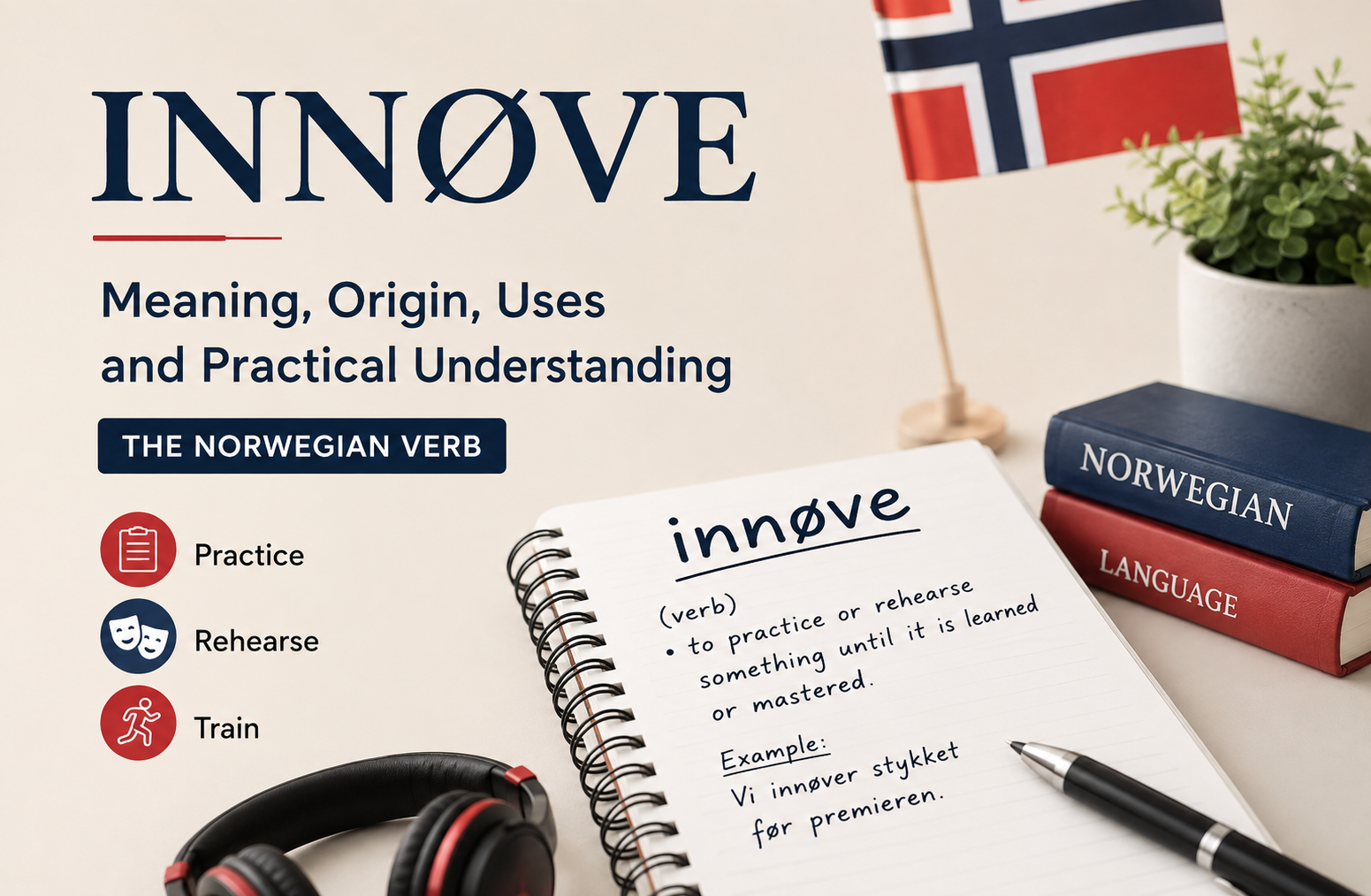
Innøve: Meaning, Origin, Uses, and Practical Understanding
Innøve is a Norwegian verb that can be confusing to English-speaking readers because its spelling looks similar to words such as “innovate,” while its established Norwegian meaning is different. In Norwegian, innøve means to practice, rehearse, or train something until it is learned or mastered. It can describe learning a role, speech, musical piece, movement, procedure, or other skill through repeated practice. The authoritative Norwegian dictionary defines it as “øve inn,” with examples involving rehearsed performances and practiced movements.
The distinction matters because the word has recently appeared in online discussions where it is sometimes presented as a new concept related to innovation, personal growth, technology, or business transformation. Those interpretations can be interesting as creative branding ideas, but they should not be confused with the established dictionary meaning.
Understanding the original word provides a much clearer starting point. Rather than treating it as a mysterious modern buzzword, it is more useful to examine its language, meaning, grammar, practical applications, and the difference between genuine linguistic evidence and newer internet interpretations.
What Does Innøve Mean?
At its simplest, innøve means to practice something until the skill or knowledge becomes learned and usable.
The word is a verb. In practical English, depending on context, it can be translated using expressions such as:
- Practice
- Rehearse
- Train
- Drill
- Learn through repeated practice
- Practice something until it becomes familiar
The Norwegian dictionary gives “øve inn” as the central meaning. An example describes a theater group that has practiced a new play.
This gives the word an important practical quality. It is not simply about being exposed to information. It suggests an active process in which a person repeatedly works on something.
For example, knowing the theory behind a speech is different from being able to deliver it naturally. Reading instructions for a dance is different from performing the movements correctly. Understanding a musical score is different from playing the piece smoothly.
That gap between knowing and doing is where the practical meaning becomes especially useful.
A Simple English Explanation
If someone asks for the meaning in plain English, a useful explanation is:
Innøve means to practice or rehearse something until you have learned it well.
The exact English translation depends on what is being practiced.
For a theater performance, “rehearse” may sound most natural.
For a physical skill, “practice” or “train” may be better.
For a routine or procedure, “drill” or “practice” may communicate the idea more effectively.
The central idea remains repeated practice leading to competence.
Is Innøve a Real Norwegian Word?
Yes. Unlike some newer online interpretations, the word itself is not merely an invented internet expression.
It appears in established Norwegian dictionary resources. Bokmålsordboka lists innøve as a verb and gives “øve inn” as its meaning. The Norwegian Academic Dictionary also records the word and explains its use in relation to learning something through repeated exercises.
This distinction is important for anyone researching the term for an article, academic project, translation, language-learning resource, or website.
There are two separate questions:
- Is the word itself legitimate?
- Are every modern interpretation and explanation of the word legitimate?
The answer to the first question is yes.
The second requires more care.
A number of online articles have recently connected the spelling with innovation, creativity, growth, and modern branding. Those interpretations may be creative uses of the term, but they should not automatically be presented as the traditional definition of the Norwegian word.
Good research separates documented language from later interpretation.
The Origin of the Word
The Norwegian Academic Dictionary explains that innøve is formed from inn and øve, following a pattern associated with the German einüben.
This construction helps explain why the word carries the sense of practicing something into a learned state.
The element øve is connected with exercising, practicing, or training. When combined with inn, the resulting word points toward bringing a skill into practiced or internalized form.
That is why the meaning is more specific than simply “try.”
Someone can try to play a song once without practicing it.
Someone can read about public speaking without rehearsing a speech.
Someone can watch a demonstration without training the required movement.
The concept behind the verb involves an intentional learning process.
Innøve and the Difference Between Practice and Mastery
One of the most useful ways to understand the word is to consider the difference between exposure and practice.
Imagine a person learning a presentation.
On the first day, the person reads the presentation several times. They understand the ideas, but they still pause frequently and forget sections.
After several practice sessions, the structure becomes familiar.
Later, the speaker can deliver the material without constantly checking notes.
The improvement did not come simply from possessing information. It came from repeated engagement with the task.
That is the practical territory associated with the word.
Repetition Alone Is Not Enough
There is an important distinction between repetition and effective practice.
Repeating an incorrect movement 100 times does not necessarily create competence.
Likewise, repeatedly rehearsing a speech while ignoring unclear sections may reinforce weak habits.
Effective practice normally involves:
- A clear objective
- Repeated attempts
- Feedback
- Correction
- Gradual improvement
- Increasing familiarity
- Application in realistic conditions
This makes the word particularly interesting from an educational perspective.
The underlying process is not merely “do it again.” It is closer to learning through structured repetition.
How Innøve Is Used in Norwegian
The word can be applied to different forms of learning and rehearsal.
The dictionary provides examples involving theatrical performance and practiced movements.
Consider several contexts.
Theater
A theater group may practice a new play.
Actors need to learn lines, movements, timing, entrances, exits, and interactions with other performers.
A performance becomes increasingly natural through rehearsal.
Music
A musician may practice a difficult piece until the sequence of notes and movements becomes familiar.
This can involve repeating difficult passages, correcting mistakes, adjusting timing, and eventually performing the complete composition.
Public Speaking
A person preparing a speech can rehearse the introduction, transitions, key points, and conclusion.
Repeated practice can make delivery smoother and reduce dependence on written notes.
Physical Skills
Athletes, dancers, and performers regularly practice movements.
The goal is not simply to understand what the movement should look like. The goal is to perform it correctly and consistently.
Professional Procedures
Training can also involve workplace routines.
A new employee may practice a process repeatedly before being expected to perform it independently.
This can apply to customer service procedures, technical tasks, emergency drills, equipment operation, or other structured activities.
Why Practice Changes Performance
There is a major difference between theoretical knowledge and practical ability.
A person might understand exactly how something should be done and still struggle when performing it.
This happens because performance often requires coordination between knowledge, timing, attention, physical movement, and decision-making.
Practice creates opportunities to connect those elements.
For example, a new public speaker might know that eye contact is important. During an actual presentation, however, they may forget to look at the audience because they are concentrating on remembering the next sentence.
Rehearsal allows the speaker to work through that difficulty before the real event.
The same principle applies to musicians, actors, athletes, students, technicians, and many other learners.
Innøve vs. Innovate
This is one of the most important distinctions to understand.
The spelling of innøve can visually remind English readers of “innovate.” That resemblance can lead to confusion.
But the two words should not be treated as synonyms.
Innovate generally refers to introducing something new, developing a new method, or creating a new approach.
Innøve, in established Norwegian usage, refers to practicing or learning something through repeated exercise.
The difference can be illustrated simply:
Innovation asks, “What new idea can we create?”
Practice asks, “How can we become capable of using this idea well?”
These activities can work together, but they are not the same.
A company can create a new software system. That is an innovation.
Employees then need training to use the system effectively. That learning process involves practice.
A musician can compose a new piece. Creating the composition may be innovative.
The musician then rehearses it repeatedly before performing it.
This distinction prevents an important research mistake: assuming that a visually unusual word must have the same meaning as the English word it resembles.
Why the Letter Ø Matters
The ø character is one of the most visually distinctive parts of the word.
It is used in several Northern European languages, including Norwegian and Danish. For someone familiar primarily with English, the character can make the term look unusual or intentionally stylized.
However, in the Norwegian word innøve, the letter is not merely a branding decoration.
It is part of the actual spelling.
This is particularly important when researching Scandinavian vocabulary. Removing or replacing special characters can sometimes change the word, its pronunciation, or its identity.
For example, writing “innove” instead of “innøve” may make the term easier for English speakers to type, but it can also blur the distinction between the Norwegian word and English “innovate.”
For accurate language content, retaining the original spelling is preferable when discussing the Norwegian term.
How to Pronounce Innøve
The pronunciation can be difficult for English speakers because the vowel ø does not have a direct equivalent in standard English pronunciation.
The Norwegian Academic Dictionary gives the pronunciation as approximately [i´n:øvə].
A learner should avoid assuming that the word is simply pronounced like English “innovate.”
The best approach is to listen to native Norwegian pronunciation when possible and practice the vowel separately.
This is a good example of why spelling-based pronunciation can be misleading when learning another language.
Grammatical Forms of Innøve
As a Norwegian verb, the word has several grammatical forms.
Common forms include:
- å innøve: infinitive
- innøver: present tense
- innøvde: past tense
- har innøvd: perfect form
- innøv: imperative
The dictionary resources also record alternative participle forms associated with Norwegian grammar.
For English speakers, the important point is that the word behaves as a verb rather than as a noun describing an abstract philosophy.
That grammatical fact can help identify its role in a sentence.
Examples of Innøve in Context
Understanding a foreign word becomes easier when it is placed into realistic situations.
Imagine a theater director preparing actors for a performance. The actors need to rehearse their lines and movements repeatedly. That is a natural environment for the verb.
A music teacher may ask a student to practice a difficult section until it becomes comfortable.
A dance group may repeatedly rehearse choreography before appearing on stage.
A professional may practice a new procedure before using it independently.
These examples all share the same basic structure:
Task → repeated practice → increased familiarity → improved performance
That pattern captures the practical meaning more effectively than an abstract definition alone.
What Innøve Does Not Automatically Mean
Because the term has appeared in modern online content, it is worth identifying several meanings that should not be automatically attributed to the established Norwegian word.
There is no good reason to treat it automatically as:
- A formal business methodology
- A recognized technology framework
- A psychological theory
- A specific productivity system
- An established corporate philosophy
- A documented innovation model
- A standardized personal development technique
Some websites may use the word creatively in these contexts.
Creative usage is possible.
But creative usage and dictionary definition are different things.
A trustworthy article should make that distinction clear rather than presenting speculation as established fact.
Why Online Definitions Can Become Confusing
Internet vocabulary can change quickly.
A distinctive word may become popular because it looks memorable, works well as a domain name, or appears suitable for branding. Once several websites publish similar explanations, later articles may repeat those explanations without checking an original dictionary.
This creates a feedback loop.
Article A makes an unsupported claim.
Article B summarizes Article A.
Article C cites Article B.
Eventually, the claim can look widely established simply because many pages repeat it.
Search volume does not prove linguistic validity.
The number of websites using a definition does not automatically make that definition correct.
For unusual terms, primary or authoritative language sources are especially valuable.
A Better Way to Research Unusual Words
When encountering an unfamiliar term such as this one, a careful research process can prevent misinformation.
Start With an Authoritative Dictionary
Look for established dictionaries, national language institutions, universities, or recognized linguistic resources.
This should normally come before blogs and social media posts.
Examine Grammar
Ask whether the word is a noun, verb, adjective, or something else.
Grammar can reveal a great deal about how a term actually functions.
Check Examples
A dictionary definition becomes much clearer when you see real examples.
Look at the objects or actions that commonly accompany the word.
Separate Translation From Interpretation
A translation answers:
“What does this word mean in another language?”
An interpretation asks:
“What could this word symbolize in a modern context?”
Those are different questions.
Check the Original Language
If a term contains unusual characters or appears Scandinavian, researching the original language can prevent false assumptions based on English spelling.
The Value of Practice in Learning
Although the word should not be incorrectly turned into a modern productivity philosophy, its actual meaning points toward an important truth about learning.
Skills require application.
Reading about a skill is useful.
Watching someone perform it is useful.
Understanding the theory is useful.
But actual performance requires practice.
This applies across many fields.
A student preparing for an exam benefits from solving problems rather than simply rereading notes.
A speaker improves by rehearsing rather than only writing a speech.
A musician improves by playing rather than only studying music theory.
An athlete improves by training rather than only watching competitions.
A new employee becomes comfortable with a process by practicing it.
This is why rehearsal remains important even in a world filled with digital learning tools.
Technology can provide information quickly, but information does not automatically become skill.
Practical Lessons for Students
Students can apply the underlying principle in several ways.
Instead of studying for hours without testing themselves, they can break learning into smaller practice sessions.
A useful cycle is:
- Learn the basic concept.
- Attempt the task.
- Identify mistakes.
- Correct those mistakes.
- Repeat the difficult parts.
- Test the skill without assistance.
- Review performance again.
This approach turns passive learning into active learning.
It also makes weaknesses easier to identify.
If a student repeatedly makes the same error, that error becomes a clear target for additional practice.
Practical Lessons for Professionals
The same principle applies in the workplace.
When introducing a new process, organizations sometimes focus heavily on documentation and assume employees will immediately perform the task correctly.
Documentation matters, but it is only part of implementation.
Employees may also need:
- Demonstration
- Guided practice
- Feedback
- Repetition
- Realistic scenarios
- Performance checks
- Refresher training
This is especially important when mistakes carry significant consequences.
A well-designed training program should not simply ask whether an employee understands the instructions.
It should also determine whether the employee can successfully perform the task.
Practical Lessons for Creators and Performers
Creative work is another area where rehearsal matters.
Writers may revise drafts repeatedly.
Actors rehearse scenes.
Musicians practice passages.
Presenters rehearse delivery.
Designers iterate on concepts.
The process may look different across disciplines, but the underlying pattern is similar.
A first attempt rarely represents the final level of performance.
Repeated work reveals problems that are difficult to see during initial creation.
That is one reason experienced performers often spend substantial time preparing before the audience ever sees the final result.
Common Misunderstandings About Innøve
Several misconceptions are worth addressing directly.
Misunderstanding 1: It Is Simply Another Form of “Innovate”
It is not.
The Norwegian dictionary meaning centers on practicing or learning something through repeated exercise.
Misunderstanding 2: It Is a Newly Invented Internet Word
The word itself has established Norwegian dictionary documentation and historical usage.
Misunderstanding 3: The Ø Is Only a Branding Trick
In the Norwegian spelling, the character is a genuine part of the word.
Misunderstanding 4: Practice Means Mindless Repetition
Effective practice usually involves correction and improvement rather than simply repeating the same action without reflection.
Misunderstanding 5: Every Modern Explanation Is a Dictionary Definition
This is perhaps the most important mistake to avoid.
Modern websites may assign new symbolic meanings to an existing word. Those interpretations should be labeled as interpretations rather than presented as established linguistic facts.
Innøve in Modern Digital Content
The term presents an interesting challenge for writers and publishers because it has both an established linguistic meaning and newer online interpretations.
If you are writing about it for a website, accuracy should come before keyword repetition.
A strong article should explain what the word means, where it belongs linguistically, how it is used, and why people may encounter different explanations online.
It should not manufacture a complicated theory simply because the keyword appears unusual.
This is particularly important for informational SEO.
Searchers often arrive at an article because they genuinely want to understand a strange word. Giving them a clear definition early is more useful than surrounding the term with unrelated discussion.
How to Use the Term Correctly in Content
If you are using the word in an English-language article, introduce it with context.
For example, explain that it is a Norwegian verb and provide the closest English equivalents.
Then explain the situation in which the word is used.
Avoid treating the term as an English noun unless you are specifically discussing a modern coined or branded use.
This approach reduces ambiguity and gives readers enough information to understand why the word appears different from familiar English vocabulary.
A Useful Mental Model
One simple way to remember the meaning is to think about the difference between knowing and being able to perform.
Knowing how to play a scale is not the same as playing it smoothly.
Knowing the words of a speech is not the same as delivering it confidently.
Knowing the steps of a procedure is not the same as completing the procedure correctly.
Practice bridges that gap.
That is the most practical way to understand the established meaning of the term.
Why This Meaning Still Matters Today
Modern technology has changed how people access information, but it has not eliminated the need for practice.
Online courses can explain concepts.
Artificial intelligence can answer questions.
Video platforms can demonstrate techniques.
Digital tools can provide instant feedback.
Yet the learner still needs to engage with the task.
Information can reduce the time required to understand something, but competence usually requires active application.
This makes the traditional meaning relevant even in modern education, professional training, sports, music, and creative work.
The word is not necessarily describing a new technology.
It describes a familiar human learning process.
How Teachers Can Apply the Principle
Teachers can use repeated practice strategically rather than simply assigning more work.
A strong learning activity might begin with a demonstration.
Students then attempt the task with support.
The teacher identifies common errors.
Students repeat the difficult part.
Finally, students perform the task independently.
This structure provides a gradual movement from instruction to independent performance.
It also helps teachers distinguish between students who understand an idea conceptually and students who can actually apply it.
How Managers Can Apply the Principle
Managers introducing new systems or procedures can use a similar approach.
Instead of sending employees a long document and assuming the process is understood, managers can demonstrate the workflow and provide opportunities for employees to practice it.
Short realistic scenarios can be particularly useful.
For example, if employees must learn a customer service procedure, they can practice sample conversations before handling real cases.
The result is often more informative than a simple acknowledgment that employees have read the instructions.
How Individuals Can Build Better Practice Habits
Individuals do not need a complicated system to improve.
A practical routine can be built around four questions:
What am I trying to learn?
Define the skill clearly.
What part is difficult?
Identify the weakest component rather than repeating everything equally.
What mistake am I making?
Look for a specific problem.
What will I change in the next attempt?
Make the next practice session purposeful.
This creates a feedback loop.
The objective is not simply to spend more time practicing. It is to make each round of practice more useful.
The Difference Between Rehearsing and Performing
Another useful distinction is the difference between practice conditions and real-world conditions.
A musician may practice alone in a quiet room but perform in front of hundreds of people.
A student may solve problems at home but take an exam under time pressure.
An employee may practice a procedure during training but need to use it while handling real customers.
Good preparation gradually introduces realistic conditions.
That means practice should eventually become more demanding.
The learner needs opportunities to demonstrate that the skill works outside the protected environment of training.
Frequently Asked Questions
What does innøve mean?
Innøve is a Norwegian verb meaning to practice, rehearse, or learn something through repeated exercise. Norwegian dictionary sources define it in relation to “øve inn,” or practicing something until it is learned.
Is innøve the same as innovate?
No. The Norwegian word refers to practicing or learning something through repeated exercise. English “innovate” refers to creating or introducing something new. Their similar appearance can cause confusion, but their meanings are different.
Is innøve a Norwegian word?
Yes. It is documented in established Norwegian dictionaries, including Bokmålsordboka and the Norwegian Academic Dictionary.
What is the closest English translation?
Depending on context, useful translations include “practice,” “rehearse,” “train,” or “learn through repeated practice.” The best choice depends on what is being practiced.
Why does innøve use the letter ø?
The letter ø is part of the Norwegian spelling. It is not simply an ornamental replacement for the English letter “o.”
Can innøve be used as a modern concept about innovation?
People may creatively use an existing word as a brand, philosophy, or metaphor. However, such modern interpretations should be distinguished from the established Norwegian dictionary meaning, which relates to practicing or rehearsing.
Conclusion
Innøve is best understood first through its established Norwegian meaning rather than through newer internet interpretations. It is a verb associated with practicing, rehearsing, training, and learning something through repeated exercise.
Its similarity to the English word “innovate” can make the term appear more mysterious than it actually is. The distinctive ø also gives it a Scandinavian appearance, but the spelling reflects genuine Norwegian language rather than automatically indicating a modern branding concept.
The most important distinction is between documented meaning and creative interpretation. Established Norwegian dictionaries provide evidence that the word has long been used in connection with practicing or learning something. Modern websites may attach additional meanings involving innovation, growth, or creativity, but those should be presented as contemporary interpretations unless reliable linguistic evidence supports them.
For anyone researching the word, the most reliable approach is straightforward: identify the language, check authoritative dictionaries, examine real usage, understand the grammar, and distinguish translation from interpretation.
Ultimately, the concept behind the established meaning is easy to recognize even without knowing Norwegian. People improve through practice. Performers rehearse. Students repeat difficult skills. Professionals train on procedures. Musicians practice passages. Athletes repeat movements.
The word simply gives that familiar process a distinctly Norwegian name.