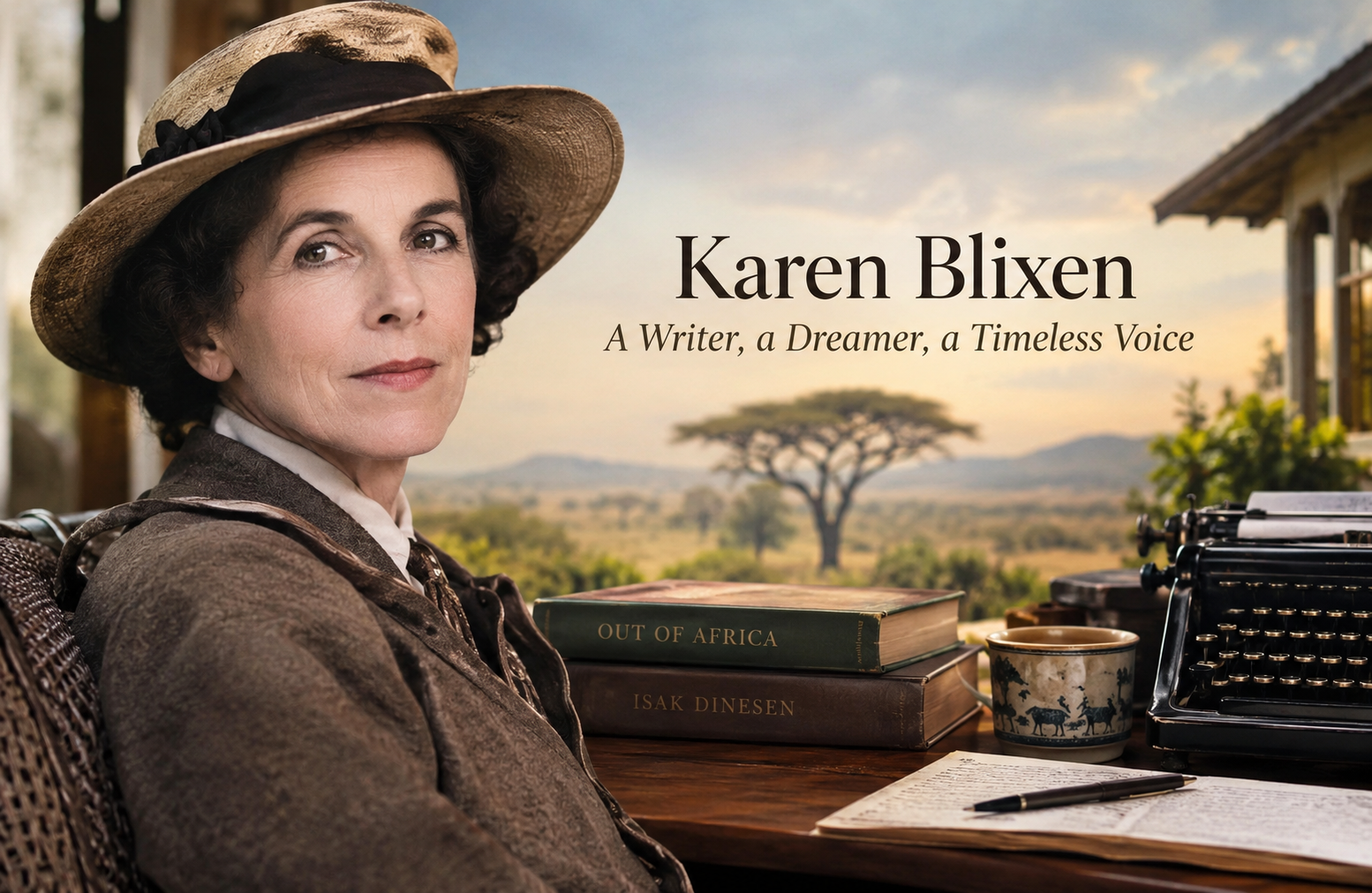
Karen Blixen: Life, Books, Legacy, and Literary Significance
Karen Blixen was a Danish author whose extraordinary life and literary work made her one of the most distinctive voices in twentieth-century literature. Best known internationally for Out of Africa, Karen Blixen wrote about memory, identity, love, loss, nature, and the complicated relationship between people and the places they call home. Her stories often combine realistic settings with folklore, symbolism, psychological insight, and a deep interest in human character. For readers discovering her work today, her writing offers both a window into a particular historical period and an opportunity to reflect on universal questions about belonging, freedom, and the stories people tell about themselves.
Born in Denmark in 1885, Blixen became internationally recognized through works published under different names, including Isak Dinesen. Her years in Kenya shaped her public image, but her literary achievement extends well beyond her African experiences. She was also a skilled storyteller whose short fiction challenged conventional expectations and explored the tension between personal desire and social responsibility. Understanding her life requires looking at both her creative achievements and the historical realities surrounding them, particularly the colonial society in which she lived.
Who Was Karen Blixen?
Karen Blixen was a Danish novelist, essayist, and short-story writer whose literary career crossed national and linguistic boundaries. She is widely remembered for her memoir Out of Africa, but her reputation also rests on imaginative fiction that draws on European history, folklore, religious traditions, and the art of oral storytelling.
Her full name was Karen Christentze Dinesen. She was born on April 17, 1885, in Rungsted, Denmark, and died on September 7, 1962, at her family home in Rungstedlund. She published many of her best-known works in English under the pen name Isak Dinesen, while Danish editions appeared under her own name, Karen Blixen.
Her identity as a writer is important because she did not fit neatly into a single literary category. Some readers know her as an author of African memoirs. Others admire her as a master of Gothic fiction, a genre that uses mystery, unusual settings, psychological tension, and sometimes supernatural elements. Still others study her as a woman who pursued an independent artistic life during a period when social expectations placed considerable limits on women’s choices.
What makes her work particularly interesting is the relationship between experience and imagination. Blixen drew on events she had witnessed, but she did not simply record them. She transformed personal memories, cultural encounters, and historical settings into carefully constructed narratives.
To understand her importance, it is necessary to examine her early life, her years in Kenya, her major books, and the difficult questions that modern readers bring to her legacy.
Early Life and Family Background
Karen Blixen grew up in a comfortable Danish household at Rungstedlund, a family estate north of Copenhagen. Her childhood brought her into contact with literature, art, nature, and the stories told by people around her.
Her father, Wilhelm Dinesen, was a writer and former military officer with an adventurous outlook on life. His interests helped expose Blixen to the natural world and encouraged her imagination. However, his suicide in 1895, when she was nine years old, became a major loss in her childhood.
The experience of losing her father may help explain why questions of grief, identity, destiny, and personal independence recur throughout discussions of her life and literature. It would be too simple to attribute her later writing directly to this event, but it formed part of the emotional background against which her personality developed.
Her mother, Ingeborg Westenholz, raised five children after her husband’s death. The family environment continued to provide educational and cultural opportunities, even though girls of Blixen’s social background often faced different expectations from boys.
Her Early Interest in Writing and Art
Blixen showed an interest in storytelling at a young age. She wrote early stories and plays, entertained family members with invented narratives, and explored visual art before committing herself to a literary career.
She studied art in Copenhagen and spent time developing her creative interests. This artistic background matters because her prose often feels visual. She establishes a setting through color, atmosphere, clothing, architecture, and landscape before revealing the emotional or moral tensions within it.
Her stories frequently resemble paintings brought to life. Characters appear in carefully designed environments, and details that initially seem decorative can become important symbols.
For example, a formal dinner may reveal social hierarchy. A costume may conceal a character’s identity. A remote house may represent isolation, privilege, or the pressure of family tradition.
These techniques show how her artistic interests supported her later writing.
The Development of an Independent Personality
Blixen lived during a period when women from privileged European families were often expected to marry well, manage households, and maintain social standing. She wanted a life that involved more than following those conventions.
Her ambition was not simply to become famous. She wanted to experience the world, develop her own ideas, and create work that reflected her imagination.
That ambition helps explain the unusual direction her life eventually took. Her move to Africa exposed her to practical responsibilities and financial uncertainty, while her return to Denmark forced her to rebuild her future around writing.
Her life illustrates the difference between having creative ambition and finding the circumstances in which that ambition can succeed.
Karen Blixen in Africa: The Years That Changed Her Life
Karen Blixen’s years in Kenya became the defining experience of her public identity. She traveled to British East Africa in the early twentieth century and married her Swedish relative, Baron Bror von Blixen-Finecke, in 1914.
The couple established a coffee plantation near Nairobi, in the region associated with the Ngong Hills. At the time, Kenya was under British colonial rule, and European settlers occupied farms and businesses within a political and economic system that gave them advantages over the African population.
Blixen’s experience was therefore shaped by two realities at once. She faced genuine personal difficulties as a farmer and business manager, but she also lived within a colonial system that must be considered when evaluating her descriptions of Africa.
Life on the Coffee Plantation
Running a coffee plantation required much more than an interest in agriculture. It involved managing land, workers, equipment, production, finances, weather conditions, and the uncertainties of international markets.
The farm struggled with financial problems and agricultural difficulties. Coffee production did not provide the stable income the owners needed, and the business eventually became unsustainable.
Blixen’s marriage also deteriorated. She and Bror separated, and she continued managing the property after their relationship ended.
These years gave her firsthand knowledge of the practical challenges of maintaining a large agricultural enterprise. They also exposed her to the complicated relationships between landowners, employees, neighboring communities, and the natural environment.
Her later memoirs turn these experiences into literary material, but they should not be read as a complete economic or social history of colonial Kenya.
Her Relationship With the African Landscape
The Kenyan landscape became central to Blixen’s imagination. The Ngong Hills, open plains, changing light, birds, animals, and seasonal rhythms all feature prominently in her writing about Africa.
Nature in her work is not merely a beautiful background. It often becomes a way to explore human limitations. The landscape can be generous and magnificent, yet it remains indifferent to individual hopes and ambitions.
This contrast is especially important when reading her descriptions of the farm. The natural world offers a sense of freedom, but the business operating within it remains subject to financial pressures and human decisions.
Blixen’s writing also reveals her attention to the relationship between observation and memory. She describes places as someone who lived in them, but her descriptions are shaped by the perspective of a storyteller looking back after leaving them behind.
That distance gives her prose much of its emotional force.
Denys Finch Hatton and Personal Loss
During her years in Kenya, Blixen developed a close relationship with Denys Finch Hatton, a British big-game hunter and pilot. Their relationship became an important part of the story later associated with Out of Africa.
Finch Hatton died in an airplane crash in 1931. His death occurred during a period when Blixen was also confronting the failure of the coffee business.
The combination of bereavement and financial collapse marked the end of her life in Kenya. In 1931, she returned to Denmark, leaving behind the farm that had shaped much of her adult experience.
It is tempting to interpret her entire literary career through this period of loss, but that would overlook her earlier interests and the wider range of her imagination. Africa provided important material for her writing, while her literary methods drew on traditions extending far beyond her personal experiences.
Why Karen Blixen Returned to Denmark
Blixen’s departure from Kenya was not simply a decision to leave one country for another. It marked the end of a long attempt to establish a life that combined personal independence, romantic attachment, and financial success.
The plantation had become increasingly difficult to sustain. Economic pressures and unsuccessful agricultural operations undermined its future, while personal relationships had changed beyond repair.
Returning to Denmark meant giving up the life she had built in Africa. It also meant returning to a society where she could resume her literary work and live at Rungstedlund.
Although the return was painful, it created the conditions for her emergence as an internationally recognized author.
Turning Experience Into Literature
Blixen had developed her storytelling abilities over many years, but her most successful literary career took shape after she returned home.
Her experience of Kenya gave her a rich collection of memories, characters, and settings. However, her literary success depended on more than those experiences alone. It also required a distinctive voice, strong narrative structure, and a willingness to write for readers who might not share her background.
Her career demonstrates an important principle about memoir and autobiographical fiction: lived experience supplies material, but literary craft determines how that material is organized and communicated.
Blixen’s memories were not presented as a diary of everything that happened to her. She selected episodes, shaped scenes, developed recurring themes, and created an account designed to communicate the emotional meaning of a vanished period in her life.
That process helped transform a personal story into a work with international appeal.
Karen Blixen’s Most Famous Book: Out of Africa
Out of Africa, published in 1937, is the book most closely associated with Karen Blixen. It is a memoir about her years in Kenya, combining recollections of plantation life with portraits of people, reflections on the landscape, and meditations on memory and loss.
Rather than presenting a straightforward chronological autobiography, the book moves through episodes and impressions. Its structure reflects the way memory often works: one encounter leads to another, a place evokes a person, and a small detail opens into a larger reflection.
The result is a narrative that blends personal history with literary interpretation.
What Is Out of Africa About?
At its center is Blixen’s experience of living on a coffee farm near the Ngong Hills. She writes about the farm, its surroundings, the people she encountered, the animals and birds she observed, and the relationships that shaped her life.
The book also reflects on the passage of time. The life she describes no longer exists in the same form by the time she writes about it. Her return to Denmark gives the memories a sense of distance, making the narrative both a recollection and an act of mourning.
Readers can approach the book through several related questions:
- What does it mean to belong to a place?
- How does memory change the way people understand their past?
- Can a person preserve an experience through storytelling?
- What is lost when a familiar way of life comes to an end?
- How should personal memories be understood within a larger historical system?
These questions help explain why the memoir continues to attract readers interested in literature, biography, African history, and travel writing.
The Meaning of Place in Out of Africa
The landscape is one of the memoir’s strongest elements. Blixen’s descriptions of the hills and plains create a powerful sense of location, but the landscape also becomes part of her emotional life.
The farm represents work, independence, hope, and disappointment. The surrounding land represents beauty and scale beyond the concerns of any single person.
This relationship between the individual and the natural world gives the book a reflective quality. The narrator remembers a place she can no longer inhabit in the same way, and writing becomes a means of returning to it.
However, the book should not be treated as a neutral portrait of Kenya. It presents Africa through the perspective of a European settler. Modern readers should distinguish between its literary value and the historical limitations of its viewpoint.
Is Out of Africa a True Story?
Yes. The book draws on Blixen’s real experiences in Kenya, including her years on the coffee plantation and her relationships with people she knew.
Nevertheless, it is a literary memoir rather than a comprehensive record of events. The episodes have been selected and arranged to create a meaningful narrative.
Readers should therefore understand it as an account of personal experience, not as a complete representation of every person or community connected to the farm.
This distinction is especially useful for students. A memoir can be valuable historical evidence about its author’s life and perspective while still requiring comparison with other sources to understand the broader context.
The Film Adaptation
The 1985 film Out of Africa, directed by Sydney Pollack and starring Meryl Streep and Robert Redford, brought renewed international attention to Blixen’s life.
The film drew on her memoir and other biographical material, emphasizing romance, landscape, and personal loss. Its sweeping visual style helped establish a lasting popular image of her years in Kenya.
However, the film is an adaptation rather than a documentary. It condenses events, reshapes relationships, and makes choices designed for cinematic storytelling.
Readers interested in the historical Blixen should therefore distinguish among her memoir, the film, and later biographies. Each provides a different kind of interpretation.
The book offers her own literary recollection. The film presents a dramatized version of the story. Biographies can add evidence and context that neither necessarily includes.
Karen Blixen’s Major Books and Literary Works
Although Out of Africa remains her most widely recognized work, Blixen wrote several collections of short stories and other books that reveal a broader range of themes and styles.
Her fiction often moves away from autobiographical material into imaginative settings. She wrote about aristocratic households, artists, religious figures, unusual travelers, and people caught in conflicts between personal wishes and social expectations.
The following works offer a useful introduction to her literary development.
1. Seven Gothic Tales
Published in English in 1934 under the name Isak Dinesen, Seven Gothic Tales established Blixen as a distinctive literary voice.
The collection contains stories marked by elaborate settings, unusual characters, moral ambiguity, and surprising turns of events. Its Gothic elements create a sense that ordinary social life may conceal deeper mysteries.
The stories frequently examine identity and the roles people adopt in public. Characters may find themselves trapped by family expectations, social rank, personal secrets, or the consequences of earlier decisions.
For readers accustomed to modern, fast-paced fiction, the collection may require patience. Blixen often builds atmosphere and develops philosophical questions before revealing the full significance of an event.
That approach is part of the book’s appeal. The reader is invited to consider how a story changes when its assumptions about identity, truth, and responsibility are challenged.
It is an especially useful starting point for anyone interested in her imagination beyond Africa.
2. Winter’s Tales
Published in 1942, Winter’s Tales appeared during the Second World War. Its stories reflect an interest in resilience, moral choice, social change, and the uncertain relationship between individuals and the forces shaping their lives.
The collection demonstrates Blixen’s ability to use different historical periods and social environments to examine persistent human concerns.
Her characters are rarely reduced to simple examples of virtue or wrongdoing. They make choices under pressure, and those choices can reveal strengths and weaknesses that were not obvious at the beginning.
The winter setting also invites a broader interpretation. Winter can suggest hardship, uncertainty, or a temporary suspension of ordinary life. Within such conditions, people may be forced to reconsider what matters most.
Readers interested in her treatment of character and moral complexity will find this collection rewarding.
3. The Angelic Avengers
Blixen published The Angelic Avengers during the Second World War under the pseudonym Pierre Andrézel. The novel uses suspense, deception, and social danger to examine the vulnerability of young people facing manipulative adults and uncertain circumstances.
The book differs from her better-known memoirs because its primary purpose is not to recount personal experience. Instead, it uses a constructed narrative to explore fear, power, and the possibility of resistance.
Its unusual publication history also illustrates Blixen’s interest in literary identities. She was willing to publish under different names and to approach readers through distinct authorial personas.
The novel is particularly interesting for readers who want to explore the less familiar parts of her bibliography.
4. Last Tales
Published in 1957, Last Tales brings together stories that explore the relationship between artistic creation, destiny, identity, and the passage of time.
Blixen’s fiction often gives considerable attention to the act of storytelling itself. Characters tell stories, interpret events, and attempt to understand what their experiences mean.
This creates a layered reading experience. A tale may be about the events within it, but it may also raise questions about the person telling it and the reasons for telling it.
In this sense, the collection offers insight into Blixen’s wider literary philosophy. Stories are not merely entertainment. They can help people interpret their lives, preserve memories, and confront experiences that resist simple explanation.
5. Anecdotes of Destiny
Published in 1958, Anecdotes of Destiny is one of Blixen’s best-known later collections.
Its stories include Babette’s Feast, which explores hospitality, sacrifice, artistic excellence, and the power of a shared meal. Another story, The Immortal Story, examines wealth, desire, storytelling, and the difficulty of controlling how others interpret events.
These narratives are useful examples of Blixen’s ability to combine a clear plot with larger questions about human nature.
A meal, a bargain, or a seemingly simple decision can become a test of a character’s values. The consequences may extend beyond the immediate situation, changing how characters understand generosity, pleasure, or personal responsibility.
6. Shadows on the Grass
Published in 1960 in Danish and in English in 1961, Shadows on the Grass returns to Blixen’s African memories.
The book complements Out of Africa by revisiting aspects of her life in Kenya and the people she remembered from that period. It offers a further opportunity to consider how memory changes with time.
Readers who have already explored her earlier memoir may find this work valuable because it shows that her engagement with Africa did not end with a single book.
Together, the two works provide a more developed picture of how she chose to remember her experiences.
Understanding Karen Blixen’s Writing Style
Blixen’s literary style is distinctive because it combines the voice of a storyteller with the precision of a carefully constructed writer.
Her work often sounds as if someone is recounting an extraordinary event to an attentive audience. Yet the stories are not casual improvisations. Their pacing, imagery, symbolism, and structure reflect careful artistic decisions.
Understanding several key features can make her books easier to appreciate.
The Influence of Oral Storytelling
Blixen admired the tradition of stories told aloud. Her fiction frequently creates the feeling that a narrator is speaking directly to listeners.
This effect comes from the way she introduces characters, delays information, creates suspense, and moves between events and reflections.
A story may begin with an apparently simple situation before opening into a series of complications. The narrator may withhold details, offer a surprising interpretation, or reveal that the meaning of an earlier event has changed.
This method encourages active reading. Instead of receiving all the information immediately, readers must consider how the pieces fit together.
Symbolism and Imagery
Blixen uses physical details to suggest larger ideas. Objects, clothes, rooms, landscapes, and rituals can acquire symbolic meaning as a story develops.
A character’s appearance may communicate social status. A formal gathering may expose unspoken tensions. A natural setting may reflect the difference between human ambition and forces beyond human control.
These details are most effective when read in context. Rather than assuming that every object represents a single fixed idea, readers should consider how its meaning changes through the story.
Identity and Performance
Many of Blixen’s characters perform roles shaped by their society. They may act as respectable citizens, devoted partners, generous hosts, artists, or members of powerful families.
The tension appears when the role conflicts with private desires or hidden truths.
This theme connects her Gothic stories to her interest in storytelling. Just as a narrator chooses how to present an event, people choose how to present themselves to others.
The result is a body of work that often asks whether identity is something people possess naturally or something they create through actions, relationships, and stories.
Destiny and Personal Choice
Blixen frequently explores the relationship between fate and free will. Her characters may believe they control their futures, only to discover that their choices produce unexpected consequences.
However, destiny in her stories does not always mean that individual decisions are meaningless. A person may have limited control over circumstances but still retain responsibility for how they respond.
This tension gives her fiction much of its moral complexity. Her characters are neither entirely free nor completely powerless.
Irony and Moral Ambiguity
Blixen does not always tell readers what to think. Her stories may expose contradictions in a character’s behavior without providing a simple judgment.
Generosity can contain pride. Respectability can conceal cruelty. An apparently foolish decision can reveal unexpected wisdom.
This ambiguity makes her work well suited to discussion and close reading. Readers can disagree about a character’s motives while still recognizing how carefully the narrative has been constructed.
The Central Themes in Karen Blixen’s Work
The strongest way to understand Blixen is to look beyond the events of her biography and examine the questions that connect her different books. Her memoirs and short stories often explore similar concerns, even when they take place in very different worlds.
Memory and the Meaning of the Past
Memory is central to Out of Africa, but it also matters throughout Blixen’s fiction. Her narrators often look backward, trying to understand events that cannot be changed.
Remembering is not simply a process of recovering facts. It involves deciding which details matter and how separate experiences fit together. This is one reason Blixen’s narratives often feel reflective rather than strictly chronological.
Her work can help readers understand the difference between an event and its later interpretation. Two people may experience the same situation but remember it differently because their hopes, fears, and relationships differ.
For students of literature, this theme offers a useful starting point for examining narrative perspective. It also raises a question relevant to memoir writing today: how can a writer represent the past honestly while acknowledging that memory is selective?
Love, Loss, and Emotional Independence
Love appears in several forms across Blixen’s writing. It can be romantic, familial, artistic, or connected to a person’s attachment to a place.
Her personal relationships attracted public attention, particularly her relationship with Denys Finch Hatton. Yet her literary treatment of love is wider than a single romance.
Her stories often explore the tension between attachment and independence. People may want intimacy while resisting the limits that relationships impose. They may love someone without being able to control that person’s choices.
Loss can make those tensions more visible. The end of a relationship or the disappearance of a familiar world forces characters to confront what they cannot preserve.
Blixen’s writing suggests that emotional significance does not depend on permanence. An experience may remain important even after the circumstances that created it have disappeared.
Power, Class, and Social Expectations
Blixen frequently wrote about aristocratic families, social rituals, and communities governed by established rules.
These settings allowed her to examine how status affects personal freedom. A character’s family name, wealth, gender, or reputation may determine what others expect from them.
Such expectations can offer security, but they can also become restrictive. Characters who challenge them may face ridicule, exclusion, or personal sacrifice.
This theme connects her fiction to her own life as a woman seeking artistic independence. However, her work should not be reduced to autobiography. She used historical and fictional settings to investigate social pressures in ways that went beyond her own experience.
Her stories can be read as studies of the difference between the public roles people occupy and the private lives they attempt to protect.
Nature and Human Limitations
Nature appears prominently in Blixen’s writing about Africa, but the underlying question extends beyond any particular landscape.
The natural world operates according to forces that individuals cannot fully control. Weather, distance, animal behavior, and the passage of seasons can frustrate even carefully made plans.
For Blixen, these limits often create a contrast between human ambition and the wider world. People may imagine themselves to be masters of their circumstances, but their lives remain vulnerable to events beyond their control.
This idea is particularly clear when her descriptions of the Kenyan landscape are considered alongside the financial difficulties of the plantation. Beauty and hardship coexist. A place can inspire deep affection without guaranteeing success or security.
Art, Storytelling, and Human Dignity
Another important theme is the value of artistic creation.
In Babette’s Feast, for example, artistic excellence becomes connected to generosity and transformation. The story explores what happens when a person uses exceptional skill to create something for others, even when the recipients may not fully understand its value.
This idea appears in different forms throughout Blixen’s work. Storytelling can preserve an experience, while art can express feelings that ordinary conversation cannot easily communicate.
Her fiction therefore treats artistic ability as more than a means of earning recognition. It can also be a way to give shape to experience and create meaning in an uncertain world.
Babette’s Feast: A Closer Look at One of Her Most Famous Stories
Babette’s Feast is one of Blixen’s most accessible stories and a strong introduction to her use of symbolism.
The story centers on Babette, a French woman who finds refuge in a small religious community in Denmark. She works for two elderly sisters whose lives are shaped by a strict religious tradition.
After receiving unexpected good fortune, Babette chooses to prepare an elaborate French dinner for the community. The meal becomes much more than an act of hospitality. It challenges the group’s assumptions about pleasure, generosity, and the place of artistic excellence in a disciplined life.
What Makes the Story Important?
The central conflict is not simply between good food and religious restraint. It concerns the relationship between art and the people who receive it.
Babette is a gifted cook. Her skill allows her to create an experience that transforms the atmosphere of the gathering, even though the guests initially approach the meal with hesitation.
The story asks whether art needs to be fully understood to have value. It also explores whether pleasure and spiritual seriousness must always be opposed.
Babette’s decision is especially meaningful because she does not create the feast merely to gain praise. Her act reveals something about her identity and the importance of practicing her art.
The Meaning of Generosity
Generosity in the story is complicated. The meal costs money, requires effort, and draws on Babette’s extraordinary abilities.
It is not simply a practical exchange in which one person gives something and expects an equal reward. Instead, the feast becomes an expression of a person’s capacity to create something beyond ordinary expectations.
This is why the story remains effective for readers who are interested in ethics, religion, hospitality, or artistic expression.
It suggests that generosity can involve giving the best of one’s abilities, not merely offering something convenient or inexpensive.
The Film Adaptation
The 1987 Danish film Babette’s Feast, directed by Gabriel Axel, brought the story to a wider international audience and won the Academy Award for Best Foreign Language Film.
Like the original story, the film emphasizes the relationship between food, community, belief, and artistic expression.
For readers who enjoy comparing literary works with film, it offers an opportunity to consider how a director can translate symbolism and interior reflection into visual scenes, performances, and atmosphere.
Karen Blixen and the Colonial History of Kenya
Any balanced account of Blixen’s life must address the colonial context in which she lived.
During her years in Kenya, European settlers held economic and political advantages under British colonial rule. Land ownership, labor arrangements, and access to commercial resources were shaped by unequal systems of power.
Blixen’s experience as a farm manager was real, and the difficulties she faced should not be dismissed. At the same time, her personal struggles occurred within a broader structure that treated European settlement differently from African claims to land and resources.
Both facts matter when reading her work.
Reading Her African Memoirs Critically
Out of Africa offers valuable insight into how one European settler remembered her life in Kenya. It is not, however, a complete account of Kenyan history or a substitute for the voices of African communities.
The memoir reflects the narrator’s perspective, interests, relationships, and social position. As with any autobiographical work, what is included and what is left outside the narrative influence the reader’s understanding.
Modern readers can approach the book by asking several questions:
- Whose experiences receive the most attention?
- How are African people described, and how much space do they receive to express their own perspectives?
- What does the narrator understand about the society around her, and what might remain outside her view?
- How does the language of admiration or affection relate to the realities of colonial power?
- What additional historical sources would help build a fuller picture?
These questions do not require readers to ignore the memoir’s literary qualities. Instead, they help separate an appreciation of its prose from an uncritical acceptance of its historical perspective.
Why Historical Context Matters
Literary works are created within particular social conditions. Understanding those conditions can reveal meanings that might otherwise remain hidden.
Blixen’s descriptions of the land, the farm, and her relationships with African people reflect the world in which she lived. They also reflect her position within that world.
A thoughtful reading therefore recognizes both her sensitivity to individual experiences and the limits of a narrative shaped by colonial privilege.
This approach makes her writing more interesting, not less. It allows readers to examine how beauty, memory, power, and inequality can coexist within the same work.
Karen Blixen’s Influence on Literature and Popular Culture
Blixen’s literary influence extends beyond the books she published during her lifetime. Her work continues to attract readers, researchers, filmmakers, and students because it offers a distinctive combination of storytelling, symbolism, and psychological insight.
Her memoirs are important to discussions of travel writing and autobiographical literature. Her fiction is studied for its use of narrative framing, historical settings, and moral ambiguity.
The film adaptations of Out of Africa and Babette’s Feast have also helped introduce her work to people who might not otherwise read literary fiction.
Her Place in Danish Literature
Blixen is regarded as one of Denmark’s major literary figures. Her importance comes partly from her ability to write across linguistic and cultural boundaries.
She wrote in English and Danish, and her work reached readers in different countries. Her success also challenged the assumption that a writer must focus on familiar national subjects to produce significant literature.
Her stories drew on European literary traditions while her memoirs reflected her experiences in Kenya. This combination gave her a distinctive place in international literature.
Her Influence on Short Fiction
Blixen’s short stories demonstrate how a limited number of characters and a carefully controlled setting can support complex themes.
Rather than explaining every motive directly, she often allows the reader to discover meaning through dialogue, symbolism, and unexpected developments.
This approach can be useful for writers studying how to create narrative tension. A story does not always need a large cast or a complicated external plot. It can gain depth from the conflict between what characters say, what they believe, and what their actions reveal.
Her work also demonstrates the value of a strong narrative voice. The manner in which a story is told can shape the reader’s response as much as the events themselves.
The Continuing Importance of Adaptations
Film adaptations give literary works new audiences, but they also change the experience of the story.
A novel or memoir allows readers to spend time with a narrator’s thoughts and reflections. A film must communicate through images, sound, acting, and editing.
Blixen’s writing is particularly interesting in this respect because atmosphere and storytelling voice are so important to her work.
Comparing an adaptation with its source can reveal what the filmmaker chooses to emphasize, what must be condensed, and how the meaning of a story changes when it moves between artistic forms.
Challenges Modern Readers May Encounter
Despite her reputation, Blixen’s writing may not appeal immediately to every reader. Her prose can be formal, her plots can move slowly, and her stories often depend on historical references or social conventions unfamiliar to contemporary audiences.
Recognizing these challenges can make reading her work more rewarding.
1. An Older Literary Style
Her language often differs from the direct, conversational style common in contemporary popular fiction.
Readers may encounter long sentences, elaborate descriptions, and formal dialogue. Rather than rushing through these passages, it can help to read them in smaller sections and pay attention to the details that establish mood or character.
The effort often pays off when an apparently minor detail becomes important later in the story.
2. Unfamiliar Historical Settings
Many of her fictional tales take place in earlier centuries or within social environments that no longer operate in the same way.
Readers may find it helpful to identify the basic historical setting before beginning a collection. A little context about aristocratic society, religious institutions, or nineteenth-century conventions can clarify why a character’s decision carries particular weight.
However, readers do not need to understand every reference to appreciate the central conflicts.
3. Ambiguous Characters and Endings
Blixen does not always provide clear moral conclusions. Characters may behave in contradictory ways, and endings may leave readers with questions rather than answers.
This ambiguity is a feature of her work, not necessarily a flaw.
One useful reading method is to distinguish what the narrative explicitly establishes from what it invites readers to infer. Consider the evidence for different interpretations before deciding which one is most persuasive.
4. The Need for Historical Criticism
Her memoirs reflect the perspective of a European settler in colonial Kenya. Readers who overlook that context may misunderstand the relationship between the narrator and the society she describes.
A balanced approach involves reading her prose carefully while also considering historical evidence and perspectives that the memoir does not fully represent.
This method is valuable for many historical works, not only those by Blixen.
How to Start Reading Karen Blixen
For readers unfamiliar with her books, choosing a starting point can make a significant difference. Her memoirs and short stories offer different experiences, so the best choice depends on what interests the reader.
For biography and memoir: Out of Africa
Begin here if you want to understand her years in Kenya, her relationship with the landscape, and the way she transformed personal memories into literature.
For imaginative storytelling: Seven Gothic Tales
Choose this collection if you enjoy mysterious plots, unusual characters, elaborate settings, and questions about identity and destiny.
For shorter, accessible fiction: Anecdotes of Destiny
This is a useful choice if you want to explore her symbolic storytelling through compact narratives, including Babette’s Feast.
For moral questions and character: Winter’s Tales
Start with this collection if you enjoy fiction that examines difficult decisions, personal responsibility, and the effects of social change.
A Practical Reading Method
You can get more from her work by following a simple process.
- Start with the story’s situation. Identify the main characters, their circumstances, and the problem they face.
- Notice the narrator. Ask who is telling the story and whether that person has complete knowledge of events.
- Track recurring details. Pay attention to objects, settings, rituals, and repeated images.
- Consider the central conflict. Look for tensions between freedom and duty, appearance and reality, or desire and responsibility.
- Question the ending. Ask whether the conclusion resolves the conflict or deliberately leaves it open.
- Add historical context. When the work refers to colonial society or unfamiliar customs, use reliable historical information to deepen your understanding.
This method can be applied to literary study, independent reading, or classroom discussion. It also helps readers appreciate the difference between simply following a plot and interpreting how a story creates meaning.
Karen Blixen’s Personal Legacy and the Karen Blixen Museum
Blixen spent the final decades of her life at Rungstedlund, her family home in Denmark. After returning from Kenya in 1931, she developed her literary career there and continued to write until her health declined.
She died in 1962, aged 77. Her home later became a museum dedicated to her life, books, art, and personal history.
The Karen Blixen Museum in Denmark allows visitors to learn about her childhood, her creative work, and the environment in which many of her stories were written. A separate museum in Nairobi occupies the former farmhouse associated with her years in Kenya.
These two places represent different parts of her legacy. Rungstedlund connects visitors with her Danish background and literary career, while the Nairobi museum provides a setting for understanding her life as a coffee farmer in colonial East Africa.
For readers interested in further research, the official Karen Blixen Museum website offers biographical information and details about her literary work.
Her legacy is not limited to preserved buildings or published books. It also includes continuing debates about how writers represent their experiences, how memory shapes history, and how literary achievements should be understood within the social conditions in which they were created.
Frequently Asked Questions About Karen Blixen
1. Who was Karen Blixen?
Karen Blixen was a Danish author born on April 17, 1885. She became internationally famous for her memoir Out of Africa and her short-story collections, including Seven Gothic Tales. She published many English-language works under the pen name Isak Dinesen.
2. What is Karen Blixen most famous for?
She is best known for Out of Africa, her 1937 memoir about living on a coffee plantation in Kenya. She is also widely recognized for Babette’s Feast and Seven Gothic Tales.
3. Why did Karen Blixen live in Kenya?
Blixen traveled to British East Africa in the early twentieth century and married Bror von Blixen-Finecke in 1914. They established a coffee plantation near Nairobi. After their marriage deteriorated, she continued managing the farm until financial difficulties forced her to leave Kenya in 1931.
4. Was Isak Dinesen the same person as Karen Blixen?
Yes. Isak Dinesen was the principal pen name Blixen used for her English-language literary career. Her books appeared under different names at different times, including Pierre Andrézel for The Angelic Avengers.
5. What are Karen Blixen’s most important books?
Her best-known works include Out of Africa, Seven Gothic Tales, Winter’s Tales, Last Tales, Anecdotes of Destiny, and Shadows on the Grass. Together, these books demonstrate her range as a memoirist and imaginative storyteller.
6. What themes appear in Karen Blixen’s writing?
Her work frequently explores memory, identity, love, loss, destiny, social class, artistic expression, and the relationship between people and their environment. Her African memoirs also raise important questions about colonial history and the limits of personal perspective.
Conclusion
Karen Blixen remains an important literary figure because her writing combines personal experience with an imaginative understanding of human nature. Her years in Kenya provided the foundation for Out of Africa, while her short stories demonstrated her ability to explore identity, destiny, social expectations, and artistic freedom through carefully constructed narratives.
Her literary legacy is best understood through both appreciation and critical reflection. Her descriptions of the African landscape and her skill as a storyteller have enduring value, but her memoirs also reflect the limitations of a European settler’s perspective during the colonial period.
Reading her work alongside historical context helps reveal the complexity of her achievements. Whether approaching her through Out of Africa, Seven Gothic Tales, or Babette’s Feast, readers encounter a writer deeply interested in how people create meaning from their experiences.
Her books continue to invite discussion because they do more than recount events. They encourage readers to question memory, examine personal choices, and consider the relationship between the stories people tell and the lives they lead.