BrandRank.ai Normalization Transformation Rules: A Complete Guide
Understanding brandrank.ai normalization transformation rules starts with a simple question: how can businesses make sure their brand information is consistent, accurate, and easy to interpret across digital platforms and AI-generated answers? As companies pay more attention to AI search visibility, brand mentions, citations, and recommendations, reliable data becomes increasingly important. However, it is essential to distinguish established data-management practices from features officially documented by a particular software provider.
The phrase refers to a useful combination of two concepts: normalization, which standardizes inconsistent information, and transformation, which converts that information into a structured format for analysis. These practices can help marketing teams organize brand names, website addresses, product details, citations, and AI-generated responses. They can also make reporting more consistent and reduce errors when comparing brand visibility across different sources.
There is one important qualification. The publicly available information reviewed for this article does not establish that BrandRank.AI has published an official technical specification under the exact name “normalization transformation rules.” Therefore, this guide explains the underlying concepts, shows how to implement them, and distinguishes practical recommendations from verified product capabilities. This approach gives readers useful guidance without presenting an inferred workflow as proprietary software documentation.
What Are BrandRank.ai Normalization Transformation Rules?
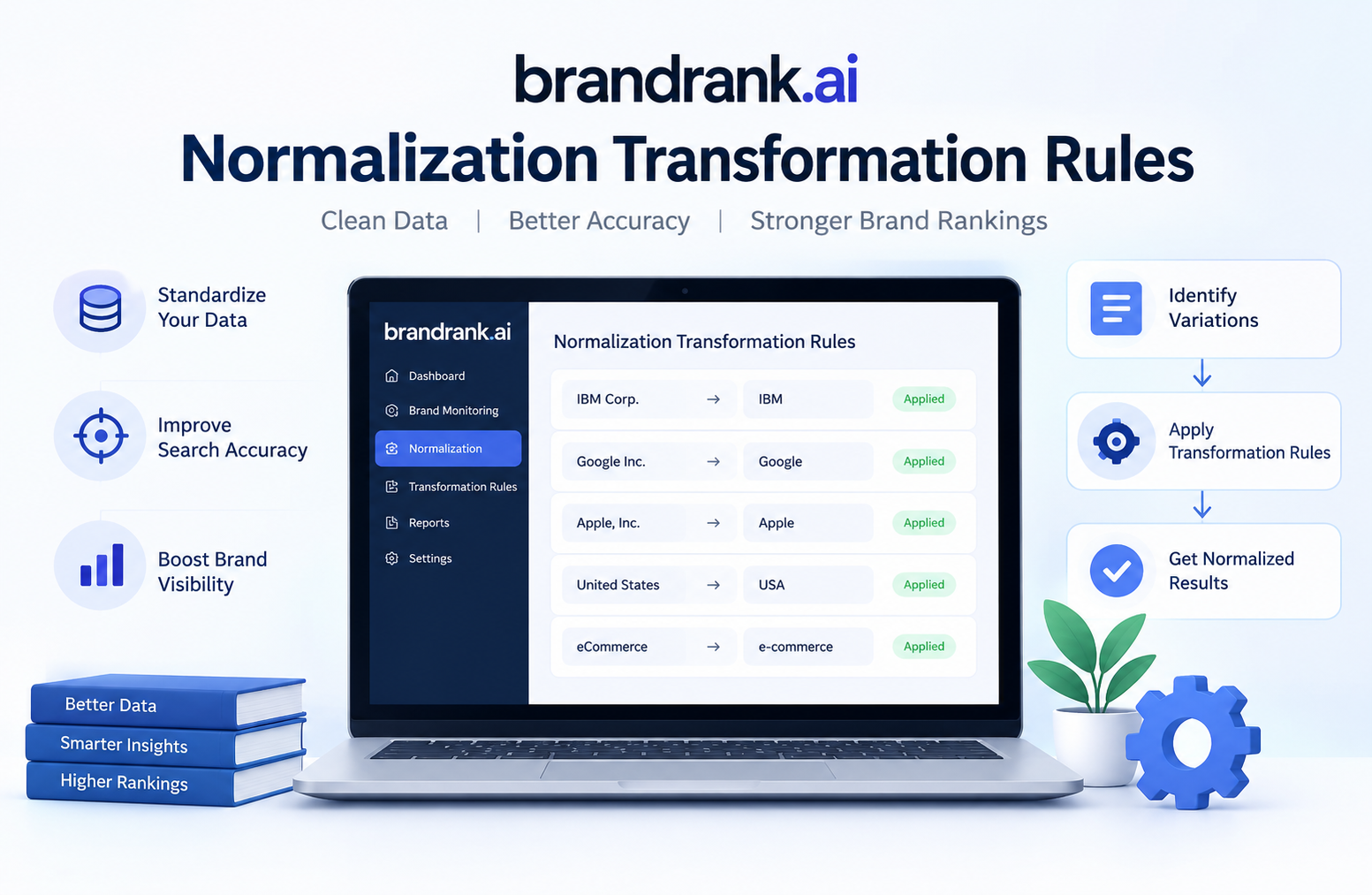
In practical terms, brandrank.ai normalization transformation rules can be understood as a framework for standardizing brand-related information and converting it into consistent, measurable records. The framework is useful for businesses investigating how their names, products, services, and supporting information appear in AI-generated answers.
Normalization and transformation perform different jobs, although they often operate together.
Normalization answers questions such as:
- Are “Northstar Digital,” “NORTHSTAR DIGITAL,” and “Northstar Digital Ltd.” references to the same organization?
- Do two different website addresses lead to the same page?
- Is a product name an alias, an older name, or a separate product?
- Are two citations duplicates or genuinely different sources?
Transformation addresses another set of questions:
- Was a brand mentioned in an answer?
- Was it recommended or merely discussed?
- Did the answer include a supporting citation?
- Which product, location, or competitor appeared?
- Did the response contain a factual claim that needs verification?
Imagine a fictional company called Northstar Analytics. Its name appears as “Northstar Analytics,” “NorthstarAnalytics,” and “Northstar Analytics Inc.” across several datasets.
A normalization process identifies which variations refer to the same entity and maps verified alternatives to an approved brand record. A transformation process then extracts relevant information from AI answers and stores it in fields that can be compared across reports.
The result is more dependable data, provided that the identity matches and extracted information are checked carefully.
Important distinction: these examples illustrate general data-management practices. They do not describe a confirmed internal algorithm, scoring formula, or proprietary implementation used by BrandRank.AI.
Why Normalization Matters for AI Search Visibility
A brand can publish accurate information and still face inconsistent representation across search results, business directories, product pages, reviews, and AI-generated answers. The problem is not always a lack of content. Sometimes the available information is fragmented, outdated, ambiguous, or difficult to connect.
For example, a company might use one name on its website, a shortened name on a social profile, and a legal name in a business directory. Customers may understand that these references describe the same business, but an automated reporting system must use evidence and defined matching rules to reach that conclusion reliably.
This is where data standardization becomes valuable.
BrandRank.AI publicly describes its platform as a way to monitor brand visibility in AI answers, assess reputational vulnerabilities, evaluate content readiness, and compare performance across answer engines. Its official product information also discusses citation analysis and competitive benchmarking. These capabilities provide relevant context for understanding why accurate identity matching and structured data can matter, but they do not establish a particular unpublished normalization algorithm. BrandRank.AI official website
1. Consistent Brand Recognition
A business should maintain one approved identity record containing its preferred name, primary domain, official description, product relationships, and verified aliases.
This does not mean every mention must display the exact same text. A customer review may use a nickname, while a legal document uses the registered company name. The goal is to identify the relationship without destroying the original information.
A good system therefore separates two values:
- Original value: The exact name found in the source.
- Canonical value: The approved identity used for reporting.
Keeping both values makes it easier to investigate mismatches and correct errors.
2. More Reliable Citation Analysis
AI visibility research often involves collecting answers from multiple platforms and identifying the sources associated with those answers.
The same webpage might appear with different tracking parameters, a mobile subdomain, or a redirect. Without suitable URL normalization, a reporting system could count the same underlying resource more than once.
However, URLs should not be merged merely because they look similar. Two pages on the same domain may contain different information, and a query parameter may change the page’s meaning or content.
Reliable normalization considers the destination and the content, not just the appearance of a link.
3. Better Competitive Comparisons
Suppose a report compares three brands in the same category. One competitor has a product name that is sometimes treated as a separate company, while another has several aliases.
If the records are inconsistent, the resulting comparison may overcount one competitor and undercount another.
A shared identity model helps teams distinguish:
- Parent companies from subsidiaries.
- Brands from individual products.
- Current names from former names.
- Direct competitors from related organizations.
- Genuine recommendations from incidental mentions.
These distinctions are especially important when businesses use the results to guide marketing budgets or executive reporting.
4. Faster Investigation of Inaccurate Claims
Normalization can also support reputation monitoring.
If an AI-generated response attributes an incorrect price, discontinued feature, or unsupported claim to a company, the monitoring team needs to identify the affected brand and the source of the information.
A normalized record makes it easier to connect that finding with the relevant product, market, source, and date.
The process does not prove that the claim is false. A separate verification step must compare it with reliable evidence. Normalization helps organize the investigation; verification establishes the facts.
5. More Consistent Reporting Over Time
A brand’s performance may change because its reputation changes, because competitors improve their content, or because an answer engine changes its response.
It may also appear to change because the measurement process has changed.
For example, if a reporting team begins treating a shortened brand name as a valid alias halfway through a quarterly study, the number of recorded mentions could rise even if the brand’s actual visibility remains stable.
Versioned rules and consistent historical records help separate genuine changes from changes caused by data processing.
Normalization vs. Transformation: Understanding the Difference
Normalization and transformation are closely related, but they should not be treated as interchangeable terms.
Normalization establishes consistency. Transformation changes the representation of information so it can be processed, analyzed, or reported.
Consider an AI answer about a fictional software provider:
“Northstar Analytics is suitable for large teams. Northstar also offers reporting tools, although independent verification of some features is recommended.”
The answer contains a possible brand alias, a product-related statement, and a qualification about verification. Each element needs a different treatment.
| Processing stage | Main purpose | Example |
| Normalization | Standardize verified identity variations | Map “Northstar” to the canonical brand when context confirms the match |
| Entity resolution | Decide whether two references describe the same entity | Compare the name, domain, product context, and source |
| Transformation | Convert information into structured fields | Record a mention, topic, and qualification |
| Validation | Check the result against evidence | Confirm the identity and review the feature claim |
| Aggregation | Combine records into a report | Count valid mentions across a defined sample |
The distinction has practical consequences.
If a team transforms data before resolving identity, it may create inaccurate metrics. If it normalizes too aggressively, it may combine separate organizations. If it skips validation, the resulting dashboard may look precise while containing unreliable information.
The strongest workflow performs each task separately and preserves enough evidence to explain the final result.
The Core Normalization Rules Businesses Should Establish
The following rules form a practical starting point for teams working with brand data. They are recommended implementation principles, not a representation of BrandRank.AI’s private software configuration.
Rule 1: Establish a Canonical Brand Name
Choose the preferred name that will appear in internal reports and use it consistently.
The canonical name should be based on reliable company records and the organization’s established public identity. Do not choose a name solely because it appears most often in a dataset.
For example:
| Original value | Canonical value | Decision |
| NORTHSTAR ANALYTICS | Northstar Analytics | Normalize capitalization |
| NorthstarAnalytics | Northstar Analytics | Map verified alias |
| Northstar Analytics Inc. | Northstar Analytics | Preserve legal name separately |
| North Star Consulting | Unresolved | Review identity before merging |
The final example is important. Similar wording does not establish that two organizations are the same business.
Rule 2: Maintain an Approved Alias Dictionary
An alias dictionary records alternative names that have been verified as referring to the same entity.
It can include:
- Common abbreviations.
- Historical company names.
- Former trading names.
- Widely used spelling variations.
- Product names associated with a parent brand, when the relationship is explicitly recorded.
- Localized names used in particular markets.
Each alias should have a reason for inclusion and an appropriate evidence source.
Do not add every similar phrase automatically. An alias dictionary should reduce ambiguity, not create it.
Rule 3: Preserve Legal and Commercial Identities Separately
A registered legal entity and a consumer-facing brand may be related without being identical.
For example, a company may own several brands and operate through different regional subsidiaries. Combining all of these records into one name can hide differences in ownership, market coverage, and product responsibility.
A better model stores separate fields for:
- Consumer-facing brand.
- Registered legal entity.
- Parent organization.
- Subsidiary.
- Product or service.
- Country or operating region.
Relationships connect the records without erasing their individual identities.
Rule 4: Normalize URLs Carefully
Website normalization should identify equivalent addresses without merging genuinely different pages.
Potential cleanup operations include:
- Standardizing URL scheme handling.
- Resolving redirects where appropriate.
- Removing known tracking parameters when they do not affect content.
- Standardizing hostnames and other safe formatting variations.
- Checking canonical tags and destination content.
- Retaining parameters that change the resource or its meaning.
For example, a page with a campaign tracking parameter may refer to the same underlying article as its untracked version. Yet a product URL with a parameter that selects a different model or region may represent different content.
A reliable process verifies equivalence before deduplication.
Rule 5: Separate Parent Brands From Products
A product can receive recommendations independently of its parent company.
Consider a fictional company called Northstar Technologies with a product named Northstar Flow. A customer might ask an AI assistant to recommend workflow software and receive Northstar Flow as the answer.
A report that only records the parent company may miss the product recommendation. A report that counts the product as an unrelated company may distort the competitive comparison.
The data model should retain both entities and define their relationship.
This is particularly useful for organizations with large product portfolios, acquired brands, or multiple service lines.
Rule 6: Handle Former Names and Rebranding Explicitly
Rebranding creates a difficult measurement problem because old and new names may appear at the same time.
A company may change its public name while older articles, reviews, directories, and archived pages continue using the previous identity.
The system should record:
- The previous name.
- The current name.
- The effective date of the change, if verified.
- Whether the former name is still used commercially.
- The evidence connecting the two identities.
Historical mentions should not be rewritten as though they originally used the new name. Instead, reports can connect the historical record to the current entity while preserving the original wording and date.
Rule 7: Standardize Locations and Languages
Global companies may use different spellings, transliterations, and localized names across markets.
A location may also appear under a city name, region name, postal designation, or shortened address.
The correct normalization depends on the question being measured. A report comparing worldwide brand visibility may aggregate verified regional aliases, while a report about a particular country should preserve local distinctions.
Language handling requires similar care. Two translations may be equivalent in one context but carry different commercial meanings in another.
Never assume that a translated product name is an official alias without supporting evidence.
Rule 8: Deduplicate Records Without Losing Evidence
Duplicate records can distort reporting, but removing them carelessly can erase useful information.
Two identical captures of the same answer in the same test run may be duplicates. Two similar answers collected from different AI engines or on different dates are separate observations.
A sensible deduplication key may consider:
- Original answer identifier.
- Source platform.
- Prompt or query.
- Capture timestamp.
- Citation destination.
- Relevant content fingerprint.
The exact fields depend on the data available. The central principle is that duplicate content and distinct observations are not the same thing.
Rule 9: Resolve Ambiguous Matches With Confidence Levels
Not every identity match can be resolved automatically.
A short name may refer to multiple companies, and a product term may also be a common word. An automated process should not turn uncertainty into a definite match merely to complete a report.
Use three practical categories:
- High confidence: Strong evidence supports the identity match.
- Medium confidence: The match is plausible but requires additional context.
- Low confidence: The available information is insufficient or contradictory.
Set the thresholds according to the risk of an incorrect match. For high-impact reporting, ambiguous cases should receive human review.
Rule 10: Keep an Audit Trail
Every important transformation should be explainable.
An audit record can capture the original value, normalized value, rule identifier, rule version, timestamp, and reason for the decision.
This makes it possible to answer questions such as:
- Why was this name treated as an alias?
- Why were these URLs counted as one source?
- When did the rule change?
- Which historical reports were affected?
- Who approved an exception?
An audit trail is especially valuable when the results inform legal, communications, or executive decisions.
How Transformation Rules Turn AI Answers Into Useful Data
Once brand identities and source records are standardized, transformation rules can convert raw answers into fields that support meaningful analysis.
AI-generated responses are not naturally consistent. One answer may contain a short recommendation, another a comparison table, and another several paragraphs with citations and qualifications. A reporting process needs a repeatable way to extract the relevant information from each response.
The fields below are examples of a useful analytical model, not confirmed details of BrandRank.AI’s internal data schema.
1. Brand Mention Detection
The first task is determining whether a response mentions the brand.
A simple field might contain true or false, alongside the original text span that supports the decision.
However, name matching alone is not enough. If a brand name is also a common word, the system must consider context before counting the occurrence.
For example, the word “Pioneer” could identify a company, a product, or a person described as a pioneer in a field. Treating every occurrence as a company mention would produce false positives.
2. Recommendation Classification
A mention does not necessarily mean a recommendation.
Consider these fictional responses:
- “Northstar Flow is a workflow management platform.”
- “Northstar Flow is one option for managing complex projects.”
- “For your requirements, I recommend Northstar Flow because it supports the integrations you need.”
All three mention the product, but the third response clearly recommends it. The second expresses a weaker form of endorsement, while the first is descriptive.
A robust classification system should distinguish these cases rather than count every appearance as a successful recommendation.
It should also preserve context. A brand may appear in a warning, a criticism, or a comparison that favors a competitor.
3. Citation Detection
Citation detection identifies whether a response points to supporting material.
The analysis should distinguish between:
- A brand being mentioned without a source.
- A brand’s official website being cited.
- An independent source discussing the brand being cited.
- A source being cited for a claim that does not directly concern the brand.
These categories provide different information.
A citation to an official product page may support a feature description. An independent review may provide context about customer experience. A general industry report may explain a market trend without establishing anything specific about the company.
A citation should therefore be evaluated for relevance and evidential strength, not simply counted.
4. Sentiment and Context Analysis
Sentiment analysis attempts to identify the tone of a statement, but simple positive and negative labels can miss important meaning.
For example, “The product is not unreliable” contains a negative word but expresses a positive judgment. Similarly, “The company is popular, although its reliability claims remain unverified” combines a positive observation with a qualification.
For this reason, sentiment should be recorded separately from factual accuracy, recommendation status, and risk.
Where the result matters commercially, human reviewers should examine uncertain or high-impact classifications.
5. Claim Extraction and Verification
A claim-extraction process identifies statements that can be checked against evidence.
Examples include:
- A product supports a particular integration.
- A company operates in a particular country.
- A service has a stated price.
- A business offers a specified warranty.
- A product has a certain release date.
Each extracted claim should ideally retain the original sentence, source, relevant date, and verification status.
A useful status model includes verified, contradicted, outdated, and unverified. These labels should have clear definitions.
Importantly, an unverified claim is not automatically false. It simply lacks sufficient evidence within the review process.
6. Competitor and Category Mapping
A response may name several products in one category. Transformation rules can identify those products and connect them to the appropriate companies.
The analysis should record whether a competitor was mentioned, recommended, criticized, or used as a comparison point.
It should also preserve the original response order when position matters. A product named first may have a different role from one included in a final list of alternatives.
However, first position alone does not always prove preference. The wording and purpose of the answer must be considered.
A Practical Step-by-Step Implementation Process
Businesses do not need to begin with a complicated data platform. A small, controlled pilot can reveal the most important problems before the process expands.
The following workflow is a practical way to implement the concepts.
Step 1: Define the Business Question
Start with the decision the data should support.
Possible objectives include:
- Measuring how often a brand appears in AI-generated recommendations.
- Identifying incorrect descriptions of a product.
- Comparing the visibility of competing brands.
- Finding missing information on official product pages.
- Tracking the sources that support brand-related answers.
A clear objective prevents the team from collecting large amounts of data that never influence a decision.
Step 2: Build a Trusted Reference Record
Create a reference record for each brand being monitored.
Include the approved name, official domain, verified aliases, product relationships, relevant locations, and authoritative evidence sources.
For larger organizations, maintain separate records for parent companies, subsidiaries, products, and regional operations.
The record should have an owner responsible for reviewing changes and resolving disputes.
Step 3: Collect Raw Observations
Capture the original answers and their relevant metadata.
Depending on the project, this may include the prompt, answer engine, date, response text, cited URLs, and market or language.
Do not overwrite raw data during cleanup. Preserving the original observation makes later verification possible.
The collection method should also remain consistent enough for meaningful comparisons. If the prompt changes significantly between measurements, the resulting data may not represent the same question.
Step 4: Apply Normalization Rules
Apply the approved rules to names, URLs, product identities, dates, and other fields.
Keep the rules in a documented order. For example, check for known exceptions before applying broad name-cleaning rules, then resolve the entity before aggregating its mentions.
The process should produce a normalized record without erasing the original value.
Step 5: Transform Answers Into Structured Fields
Extract the relevant information from each answer.
A basic record might look like this:
| Field | Illustrative value |
| Brand | Northstar Analytics |
| Product | Northstar Flow |
| Engine | Example AI engine |
| Mention detected | Yes |
| Recommendation detected | Yes |
| Official citation present | No |
| Sentiment | Positive |
| Claim requiring review | Integration availability |
| Review status | Pending |
Every value in this example is fictional. The table illustrates how a raw response can become a structured record, not an actual BrandRank.AI report.
Step 6: Validate the Results
Review a sample of processed answers manually.
Check whether:
- Brand aliases were matched correctly.
- Unrelated companies were kept separate.
- Recommendations were distinguished from mentions.
- Citations were assigned to the correct claims.
- Sentiment labels reflected the full statement.
- Unverified claims were not incorrectly marked as false.
Measure the error rate before expanding the process.
A useful pilot deliberately includes difficult cases, such as similar company names, mixed sentiment, regional product names, and contradictory sources.
Step 7: Aggregate the Findings
Only aggregate records after identity matching and classification have been checked.
At this stage, the team can calculate metrics such as the proportion of tested answers mentioning a brand, the share containing an explicit recommendation, or the percentage of claims that require review.
Every metric needs a clear denominator. A recommendation rate based on all tested answers is different from one based only on answers that mention the brand.
The report should state which definition it uses.
Step 8: Investigate and Correct the Root Cause
Do not treat a low score as proof that a website needs more keywords.
The underlying problem might be incomplete product information, inconsistent pricing, missing supporting evidence, weak third-party coverage, an outdated page, or an identity-matching error.
Each finding should lead to a specific investigation. Corrections should address the source of the problem rather than simply changing the reporting output.
Step 9: Repeat the Measurement
After making changes, repeat the analysis using comparable prompts, platforms, and collection conditions.
Compare the new results with the baseline, and record any changes in methodology.
AI-generated answers can vary over time, so a single observation should not be treated as definitive evidence of a lasting trend. Repeated measurements provide a more useful view of performance.
A Worked Example: From Raw Answer to Reliable Report
Consider a fictional business named Cedar Lane Software. The company sells a product called Cedar Lane Desk.
A sample AI answer says:
“For small support teams, Cedar Lane Desk is worth considering. The company also offers reporting features, but buyers should verify whether its current plan includes advanced integrations.”
A separate source refers to the business as “Cedar Lane Software Ltd.”
Here is how the workflow could process the example.
First, resolve the identity. If company records establish that Cedar Lane Software Ltd. is the legal entity behind Cedar Lane Software, the two names can be connected while remaining distinct fields.
Second, identify the product. Cedar Lane Desk should be recorded as a product associated with the company, not as an unrelated business.
Third, classify the answer. The wording “worth considering” indicates a qualified recommendation. It should not automatically receive the same label as an unequivocal first-choice endorsement.
Fourth, extract the qualification. The statement about advanced integrations identifies a feature claim that needs checking. It does not establish that the integrations are missing or unavailable.
Fifth, record the evidence. The original answer, capture date, source links, and verification result should remain accessible.
The resulting record is more useful than a simple count of the words “Cedar Lane.” It preserves identity, product context, recommendation strength, and uncertainty.
This is the central benefit of a carefully designed transformation process: it converts unstructured information into records that support decisions without pretending that every interpretation is certain.
Measuring Results Without Creating Misleading Metrics
Standardized data makes measurement easier, but it does not automatically make every metric meaningful.
A dashboard can contain perfectly formatted numbers and still answer the wrong question. To avoid that problem, define each metric before collecting results.
Brand Mention Rate
A basic mention rate can be calculated as:
MentionRate=AnswerscontainingavalidbrandmentionTotaleligibleanswerstested100
If a brand appears in 24 out of 80 eligible answers, its mention rate for that sample is 30%.
That figure describes the tested sample. It does not prove that 30% of all AI answers across the internet mention the brand.
Recommendation Rate
A recommendation rate can use the same denominator if the goal is to measure how often the brand is recommended across all tested prompts.
Alternatively, the team can calculate recommendations among answers that mention the brand.
Both measures can be useful, but they answer different questions. Reports must label the denominator clearly.
Citation Coverage
Citation coverage measures how often relevant answers include a qualifying citation under a defined rule.
The team must decide whether the metric includes official sources only, independent sources, or all relevant sources.
A high citation count is not necessarily evidence of high quality. Ten weak references may provide less support than one authoritative, directly relevant source.
Classification Accuracy
For quality control, compare automated labels with a manually reviewed sample.
Useful measures include:
- Precision: Of the records classified as positive, how many were correct?
- Recall: Of the genuinely positive records, how many did the system identify?
- False-positive rate: How often did the system incorrectly identify a match or classification?
- False-negative rate: How often did it miss a valid match or classification?
These measures help teams decide where human review is most valuable.
Recommendation Share and Platform-Specific Scores
BrandRank.AI publicly discusses Recommendation Share alongside AI search visibility, brand vulnerability, and content readiness. These concepts are relevant when evaluating how often brands are recommended and how accurately they are represented in AI-generated answers.
However, a custom mention rate or recommendation rate should not be presented as an official vendor score. Before comparing an internal metric with a platform metric, verify the definitions, sample selection, scoring methodology, and reporting period.
This distinction prevents teams from combining different measurements into a misleading headline number.
Common Challenges and How to Avoid Them
Even a well-designed normalization system can produce poor results if its rules are too broad, its source data is incomplete, or its assumptions go unchecked.
Over-Normalization
Over-normalization occurs when different entities are merged because their names look similar.
For example, two businesses may share a common word but operate in different industries or locations. Treating them as one company can corrupt historical reports and competitor comparisons.
How to prevent it: Require supporting evidence for identity matches, maintain an exception list, and send ambiguous cases for review.
Under-Normalization
Under-normalization happens when verified aliases remain separate.
A company might appear under three names in the same dataset, causing its mentions to be split across several records.
How to prevent it: Maintain an approved alias dictionary and review recurring unmatched names during each reporting cycle.
Changing Rules Without Version Control
A rule change can affect historical results. For example, adding a former company name to an alias list may increase the number of recorded mentions even when the underlying observations have not changed.
How to prevent it: Version the rules, document their effective dates, and decide whether historical records should be recalculated. When comparing reports, distinguish genuine changes in brand representation from changes caused by the processing method.
Confusing Correlation With Causation
A brand may become more visible after updating its website, but that does not prove the website change caused the improvement.
Other factors may include changing prompts, new product launches, competitor activity, updated sources, or changes in an answer engine.
How to prevent it: Establish a baseline, use comparable measurements, record other changes, and avoid making causal claims that the evidence does not support.
Treating AI Answers as Verified Facts
An AI response may sound confident while containing an outdated or incorrect statement.
Extracting that statement into a structured database does not make it true. Nor does the appearance of the same claim in several generated answers necessarily establish independent corroboration.
How to prevent it: Preserve the original wording, trace claims to supporting evidence, distinguish verified from unverified information, and investigate material discrepancies before publishing conclusions.
Overlooking Privacy and Governance
Brand monitoring can involve customer reviews, employee names, personal information, and other data that should not be collected or retained without a clear purpose.
How to prevent it: Limit collection to necessary information, establish retention rules, restrict access, and follow applicable privacy and data-protection requirements.
Real-World Applications Across Different Industries
Normalization and transformation are useful wherever organizations need to compare inconsistent information. The exact implementation depends on the business question and the cost of making an incorrect decision.
E-Commerce and Retail
Retailers often manage large catalogs containing product variants, brand names, model numbers, and regional listings.
A normalization process can connect verified product aliases, distinguish different models, and reduce duplicate source records.
Transformation can then classify AI-generated shopping answers by product mention, recommendation, price claim, availability statement, and cited source.
The practical benefit is clearer reporting about which products appear in relevant buying conversations. It does not guarantee that an AI assistant will recommend a particular retailer.
Software as a Service
Software companies may have a parent brand, several products, different subscription plans, and integrations that vary by tier.
A structured identity model helps separate company-level mentions from product-specific recommendations. Transformation can extract feature statements, pricing references, security claims, and compatibility questions for review.
This is particularly useful when public documentation changes frequently and older information remains available elsewhere.
Healthcare and Medical Technology
Healthcare organizations need especially careful identity and claim handling.
A company name should not be confused with a similarly named hospital, a medical device, or a clinical service. Claims about regulatory approval, clinical performance, and safety require reliable evidence and appropriate expert review.
Normalization can help organize the records. It cannot substitute for medical, legal, or regulatory verification.
Financial Services
Banks, insurers, and financial technology providers often operate through parent companies, subsidiaries, regional entities, and separate product brands.
A sound normalization model helps distinguish these entities and maintain consistent records across markets.
Transformation can flag statements about fees, eligibility, interest rates, and service availability that require confirmation. Since financial information can change quickly, every material claim should be checked against an appropriate, current source before being treated as accurate.
Travel and Hospitality
Hotels and travel businesses may appear under property names, management companies, franchise brands, and booking-platform listings.
Normalization helps determine which records refer to a property, a hotel group, or a booking service. Transformation can classify statements about amenities, location, cancellation policies, and availability.
Dates and geographic context are important because a correct statement for one property or booking period may be incorrect for another.
Agencies and Multi-Brand Enterprises
Agencies and large organizations may monitor several brands across different clients, markets, and business units.
A shared data model reduces inconsistent naming and helps teams apply comparable quality checks. At the same time, separate permissions and ownership records help prevent data from one client or business unit from being incorrectly combined with another.
The most effective implementation balances standardization with the need to preserve real differences between entities.
How to Build a Maintainable Rule Library
A rule library is a documented collection of the decisions used to normalize and transform data. It should be treated as an operational resource rather than a one-time cleanup project.
Each rule should include:
| Rule component | What to document |
| Rule ID | A unique identifier |
| Purpose | The problem the rule is intended to solve |
| Input conditions | The data that qualifies for processing |
| Transformation | The exact change or mapping |
| Exceptions | Conditions that prevent automatic processing |
| Evidence | The source supporting the rule |
| Owner | The person or team responsible |
| Version | The current rule revision |
| Validation | The test used to check correctness |
For example, a rule might map a verified abbreviation to the canonical company name only when the surrounding context or official domain confirms the identity.
The rule should specify what happens when that evidence is missing. Leaving uncertain records unresolved is often safer than forcing a match.
Establish a Review Schedule
Rules need regular maintenance because organizations change names, launch products, enter new markets, and retire old services.
A practical schedule might include:
- Routine automated checks for new unmatched names.
- Monthly reviews of recurring exceptions.
- Reviews after a rebrand, acquisition, or product launch.
- Immediate investigation of high-impact factual errors.
- Periodic audits of historical records and classification quality.
The schedule should reflect the rate of change and the business risk involved. A fast-changing product catalog may require more frequent reviews than a small, stable brand portfolio.
Assign Clear Ownership
Normalization often involves marketing, SEO, analytics, product teams, communications, and legal reviewers.
Without clear ownership, teams may create conflicting definitions of the same entity or apply different rules to similar records.
A useful division of responsibility is:
- Marketing maintains public brand naming and positioning.
- Product teams confirm product identities and feature details.
- Data teams maintain transformation logic and reporting definitions.
- Legal or compliance specialists review sensitive claims when appropriate.
- Communications teams coordinate responses to material reputational issues.
The exact structure varies by organization. The important point is that every significant rule and unresolved issue has an accountable owner.
Frequently Asked Questions
1. What are BrandRank.ai normalization transformation rules?
The phrase describes practices for standardizing brand identities and converting raw information into structured data for analysis. It is useful as an educational framework, but an official BrandRank.AI technical specification under this exact name was not established by the public documentation reviewed for this article.
2. Has BrandRank.AI officially published a normalization rulebook?
The public materials reviewed do not establish a dedicated rulebook under that name. BrandRank.AI does describe AI search visibility, brand vulnerability, content readiness, citation analysis, and competitive tracking. Its internal matching rules and complete processing specifications should not be inferred from those general capabilities.
3. What is the difference between normalization and transformation?
Normalization standardizes inconsistent values, such as verified variations of a company name. Transformation converts information into a different structure, such as turning an AI-generated answer into fields for brand mentions, recommendations, citations, and claims.
4. Can normalization improve AI search visibility?
Normalization can improve the reliability of brand monitoring and help teams identify inconsistencies in their information. It does not guarantee that AI systems will mention, cite, or recommend a business. Visibility also depends on factors such as relevant content, evidence, source credibility, and the specific question being asked.
5. How can businesses measure whether their rules are working?
Businesses can manually review representative samples, measure identity-matching errors, assess classification precision and recall, and compare results over time using consistent definitions. The original data should remain available so that incorrect transformations can be identified and corrected.
6. Should every brand mention be counted as a recommendation?
No. A mention only establishes that the brand appears in the response. A recommendation indicates that the response suggests or favors the brand for a particular need. Reports should distinguish neutral descriptions, qualified suggestions, explicit recommendations, and negative references.
Conclusion
BrandRank.ai normalization transformation rules provide a useful starting point for understanding how consistent brand data can support AI visibility analysis, provided the phrase is treated as a general framework rather than a verified proprietary feature.
Normalization establishes consistent identities, preserves verified aliases, standardizes appropriate URLs, and keeps related companies and products distinct. Transformation converts raw AI-generated answers into structured information about mentions, recommendations, citations, sentiment, and claims. Validation then checks whether those results are supported by evidence.
The most important lesson is that reliable reporting depends on more than clean data. It requires clear definitions, careful identity matching, transparent measurement, human review of ambiguous cases, and an audit trail that explains how each result was produced.
Businesses should also distinguish what a monitoring platform publicly documents from what they infer about its internal methods. BrandRank.AI describes capabilities for measuring AI visibility, evaluating brand vulnerability, assessing content readiness, and monitoring recommendations. Those capabilities provide useful context, but they should not be presented as proof of an unpublished technical specification.
Ultimately, the value of normalization and transformation lies in making brand information more consistent, traceable, and useful for decision-making. When implemented carefully, these practices help organizations investigate inaccuracies, compare results more fairly, and understand how their brands are represented across AI-driven discovery channels.