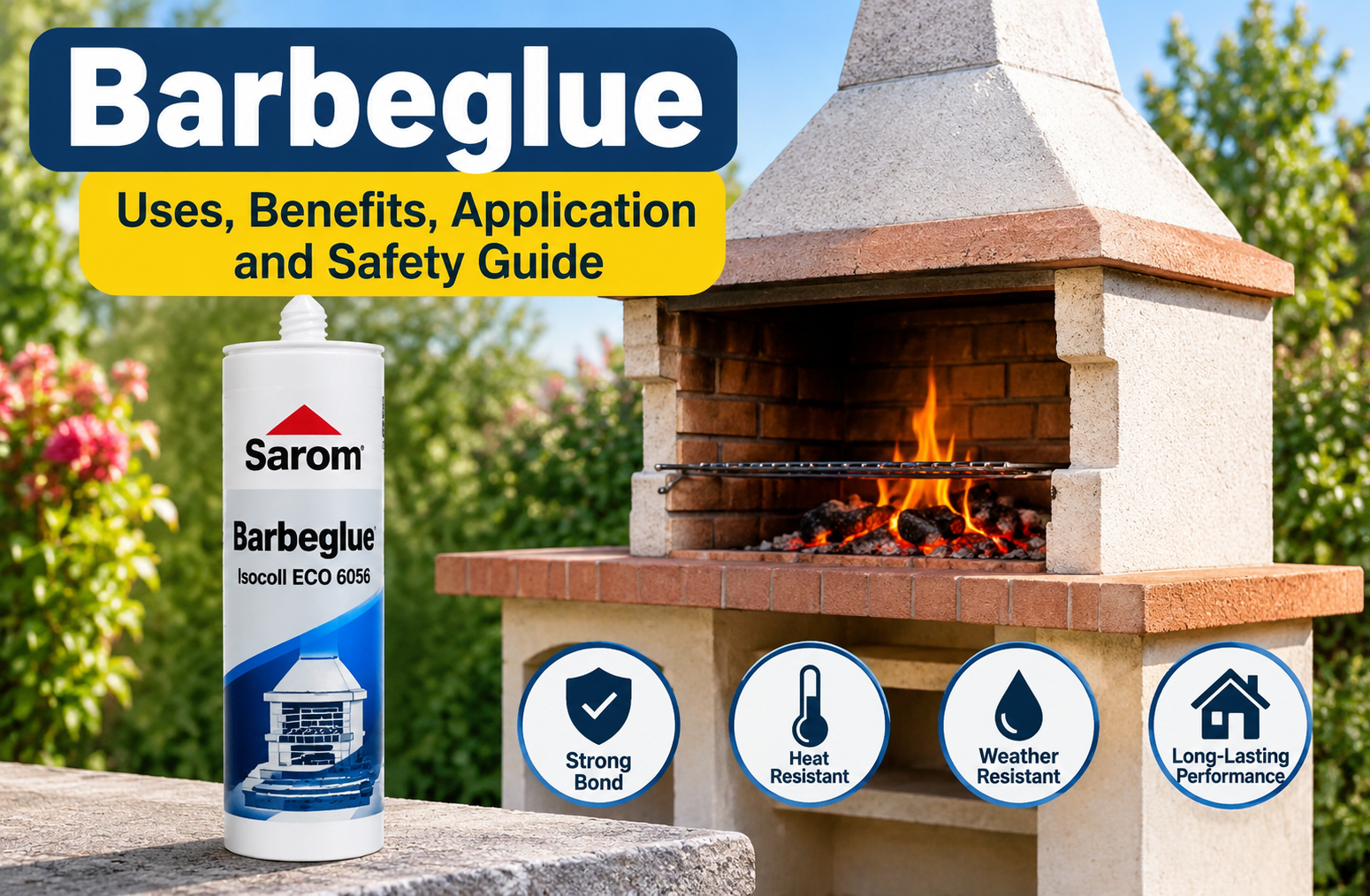
Barbeglue: Uses, Benefits, Application and Safety Guide
Barbeglue is a specialist adhesive associated with the Italian barbecue manufacturer Sarom. It is designed for joining compatible components of prefabricated masonry barbecues, particularly concrete sections that need a reliable bond during assembly. Although it may look like an ordinary construction adhesive, its intended application makes it different from general-purpose household glue.
People searching for this product are often trying to understand what it is, why barbecue manufacturers recommend it, how it should be applied, and whether another adhesive can replace it. These are important questions because choosing the wrong bonding material can affect the stability, durability, and safe operation of an outdoor barbecue.
A masonry barbecue is exposed to several conditions that ordinary indoor furniture never experiences. Its components must cope with outdoor moisture, changing temperatures, mechanical stress, and repeated heating and cooling. The adhesive used during assembly therefore needs to be appropriate for the materials and joints specified by the manufacturer.
This guide explains the product, its documented applications, its practical advantages, its limitations, and the precautions worth following before using it. It also separates verified manufacturer information from details that should not be assumed without technical evidence.
What Is Barbeglue?
Barbeglue is a branded adhesive-sealant used in the assembly of compatible masonry barbecue structures. It is associated with Sarom, an Italian manufacturer of outdoor barbecues and related accessories.
The product is identified in its technical documentation as Barbeglue Isocoll ECO 6056. It is a one-component adhesive based on silyl-terminated polymer technology.
This means it is supplied ready to use rather than requiring the user to mix two separate components. After application, it reacts with moisture in the surrounding air and gradually forms an elastic bond.
Understanding Its Main Purpose
The main purpose of this adhesive is to connect selected barbecue components during installation. These can include compatible concrete, cement, stone, and other construction materials.
A prefabricated masonry barbecue often arrives as several separate sections. These sections must be positioned correctly and secured according to the manufacturer’s instructions.
The bonding material plays an important role because it helps:
- Hold compatible structural sections together.
- Maintain the intended alignment between components.
- Accommodate limited movement in the assembled structure.
- Reduce the risk of joints becoming brittle.
- Support the durability of suitable outdoor installations.
- Create a more consistent connection between prepared surfaces.
It is important to understand that this product is not a universal solution for every barbecue repair. Its suitability depends on the barbecue model, the materials being joined, and the location of the joint.
Is It an Ordinary Construction Glue?
No. Although it belongs to the broader family of construction adhesives and sealants, its formulation and intended applications make it different from many ordinary household products.
General-purpose glue is usually selected according to basic bonding requirements. A masonry barbecue, however, has more demanding installation conditions.
For example, concrete sections may experience small movements as temperatures change. Outdoor structures are also exposed to rain, sunlight, humidity, and seasonal weather conditions.
The technical documentation describes the product as remaining highly elastic after curing. This characteristic makes it useful for suitable joints where some flexibility is desirable.
However, its elasticity should not be confused with unlimited heat resistance. Its published temperature resistance is a particularly important limitation, which deserves separate attention.
Barbeglue Technical Specifications
Understanding technical specifications helps users make better purchasing and installation decisions.
Product descriptions sometimes use broad expressions such as strong, durable, flexible, and heat-resistant. These words can be useful, but they do not explain the actual operating limits of an adhesive.
The technical sheet for Isocoll ECO 6056 provides measurable information about its performance.
The following table summarizes the documented specifications.
| Property | Published specification |
| Product identification | Barbeglue Isocoll ECO 6056 |
| Manufacturer | Sarom SpA |
| Chemical type | One-component silyl-terminated polymer |
| Physical appearance | White or grey paste |
| Density | Approximately 1.42 g/cm³ |
| Tack-free time | Approximately 30 minutes |
| Curing speed | Approximately 3 mm per 24 hours |
| Shore A hardness | 45 |
| Tensile strength | 2.10 N/mm² |
| Elongation at break | Approximately 400% |
| Application temperature | +5°C to +50°C |
| Temperature resistance after curing | -40°C to +100°C |
| Standard cartridge size | 290 ml |
| Storage period | 24 months under specified conditions |
These figures come from the manufacturer’s March 2021 technical documentation. They should not be treated as guaranteed results for every installation because actual performance can depend on surface preparation, humidity, temperature, joint dimensions, and the materials involved.
What Does the 400% Elongation Figure Mean?
One of the interesting properties is the stated elongation at break of approximately 400%.
In simple terms, elongation describes how much a material can stretch before breaking under the specified test conditions.
A high elongation figure indicates that the cured adhesive has substantial flexibility compared with a completely rigid bonding material.
This matters in outdoor construction because different materials can move at different rates.
Concrete, metal, stone, and other construction materials do not necessarily respond to temperature changes in the same way. A suitable elastic adhesive can help accommodate some of that movement.
However, the 400% figure is a laboratory material property. It does not mean that an installed joint can safely stretch by 400% during normal barbecue operation.
Understanding the Temperature Rating
Temperature resistance is one of the most important specifications to understand before purchasing this product.
The technical sheet lists a cured temperature resistance range of -40°C to +100°C.
This tells users that the adhesive has a defined operating range. It does not establish that it can withstand direct contact with flames, glowing charcoal, or the extreme temperatures found inside a firebox.
This distinction is essential.
A masonry barbecue contains several different areas:
- The external concrete structure.
- The supporting sections.
- The worktop and side surfaces.
- The firebox.
- The areas directly exposed to combustion.
An adhesive suitable for an external assembly joint may not be suitable for a surface exposed to direct fire.
Always follow the specific barbecue manufacturer’s instructions when deciding which material belongs in each location.
How Does Barbeglue Work?
The product works through moisture-curing polymer chemistry.
Unlike traditional adhesives that simply dry through the evaporation of a solvent, this formulation reacts with atmospheric moisture to develop its cured structure.
Understanding this process helps explain why application conditions and waiting periods matter.
Step 1: Application
The adhesive is supplied in a cartridge or suitable packaging.
It is applied to the prepared surfaces using an appropriate manual or pneumatic application gun.
The material comes out as a paste, making it possible to control where it is placed along the joint.
Step 2: Moisture Reaction
After application, the adhesive reacts with moisture in the air.
This process gradually changes the uncured paste into an elastic material.
The reaction does not happen instantly. The exposed surface may become tack-free before the entire adhesive layer has cured.
Step 3: Formation of an Elastic Bond
As curing continues, the adhesive develops its final bonding characteristics.
Its flexibility helps it accommodate certain movements between connected materials.
This can be useful in outdoor structures where small dimensional changes occur due to temperature and environmental conditions.
Step 4: Continued Curing
The curing process continues beyond the initial surface-drying stage.
The technical sheet gives an approximate curing speed of 3 mm per 24 hours under specified laboratory conditions.
This is why users should not assume that an adhesive is completely cured simply because its surface feels dry.
The thickness of the applied layer, temperature, and surrounding humidity can affect the actual curing period.
Main Benefits of Barbeglue
The benefits of this product are connected to its chemical formulation and intended construction applications.
It is not necessarily better than every other adhesive. Its value comes from having properties that suit particular bonding and sealing requirements.
1. Long-Term Elasticity
One of its most important characteristics is its ability to remain elastic after curing.
Rigid bonding materials can be unsuitable for joints that experience repeated movement.
Outdoor barbecue structures may experience small changes caused by environmental conditions. An elastic bonding material can help accommodate some of these changes.
This does not eliminate every possibility of cracking, but it provides a different type of joint performance from completely rigid cement-based materials.
2. Resistance to Outdoor Weather Conditions
The technical documentation identifies good weathering resistance and UV resistance.
These properties are useful for materials exposed to sunlight and changing outdoor conditions.
Ultraviolet radiation can contribute to the deterioration of certain construction products over time.
A material with suitable UV resistance may retain its appearance and performance better in exposed applications.
Nevertheless, the entire barbecue still requires appropriate outdoor protection.
Sarom’s assembly instructions specifically recommend protecting exposed external surfaces with suitable exterior paint or water-repellent coating.
3. Compatibility With Multiple Materials
The technical sheet identifies several materials that can be suitable bonding or sealing substrates.
These include:
- Brick.
- Cement.
- Stone.
- Marble.
- Porcelain.
- Glass.
- Wood.
- Aluminium.
- Steel.
- Stainless steel.
- Certain construction panels.
This range makes the formulation useful in more than one industrial or construction application.
However, material compatibility does not automatically mean that every combination is approved for every barbecue model.
Some surfaces may require specific preparation, primers, or preliminary compatibility testing.
4. Ready-to-Use Formulation
Another practical benefit is its one-component formulation.
Users do not need to measure separate ingredients or prepare a chemical mixture before application.
This makes the product more convenient for controlled installation work.
It can also reduce preparation mistakes associated with incorrect mixing ratios.
5. Good Adhesion Performance
The documented tensile strength is approximately 2.10 N/mm².
Tensile strength measures the resistance of a material to being pulled apart under a specified test.
This figure provides useful technical information, but it should not be interpreted as the maximum load that an assembled barbecue can safely support.
Actual joint performance depends on the materials, surface preparation, adhesive thickness, bonding area, and installation quality.
6. Vibration and Sound Damping
The technical documentation also identifies vibration and sound-damping properties.
These characteristics are relevant to certain industrial applications involving vehicles, containers, and construction joints.
In suitable installations, an elastic adhesive can help reduce the transmission of some vibration between connected components.
For a masonry barbecue, this is a supporting material characteristic rather than the primary reason to select the product.
7. Paintability After Curing
The manufacturer describes the cured product as suitable for overpainting with many industrial coating systems.
This can help when the finished installation needs a consistent appearance.
However, paint compatibility should be checked before applying a coating over the adhesive.
Different paint formulations may react differently, and the manufacturer’s documentation recommends compatibility testing.
Where Is Barbeglue Used?
Although the product is strongly associated with masonry barbecue assembly, its documented applications extend beyond outdoor cooking equipment.
Its polymer formulation is designed for several bonding and sealing applications involving suitable materials.
Understanding these applications helps explain why the product is more specialized than its name might initially suggest.
1. Prefabricated Masonry Barbecues
This is the application most relevant to people searching for the product.
Prefabricated masonry barbecues often contain several sections that must be connected during installation.
The manufacturer may specify an adhesive for particular joints and refractory mortar for other areas.
Barbeglue is identified in Sarom assembly instructions as one acceptable bonding material for specified connections.
The instructions also explain how to prepare the components, position them, use supporting brackets where required, and allow sufficient drying time.
2. Concrete and Cement Components
Concrete and cement-based materials are widely used in outdoor structures.
Their surfaces may need bonding or sealing during installation.
The product documentation identifies cement as a suitable substrate for relevant applications.
However, concrete condition matters. Dust, moisture, oil, grease, and loose particles can interfere with adhesion.
Proper preparation is therefore essential.
3. Stone and Marble Applications
The technical documentation also includes stone and marble among its listed substrates.
These materials appear in construction, decorative installations, and certain architectural applications.
A compatible adhesive may be useful when joining or sealing suitable surfaces.
Before using it on visible stone or marble, users should test the product in an inconspicuous area to check compatibility and appearance.
4. Metal Components
The formulation is also listed for selected metals, including aluminium, steel, and stainless steel.
This can be relevant where a construction assembly includes different materials.
Metal and masonry have different physical properties, so the joint must be designed around the specific application.
Not every metal surface will bond equally well without suitable preparation.
5. Automotive and Transport Applications
The technical sheet identifies automotive and transport sectors among its application areas.
It also mentions buses, caravans, motor homes, commercial vehicles, and containers.
In these settings, adhesive-sealants may be used for selected bonding and sealing tasks.
Their elasticity can be useful in assemblies that experience vibration and movement.
These industrial applications should not be taken as permission to use the product for vehicle repairs without checking the relevant manufacturer’s specifications.
6. Roofing and Plumbing Joints
The documentation includes roofing and plumbing-related applications.
These uses involve joints that may require both sealing and bonding characteristics.
For example, a suitable sealant may help create a connection between compatible construction surfaces.
However, plumbing systems have different pressure, temperature, and material requirements. Product suitability must always be checked for the particular job.
How to Apply Barbeglue Correctly
Correct application is just as important as choosing an appropriate adhesive.
Even a technically suitable product can produce a poor result when applied to dirty, wet, or incorrectly positioned surfaces.
The safest approach is to follow the assembly manual for the exact barbecue model.
The following steps explain the general preparation and installation principles documented by Sarom.
Step 1: Prepare a Stable Foundation
Before assembling the barbecue, prepare a solid concrete base.
The base should be appropriate for the dimensions and weight of the structure.
A weak or uneven foundation can create problems that no adhesive can reliably correct.
Check the base using a spirit level before starting the assembly process.
Step 2: Identify the Correct Components
Check the packaging, model number, and assembly diagrams.
Prefabricated barbecue components are often numbered to indicate their intended installation order.
Do not assume that sections that appear similar can be installed interchangeably.
Keeping the original instructions available can prevent unnecessary mistakes.
Step 3: Clean the Bonding Surfaces
Remove dust, loose particles, and dirt from the surfaces that will be joined.
If the surfaces are wet, dry them before applying the product.
The technical sheet also warns that oil, grease, and rust can reduce adhesion performance.
A clean surface provides a better starting point for a reliable bond.
Step 4: Apply the Adhesive
Use a suitable application gun to dispense the product.
Apply it to the areas specified in the barbecue’s installation diagram.
Do not spread it randomly across every surface.
The required application pattern and quantity depend on the specific component and joint design.
Step 5: Position the Components
Carefully place the components according to the manufacturer’s instructions.
Check their alignment with a spirit level.
This step is important because small positioning errors near the bottom of the structure can become more noticeable as additional sections are installed.
Avoid rushing the process.
Step 6: Install Supporting Brackets Where Required
Some Sarom barbecue models include side tables or additional worktop components.
The assembly instructions describe using suitable corner brackets and screws for these sections.
The manual specifies a 15-minute wait after fitting the bracket before proceeding with the next relevant operation.
This is an assembly instruction for the documented model, not a universal curing time for every adhesive joint.
Step 7: Protect the External Structure
Outdoor masonry structures are exposed to rain, sunlight, and changing weather.
Sarom recommends applying suitable exterior paint or water-repellent protection to the relevant external surfaces.
The instructions specifically exclude the internal firebox area from this external coating recommendation.
Always use a coating appropriate for the intended surface and operating conditions.
Step 8: Allow the Required Drying Period
One of the most important instructions in the Sarom assembly manual is to wait at least 48 hours after assembly and painting before using the barbecue.
This allows the completed structure to dry properly under the conditions described by the manufacturer.
Do not shorten this period simply because the adhesive looks dry.
The time needed for curing can vary with environmental conditions and adhesive thickness.
Important Limitations and Things to Avoid
Understanding the limitations of a construction product is just as important as understanding its benefits.
Many installation problems happen because users assume that a product described as strong or heat-resistant can be used anywhere.
That assumption is particularly risky when working with barbecue structures.
1. It Is Not Designed for Direct Flame Contact
The technical sheet specifies temperature resistance up to +100°C after curing.
This is a clear limit that users should take seriously.
A working barbecue firebox can experience temperatures considerably higher than this. Therefore, the published rating does not support using the adhesive as a direct-fire bonding material.
Use refractory materials in locations where the barbecue manufacturer specifies them.
2. Do Not Replace It With Ordinary Silicone
Sarom’s assembly instructions explicitly warn against using silicone adhesive for the specified barbecue assembly work.
This is an important distinction because many household silicone products look similar to construction adhesive.
However, appearance does not establish chemical compatibility or suitability.
A bathroom sealant, general-purpose silicone, or ordinary household adhesive should not be treated as an approved replacement.
3. Avoid Ordinary Non-Refractory Mortar
Ordinary mortar is not necessarily suitable for joints exposed to the conditions found in a masonry barbecue.
Sarom’s instructions specify suitable adhesive or refractory mortar for the relevant assembly joints.
They also warn against high-strength, fast-setting cement because it does not allow the required thermal movement between components.
Always distinguish between ordinary masonry work and the specific requirements of a barbecue structure.
4. Do Not Apply It to Dirty Surfaces
Dust, grease, oil, and rust can weaken adhesion.
Applying more adhesive does not necessarily solve a surface-preparation problem.
The better approach is to clean and prepare the materials before application.
5. Do Not Ignore the Curing Period
The product may become tack-free relatively quickly, but that does not mean the entire joint has cured.
The manufacturer’s technical documentation gives a curing speed rather than a universal complete-curing time for every possible joint.
Follow the barbecue assembly instructions and do not use the structure before the specified waiting period.
6. Do Not Assume Every Model Requires the Same Quantity
Different barbecue models have different dimensions, component arrangements, and joint requirements.
Some models may include adhesive in their packaging, while others may require a separate purchase.
The quantity needed should be established from the product’s parts list or the supplier’s instructions.
Buying based on another model’s requirements can lead to unnecessary expense or insufficient material.
Barbeglue vs. Refractory Mortar
One common question is whether an elastic adhesive and refractory mortar perform the same function.
They are both used in certain barbecue assembly situations, but they are different materials.
Understanding their differences helps prevent incorrect substitutions.
| Feature | Barbeglue | Refractory mortar |
| Material type | Polymer adhesive-sealant | Heat-resistant mineral mortar |
| Preparation | Ready to use | Usually requires preparation according to instructions |
| Flexibility | Remains elastic after curing | Generally more rigid |
| Application | Specified bonding and sealing joints | Specified refractory masonry joints |
| Heat exposure | Published limit of +100°C | Depends on the specific formulation |
| Typical use | Compatible assembly components | Suitable heat-exposed masonry connections |
| Application equipment | Cartridge application gun | Tools appropriate for mortar |
Neither material should be considered universally superior.
The right choice depends on the location of the joint, the materials involved, and the instructions for the particular barbecue.
When Should You Choose the Adhesive?
Choose the specified adhesive when the barbecue manufacturer identifies it as suitable for the particular connection.
Its ready-to-use formulation and elasticity can make it convenient for certain assembly tasks.
When Is Refractory Mortar More Appropriate?
Refractory mortar is intended for applications where a heat-resistant mineral bonding material is required.
It may be the correct choice for particular firebox-related masonry connections.
However, refractory mortar products also have different formulations and operating limits.
Check the product instructions rather than assuming every refractory mortar is suitable for every firebox.
Is Barbeglue Heat Resistant?
Yes, the product has a documented temperature-resistance range, but the meaning of that specification needs careful explanation.
The Isocoll ECO 6056 technical sheet lists a cured temperature resistance range of -40°C to +100°C.
This indicates that the product is designed to tolerate temperatures within that published range under the relevant test and application conditions.
It does not mean that it can withstand unlimited heat.
Why This Matters for Barbecue Owners
A masonry barbecue contains areas with different thermal conditions.
The outside structure may remain relatively cool compared with the internal combustion area.
The joints connecting external concrete sections may therefore have different requirements from joints directly exposed to fire.
This explains why the manufacturer provides instructions about which bonding materials to use for different components.
Does It Mean the Adhesive Cannot Be Used Anywhere Near a Barbecue?
Not necessarily.
Its use in a barbecue assembly depends on the exact location and the manufacturer’s approval for that particular joint.
A product can be suitable for connecting external structural components without being suitable for the firebox itself.
This is why it is important to follow the assembly diagram instead of choosing an adhesive based only on its product description.
How to Choose the Right Product Before Buying
Purchasing the correct adhesive requires more than searching for a product name online.
There are several practical checks that can prevent confusion and unnecessary spending.
Check the Manufacturer and Product Identification
Look for the Sarom product identification and the Isocoll ECO 6056 designation.
Product names can sometimes be copied or used loosely by online sellers.
Checking the technical information helps establish whether the product matches the one specified in the assembly documentation.
Confirm the Cartridge Size
The manufacturer’s technical sheet identifies a standard 290 ml cartridge.
Other online descriptions may show different packaging details.
Do not assume that every listing uses the same formulation, cartridge size, or product reference.
Check the actual packaging before purchasing.
Check Whether Your Barbecue Includes Adhesive
Some prefabricated barbecue models may include the required adhesive.
Others may require it to be purchased separately.
Inspect the original packaging and parts list before ordering another cartridge.
This simple step can prevent duplicate purchases.
Review Storage Conditions
The March 2021 technical sheet specifies a storage temperature between 5°C and 25°C and a storage period of 24 months in the original packaging.
It also recommends keeping the product away from heat sources.
An adhesive that has been stored incorrectly or has passed its stated storage period may not perform as expected.
Check the packaging and storage information before use.
Buy From a Reliable Supplier
A reliable seller should provide clear product identification, manufacturer details, packaging information, and appropriate documentation.
Be cautious when a product listing makes claims that are not supported by the manufacturer’s technical information.
For example, a claim that an adhesive can withstand direct flames should not be accepted simply because the listing describes it as heat-resistant.
Common Barbeglue Application Mistakes
Even when users purchase the correct product, mistakes during installation can affect the final result.
Here are some problems worth avoiding.
Applying Too Much Adhesive
More adhesive does not automatically create a stronger joint.
Excess material can produce an uneven finish and make it harder to position components correctly.
Follow the application instructions for the specific barbecue model.
Ignoring Surface Moisture
The technical documentation describes a moisture-curing product, but that does not mean it should be applied to dirty or visibly wet surfaces.
Sarom’s assembly instructions specifically say to dry damp components before applying the adhesive.
There is an important difference between atmospheric moisture helping a curing reaction and water covering the bonding surface.
Skipping Level Checks
A masonry barbecue needs a stable and properly aligned structure.
If one section is incorrectly positioned, the problem can affect the components installed above it.
Use a spirit level throughout assembly rather than checking alignment only after the entire structure is complete.
Using It for an Unapproved Repair
A loose concrete panel or damaged firebox may require more than adhesive.
The underlying problem could involve structural movement, foundation damage, heat deterioration, or a failed joint.
Before repairing an existing barbecue, identify the cause of the damage.
If a component is cracked or unstable, replacing or professionally repairing it may be safer than simply covering the problem with adhesive.
Starting the First Fire Too Early
Newly assembled masonry structures need sufficient drying time.
Using the barbecue before the manufacturer’s waiting period can place unnecessary stress on incompletely dried joints.
Follow the documented minimum 48-hour waiting period for the Sarom model covered by the instructions.
Safety and Storage Considerations
Safe handling is an important part of any adhesive application.
Even when a product does not require a particular hazard symbol under its technical description, users should still follow the relevant safety documentation.
Wear Suitable Protective Equipment
Basic precautions include:
- Wearing appropriate protective gloves.
- Avoiding unnecessary skin contact.
- Preventing contact with the eyes.
- Working in a suitably ventilated area.
- Keeping the product away from children.
- Washing exposed skin according to the safety instructions.
The product’s safety data sheet should be consulted before use.
Store It Correctly
Storage conditions can affect the quality of construction materials.
For this formulation, the published technical sheet specifies storage in the original closed packaging at 5°C to 25°C.
Keep cartridges away from direct heat and excessive temperatures.
Avoid storing opened packaging in a way that allows the remaining material to cure inside the cartridge.
Dispose of Packaging Responsibly
Do not pour leftover adhesive into drains or watercourses.
Follow the local disposal requirements and the product’s safety documentation.
Packaging disposal rules can vary depending on the country and whether the container is empty or contains uncured material.
What If the Adhesive Gets on Your Skin?
Avoid spreading uncured material over a larger area.
Follow the manufacturer’s safety data sheet for the appropriate cleaning procedure.
Do not assume that a household solvent is suitable for skin cleaning.
If irritation or another concerning reaction occurs, seek appropriate medical advice.
Can Barbeglue Be Used for Repairs?
It may be suitable for certain repairs, but the answer depends on the type and location of the damage.
A loose exterior component is different from a cracked firebox or a damaged supporting foundation.
Repairing a Loose Exterior Component
If a compatible external component has become loose, the first step is to inspect the joint.
Check whether the surfaces are damaged, contaminated, or incorrectly positioned.
If the barbecue manufacturer approves the adhesive for that joint, it may be possible to restore the connection using the prescribed installation method.
Repairing Cracked Concrete
A crack in concrete does not automatically mean adhesive is the right repair material.
The crack may be caused by:
- Foundation movement.
- Incorrect installation.
- Repeated thermal stress.
- Water penetration.
- Freezing and thawing.
- Mechanical impact.
- Long-term material deterioration.
The cause should be identified before selecting a repair method.
A surface-level repair may hide a more serious structural problem.
Repairing a Firebox
The firebox is a particularly important area because it experiences direct heat exposure.
The published +100°C temperature resistance of this formulation does not establish suitability for direct firebox use.
Use the refractory products specified by the barbecue manufacturer.
If the firebox has significant damage, a suitable replacement component or specialist repair may be necessary.
Barbeglue and the Importance of Manufacturer Instructions
One of the most valuable resources for anyone assembling a prefabricated barbecue is the original installation manual.
Online descriptions can provide useful product information, but they cannot replace model-specific assembly instructions.
Sarom’s documentation provides several practical requirements:
- Prepare a solid and level concrete foundation.
- Assemble the barbecue components in the specified numerical order.
- Use the approved adhesive or refractory mortar for the relevant joints.
- Avoid silicone adhesive and non-refractory mortar.
- Check component alignment with a spirit level.
- Clean and dry the relevant surfaces.
- Use the specified brackets and screws where required.
- Protect exposed external surfaces with suitable exterior coating.
- Wait at least 48 hours after assembly and painting before using the barbecue.
The instructions also explain that certain refractory plates should simply rest in their designated positions rather than being fixed with an adhesive.
That detail demonstrates why applying adhesive everywhere is not a good installation practice.
The correct material and method depend on the function of each component.
Why Product Information Matters When Buying Construction Adhesives
The market contains many products that look similar but serve different purposes.
A cartridge may be labelled as a construction adhesive, masonry sealant, heat-resistant glue, or flexible bonding compound.
These descriptions are not interchangeable.
A product’s actual suitability depends on its chemical composition, technical ratings, approved substrates, and installation conditions.
For example, a product may offer excellent flexibility but have a relatively limited temperature range. Another product may tolerate much higher temperatures but provide a rigid bond.
Neither characteristic makes one product suitable for every construction situation.
A useful buying process should consider five questions:
- What materials need to be joined?
- Will the joint experience direct heat?
- Does the manufacturer require flexibility or a rigid connection?
- What temperature range must the product tolerate?
- Is the product specifically approved for the intended installation?
These questions help buyers avoid choosing construction materials based on marketing descriptions alone.
Is Barbeglue Worth Understanding for DIY Barbecue Projects?
For people assembling a prefabricated masonry barbecue, understanding the specified bonding material can prevent several common installation problems.
The adhesive is only one part of the complete assembly process, but it has an important role.
A well-installed barbecue depends on several factors working together:
- A suitable foundation.
- Correct component placement.
- Proper surface preparation.
- Appropriate bonding materials.
- Accurate alignment.
- Adequate drying time.
- Suitable external weather protection.
Ignoring any of these elements can affect the finished structure.
For DIY users, the most useful approach is to read the manual before purchasing materials.
This makes it easier to identify which products are necessary, which components require mechanical support, and which sections should remain unbonded.
It also helps avoid unnecessary experimentation with products that were never intended for the job.
Frequently Asked Questions About Barbeglue
1. What is Barbeglue used for?
Barbeglue is a specialist adhesive-sealant associated with Sarom. It is used for bonding compatible components of prefabricated masonry barbecues and has other documented construction and industrial applications.
2. Who manufactures Barbeglue?
Barbeglue is associated with Sarom SpA, an Italian manufacturer of masonry barbecues and outdoor cooking products. Its technical documentation identifies the formulation as Isocoll ECO 6056.
3. Is Barbeglue heat resistant?
Yes, its technical sheet specifies a cured temperature-resistance range of -40°C to +100°C. However, this does not make it suitable for direct flame contact or every firebox application.
4. Can ordinary silicone replace Barbeglue?
No. Sarom’s assembly instructions specifically warn against silicone adhesive for the specified barbecue assembly work. Use only the bonding material approved for the relevant model and joint.
5. How long does Barbeglue take to cure?
Its technical sheet gives an approximate curing speed of 3 mm per 24 hours under specified conditions. The actual curing period depends on the adhesive layer and environment. Sarom’s assembly instructions require at least 48 hours after assembly and painting before the barbecue is used.
6. Can Barbeglue be used on concrete?
The technical documentation identifies cement as a suitable substrate for relevant bonding and sealing applications. However, the surfaces must be properly prepared, and the intended application must be compatible with the manufacturer’s instructions.
7. Is Barbeglue waterproof?
The technical documentation describes good weathering resistance, but this should not be interpreted as an unlimited waterproofing guarantee for every installation. The complete structure should receive appropriate outdoor protection.
8. Does Barbeglue come ready to use?
Yes. It is a one-component adhesive supplied in ready-to-use packaging. It does not require the user to mix separate adhesive components before application.
9. Can Barbeglue be painted?
The technical documentation states that the cured adhesive can be overpainted with many industrial coating products. However, compatibility testing is recommended because different paints can behave differently.
10. How should Barbeglue be stored?
The March 2021 technical sheet specifies storage in the original packaging at temperatures between 5°C and 25°C, away from heat sources. It lists a storage period of 24 months under those conditions.
Final Thoughts
Barbeglue is a specialized adhesive-sealant designed for applications where reliable bonding, flexibility, and suitable environmental resistance are important. Its association with Sarom makes it particularly relevant to people assembling prefabricated masonry barbecues.
Its one-component formulation, elastic curing properties, material compatibility, and weathering resistance make it useful for specified construction applications. However, understanding its limitations is equally important.
The published temperature-resistance range of -40°C to +100°C means it should not be treated as a direct-fire adhesive. Its correct use depends on the barbecue model, the location of the joint, and the manufacturer’s installation requirements.
For the best results, users should prepare clean and dry surfaces, follow the correct assembly sequence, check alignment, use approved materials, and allow sufficient drying time before lighting the barbecue.
Ultimately, the most important lesson is that choosing the right adhesive is not simply about finding the strongest product. It is about selecting a material that matches the construction requirements and using it correctly.
Anyone researching this product should prioritize manufacturer documentation over unsupported online claims. This approach makes purchasing and installation decisions more reliable while helping prevent avoidable construction mistakes.