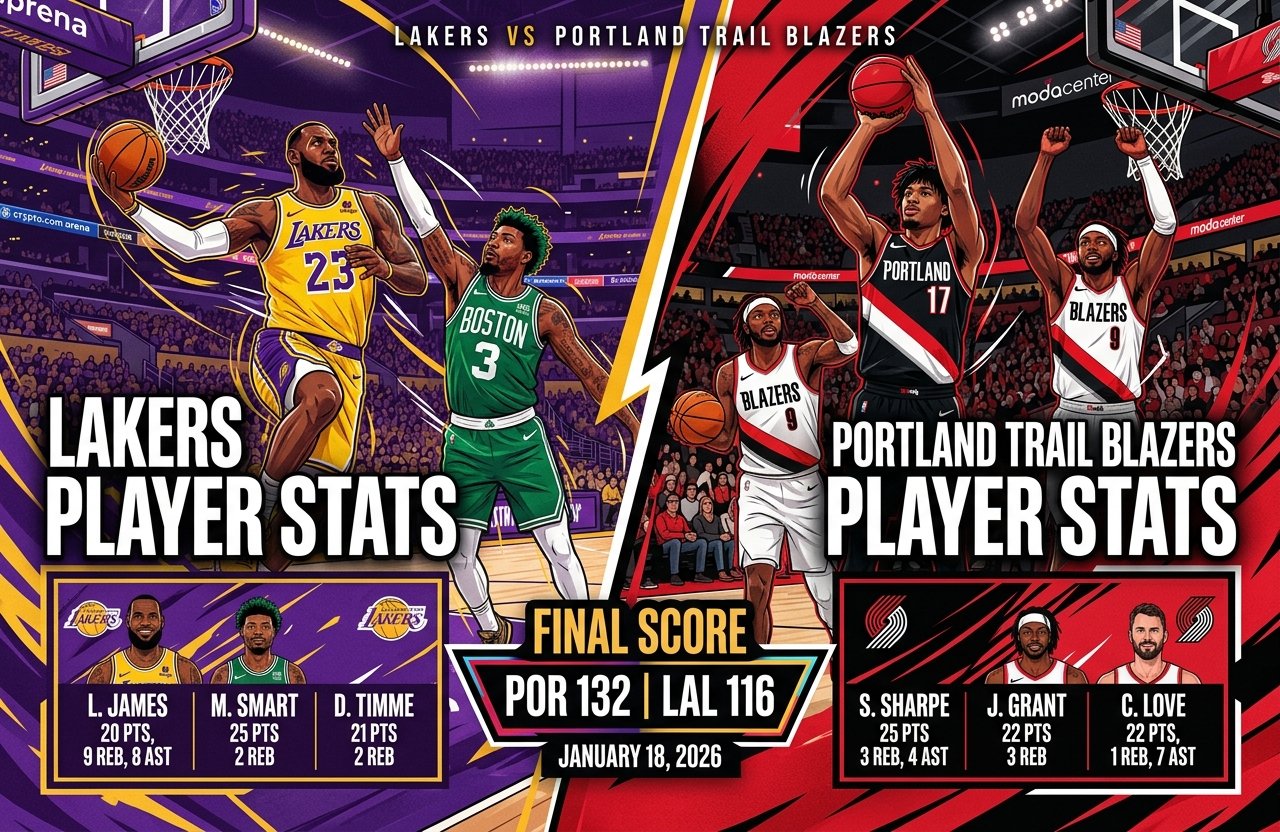
Lakers vs Portland Trail Blazers Match Player Stats
The lakers vs portland trail blazers match player stats from January 18, 2026, tell the story of a game Portland controlled early and ultimately won 132-116 at Moda Center. The Trail Blazers built a 13-point advantage after the first quarter, survived a Lakers response in the second, and then created separation again in the third quarter.
Portland finished the game shooting 52% from the field and made 16 of 42 three-point attempts. The Lakers also shot efficiently at 49%, but their 27 total rebounds compared with Portland’s 42 proved important. The Trail Blazers also collected 12 offensive rebounds, giving them additional possessions and opportunities to maintain their advantage.
Shaedon Sharpe led Portland with 25 points, while Jerami Grant and Caleb Love each scored 22. Donovan Clingan produced 18 points and 11 rebounds, adding four assists. For Los Angeles, Marcus Smart scored 25 points, Drew Timme contributed 21 off the bench, and LeBron James finished with 20 points, nine rebounds and eight assists.
The official NBA game record confirms the 132-116 Portland victory and the principal player leaders from the contest. official NBA box score
Lakers vs Portland Trail Blazers Match Player Stats Overview
This matchup was more competitive statistically than the 16-point final margin might initially suggest.
Los Angeles made 42 of 85 field-goal attempts for 49.4%. Portland made 45 of 86 for 52.3%. That difference is modest on its own. The larger separation came from possessions, rebounding and Portland’s ability to establish control early.
Here are the main team numbers:
| Category | Lakers | Trail Blazers |
| Final Score | 116 | 132 |
| Field Goals | 42-85 | 45-86 |
| Field Goal % | 49% | 52% |
| Three-Pointers | 13-31 | 16-42 |
| Three-Point % | 42% | 38% |
| Free Throws | 19-21 | 26-34 |
| Free Throw % | 90% | 76% |
| Rebounds | 27 | 42 |
| Assists | 25 | 24 |
| Turnovers | 15 | 15 |
| Steals | 8 | 9 |
| Blocks | 6 | 5 |
| Offensive Rebounds | 7 | 12 |
| Defensive Rebounds | 20 | 30 |
| Fouls | 25 | 17 |
The numbers show an interesting contrast.
The Lakers were excellent at the free-throw line, converting 90% of their attempts. They also slightly outperformed Portland from three-point range by percentage.
However, Portland dominated the glass. The 42-27 rebounding advantage gave the Trail Blazers a 15-rebound edge. Five extra offensive rebounds were especially valuable because they created second-chance possessions.
That is one of the clearest reasons the final score was not simply a product of shooting percentage.
Game Score and Quarter-by-Quarter Breakdown
Portland’s victory was shaped by the opening and third quarters.
| Quarter | Lakers | Trail Blazers | Difference |
| Q1 | 27 | 40 | Portland +13 |
| Q2 | 34 | 31 | Lakers +3 |
| Q3 | 29 | 36 | Portland +7 |
| Q4 | 26 | 25 | Lakers +1 |
| Final | 116 | 132 | Portland +16 |
First Quarter: Portland Takes Control
The opening period was decisive.
Portland scored 40 points while limiting Los Angeles to 27. A 13-point deficit after one quarter immediately forced the Lakers to spend the rest of the game trying to recover.
This type of start matters because it changes the offensive priorities of the trailing team. Los Angeles had to generate scoring while also attempting to close the possession gap.
Portland, meanwhile, could play from a position of control.
The Blazers’ early advantage also reduced the pressure of needing to win every later possession. Even when Los Angeles won the second quarter, Portland still entered halftime with a 71-61 lead.
Second Quarter: Lakers Respond
Los Angeles improved significantly in the second period.
The Lakers scored 34 points, their highest-scoring quarter of the game, while Portland produced 31.
The three-point margin for the quarter was only three points in Los Angeles’ favor, so the Lakers did make progress. However, the first-quarter deficit meant that a strong second period was not enough to erase Portland’s lead.
LeBron James remained central to the Lakers’ offense. His passing helped Los Angeles create opportunities, while Marcus Smart provided scoring pressure.
Third Quarter: Portland Reasserts Control
The third quarter was another major turning point.
Portland scored 36 points compared with 29 for Los Angeles. The seven-point difference expanded the halftime lead from 10 points to 17.
This was particularly important because the Lakers had already used the second quarter to reduce Portland’s momentum. Instead of allowing Los Angeles to continue building on that improvement, Portland responded immediately after halftime.
Shaedon Sharpe’s scoring was a major part of Portland’s offensive attack.
Fourth Quarter: Lakers Cannot Complete the Comeback
Los Angeles actually outscored Portland by one point in the fourth quarter, 26-25.
However, by that stage the deficit was too large.
Portland had already established a 17-point advantage entering the final period. The Lakers needed a dramatic scoring run to turn the game around, but the Trail Blazers managed the final quarter well enough to protect their lead.
The final margin was 132-116.
Lakers Player Stats
The Lakers received important contributions from several players, but their production was not enough to overcome Portland’s overall balance.
Marcus Smart
Marcus Smart was Los Angeles’ leading scorer with 25 points.
His scoring was especially important because Luka Doncic was unavailable for the game. Smart became one of the Lakers’ primary offensive contributors and finished ahead of LeBron James in total points.
Smart also recorded two rebounds and one steal.
His scoring output gave Los Angeles a reliable source of offense, but the Lakers needed more overall production to match Portland’s three 22-plus-point contributors.
LeBron James
LeBron James delivered an all-around performance.
He finished with:
- 20 points
- 9 rebounds
- 8 assists
- 1 steal
- 2 blocks
His nine rebounds led the Lakers, while his eight assists were also the team’s best total.
The most important aspect of his performance was its balance. James was not simply a scorer. He was responsible for creating opportunities, rebounding and defensive activity.
He came close to a triple-double, missing that mark by two assists.
His 20 points came on 6-of-16 shooting from the field, while he made all seven of his free throws.
Drew Timme
Drew Timme was one of the Lakers’ most efficient offensive players.
He scored 21 points on 9-of-12 shooting from the field. He also made three of four attempts from three-point range.
That means Timme converted 75% of his field-goal attempts and 75% of his three-point attempts.
He also added:
- 2 rebounds
- 4 assists
- 2 steals
Timme’s performance stands out because he produced 21 points without needing a large number of shots.
His scoring efficiency was one of the strongest individual statistical positives for Los Angeles.
Jake LaRavia
Jake LaRavia finished with:
- 2 points
- 5 rebounds
- 4 assists
- 1 steal
Although his scoring was limited, his passing and rebounding added value.
His four assists were particularly useful in a game where Los Angeles needed multiple players to contribute to ball movement.
Maxi Kleber
Maxi Kleber scored 11 points and grabbed five rebounds.
He also recorded one assist and one steal.
His five rebounds helped, but Los Angeles still needed considerably more collective rebounding to match Portland’s physical presence.
Rui Hachimura
Rui Hachimura finished with 11 points, one rebound, one assist, two steals and one block.
His defensive activity was notable because the Lakers finished with eight steals and six blocks overall.
However, his limited rebounding contribution was another example of the broader issue that affected Los Angeles throughout the game.
Jarred Vanderbilt
Jarred Vanderbilt scored six points while shooting efficiently from the field.
He also recorded two rebounds, one assist and one block.
His defensive impact was useful, but Portland’s overall rebounding advantage remained a major concern.
Kobe Bufkin
Kobe Bufkin produced nine points, one rebound, one assist and two blocks.
He made three of eight field-goal attempts and one of five three-point attempts.
His two blocks were among the Lakers’ stronger defensive contributions from the backcourt.
Other Lakers Contributions
Nick Smith Jr. finished with five points and three assists.
Gabe Vincent recorded three points and one assist.
Dalton Knecht scored three points.
Bronny James did not score but recorded one assist.
Together, these smaller contributions mattered, but the Lakers did not receive enough scoring depth to counter Portland’s balanced attack.
Complete Lakers Statistical Summary
| Player | Points | Rebounds | Assists | Steals | Blocks |
| Marcus Smart | 25 | 2 | 0 | 1 | 0 |
| LeBron James | 20 | 9 | 8 | 1 | 2 |
| Drew Timme | 21 | 2 | 4 | 2 | 0 |
| Maxi Kleber | 11 | 5 | 1 | 1 | 0 |
| Rui Hachimura | 11 | 1 | 1 | 2 | 1 |
| Kobe Bufkin | 9 | 1 | 1 | 0 | 2 |
| Jarred Vanderbilt | 6 | 2 | 1 | 0 | 1 |
| Nick Smith Jr. | 5 | 0 | 3 | 0 | 0 |
| Gabe Vincent | 3 | 0 | 1 | 0 | 0 |
| Dalton Knecht | 3 | 0 | 0 | 0 | 0 |
| Jake LaRavia | 2 | 5 | 4 | 1 | 0 |
| Bronny James | 0 | 0 | 1 | 0 | 0 |
Trail Blazers Player Stats
Portland’s biggest advantage was its balanced scoring.
Shaedon Sharpe led the team with 25 points, but Jerami Grant and Caleb Love added 22 each. Donovan Clingan scored 18 while controlling the boards.
This distribution made it difficult for the Lakers to focus defensive attention on one player.
Shaedon Sharpe
Shaedon Sharpe was Portland’s leading scorer with 25 points.
He also contributed:
- 3 rebounds
- 4 assists
- 2 steals
Sharpe’s scoring was important because he provided an aggressive perimeter option while Portland’s frontcourt players created opportunities around the basket.
His four assists also show that his contribution was not limited to scoring.
The combination of 25 points, four assists and two steals made Sharpe one of the most influential players in the game.
Jerami Grant
Jerami Grant scored 22 points.
He also collected three rebounds and two assists while making seven of nine free throws.
His free-throw shooting was particularly important because Portland attempted 34 free throws as a team.
Grant’s ability to score efficiently and convert at the line helped Portland maintain its offensive output.
Caleb Love
Caleb Love also scored 22 points, matching Grant.
His complete line included:
- 22 points
- 1 rebound
- 7 assists
- 2 steals
The seven assists were the most by any Trail Blazers player.
His reported plus-minus of +23 was also the largest notable plus-minus figure in the supplied game data.
That combination of scoring, playmaking and positive on-court impact made Love one of Portland’s most complete performers.
Donovan Clingan
Donovan Clingan recorded an impressive double-double.
He finished with:
- 18 points
- 11 rebounds
- 4 assists
His 11 rebounds were the most by any player in the game.
That contribution was directly connected to Portland’s 42-27 team rebounding advantage.
Clingan’s presence also helped Portland maintain second-chance opportunities and control the interior.
Sidy Cissoko
Sidy Cissoko scored 14 points while adding five rebounds and two blocks.
He shot efficiently, making five of seven field-goal attempts.
His two blocks also contributed to Portland’s five total blocks.
Toumani Camara
Toumani Camara scored nine points and added two rebounds, one assist, one steal and one block.
His contribution was balanced across several categories.
Although he was not among Portland’s leading scorers, his defensive statistics helped strengthen the team’s overall performance.
Jrue Holiday
Jrue Holiday recorded nine points, three rebounds and four assists.
His four assists tied Clingan for second among Portland players behind Caleb Love’s seven.
Holiday’s role was therefore important in connecting Portland’s scoring opportunities.
Robert Williams III
Robert Williams III scored eight points and grabbed six rebounds.
His six rebounds were valuable in a game where Portland’s control of the glass was one of the biggest statistical differences.
Duop Reath
Duop Reath finished with five points and five rebounds.
His five rebounds added to Portland’s strong frontcourt production.
Rayan Rupert
Rayan Rupert did not score but recorded two rebounds, two assists and four steals.
His four steals were the most by any player in the game.
That defensive activity provided Portland with another source of pressure beyond its primary scorers.
Complete Trail Blazers Statistical Summary
| Player | Points | Rebounds | Assists | Steals | Blocks |
| Shaedon Sharpe | 25 | 3 | 4 | 2 | 0 |
| Jerami Grant | 22 | 3 | 2 | 0 | 0 |
| Caleb Love | 22 | 1 | 7 | 2 | 0 |
| Donovan Clingan | 18 | 11 | 4 | 0 | 0 |
| Sidy Cissoko | 14 | 5 | 0 | 0 | 2 |
| Toumani Camara | 9 | 2 | 1 | 1 | 1 |
| Jrue Holiday | 9 | 3 | 4 | 0 | 0 |
| Robert Williams III | 8 | 6 | 0 | 0 | 0 |
| Duop Reath | 5 | 5 | 0 | 0 | 0 |
| Rayan Rupert | 0 | 2 | 2 | 4 | 0 |
| Yang Hansen | 0 | 0 | 0 | 0 | 0 |
| Javonte Cooke | 0 | 1 | 0 | 0 | 0 |
Kris Murray, Deni Avdija and Matisse Thybulle were listed as unavailable for the game.
Why Portland Won the Game
The final score can be explained through several statistical factors.
1. Portland Won the Rebounding Battle
The largest statistical difference was rebounding.
Portland finished with 42 rebounds.
Los Angeles finished with 27.
That 15-rebound advantage is substantial.
More importantly, Portland collected 12 offensive rebounds compared with seven for Los Angeles.
Offensive rebounds create second opportunities. A team can miss a shot but retain possession, reset its offense and attack again.
That advantage becomes even more valuable when a game is decided by multiple possessions.
2. Portland Started Much Faster
Portland scored 40 points in the first quarter.
Los Angeles scored 27.
The Lakers spent the remainder of the game trying to recover from that opening deficit.
Although Los Angeles won the second quarter, the three-point improvement was not enough to erase the first-quarter damage.
Portland then won the third quarter 36-29, restoring and expanding its advantage.
3. Portland Had More Scoring Options
The Trail Blazers had three players at 22 or more points.
Sharpe scored 25.
Grant scored 22.
Love scored 22.
Clingan added 18.
Cissoko contributed 14.
This balance is difficult to defend.
The Lakers had three players at 20 or more points:
Smart scored 25.
Timme scored 21.
James scored 20.
The difference was not enormous among the top scorers, but Portland received strong contributions across more areas of the lineup.
4. Second-Chance Opportunities Favored Portland
Portland’s 12 offensive rebounds were a direct contributor to its possession advantage.
The Lakers had seven offensive rebounds.
That five-rebound difference means Portland repeatedly extended possessions.
The game therefore was not simply about which team converted its first shot attempt.
Portland was better at creating additional opportunities after missed shots.
5. Portland Controlled the Paint More Effectively
Portland scored 52 points in the paint.
Los Angeles scored 46.
That six-point advantage was not as large as the rebounding gap, but it supported Portland’s interior attack.
The combination of 52 points in the paint and 42 rebounds shows that Portland consistently generated physical opportunities around the basket.
Shooting Efficiency Comparison
The shooting numbers deserve a closer look.
The Lakers made 49% of their field goals.
Portland made 52%.
That three-percentage-point difference is meaningful, but it does not fully explain the 16-point victory.
Los Angeles actually shot better from three-point range.
The Lakers made 13 of 31 attempts, or about 42%.
Portland made 16 of 42, or about 38%.
So why did Portland score 132 points?
Volume was part of the answer.
Portland attempted 42 three-pointers compared with 31 for Los Angeles.
The Trail Blazers therefore made three more three-pointers overall despite shooting a lower percentage.
Free throws also played a role.
Los Angeles made 19 of 21 attempts.
Portland made 26 of 34.
The Lakers were more accurate at the line, but Portland attempted 13 more free throws and made seven more.
That difference contributed directly to the final scoring margin.
Turnovers Were Not the Main Problem
Both teams committed 15 turnovers.
This is important because it removes one common explanation for the result.
Portland did not win because Los Angeles dramatically lost the turnover battle.
Instead, both teams gave the ball away the same number of times.
The difference came elsewhere.
Portland generated more rebounds, more offensive rebounds and more free-throw opportunities.
The Trail Blazers also made 45 field goals compared with 42 by Los Angeles.
Therefore, the game was largely decided by what happened after missed shots and around the basket rather than a major turnover disparity.
The Importance of LeBron James’ All-Around Line
LeBron James’ 20-point, nine-rebound and eight-assist performance deserves separate attention.
A box score can make a game look like a simple scoring contest, but James influenced several areas.
- His nine rebounds led the Lakers.
- His eight assists also led the team.
- His two blocks were tied for the Lakers’ team high among individual players.
That means James contributed in scoring, rebounding, passing and rim protection.
The issue was not a lack of production from him.
Instead, the Lakers needed more collective impact around that production.
Portland’s balanced scoring allowed the Trail Blazers to withstand individual Lakers performances.
Drew Timme’s Efficient Scoring
Drew Timme produced one of the most efficient offensive performances in the game.
He made nine of 12 field-goal attempts.
He also made three of four three-point attempts.
That is a remarkable shooting line for a player who scored 21 points.
Timme therefore provided a highly efficient scoring source for Los Angeles.
The problem was that efficiency from one player could not overcome Portland’s broader statistical advantages.
This is an important lesson when reading player statistics.
The highest shooting percentage does not automatically identify the winning team.
Team possession volume, rebounding, free throws and scoring distribution also matter.
Donovan Clingan’s Rebounding Impact
Clingan’s 11 rebounds were crucial.
The Lakers had only 27 rebounds as a team.
Clingan alone collected 11.
That means he accounted for a significant share of Portland’s total rebounding output.
His 18 points also meant that his influence was not limited to defense.
The 18-point, 11-rebound performance was one of the clearest examples of how Portland controlled the physical side of the game.
When a team wins the rebounding battle by 15, a center producing a double-double becomes especially important.
Caleb Love’s Two-Way Statistical Impact
Caleb Love’s line is another reason the game was difficult for Los Angeles to overcome.
He scored 22 points and recorded seven assists.
He also collected two steals.
His reported plus-minus of +23 was the highest notable figure in the supplied statistics.
A plus-minus number should not be interpreted in isolation, but it does provide useful context when combined with the rest of his performance.
Love was not simply scoring.
He was also creating shots for teammates and contributing defensively.
What the Match Stats Reveal About Both Teams
The numbers reveal different strengths.
Lakers Strengths
Los Angeles showed several positive indicators:
- 49% team field-goal shooting
- 42% three-point shooting
- 90% free-throw shooting
- 25 team assists
- 15 turnovers
- 20 points from LeBron James
- 21 points from Drew Timme
- 25 points from Marcus Smart
The Lakers therefore had efficient shooting and strong individual performances.
Lakers Weaknesses
The main concerns were:
- 27 total rebounds
- 7 offensive rebounds
- 13 fewer free-throw attempts
- 15-rebound disadvantage overall
- 13-point first-quarter deficit
- 17-point deficit entering the fourth quarter
The rebounding gap was particularly difficult to overcome.
Trail Blazers Strengths
Portland’s strengths included:
- 52% field-goal shooting
- 42 three-point attempts
- 42 total rebounds
- 12 offensive rebounds
- 26 made free throws
- 52 points in the paint
- 25 points from Sharpe
- 22 points each from Grant and Love
- 18 points and 11 rebounds from Clingan
Portland also had a strong scoring balance.
Trail Blazers Weaknesses
Portland did not dominate every category.
The Lakers shot better from three-point range and converted free throws at a much higher percentage.
Portland also committed 15 turnovers.
Therefore, the win was not perfect statistically.
The Trail Blazers won because their advantages were concentrated in high-impact areas.
A Closer Look at Possession Control
One of the most useful ways to understand this game is to think about possessions.
Both teams committed 15 turnovers.
Therefore, neither team gained a major advantage from protecting the ball.
But Portland grabbed 12 offensive rebounds.
That gave the Trail Blazers additional chances after missed shots.
Los Angeles grabbed only seven offensive rebounds.
The difference was five extra second-chance opportunities for Portland.
Free-throw attempts created another advantage.
Portland attempted 34 free throws.
Los Angeles attempted only 21.
Even though the Lakers converted their attempts at a better rate, Portland still scored seven more points from the free-throw line.
This combination of extra possessions and extra free-throw opportunities helps explain how Portland reached 132 points.
Biggest Individual Statistical Performances
The leading individual performances can be summarized simply.
Leading Scorers
Lakers: Marcus Smart, 25 points
Trail Blazers: Shaedon Sharpe, 25 points
Both teams therefore had a 25-point leading scorer.
However, Portland received 22 points each from Grant and Love, giving the Trail Blazers a stronger group of high-scoring contributors.
Leading Rebounders
Lakers: LeBron James, 9 rebounds
Trail Blazers: Donovan Clingan, 11 rebounds
Clingan won the individual rebounding matchup and helped drive Portland’s overall advantage.
Leading Playmakers
Lakers: LeBron James, 8 assists
Trail Blazers: Caleb Love, 7 assists
James led the entire game in assists, but Love was close behind.
Defensive Leaders
Rayan Rupert led all players with four steals.
LeBron James recorded two blocks for Los Angeles.
Kobe Bufkin also had two blocks.
Sidy Cissoko recorded two blocks for Portland.
What Happened to the Lakers Without Their Key Availability?
The supplied game data shows that Los Angeles was missing important players.
The absence of Luka Doncic was particularly significant because it removed one of the team’s primary scoring and creation options.
Deandre Ayton was also unavailable for the matchup.
That context matters when evaluating the player statistics.
The Lakers still produced 116 points and shot 49% from the field.
However, they were forced to rely more heavily on players such as Smart, James and Timme.
Portland also had an important absence in Deni Avdija.
This means both teams entered the matchup without major contributors.
The difference was that Portland’s available lineup still produced five players with at least 14 points.
Series Result
Portland won the season series 2-1 according to the supplied game data.
That result gives the January matchup additional context.
The 132-116 victory was not an isolated win in the matchup between the teams.
Portland finished the season series ahead, while this particular game demonstrated how its rebounding and scoring balance could create a decisive advantage.
Practical Guide to Reading These Match Stats
If you are analyzing an NBA box score, do not look only at the top scorer.
A stronger approach is to examine the game in this order:
Step 1: Check the Final Score
The final score establishes the basic result.
Here, Portland won 132-116.
Step 2: Check Quarter Scoring
The quarter breakdown explains when the game changed.
Portland’s 40-point first quarter was immediately significant.
Step 3: Compare Shooting
Look at both field-goal percentage and shooting volume.
The Lakers shot 49%.
Portland shot 52%.
Then examine three-point attempts and makes.
Step 4: Check Rebounding
This was one of the most important steps in this game.
Portland won the rebound battle 42-27.
Step 5: Check Free Throws
Portland attempted 34 free throws.
The Lakers attempted 21.
That is a substantial difference in scoring opportunities.
Step 6: Examine Individual Production
Look beyond the leading scorer.
Clingan’s rebounding, Love’s assists and James’ all-around production provide important context.
Step 7: Look at the Bench
Drew Timme scored 21 points for Los Angeles.
That was one of the Lakers’ best individual performances despite coming in a losing effort.
Suggested Visuals for the Published Article
For a stronger reader experience, the article can be supported by original visuals created from the supplied game data.
A useful first graphic would compare the final score by quarter. It could show Portland’s 40-point opening period and the Lakers’ 34-point second quarter.
A second graphic could compare team shooting, rebounds, assists and turnovers.
A third chart could rank the top five scorers from both teams.
A fourth visual could focus on the rebounding difference, showing Portland’s 42 rebounds against Los Angeles’ 27.
These visuals should be created from the verified box-score numbers rather than generic basketball images. That approach gives readers information that directly supports the written analysis.
Internal Linking Suggestions
For a sports statistics website, this article can naturally connect to related content.
Useful internal links could include:
- A Lakers player statistics article
- A Portland Trail Blazers player statistics article
- A previous Lakers vs Trail Blazers matchup analysis
- A guide explaining NBA box-score statistics
- A page covering the Lakers’ 2025-26 season results
- A page covering the Trail Blazers’ 2025-26 season results
Internal links should use descriptive anchor text and should only be added where they genuinely help the reader.
FAQ
Who led the Lakers in the game against the Trail Blazers?
Marcus Smart led the Lakers with 25 points. LeBron James added 20 points, nine rebounds and eight assists.
Who led the Trail Blazers in scoring?
Shaedon Sharpe led Portland with 25 points. Jerami Grant and Caleb Love each scored 22 points.
What was the final score between the Lakers and Trail Blazers?
The Portland Trail Blazers defeated the Los Angeles Lakers 132-116.
Who had the most rebounds in the game?
Donovan Clingan led all players with 11 rebounds. LeBron James led the Lakers with nine.
Who had the most assists?
LeBron James led the game with eight assists for Los Angeles. Caleb Love led Portland with seven assists.
Why did the Trail Blazers beat the Lakers?
Portland’s 42-27 rebounding advantage, 12 offensive rebounds, stronger start and balanced scoring were major factors in the victory. Portland also attempted 34 free throws compared with 21 for Los Angeles.
Conclusion
The lakers vs portland trail blazers match player stats show that Portland’s 132-116 victory was built on more than one hot scorer.
Shaedon Sharpe led all Portland scorers with 25 points, while Jerami Grant and Caleb Love added 22 each. Donovan Clingan supplied 18 points and 11 rebounds, and Caleb Love contributed seven assists.
For Los Angeles, Marcus Smart scored 25 points, Drew Timme added 21 and LeBron James produced an all-around 20-point, nine-rebound and eight-assist performance.
The most revealing team statistic was rebounding. Portland collected 42 rebounds compared with 27 for Los Angeles. The Trail Blazers also secured 12 offensive rebounds, creating valuable second chances.
The Lakers shot well from the field and were particularly strong from the free-throw line. They also shot better from three-point range by percentage. However, Portland attempted more threes, earned more free throws and controlled the glass.
The quarter-by-quarter numbers explain the final margin clearly. Portland jumped ahead 40-27 in the first quarter, remained ahead 71-61 at halftime, and then extended the advantage to 17 points after the third quarter.
Los Angeles won the fourth quarter by one point, but the comeback opportunity had already disappeared.
For anyone studying the lakers vs portland trail blazers match player stats, the biggest lesson is that individual scoring tells only part of the story. Rebounding, second chances, free-throw volume, scoring balance and quarter-by-quarter control all shaped the result.



One Comment