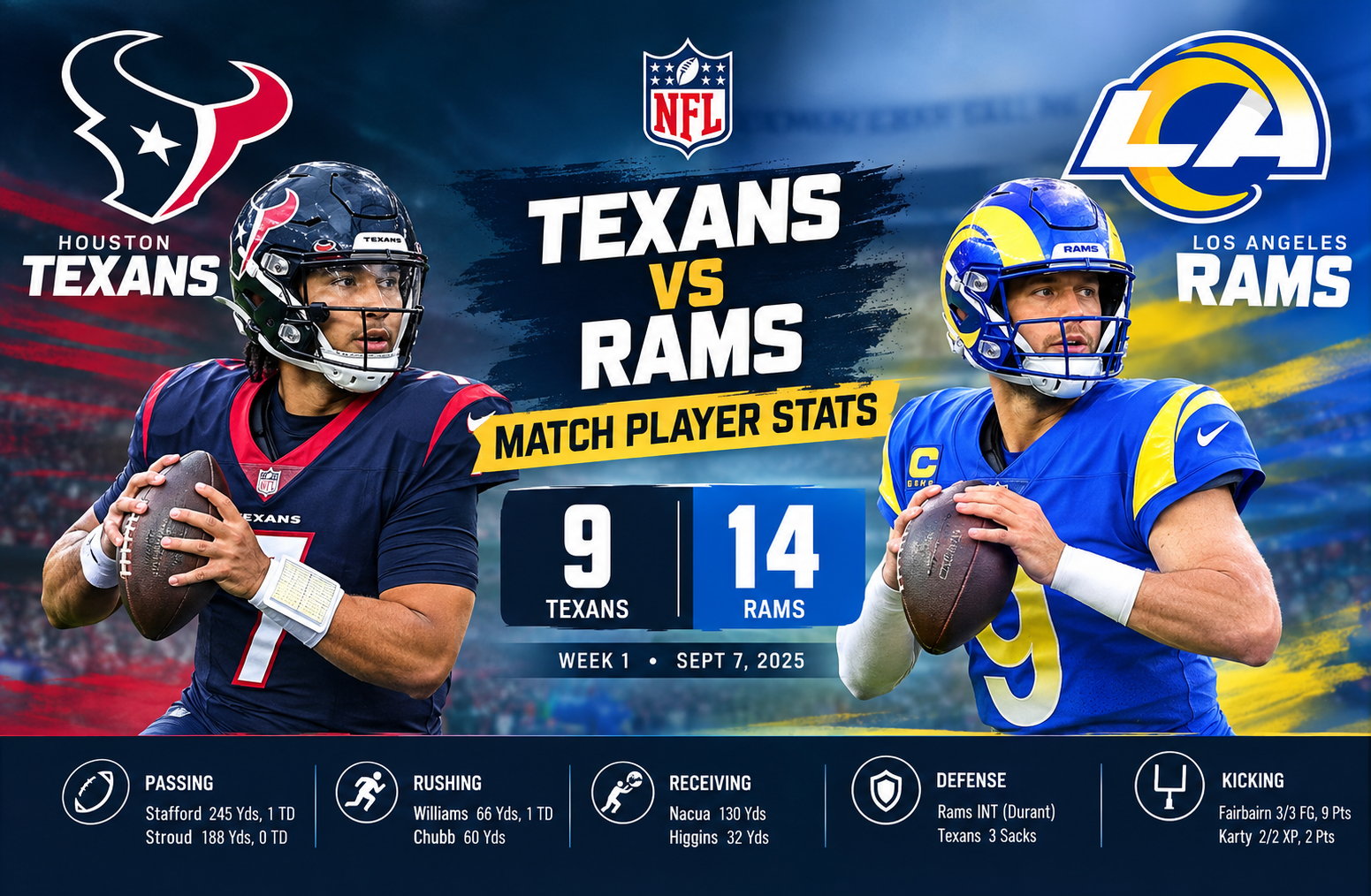
Houston Texans vs Los Angeles Rams Match Player Stats
The houston texans vs los angeles rams match player stats from the September 7, 2025 Week 1 meeting show how a low-scoring game can still produce a wide range of individual performances worth studying. The Los Angeles Rams defeated the Houston Texans 14-9 at SoFi Stadium, overcoming Houston’s early advantage and holding the Texans scoreless in the second half. (ESPN)
The final score does not fully explain how the game developed. Houston actually produced more rushing yards, 114 compared with 72, while Los Angeles controlled the passing game through Matthew Stafford and Puka Nacua. The Rams also produced the game’s only offensive touchdown through Kyren Williams.
This makes the matchup particularly useful for anyone looking beyond the scoreboard. The numbers reveal a game shaped by efficiency, field position, third-down execution, defensive pressure, and a few critical individual plays.
Houston Texans vs Los Angeles Rams Match Player Stats
The most important numbers from the game are summarized below.
| Category | Houston Texans | Los Angeles Rams |
| Final Score | 9 | 14 |
| Passing | 188 yards | 245 yards |
| Passing TDs | 0 | 1 |
| Interceptions | 1 | 0 |
| Rushing | 114 yards | 72 yards |
| Rushing TDs | 0 | 1 |
| Receptions | 19 | 21 |
| Receiving Yards | 188 | 245 |
| Sacks | 3 | 3 |
| QB Hits | 6 | 7 |
| Tackles | 61 | 66 |
| Tackles for Loss | 5 | 3 |
| Passes Defended | 1 | 4 |
| Lost Fumbles | 1 | 1 |
The central statistical contrast is straightforward. Houston ran the ball better, but Los Angeles passed the ball better and ultimately generated the only touchdown of the game. (NFL)
That difference mattered more than the raw yardage totals.
Game Overview: How the Rams Won 14-9
The game started with Houston taking a 3-0 first-quarter lead. The Texans added another six points in the second quarter, while Los Angeles responded with its first touchdown.
At halftime, Houston led 9-7.
The Rams then produced the decisive scoring drive in the third quarter, taking a 14-9 advantage. Neither team scored in the fourth quarter, allowing Los Angeles to protect the five-point lead.
The scoring progression was:
- First quarter: Texans 3, Rams 0
- Second quarter: Texans 6, Rams 7
- Third quarter: Texans 0, Rams 7
- Fourth quarter: Texans 0, Rams 0
The most important feature of that sequence was Houston’s offensive disappearance after halftime.
A five-point deficit meant the Texans needed only one touchdown to take the lead. Instead, the Rams defense prevented Houston from converting its offensive possessions into points.
The official NFL game materials list the contest as September 7, 2025, at SoFi Stadium, while the NFL schedule confirms the 14-9 Rams victory and the resulting 1-0 Los Angeles record. (NFL)
C.J. Stroud’s Passing Performance
C.J. Stroud completed 19 of 27 passes for 188 yards, with no touchdown passes and one interception. He finished with a 74.3 passer rating.
On the surface, a 19-for-27 performance looks reasonably efficient. Stroud completed approximately 70.4 percent of his attempts, but the offense struggled to turn those completions into scoring opportunities.
His statistical line:
- Completions: 19
- Attempts: 27
- Completion rate: 70.4 percent
- Passing yards: 188
- Yards per attempt: 7.0
- Touchdowns: 0
- Interceptions: 1
- Sacks: 3
- Sack yards lost: 37
- Passer rating: 74.3
The three sacks are especially important.
Stroud’s passing total was officially 188 yards, but Houston lost 37 yards on three sacks. That means the Rams defense was able to erase meaningful chunks of Houston’s offensive progress even when Stroud successfully completed passes. (ESPN)
The interception was another turning point. Cobie Durant recorded the Rams’ lone interception, ending one Houston opportunity and helping Los Angeles maintain control during a game where every possession carried extra importance.
Why Stroud’s Numbers Look Better Than the Result
There is an important distinction between completion percentage and offensive efficiency.
Stroud completed 19 passes, but Houston produced no passing touchdowns. The Texans also finished with just nine total points.
This is a good example of why box-score analysis should not stop at completion percentage.
A quarterback can complete a high percentage of passes and still struggle to produce enough points if the offense has difficulty finishing drives.
For Houston, that was the central problem.
Matthew Stafford’s Efficient Performance
Matthew Stafford delivered one of the strongest individual performances of the game.
He completed 21 of 29 passes for 245 yards, throwing one touchdown without an interception. His passer rating was 109.1.
His numbers included:
- Completions: 21
- Attempts: 29
- Completion rate: 72.4 percent
- Passing yards: 245
- Yards per attempt: 8.4
- Touchdowns: 1
- Interceptions: 0
- Sacks: 3
- Sack yards lost: 21
- Passer rating: 109.1
Stafford’s 245 passing yards represented the largest offensive yardage category for either team.
More importantly, he avoided the turnover that could have changed a close game.
The difference between Stafford and Stroud was not enormous in terms of completion percentage, but Stafford produced 57 more passing yards and a touchdown while avoiding an interception. (ESPN)
That is a meaningful advantage in a game decided by five points.
Puka Nacua Was the Rams’ Offensive Engine
Puka Nacua was the standout receiver of the matchup.
He caught 10 passes for 130 yards, averaging 13.0 yards per reception. His longest reception went for 25 yards.
His receiving line was:
- Targets: 11
- Receptions: 10
- Receiving yards: 130
- Average: 13.0 yards
- Long reception: 25 yards
- Touchdowns: 0
Nacua accounted for more than half of Los Angeles’ receiving yards.
That is significant because the Rams finished with 245 total passing yards. Nacua alone supplied 130 of them.
He also gave Stafford a reliable high-volume option throughout the game. Ten receptions from 11 targets means Stafford looked toward Nacua frequently and received consistent production in return. (NFL)
Why Nacua’s Performance Matters
The Rams did not need Nacua to score a touchdown for him to dominate the offensive statistics.
His value came from moving the chains and keeping the passing attack functional.
In a 14-9 game, sustained drives are extremely valuable. A receiver who repeatedly turns targets into first-down yardage can influence the result even without appearing in the touchdown column.
That is exactly what Nacua’s numbers demonstrate.
Kyren Williams Provided the Decisive Touchdown
Kyren Williams led Los Angeles in rushing with 18 carries for 66 yards and one touchdown.
His rushing average was 3.7 yards per carry, and his longest run was nine yards.
That average was not spectacular, but the touchdown was decisive.
Williams’ statistics:
- Carries: 18
- Rushing yards: 66
- Average: 3.7 yards
- Long: 9 yards
- Touchdowns: 1
Los Angeles had only 72 total rushing yards, meaning Williams accounted for most of the team’s ground production.
His touchdown was also the game’s only rushing touchdown and one of just two total Rams touchdowns.
This illustrates an important football principle: efficiency cannot always be measured by average yards alone.
Williams did not need to produce explosive runs. His ability to handle 18 carries and eventually reach the end zone provided the Rams with the scoring difference they needed.
Nick Chubb Led Houston’s Ground Game
Nick Chubb was Houston’s leading rusher with 13 carries for 60 yards.
He averaged 4.6 yards per carry and produced a long run of 13 yards.
His numbers were:
- Carries: 13
- Rushing yards: 60
- Average: 4.6 yards
- Long: 13 yards
- Touchdowns: 0
Chubb was one of the reasons Houston finished with more rushing yards than Los Angeles.
The Texans accumulated 114 rushing yards on 27 carries, averaging 4.2 yards per attempt. The Rams managed 72 yards on 25 attempts, averaging 2.9. (NFL)
That is one of the more interesting statistical contradictions in the game.
Houston won the rushing-yardage battle but lost the game.
The reason is that rushing production alone does not determine the winner. Touchdowns, turnovers, passing efficiency, and defensive stops all matter.
Houston’s Receiving Production
Houston’s passing attack produced 188 yards, matching the team’s total receiving yardage.
Jayden Higgins led the Texans in receiving yards with 2 receptions for 32 yards, averaging 16.0 yards per catch.
Other notable Houston receiving performances included:
| Player | Receptions | Yards | Average | TD |
| Jayden Higgins | 2 | 32 | 16.0 | 0 |
| Dalton Schultz | 3 | 28 | 9.3 | 0 |
| Nico Collins | 3 | 25 | 8.3 | 0 |
| Xavier Hutchinson | 2 | 30 | 15.0 | 0 |
| John Metchie III | 2 | 27 | 13.5 | 0 |
| Dare Ogunbowale | 2 | 17 | 8.5 | 0 |
| C.J. Stover | 4 | 22 | 5.5 | 0 |
The lack of a receiving touchdown is the biggest issue.
Houston moved the ball through several players, but none of those plays became a touchdown.
That helps explain why the Texans could produce 188 passing yards while scoring only three field goals.
Rams Receiving Production Beyond Puka Nacua
Nacua was clearly the headline receiver, but Los Angeles received contributions from several other targets.
Davante Adams recorded 4 receptions for 51 yards, while Xavier Smith caught one pass for 36 yards.
Demarcus Allen also caught a touchdown pass, finishing with one reception for 13 yards.
The Rams receiving distribution included:
- Puka Nacua: 10 receptions, 130 yards
- Davante Adams: 4 receptions, 51 yards
- Xavier Smith: 1 reception, 36 yards
- Demarcus Allen: 1 reception, 13 yards, 1 TD
- Blake Corum: 1 reception, 14 yards
- Tyler Atwell: 1 reception, 4 yards
- Kyren Williams: 1 reception, 3 yards
- Colby Parkinson: 2 receptions, -6 yards
The variety in the passing attack mattered.
Although Nacua dominated the volume, Stafford did not have to rely exclusively on one player to move the offense.
Houston Texans Defensive Performance
The Texans defense produced some strong numbers despite the defeat.
Houston recorded:
- 61 total tackles
- 38 solo tackles
- 3 sacks
- 5 tackles for loss
- 6 quarterback hits
- 1 pass defended
Three sacks and six quarterback hits demonstrate that Houston was capable of creating pressure.
The problem was that those defensive successes did not consistently translate into offensive points.
This is one of the clearest lessons from the game. Defensive pressure can keep a team competitive, but the offense still has to capitalize on the resulting field position and shortened drives.
Houston also forced a Rams fumble and recovered one Los Angeles turnover.
Yet the Texans ultimately committed one lost fumble themselves and threw an interception.
Los Angeles Rams Defensive Performance
The Rams defense recorded:
- 66 total tackles
- 40 solo tackles
- 3 sacks
- 3 tackles for loss
- 7 quarterback hits
- 4 passes defended
- 1 interception
The seven quarterback hits are particularly notable.
Los Angeles produced the same number of sacks as Houston but generated one additional quarterback hit.
The Rams also defended four passes compared with Houston’s one.
Most importantly, Cobie Durant recorded the game’s only interception.
That turnover came from a defense that ultimately held Houston without a second-half point.
Cobie Durant’s Interception
Cobie Durant finished with one interception and zero return yards.
While the return distance was zero, the play itself was valuable because interceptions are about possession first.
In a nine-point performance, every lost possession becomes more important.
The Texans did not throw multiple interceptions, but the single turnover was enough to become a meaningful part of the game’s statistical story.
The Rams, meanwhile, finished without an interception thrown by Stafford.
That gave Los Angeles a clean passing turnover profile compared with Houston.
Special Teams Played a Major Role
Houston’s kicking game was responsible for all nine of the team’s points.
Ka’imi Fairbairn converted:
- 3 field goals
- 3 attempts
- Long of 53 yards
- 9 total points
That was an excellent individual kicking performance.
Fairbairn effectively accounted for the entire Houston scoring total.
The Rams, meanwhile, scored through touchdowns rather than field goals.
Joshua Karty converted both extra-point attempts, finishing with two points.
This creates another useful contrast.
Houston was perfect on field-goal attempts but could not reach the end zone.
Los Angeles found the end zone twice and converted both extra points.
In a five-point game, that difference was decisive.
Punting and Field Position
Tommy Townsend punted four times for Houston, producing 208 yards and a 52.0-yard average. His longest punt traveled 61 yards.
Ethan Evans punted five times for Los Angeles for 220 yards, averaging 44.0 yards with a 50-yard long.
Houston’s punting average was therefore considerably higher.
But again, raw averages do not tell the entire story.
The Rams had more punts because the game featured extended periods in which both offenses struggled to finish drives. What mattered most was what happened after those possessions and how each defense responded.
Special teams helped maintain the field-position battle, but neither punting performance directly explains the final result.
Houston Texans vs Los Angeles Rams Match Player Stats: The Biggest Statistical Differences
When the numbers are placed side by side, several differences stand out.
1. Passing Production Favored Los Angeles
The Rams gained 245 passing yards compared with Houston’s 188.
That is a 57-yard advantage.
Stafford also produced one touchdown and no interceptions, while Stroud produced no touchdowns and one interception.
2. Rushing Production Favored Houston
The Texans gained 114 rushing yards.
The Rams gained only 72.
Houston therefore had a 42-yard advantage on the ground.
3. Los Angeles Won the Scoring Efficiency Battle
Houston’s offense produced:
- 114 rushing yards
- 188 passing yards
- 302 yards from those two primary categories
- 9 points
Los Angeles produced:
- 72 rushing yards
- 245 passing yards
- 317 yards from those two primary categories
- 14 points
The Rams generated only 15 more combined rushing and passing yards, yet they scored five more points.
That difference shows how scoring opportunities mattered more than total yardage.
4. Turnovers Favored Los Angeles
Both teams lost one fumble, but Houston also threw an interception.
The Rams did not throw an interception.
That gave Los Angeles the cleaner turnover profile.
5. Houston Could Not Score a Touchdown
This was perhaps the simplest difference.
Three field goals produced nine points.
The Rams scored two touchdowns.
In a five-point game, the inability to finish one drive with a touchdown became the defining offensive limitation for Houston.
What the Game Says About Offensive Efficiency
The matchup is a useful reminder that total yardage is only one layer of football analysis.
Houston actually rushed for 42 more yards than Los Angeles.
That did not matter enough because the Texans struggled to turn possessions into touchdowns.
The Rams were more productive through the air, with Stafford connecting repeatedly with Nacua and other receivers.
Los Angeles also avoided the costly passing turnover that Houston suffered.
The result was a team that gained only modestly more offensive yardage but scored more efficiently.
For analysts, the lesson is clear: when evaluating a close NFL game, look beyond total yards.
A stronger checklist includes:
- Passing efficiency
- Turnovers
- Touchdowns versus field goals
- Red-zone execution
- Sack yardage
- Third-down performance
- Explosive plays
- Field position
- Time of possession
- Defensive stops after halftime
The Texans performed well in several of these areas but not enough of them simultaneously.
What Houston Could Have Done Better
The most obvious issue was finishing drives.
The Texans scored nine points despite producing 114 rushing yards and 188 passing yards.
The offense needed to convert at least one of those productive stretches into a touchdown.
The second major problem was the interception.
In a game where the defense held Los Angeles to 14 points, Houston’s offense did not have much room for mistakes.
The third issue was the second half.
Houston scored nine points before halftime but failed to score after the break.
That created an uncomfortable situation for the defense. The Texans needed a stop, followed by a scoring drive, but could not complete the combination.
What Los Angeles Did Well
The Rams’ biggest success was maintaining offensive balance even though the rushing game was limited.
Stafford’s 245 passing yards provided the bulk of the offense.
Nacua’s 130 receiving yards gave Los Angeles a consistent chain-moving option.
Williams supplied the critical rushing touchdown.
Defensively, Los Angeles generated pressure, recorded three sacks, produced seven quarterback hits, and intercepted Stroud.
That combination was enough to win despite Houston’s superior rushing production.
Player-by-Player Statistical Takeaways
C.J. Stroud
Stroud was accurate enough to complete 19 of 27 attempts, but the absence of a touchdown and the interception limited the value of his passing production.
Matthew Stafford
Stafford delivered the more efficient quarterback performance, finishing with 245 yards, one touchdown, no interceptions, and a 109.1 passer rating.
Nick Chubb
Chubb led Houston’s ground game with 60 yards on 13 carries and averaged 4.6 yards per attempt.
Kyren Williams
Williams carried the ball 18 times for 66 yards and scored the game’s decisive rushing touchdown.
Puka Nacua
Nacua was the game’s leading receiver with 10 catches for 130 yards. His consistency was central to the Rams passing attack.
Ka’imi Fairbairn
Fairbairn made all three field-goal attempts, including a 53-yarder, and scored all nine Houston points.
Cobie Durant
Durant’s interception was the Rams’ only defensive interception and one of the game’s important turnover plays.
Why the 14-9 Score Is More Interesting Than It Looks
A 14-9 final score can appear uneventful when viewed without context.
The underlying statistics tell a different story.
Houston had a productive rushing attack.
Los Angeles had a more productive passing attack.
Both defenses recorded three sacks.
Both teams lost one fumble.
Houston made all three field-goal attempts.
Los Angeles produced the game’s only two touchdowns.
That combination created a contest in which small efficiency differences mattered enormously.
The Rams did not dominate every statistical category. They simply won the categories that had the greatest impact on the scoreboard.
Houston Texans vs Los Angeles Rams Match Player Stats: Key Numbers to Remember
For readers who want the most important numbers without going through the entire box score, these are the figures that best summarize the game:
- Final score: Rams 14, Texans 9
- Stafford: 21/29, 245 yards, 1 TD, 0 INT
- Stroud: 19/27, 188 yards, 0 TD, 1 INT
- Nacua: 10 receptions, 130 yards
- Williams: 18 carries, 66 yards, 1 TD
- Chubb: 13 carries, 60 yards
- Houston rushing: 114 yards
- Rams rushing: 72 yards
- Houston sacks: 3
- Rams sacks: 3
- Houston QB hits: 6
- Rams QB hits: 7
- Fairbairn: 3/3 field goals, 9 points
- Durant: 1 interception
These figures explain the game more effectively than the final score alone. (NFL)
Frequently Asked Questions
Who won the Texans vs Rams game in 2025?
The Los Angeles Rams defeated the Houston Texans 14-9 in Week 1 of the 2025 NFL season. (NFL)
How many yards did Matthew Stafford pass for?
Matthew Stafford completed 21 of 29 passes for 245 yards, one touchdown, and no interceptions.
How many receiving yards did Puka Nacua have?
Puka Nacua recorded 10 receptions for 130 yards, averaging 13.0 yards per reception.
How many rushing yards did Nick Chubb have?
Nick Chubb rushed 13 times for 60 yards, averaging 4.6 yards per carry.
Who scored the Rams’ rushing touchdown?
Kyren Williams scored the Rams’ rushing touchdown on 18 carries for 66 yards.
How many points did Ka’imi Fairbairn score?
Ka’imi Fairbairn scored all nine of Houston’s points by making three field goals, including a 53-yard kick.
Conclusion
The houston texans vs los angeles rams match player stats provide a clear example of why NFL games should be evaluated through efficiency rather than raw yardage alone.
Houston ran for 114 yards and held Los Angeles to 72 rushing yards. Yet the Rams gained 245 passing yards, avoided an interception, received a huge contribution from Puka Nacua, and scored two touchdowns. Houston’s offense, meanwhile, settled for three field goals and failed to score after halftime.
Matthew Stafford’s 245-yard passing performance, Nacua’s 130 receiving yards, and Kyren Williams’ touchdown were central to the Rams victory. On Houston’s side, Nick Chubb’s 60 rushing yards and Ka’imi Fairbairn’s perfect three-for-three field-goal performance were strong individual efforts, but they were not enough to overcome the scoring gap.
The most useful takeaway is that the Rams did not need to dominate every statistical category. They needed to make more of their opportunities, protect the football through the passing game, and finish drives with touchdowns. That was enough to turn a five-point game into a Week 1 victory.