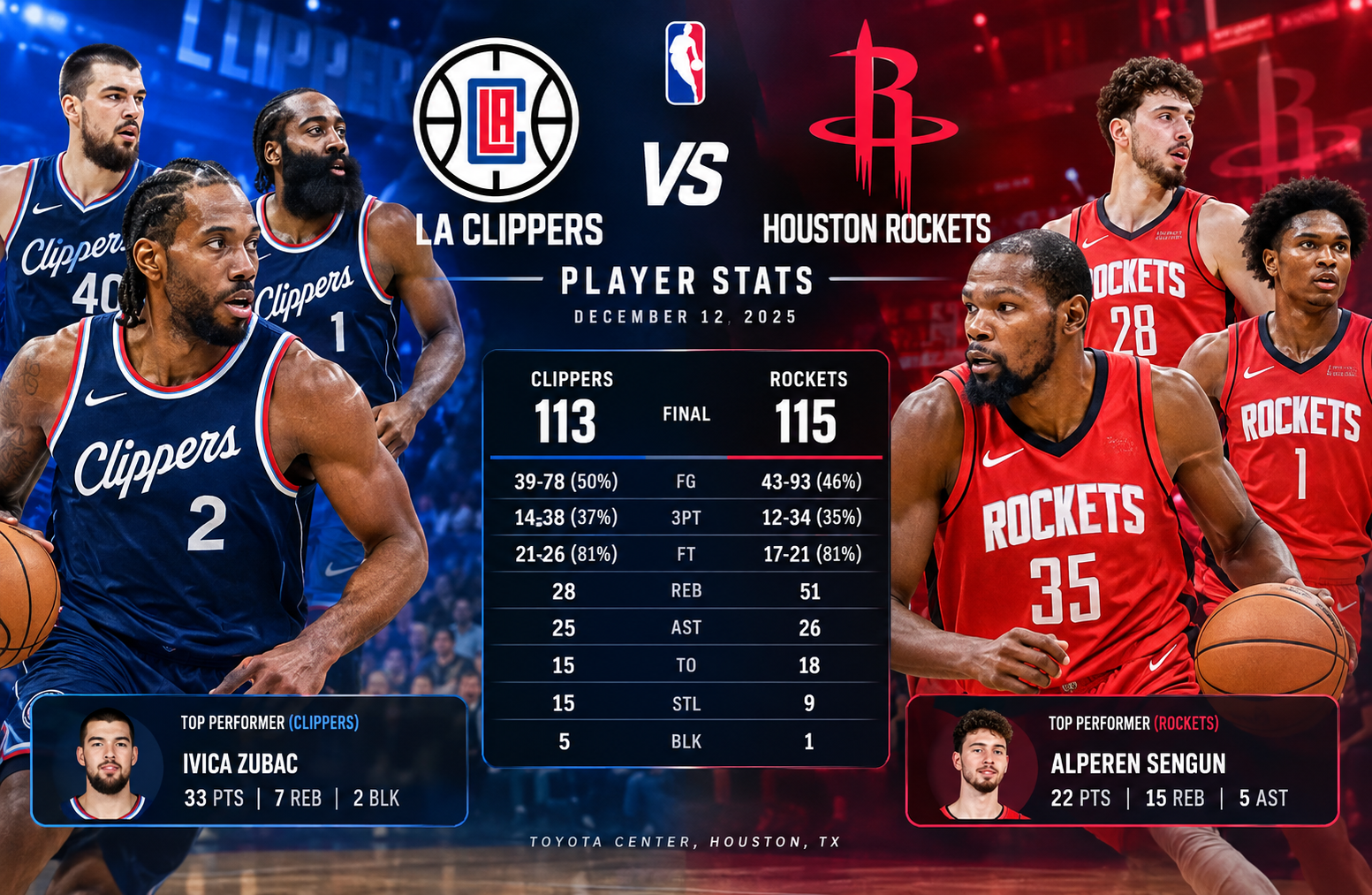
LA Clippers vs Houston Rockets Match Player Stats
The LA Clippers vs Houston Rockets match player stats from December 12, 2025 tell the story of a game that was decided by much more than the final two points. Houston defeated Los Angeles 115-113 at Toyota Center after overcoming a second-quarter deficit and finishing the fourth quarter with a 35-31 scoring edge. The Clippers actually shot better overall, connecting on 50% of their field-goal attempts compared with Houston’s 46%, but the Rockets controlled the glass, especially on the offensive end.
For readers looking beyond the final score, this was a particularly useful matchup to study. Ivica Zubac produced 33 points on an outstanding 13-of-14 shooting night, Kawhi Leonard added 24 points and nine rebounds, and James Harden contributed 22 points and seven assists. Houston answered with Alperen Sengun’s 22 points and 15 rebounds, Amen Thompson’s 20 points, nine rebounds and eight assists, and Jabari Smith Jr.’s 18 points and 10 rebounds.
The most important statistical difference was rebounding. Houston finished with 51 total rebounds compared with only 28 for Los Angeles, including a remarkable 22 offensive rebounds. That extra possession advantage helped Houston compensate for its lower shooting percentage and ultimately survive a close game.
LA Clippers vs Houston Rockets Match Player Stats: Game Overview
The matchup took place at Toyota Center in Houston. The Rockets entered the game with a 16-6 record and an 8-2 home record, while the Clippers were 6-19 overall and 3-12 on the road. Houston eventually won 115-113.
Final Score by Quarter
| Quarter | LA Clippers | Houston Rockets |
| 1st | 29 | 29 |
| 2nd | 25 | 22 |
| 3rd | 28 | 29 |
| 4th | 31 | 35 |
| Final | 113 | 115 |
The first quarter ended level at 29-29. Los Angeles then created a three-point advantage by halftime, leading 54-51. Houston responded by winning the third quarter 29-28 before taking control of the decisive fourth quarter.
The final period was the difference. Houston scored 35 points while Los Angeles scored 31. That four-point margin erased the Clippers’ advantage from the earlier stages of the game.
According to the ESPN recap, the game was tied 110-110 late before Amen Thompson made a decisive three-point play with 17.2 seconds remaining. His putback came after Houston secured its third offensive rebound of the possession.
That sequence provides perhaps the clearest example of how the team statistics translated into the final result.
Complete Clippers Player Statistics
The Clippers received a strong offensive performance from their frontcourt and useful contributions from several perimeter players.
| Player | PTS | FG | 3PT | FT | REB | AST | TO | STL | BLK |
| Ivica Zubac | 33 | 13-14 | 0-0 | 7-11 | 7 | 1 | 1 | 1 | 2 |
| Kawhi Leonard | 24 | 9-22 | 3-10 | 3-3 | 9 | 4 | 1 | 5 | 1 |
| James Harden | 22 | 7-18 | 4-10 | 4-5 | 3 | 7 | 4 | 3 | 0 |
| Bogdan Bogdanovic | 10 | 2-4 | 2-3 | 4-4 | 5 | 2 | 0 | 1 | 0 |
| John Collins | 9 | 3-7 | 0-3 | 3-3 | 0 | 2 | 2 | 2 | 0 |
| Kris Dunn | 9 | 3-7 | 3-7 | 0-0 | 1 | 6 | 3 | 2 | 0 |
| Nicolas Batum | 6 | 2-5 | 2-5 | 0-0 | 3 | 2 | 2 | 0 | 1 |
| Brook Lopez | 0 | 0-1 | 0-0 | 0-0 | 0 | 0 | 0 | 1 | 1 |
These figures are consistent with the ESPN box score.
Ivica Zubac: Clippers’ Most Efficient Scorer
Ivica Zubac was the standout scoring performer for Los Angeles. He finished with 33 points on 13-of-14 shooting from the field, giving him a field-goal percentage of approximately 92.9%.
That level of efficiency is especially notable because Zubac did not rely on three-point shooting. All of his field goals came from inside the arc, and he added seven made free throws on 11 attempts.
He also recorded seven rebounds and two blocks.
The ESPN recap noted that Zubac matched his season high with 33 points.
His performance created an interesting contrast with the final result. Los Angeles had an extremely efficient interior scorer, but Houston’s collective rebounding advantage gave the Rockets substantially more opportunities.
Kawhi Leonard: 24 Points, 9 Rebounds and 5 Steals
Kawhi Leonard finished with 24 points, nine rebounds, four assists and five steals. His five steals were the highest total among all players in the game.
Leonard shot 9-of-22 from the field and 3-of-10 from three-point range. He was perfect from the free-throw line at 3-of-3.
His defensive activity was particularly significant. Five steals can change possession volume, and Los Angeles finished with 15 steals as a team compared with nine for Houston.
However, Leonard also committed an offensive foul late in the game. According to the ESPN/AP recap, Los Angeles had two late possessions with opportunities to tie, but Leonard was called for an offensive foul and Nicolas Batum was later called for an inbounds violation.
James Harden: 22 Points and 7 Assists
James Harden recorded 22 points, seven assists and three steals while shooting 7-of-18 from the field.
His perimeter scoring was important because he made four of his 10 three-point attempts. Harden also converted four of five free throws.
The seven assists were the most on the Clippers. His four turnovers, however, were also a team-high alongside several Houston players.
Harden’s presence added another layer to the matchup because he faced the franchise for which he played for more than eight seasons. The ESPN/AP report specifically highlighted his 22-point performance against Houston.
Kris Dunn’s Two-Way Contribution
Kris Dunn scored nine points but contributed six assists and two steals.
His three-point shooting was efficient by volume, as he made three of seven attempts from beyond the arc. His six assists were second on Los Angeles behind Harden.
Dunn’s box score illustrates why points alone do not explain this game. His nine points were modest compared with Zubac’s 33, but his passing and defensive activity were valuable components of the Clippers’ overall performance.
Complete Houston Rockets Player Statistics
Houston used a more balanced scoring distribution.
| Player | PTS | FG | 3PT | FT | REB | AST | TO | STL | BLK |
| Alperen Sengun | 22 | 9-22 | 0-3 | 4-6 | 15 | 5 | 5 | 4 | 0 |
| Amen Thompson | 20 | 8-12 | 0-3 | 4-4 | 9 | 8 | 1 | 1 | 0 |
| Jabari Smith Jr. | 18 | 6-14 | 2-8 | 4-4 | 10 | 4 | 4 | 1 | 0 |
| Kevin Durant | 16 | 5-14 | 3-5 | 3-3 | 1 | 3 | 5 | 0 | 0 |
| Aaron Holiday | 13 | 4-9 | 4-7 | 1-2 | 1 | 0 | 1 | 0 | 0 |
| Reed Sheppard | 10 | 4-9 | 2-5 | 0-0 | 4 | 2 | 1 | 0 | 1 |
| Josh Okogie | 8 | 3-6 | 1-3 | 1-2 | 3 | 2 | 0 | 1 | 0 |
| Steven Adams | 4 | 2-4 | 0-0 | 0-0 | 6 | 2 | 1 | 2 | 0 |
| Clint Capela | 4 | 2-3 | 0-0 | 0-0 | 2 | 0 | 0 | 0 | 0 |
The player statistics above come from the ESPN box score for the matchup.
Alperen Sengun: 22 Points and 15 Rebounds
Alperen Sengun delivered one of the most complete statistical performances of the night.
He scored 22 points, grabbed 15 rebounds, dished out five assists and recorded four steals. His 15 rebounds were the highest individual total in the game.
Sengun shot 9-of-22 from the field. Although his three-point shooting was 0-of-3, he made four of six free throws.
His rebounding was particularly important because Houston needed second opportunities to overcome Los Angeles’ superior shooting efficiency.
Sengun’s five turnovers were a weakness in an otherwise productive performance, but the overall statistical contribution was substantial.
Amen Thompson: The Late-Game Difference Maker
Amen Thompson finished with 20 points, nine rebounds and eight assists while shooting 8-of-12 from the field.
His shooting percentage was approximately 66.7%, making him one of Houston’s most efficient high-volume scorers.
The biggest moment came late. With the score tied 110-110, Thompson converted a putback and drew a foul before completing the three-point play. ESPN’s recap states that the basket came after Houston’s third offensive rebound of the possession.
Thompson’s eight assists were also the highest total for either team except no player matched it. Harden led the Clippers with seven assists.
This is an important reason why the LA Clippers vs Houston Rockets match player stats should not be reduced to the highest scoring player. Thompson’s combination of scoring, rebounding, playmaking and late-game execution had a direct connection to the result.
Jabari Smith Jr.: Double-Double Impact
Jabari Smith Jr. recorded 18 points and 10 rebounds for a double-double.
He shot 6-of-14 from the field and made two of eight three-point attempts. He was perfect from the free-throw line at 4-of-4.
His 10 rebounds helped Houston maintain its significant advantage on the glass. He also supplied four assists.
Kevin Durant: A Slow Start, Strong Third Quarter
Kevin Durant scored 16 points, adding three assists and one rebound.
His shooting line was 5-of-14 from the field, 3-of-5 from three and 3-of-3 from the free-throw line.
The ESPN/AP recap provides useful context. Durant began the game 1-of-7 from the field but then made his next four shots. He scored 13 of his 16 points in the third quarter.
That scoring burst helped Houston stay close after Los Angeles entered halftime with a three-point lead.
Team Statistics That Decided the Game
The overall team statistics provide a clearer explanation of Houston’s victory than the shooting numbers alone.
| Category | Clippers | Rockets |
| Field Goals | 39-78 | 43-93 |
| Field Goal % | 50% | 46% |
| 3-Point Field Goals | 14-38 | 12-34 |
| 3-Point % | 37% | 35% |
| Free Throws | 21-26 | 17-21 |
| Free Throw % | 81% | 81% |
| Rebounds | 28 | 51 |
| Offensive Rebounds | 8 | 22 |
| Defensive Rebounds | 20 | 29 |
| Assists | 25 | 26 |
| Turnovers | 15 | 18 |
| Steals | 15 | 9 |
| Blocks | 5 | 1 |
| Points in Paint | 46 | 56 |
| Fast-Break Points | 9 | 24 |
The ESPN team-stat page confirms the major statistical differences, including the 51-28 rebounding gap, 22-8 offensive-rebound difference, 56-46 advantage in points in the paint and 24-9 advantage in fast-break points.
Rebounding Was the Defining Advantage
The simplest way to understand the game is to look at the rebounding margin.
Houston collected 51 rebounds.
Los Angeles collected 28.
That is a 23-rebound advantage for the Rockets.
The offensive rebounding gap was even more striking. Houston grabbed 22 offensive rebounds while the Clippers collected eight.
That means Houston had 14 more offensive rebounds than Los Angeles.
Offensive rebounds are valuable because they create additional possessions without requiring a defensive stop. Houston’s late-game winning sequence was an excellent example of this principle.
The Rockets secured multiple offensive rebounds on the possession that produced Thompson’s decisive three-point play.
Shooting Efficiency Favored Los Angeles
This is where the box score becomes more interesting.
The Clippers shot 50% from the field.
The Rockets shot 46%.
Los Angeles also made 14 three-pointers compared with Houston’s 12.
The Clippers made 21 free throws, while Houston made 17.
So why did Los Angeles lose?
The answer is opportunity volume.
Houston attempted 93 field goals.
Los Angeles attempted 78.
That is a difference of 15 field-goal attempts.
Houston’s offensive rebounding advantage was a major contributor to that extra opportunity. Even though Houston converted shots at a lower percentage, the Rockets repeatedly created additional possessions.
This is a classic example of why field-goal percentage alone does not determine a basketball game.
Points in the Paint and Transition Scoring
Houston scored 56 points in the paint compared with 46 for Los Angeles.
The Rockets also held a 24-9 advantage in fast-break points.
Those numbers indicate that Houston generated significant offense through interior scoring and transition opportunities.
Los Angeles’ 50% shooting shows that the Clippers were efficient with many of their possessions. Houston, however, generated more possessions and converted more of them into points.
Why the Clippers Still Had a Real Chance to Win
Despite the loss, Los Angeles had several statistical advantages.
First, the Clippers shot 50% from the field.
Second, they shot 37% from three-point range.
Third, they made 21 of 26 free throws.
Fourth, they forced nine more steals than Houston, finishing with 15 steals.
The Clippers also had five blocks compared with Houston’s one.
These numbers demonstrate that Los Angeles was competitive in several important areas.
The problem was that the Rockets’ rebounding and possession advantages were large enough to offset those strengths.
This distinction matters when analyzing a close game. A team can shoot better and still lose if the opponent gets substantially more opportunities.
The Four Biggest Individual Statistical Performances
The top individual lines can be summarized through different statistical lenses.
Scoring
Ivica Zubac led all players with 33 points.
The next highest scorers were:
- Alperen Sengun, 22
- James Harden, 22
- Kawhi Leonard, 24
- Amen Thompson, 20
- Jabari Smith Jr., 18
- Kevin Durant, 16
Zubac was the only player to reach 30 points.
Rebounding
Alperen Sengun led everyone with 15 rebounds.
Jabari Smith Jr. had 10.
Kawhi Leonard had nine.
Amen Thompson had nine.
Ivica Zubac had seven.
The difference between Sengun’s 15 rebounds and Zubac’s seven was particularly relevant because both centers were major interior contributors.
Assists
Amen Thompson led the game with eight assists.
James Harden had seven.
Kris Dunn had six.
Alperen Sengun had five.
Kawhi Leonard and Jabari Smith Jr. each had four.
Houston therefore had multiple players capable of creating offense for teammates.
Steals
Kawhi Leonard led all players with five steals.
Alperen Sengun followed with four.
James Harden recorded three.
Several players finished with two steals.
The Clippers’ 15 steals were a major defensive statistic, but Houston’s ability to dominate rebounding and create transition points ultimately remained more influential on the scoreboard.
A Closer Look at the Fourth Quarter
The fourth quarter deserves special attention because it explains how the game moved from a competitive contest to a Houston victory.
Los Angeles scored 31 points in the final period, which would normally be enough to give a team a strong chance in a close game.
Houston scored 35.
The Rockets therefore produced four more points than the Clippers during the game’s decisive period.
The late sequence was particularly important. ESPN reported that Thompson’s putback came with 17.2 seconds remaining, breaking a 110-110 tie. He was fouled by Kris Dunn and made the resulting free throw.
Los Angeles then had opportunities to respond, but the final possessions did not produce the required points.
The lesson from the fourth quarter is not simply that Houston scored more. It is that Houston’s rebounding strength remained effective when possession value was at its highest.
Shooting Breakdown
The shooting numbers were surprisingly favorable to Los Angeles.
Clippers Shooting
Los Angeles finished:
- 39-of-78 from the field
- 14-of-38 from three
- 21-of-26 from the free-throw line
- 50% from the field
- 37% from three
- 81% from the free-throw line
Rockets Shooting
Houston finished:
- 43-of-93 from the field
- 12-of-34 from three
- 17-of-21 from the free-throw line
- 46% from the field
- 35% from three
- 81% from the free-throw line
The free-throw percentage was identical.
Los Angeles had the better three-point percentage and field-goal percentage.
Houston had the advantage in total field-goal attempts.
That combination is the central statistical tension of the matchup.
Possession Battle: The Hidden Story
Basketball games are often explained by shooting, but possession volume can be equally important.
Houston attempted 15 more field goals than Los Angeles.
The Rockets also had 22 offensive rebounds compared with eight for the Clippers.
That combination meant Houston had far more opportunities to recover missed shots and generate another scoring chance.
The Rockets also scored 24 fast-break points against nine for Los Angeles.
Taken together, these numbers suggest that Houston’s path to victory was based on creating more opportunities rather than simply shooting more accurately.
That is arguably the most useful takeaway from this matchup for anyone studying player statistics.
What the Player Stats Say About Each Team
The Clippers’ statistics show a team that generated efficient scoring from its key players but did not control the possession battle.
Zubac’s 33 points on 13-of-14 shooting were outstanding.
Leonard provided scoring, rebounding and defensive disruption.
Harden supplied 22 points and seven assists.
Dunn added six assists and three three-pointers.
Yet the team grabbed only 28 rebounds.
Houston’s statistical profile was different.
Sengun dominated the boards.
Thompson combined scoring and playmaking.
Smith supplied a double-double.
Durant added efficient three-point shooting after a slow start.
Holiday and Sheppard provided additional perimeter scoring from the bench.
This distribution helped Houston compensate for its lower overall shooting percentage.
Season Series After the Game
This was the first meeting between the two teams in the series listed in the supplied game data, giving Houston a 1-0 advantage in the season series after the matchup.
ESPN’s schedule data also records the Clippers’ 115-113 loss at Houston on December 11 in the Houston local game date listing.
There is a date-format detail worth clarifying for readers. The game is commonly displayed as December 11, 2025 in Houston and on the U.S. ESPN page, while the supplied data identifies December 12 and a 6:00 AM game time. This reflects the time-zone/date presentation relevant to readers outside Houston. The final score and player statistics are the same.
Important Box Score Data Note
The supplied player statistics and ESPN’s main box score show Houston with 18 team turnovers when the listed player totals are added.
However, ESPN’s separate team-statistics page displays Houston with 19 total turnovers.
Because of that discrepancy, this article uses the player-level box score figure of 18 when discussing the supplied statistics and does not treat the one-turnover difference as a meaningful game-changing conclusion.
This is an important distinction for readers who rely on statistical articles. When two pages from the same provider show a minor discrepancy, it is better to identify it than silently choose one figure and present it as unquestionable.
What Stands Out Most From the LA Clippers vs Houston Rockets Match Player Stats
The most revealing numbers from the game are not necessarily the highest point totals.
The most important statistical observations are:
- Zubac scored 33 points while shooting 13-of-14.
- Sengun recorded 15 rebounds.
- Thompson produced 20 points, nine rebounds and eight assists.
- Leonard recorded five steals.
- Harden produced 22 points and seven assists.
- Houston outrebounded Los Angeles 51-28.
- Houston won the offensive rebounding battle 22-8.
- Los Angeles shot 50% from the field.
- Houston attempted 15 more field goals.
- Houston led the Clippers 56-46 in points in the paint.
- Houston led 24-9 in fast-break points.
- The Rockets scored 35 fourth-quarter points.
- The game was decided by two points.
These figures show why the final result cannot be understood by looking at scoring alone.
Frequently Asked Questions
Who scored the most points in the Clippers vs Rockets game?
Ivica Zubac led all players with 33 points for the Clippers. He shot 13-of-14 from the field and also recorded seven rebounds and two blocks.
What was the final score of Clippers vs Rockets?
The Houston Rockets defeated the LA Clippers 115-113. Houston led 35-31 in the fourth quarter to secure the two-point victory.
Who had the most rebounds in the game?
Alperen Sengun led all players with 15 rebounds. He also scored 22 points, recorded five assists and collected four steals.
How many points did Kawhi Leonard score?
Kawhi Leonard scored 24 points. He also had nine rebounds, four assists and five steals while shooting 9-of-22 from the field.
How did Houston win despite shooting a lower percentage?
Houston compensated for its 46% field-goal shooting by creating more scoring opportunities. The Rockets had 51 rebounds to Los Angeles’ 28, including 22 offensive rebounds, and attempted 93 field goals compared with 78 for the Clippers.
Who was Houston’s leading scorer?
Alperen Sengun led Houston with 22 points. Amen Thompson scored 20, Jabari Smith Jr. scored 18, and Kevin Durant finished with 16.
Conclusion
The LA Clippers vs Houston Rockets match player stats from this 115-113 contest reveal a close game in which shooting efficiency and possession control pointed in different directions.
Los Angeles shot 50% from the field and 37% from three, with Ivica Zubac producing 33 points on 13-of-14 shooting. Kawhi Leonard added 24 points, nine rebounds and five steals, while James Harden contributed 22 points and seven assists.
Houston’s answer was collective. Alperen Sengun controlled the glass with 15 rebounds, Amen Thompson filled multiple statistical categories with 20 points, nine rebounds and eight assists, and Jabari Smith Jr. added a double-double.
The decisive team statistic was rebounding. Houston collected 51 boards to Los Angeles’ 28 and grabbed 22 offensive rebounds. That possession advantage helped the Rockets attempt 93 field goals despite shooting a lower percentage than the Clippers.
The final four minutes reflected that broader statistical pattern. Houston’s ability to create extra opportunities remained important when the score was tied late, and Thompson’s offensive rebound and three-point play with 17.2 seconds remaining proved to be the key sequence before Los Angeles’ final attempts to tie the game.
For readers analyzing the box score, the game is a useful reminder that the most efficient shooting team does not always win. Rebounding, possession volume, transition scoring, interior production and late-game execution can collectively outweigh a shooting-percentage advantage.