Los Angeles Rams vs Jacksonville Jaguars Match Player Stats
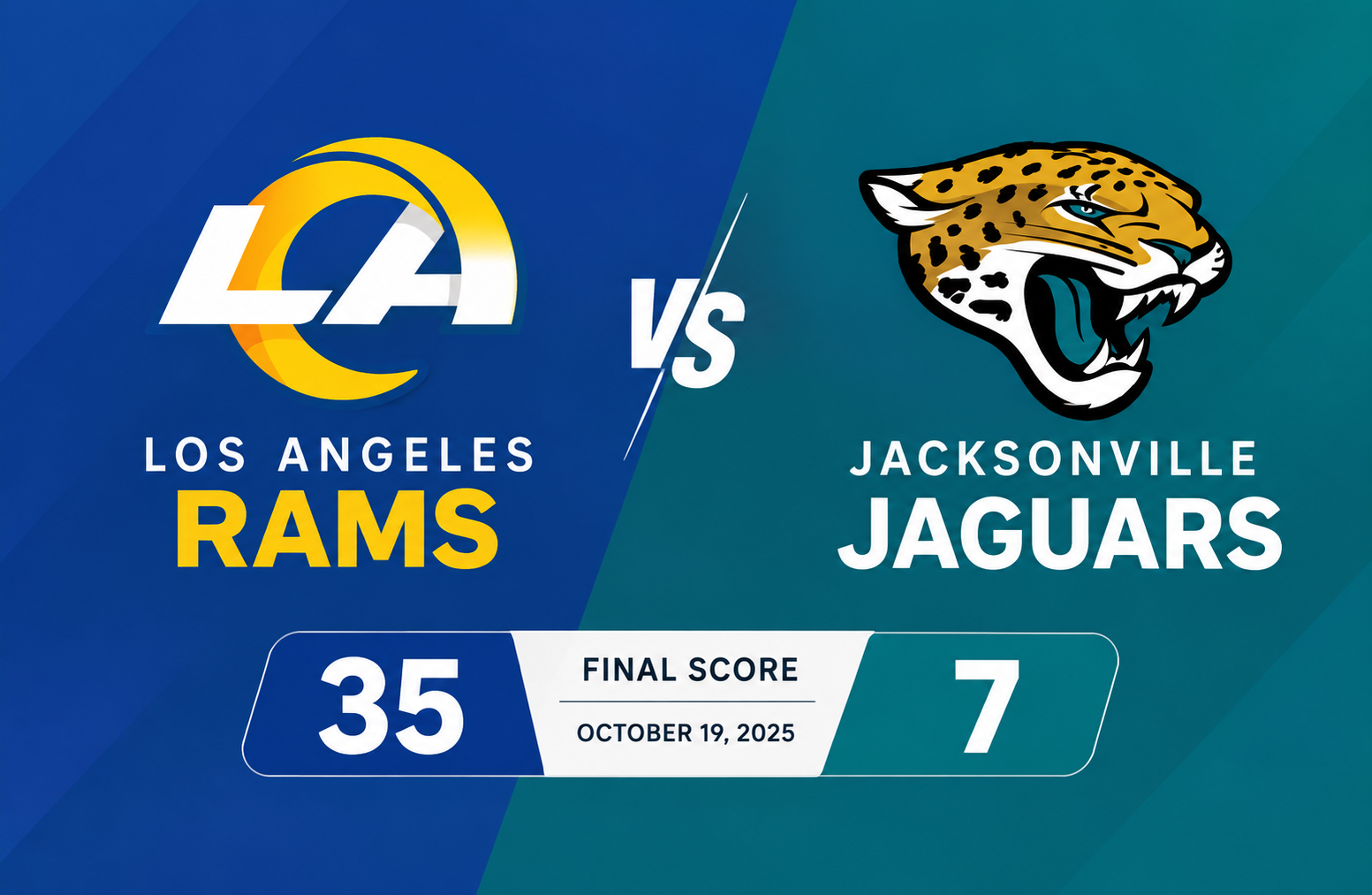
The Los Angeles Rams vs Jacksonville Jaguars match player stats from October 19, 2025, tell the story of a game that was far more one-sided than the final records of the two teams suggested. Los Angeles defeated Jacksonville 35-7, improving to 5-2 while the Jaguars moved to 4-3. The Rams built an early lead, controlled the game through the air, and finished with a dominant defensive performance that included seven sacks and 11 quarterback hits.
Matthew Stafford was the central figure in the Rams’ victory. The veteran quarterback completed 21 of 33 passes for 182 yards and threw five touchdown passes without an interception. His 117.7 passer rating reflected an efficient performance, particularly because Los Angeles repeatedly converted its opportunities in the red zone.
Jacksonville’s Trevor Lawrence produced a different statistical profile. He completed 23 of 48 passes for 296 yards and one touchdown, but he was sacked seven times for 32 yards. The Jaguars moved the ball through the passing game at times, yet their inability to protect Lawrence and their struggles to finish drives kept the offense from matching Los Angeles.
The result was a 35-7 Rams victory, with Los Angeles scoring 14 points in the first quarter, seven in the second, none in the third, and another 14 in the fourth. Jacksonville did not score until the fourth quarter.
Los Angeles Rams vs Jacksonville Jaguars Match Player Stats
The clearest way to understand this matchup is to separate the numbers into passing, rushing, receiving, and defensive production. Looking at only the final score does not fully explain why Los Angeles won so comfortably.
| Category | Los Angeles Rams | Jacksonville Jaguars |
| Final Score | 35 | 7 |
| Passing Yards | 182 | 296 |
| Passing TDs | 5 | 1 |
| Interceptions | 0 | 0 |
| Team Rushing Yards | 89 | 94 |
| Rushing Attempts | 29 | 19 |
| Total Sacks | 7 | 0 |
| Team Tackles | 60 | 55 |
| Pass Defenses | 10 | 4 |
| QB Hits | 11 | 4 |
| Fumbles | 0 | 1 |
One of the most interesting aspects of the box score is that Jacksonville actually finished with more passing yards and slightly more rushing yards. That might seem surprising in a 35-7 defeat.
The difference was efficiency.
The Rams turned 182 passing yards into five touchdowns. Jacksonville generated 296 passing yards but scored only once. That contrast demonstrates why raw yardage alone is not enough when evaluating an NFL game.
Matthew Stafford’s Five-Touchdown Performance
Matthew Stafford delivered the most important individual performance of the game.
He finished with:
- 21 completions
- 33 attempts
- 182 passing yards
- 5.5 yards per attempt
- 5 touchdown passes
- 0 interceptions
- 0 sacks
- 81.3 QBR
- 117.7 passer rating
Stafford’s completion rate was approximately 63.6 percent. More importantly, every touchdown pass translated into points for Los Angeles.
The five touchdown passes also came without a turnover or a sack. That combination is particularly important when evaluating quarterback performance. Stafford did not need to produce a huge number of passing yards because the Rams consistently finished their offensive opportunities.
His 182 yards may look modest compared with Jacksonville’s 296 passing yards, but the touchdown differential tells the more important story.
Stafford also avoided putting the Rams’ defense in difficult situations. Jacksonville never intercepted him, and Los Angeles did not allow him to be sacked.
That balance between production and ball security helped the Rams maintain control.
Why Stafford’s 182 Yards Still Mattered
A common mistake when reading quarterback statistics is assuming that the player with more passing yards necessarily had the better game.
This matchup is a strong example of why that approach can be misleading.
Trevor Lawrence threw for 296 yards, which was 114 more than Stafford. Yet Lawrence had only one touchdown compared with Stafford’s five.
Stafford’s average of 5.5 yards per attempt was not spectacular on its own. What separated his performance was what happened when the Rams reached scoring opportunities.
Five touchdown passes from 33 attempts means the Rams were highly productive when they reached favorable situations.
That is one of the most useful lessons from the Los Angeles Rams vs Jacksonville Jaguars match player stats. Production has to be viewed in context rather than through one box-score category.
Trevor Lawrence’s 296 Passing Yards
Trevor Lawrence had a difficult afternoon despite producing 296 passing yards.
His statistical line was:
- 23 completions
- 48 attempts
- 296 passing yards
- 6.2 yards per attempt
- 1 touchdown
- 0 interceptions
- 7 sacks
- 32 sack yards lost
- 9.3 QBR
- 74.7 passer rating
Lawrence completed approximately 47.9 percent of his passes.
The seven sacks are one of the most important numbers in the entire game.
Seven sacks indicate that the Jaguars’ passing offense was under significant pressure. Lawrence also faced 11 total quarterback hits from the Rams defense.
This created a difficult environment for Jacksonville’s offense. Even though Lawrence managed to accumulate 296 passing yards, the repeated negative plays disrupted the Jaguars’ ability to sustain efficient drives.
The Pressure Problem
The contrast between the two quarterbacks is especially striking.
| Quarterback | Comp/Att | Yards | TD | INT | Sacks | Rating |
| Matthew Stafford | 21/33 | 182 | 5 | 0 | 0 | 117.7 |
| Trevor Lawrence | 23/48 | 296 | 1 | 0 | 7 | 74.7 |
Stafford was protected throughout the game, while Lawrence absorbed seven sacks.
That difference had a direct effect on the rhythm of the game.
A quarterback can accumulate passing yards while still struggling to produce points. Sacks, incomplete passes, and stalled drives can erase the value of otherwise productive yardage.
For Jacksonville, the seven sacks were particularly damaging because they came against an offense that needed sustained possessions to keep pace with Los Angeles.
Rams Rushing Performance
The Rams were not dominant on the ground in terms of efficiency, but they received useful contributions from their running backs.
Kyren Williams led Los Angeles with:
- 12 carries
- 54 yards
- 4.5 yards per carry
- 0 touchdowns
- 10-yard longest run
Blake Corum also received 12 carries and gained 37 yards.
Matthew Stafford added two carries for one yard, while Jimmy Garoppolo recorded three carries for negative three yards.
As a team, Los Angeles finished with:
- 29 rushing attempts
- 89 rushing yards
- 3.1 yards per carry
- 0 rushing touchdowns
- 10-yard longest run
The rushing statistics show that the Rams did not need to dominate on the ground to control the game.
Their passing efficiency and defensive pressure created enough separation for the offense to operate without relying on explosive rushing numbers.
Kyren Williams’ Role
Williams’ 54 yards were not a massive total, but his 4.5 yards per carry represented the best rushing efficiency among the Rams’ primary backs.
His 12 carries also showed that Los Angeles maintained a balanced distribution rather than abandoning the running game.
Blake Corum received the same number of attempts but produced fewer yards, averaging approximately 3.1 yards per carry.
The Rams’ combined 89 rushing yards were enough to complement Stafford’s passing attack.
Jaguars Rushing Statistics
Jacksonville actually averaged more yards per rushing attempt than Los Angeles.
The Jaguars finished with:
- 19 carries
- 94 rushing yards
- 4.9 yards per carry
- 0 rushing touchdowns
- 14-yard longest run
Travis Etienne Jr. led the team with eight carries for 44 yards.
Bhayshul Tuten added 22 yards on five carries, while Trevor Lawrence rushed twice for 18 yards.
Parker Washington contributed 10 rushing yards on three attempts, and Travis Hunter had one carry for no gain.
Travis Etienne Jr. Leads Jacksonville
Etienne’s 44 yards came at an efficient 5.5 yards per carry.
His 13-yard longest run was also the biggest individual rushing play listed for Jacksonville.
However, the Jaguars did not convert their rushing production into touchdowns.
That is another important distinction in the box score. Jacksonville averaged 4.9 yards per carry, which was better than the Rams’ 3.1, yet the Jaguars still lost by 28 points.
The reason is that rushing efficiency in isolation does not determine the outcome. Scoring efficiency, turnovers, pressure, and passing touchdowns all matter.
Rams Receiving Statistics
Los Angeles recorded 21 receptions for 182 yards and five touchdowns.
The team averaged 8.7 yards per reception and recorded 33 total targets.
Colby Parkinson led the Rams in receiving yardage with three receptions for 47 yards.
His average was 15.7 yards per reception, and his longest reception went for 23 yards.
Terrance Ferguson produced one of the team’s most explosive individual plays, catching one pass for 31 yards and a touchdown.
His single reception accounted for a 31-yard touchdown play.
Davante Adams’ Three Touchdowns
Davante Adams was one of the biggest scoring contributors for Los Angeles.
He finished with:
- 5 receptions
- 35 yards
- 7.0 yards per reception
- 3 touchdowns
- 16-yard longest reception
- 8 targets
Adams’ yardage total was not the highest on the team, but his three touchdown receptions made him one of the most important players on the field.
This is another example of why receiving yards alone do not describe a receiver’s complete impact.
A receiver can have fewer yards than another teammate while producing significantly more points.
Adams’ three touchdown receptions represented 18 of the Rams’ 35 points, assuming the corresponding extra points were made.
Jacksonville Receiving Statistics
Jacksonville’s receivers generated considerably more yardage than Los Angeles’ receivers.
The Jaguars recorded:
- 23 receptions
- 296 receiving yards
- 12.9 yards per reception
- 1 touchdown
- 39-yard longest reception
- 47 total targets
Travis Hunter was the leading receiver.
He caught eight passes for 101 yards and one touchdown.
Hunter averaged 12.6 yards per reception, produced a 34-yard longest catch, and received 14 targets.
Those numbers indicate that Jacksonville relied heavily on Hunter as a major part of its passing attack.
Travis Hunter’s 101-Yard Performance
Hunter was the only Jacksonville receiver to exceed 100 yards.
His eight receptions accounted for a significant portion of the Jaguars’ 296 passing yards.
His 14 targets also demonstrate how frequently Lawrence looked in his direction.
Yet Hunter’s individual production did not translate into a competitive team result.
This is an important distinction when analyzing player statistics. Individual volume can remain high even when an offense is struggling.
Jacksonville needed more than receiving yardage. The offense needed sustained drives and more touchdowns.
Parker Washington’s Contribution
Parker Washington finished with:
- 4 receptions
- 52 yards
- 13.0 yards per reception
- 0 touchdowns
- 25-yard longest reception
- 10 targets
Washington was Jacksonville’s second-leading receiver by yardage.
His 13.0 yards per reception showed that the Jaguars were capable of generating meaningful gains through the passing game.
However, the team’s overall passing production was undermined by the seven sacks and limited scoring.
Defensive Statistics Define the Game
If one area best explains the 35-7 result, it is the defensive performance by Los Angeles.
The Rams recorded:
- 60 total tackles
- 42 solo tackles
- 7 sacks
- 5 tackles for loss
- 10 pass defenses
- 11 quarterback hits
Jacksonville recorded:
- 55 total tackles
- 37 solo tackles
- 0 sacks
- 1 tackle for loss
- 4 pass defenses
- 4 quarterback hits
The difference in quarterback pressure is enormous.
Los Angeles recorded seven sacks.
Jacksonville recorded zero.
That statistic provides a strong explanation for why the Rams controlled the game even though Jacksonville produced more passing yards and slightly more rushing yards.
Kam Curl Leads the Rams in Tackles
Kam Curl led Los Angeles with 10 total tackles.
He recorded eight solo tackles and one tackle for loss.
His production reflected a defense that was consistently involved in stopping Jacksonville’s offense.
The Rams also received major contributions from their pass rush.
Rams Sack Leaders
The Rams’ seven sacks were distributed among several defensive players.
Nate Landman recorded 1.5 sacks.
Jared Verse recorded 1.5 sacks.
Braden Fiske recorded 1.5 sacks.
Kobie Turner added one sack.
Other Rams defenders contributed to the remaining pressure.
The distribution is significant because Jacksonville was not dealing with pressure from only one player.
Multiple Rams defenders were able to create problems for the Jaguars’ offensive line.
Jaguars Defense Struggles to Generate Pressure
Jacksonville’s defense recorded 55 tackles, including 37 solo tackles.
Ventrell Miller led the team with seven total tackles and four solo tackles.
However, the Jaguars did not record a sack.
They also produced only one tackle for loss and four quarterback hits.
That lack of pressure gave Stafford an opportunity to operate without the disruption that Lawrence experienced.
The contrast is particularly important because both teams had quarterbacks who could make plays through the air.
Los Angeles simply gave its quarterback a cleaner environment.
Turnovers and Ball Security
Neither team recorded an interception.
That means the game was not decided by a traditional interception battle.
However, Jacksonville recorded one fumble by Hunter Long, although the fumble was not lost.
The Rams recorded no fumbles.
Therefore, the final result was primarily driven by touchdowns, defensive pressure, and execution rather than a large turnover margin.
This is an important part of the Los Angeles Rams vs Jacksonville Jaguars match player stats because it shows that a team can dominate a game without forcing interceptions.
The Rams created negative plays through sacks rather than relying on takeaways.
Special Teams Statistics
Special teams did not determine the game, but the numbers provide additional context.
Xavier Smith handled the Rams’ kick returns, recording one return for 32 yards.
He also had three punt returns for 17 yards.
Jacksonville’s Dyami Brown returned two kicks for 60 yards, averaging 30.0 yards per return.
Parker Washington returned two punts for 19 yards.
Kicking
Joshua Karty was perfect on five extra-point attempts for Los Angeles.
Cam Little made his only extra-point attempt for Jacksonville.
Little also had one field-goal attempt and did not convert it.
The Rams did not attempt a field goal according to the supplied statistics.
Punting
Ethan Evans punted five times for Los Angeles.
He recorded 242 total punting yards, averaging 48.4 yards per punt. Two punts were placed inside the 20-yard line, with a longest punt of 57 yards.
Logan Cooke punted five times for Jacksonville for 207 total yards.
His average was 41.4 yards, with two punts inside the 20 and a longest punt of 62 yards.
Quarter-by-Quarter Breakdown
The scoring pattern makes the game easier to understand.
| Quarter | Rams | Jaguars |
| 1st | 14 | 0 |
| 2nd | 7 | 0 |
| 3rd | 0 | 0 |
| 4th | 14 | 7 |
| Total | 35 | 7 |
Los Angeles established control immediately.
The Rams scored 14 points in the opening quarter while Jacksonville was held scoreless.
A further seven points in the second quarter pushed the advantage to 21-0.
Neither team scored in the third quarter.
Jacksonville finally found the end zone in the fourth quarter, but Los Angeles responded with another 14 points.
The scoring pattern demonstrates that the Rams did not simply win through a late surge. They created a substantial advantage early and maintained it.
Why Jacksonville’s 296 Passing Yards Were Not Enough
The most obvious statistical question from this game is simple: how did Jacksonville lose 35-7 after throwing for 296 yards?
The answer lies in efficiency.
Jacksonville had 296 passing yards but only one passing touchdown.
Los Angeles had 182 passing yards but five passing touchdowns.
The Jaguars also surrendered seven sacks.
Those sacks represent lost yardage and interrupted drives. They also create longer down-and-distance situations that can make offensive play calling more difficult.
Meanwhile, Stafford was not sacked.
The Rams therefore received a much cleaner version of their passing offense.
The game demonstrates why total yards should never be used as the only measure of offensive performance.
Comparing the Two Quarterbacks
The quarterback comparison is one of the clearest parts of the game.
Stafford:
- 21 completions on 33 attempts
- 182 yards
- 5 touchdowns
- 0 interceptions
- 0 sacks
- 117.7 rating
Lawrence:
- 23 completions on 48 attempts
- 296 yards
- 1 touchdown
- 0 interceptions
- 7 sacks
- 74.7 rating
Lawrence threw 15 more passes and gained 114 more yards.
Despite that, Stafford threw four more touchdown passes and was never sacked.
The numbers show the difference between volume and efficiency.
Lawrence was forced to throw frequently because Jacksonville fell behind early. Once the Rams established a large lead, the Jaguars had less flexibility and greater urgency.
That game situation likely contributed to Lawrence’s high attempt total.
What the Game Says About Offensive Efficiency
The matchup provides several useful lessons for anyone analyzing NFL box scores.
First, passing yards do not automatically equal offensive success.
Second, touchdowns carry far more weight than raw yardage when determining the final score.
Third, sacks can dramatically change the value of a passing performance.
Fourth, a receiver’s importance cannot be measured only by receiving yards.
Davante Adams had 35 yards but three touchdowns.
Travis Hunter had 101 yards but one touchdown.
Both players contributed, but their scoring impact was very different.
What the Defensive Numbers Reveal
The defensive statistics arguably provide the strongest explanation for the final result.
Los Angeles had:
- 7 sacks
- 11 quarterback hits
- 10 pass defenses
- 5 tackles for loss
Jacksonville had:
- 0 sacks
- 4 quarterback hits
- 4 pass defenses
- 1 tackle for loss
That is a major difference in disruption.
The Rams were able to affect Jacksonville’s passing game without needing interceptions.
The Jaguars, meanwhile, did not generate comparable pressure against Stafford.
This allowed the Rams to execute their offensive game plan more consistently.
Player Statistics Worth Remembering
Several individual performances stand out from the game.
Matthew Stafford
Stafford’s five touchdown passes were the defining offensive statistic.
Davante Adams
Adams scored three receiving touchdowns despite finishing with 35 receiving yards.
Travis Hunter
Hunter led all Jacksonville receivers with 101 yards and eight catches.
Kyren Williams
Williams led the Rams in rushing with 54 yards on 12 attempts.
Travis Etienne Jr.
Etienne led Jacksonville in rushing with 44 yards and averaged 5.5 yards per carry.
Kam Curl
Curl led the Rams with 10 tackles.
Nate Landman, Jared Verse and Braden Fiske
Each recorded 1.5 sacks, contributing significantly to the Rams’ seven-sack defensive total.
A Closer Look at the Statistical Contradictions
The most valuable part of this box score is the number of statistical contradictions.
Jacksonville had:
- More passing yards
- More receiving yards
- More yards per rushing attempt
Yet Jacksonville lost by 28 points.
Los Angeles had:
- Fewer passing yards
- Fewer rushing yards
- Lower yards per rushing attempt
Yet Los Angeles scored five times as many points.
This is why advanced football analysis begins with the question of how production translated into scoring opportunities.
The Rams converted their offensive opportunities extremely well.
Jacksonville accumulated yardage without matching that efficiency in the scoring area.
What Fans Should Take Away From the Box Score
For Rams fans, the most encouraging aspect was the combination of Stafford’s touchdown production and the defensive pass rush.
The Rams did not need enormous yardage totals because their offense repeatedly reached the end zone.
For Jaguars fans, the positive takeaway is that the offense still produced 296 passing yards and 94 rushing yards.
The larger concern was converting that production into points while protecting Lawrence.
Seven sacks are difficult to overcome, particularly when playing from behind.
Final Statistical Assessment
The Los Angeles Rams vs Jacksonville Jaguars match player stats present a useful example of why football games cannot be explained through total yardage alone.
Los Angeles won because it was dramatically more efficient in the areas that most directly influence the scoreboard.
Matthew Stafford threw five touchdown passes without an interception or sack.
Davante Adams scored three receiving touchdowns.
The Rams defense recorded seven sacks and 11 quarterback hits.
Jacksonville’s offense moved the ball, especially through the passing game, but its 296 passing yards resulted in only one touchdown. Lawrence was also pressured repeatedly, and the Jaguars’ defense could not produce a sack against Stafford.
The rushing statistics were relatively competitive. Jacksonville actually averaged more yards per carry than Los Angeles, while Etienne produced 44 yards and Williams produced 54.
But the Rams’ ability to turn possessions into touchdowns made the difference.
Ultimately, the 35-7 score reflects a game in which Los Angeles executed much more effectively in the most important areas of football: scoring, quarterback protection, defensive pressure, and finishing drives.
Frequently Asked Questions
What was the final score between the Rams and Jaguars?
The Los Angeles Rams defeated the Jacksonville Jaguars 35-7 on October 19, 2025.
How many touchdowns did Matthew Stafford throw?
Matthew Stafford threw five touchdown passes and no interceptions.
How many sacks did the Rams record?
The Rams recorded seven sacks against Trevor Lawrence.
Who was the Jaguars’ leading receiver?
Travis Hunter led Jacksonville with eight receptions for 101 yards and one touchdown.
Who led the Rams in rushing?
Kyren Williams led the Rams with 12 carries for 54 yards.
How many passing yards did Trevor Lawrence have?
Trevor Lawrence completed 23 of 48 passes for 296 yards, one touchdown, and no interceptions.
Conclusion
The Rams’ 35-7 victory over the Jaguars was defined by efficiency rather than total yardage. Matthew Stafford’s five touchdown passes, Davante Adams’ three touchdown receptions, and a seven-sack defensive performance gave Los Angeles a decisive advantage.
Jacksonville produced 296 passing yards and 94 rushing yards, but those numbers did not translate into enough points. Trevor Lawrence faced constant pressure, while Stafford was protected throughout the contest.
The game also demonstrates the importance of reading NFL player statistics as a complete picture. Passing yards, rushing efficiency, receiving volume, sacks, touchdowns, quarterback pressure, and scoring opportunities all contribute to understanding what actually happened on the field.
The most revealing numbers were therefore not simply the 35-7 final score or the difference in total yardage. They were the five passing touchdowns for Stafford, one touchdown for Lawrence, seven Rams sacks, zero Jaguars sacks, and the contrast between Los Angeles’ clean offensive execution and Jacksonville’s inability to finish drives.