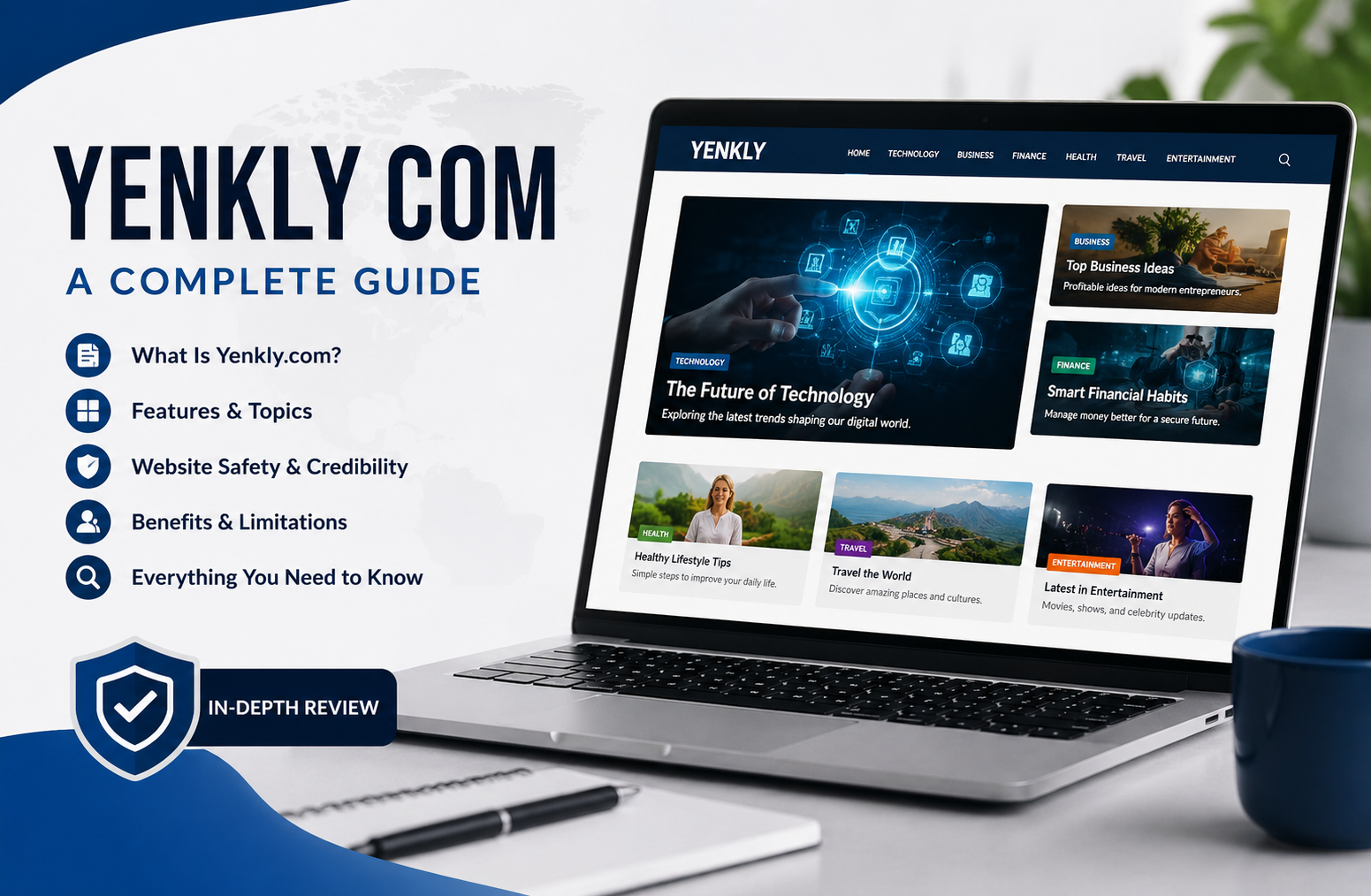
Yenkly Com: What It Is, What It Offers, and Is It Worth Exploring?
When people discover an unfamiliar website, they naturally want to know what it does, what kind of information it provides, and whether it is worth their time. yenkly com is one such website that has attracted attention from people searching for information about online publishing, technology, business, finance, entertainment, and other general-interest subjects. However, understanding a website requires more than simply looking at its homepage. Visitors also need to consider its content, navigation, transparency, credibility, and potential limitations before deciding how much they should rely on it.
Yenkly.com is described in publicly available third-party examinations as a multi-topic informational blog. Instead of concentrating on one specialist subject, it reportedly brings several categories together in one publishing environment. This approach can make it interesting to readers who enjoy exploring different topics. At the same time, a broad subject range raises important questions about editorial quality, author expertise, and the reliability of individual articles.
This guide explores the website’s reported purpose, content categories, functionality, potential benefits, limitations, ownership transparency, and online safety considerations. It also explains how readers can evaluate its information responsibly without confusing general informational content with professional advice or verified services.
What Is Yenkly Com?
Yenkly.com is described as a general-interest content website that publishes informational articles across different subject areas. Its reported publishing approach resembles that of an online magazine or conventional WordPress blog, where readers can explore articles through categories and website navigation.
Rather than focusing exclusively on technology, education, or business, the platform reportedly covers several areas of everyday interest. These include technology, finance, business, health, lifestyle, education, travel, entertainment, and other general subjects.
The main idea behind this publishing model is to make different types of information available through one website. Someone interested in technology can explore a relevant article, while another visitor might prefer reading about business developments or entertainment-related subjects.
However, it is important to understand what the website actually represents.
Yenkly.com should be approached as an informational publishing website rather than automatically being treated as a specialized software platform, online marketplace, financial institution, or professional service provider. Publishing an article about a particular product or service does not mean that the website directly operates or officially supports that service.
This distinction is especially important when reading articles about online loans, entertainment downloads, betting platforms, or other third-party services.
Readers should evaluate the information presented in each article and independently investigate any external service before interacting with it.
Understanding the Main Purpose of Yenkly.com
The purpose of a multi-topic blog is generally to organize information around subjects that attract different audiences.
A visitor might arrive through a search engine after looking for a technology explanation. Another person could discover the same website while researching a business-related question.
This creates several possible uses for a general-interest publication.
1. Providing General Information
One reported purpose of the website is sharing accessible information through articles.
General informational content can introduce readers to unfamiliar subjects without requiring advanced knowledge. A well-written introductory article should explain important terms, provide relevant background, and help readers understand the basic subject.
For example, someone researching an unfamiliar online business concept may benefit from an introductory explanation before exploring specialist publications.
However, introductory information should not replace professional guidance when a topic involves financial, legal, medical, or technical decisions.
2. Exploring Different Subject Areas
Another characteristic of multi-topic websites is their variety.
Instead of visiting several separate blogs, readers can potentially explore different subjects within one publishing environment.
This can be useful for people who enjoy learning about multiple industries and everyday topics.
Nevertheless, variety does not automatically indicate expertise. An article about medical information requires a different level of research and professional oversight from an article about general entertainment.
3. Supporting Everyday Online Research
Websites such as Yenkly.com may appear during searches for background information.
Readers can use general articles to identify unfamiliar terminology, understand broad concepts, and discover questions worth investigating further.
A sensible research process involves treating introductory articles as a starting point rather than the final authority.
Important claims should be compared with official documentation, recognized institutions, and established specialist sources.
4. Offering an Accessible Reading Experience
Traditional blogs provide a relatively simple way to distribute information.
Readers generally expect to find a homepage, category navigation, article titles, and individual posts.
This familiar structure can make a publishing website easier to explore, particularly for visitors who do not want to learn complicated software or register for an account simply to read an article.
The exact availability of these features should always be checked on the current website because online services can change their layouts and access policies.
What Topics Does Yenkly.com Cover?
The website has been described by third-party examinations as covering several general-interest categories.
Its reported subject range includes the following areas.
Technology
Technology is one of the major categories associated with the website.
Technology-related content can include discussions about digital tools, online platforms, software concepts, internet services, and developments in the digital world.
This subject attracts readers because technology affects communication, education, entertainment, and professional activities.
When evaluating technology articles, readers should look for:
- Accurate explanations of technical terms.
- Relevant examples of how a product or service works.
- Updated information about software and digital platforms.
- Clear distinctions between verified features and opinions.
- References to official product documentation where appropriate.
Technology changes quickly. An explanation that was accurate several years ago may no longer reflect current software capabilities.
Business
Business information is another reported area of interest.
Articles in this category may introduce subjects such as business planning, entrepreneurship, management, online operations, and commercial activities.
Business content can be helpful for readers who want to understand how organizations operate or learn about common business concepts.
However, business decisions often depend on individual circumstances, industry conditions, and local regulations.
Readers should therefore avoid treating general blog articles as personalized financial or commercial advice.
Finance
Financial information requires particular attention because incorrect advice can affect real decisions.
Yenkly.com has been described as publishing finance-related material, including articles concerning online lending and financial services.
People researching these subjects should distinguish between an article discussing a financial service and an actual regulated financial provider.
Before considering any loan or financial product, examine:
- The identity of the lending company.
- Its regulatory status.
- Interest rates and additional charges.
- Repayment schedules.
- Late-payment penalties.
- Privacy and data-handling policies.
- The total amount payable over the borrowing period.
An attractive headline or advertised borrowing limit does not provide enough information to judge whether a financial product is suitable.
For this reason, readers should verify financial claims through official institutions and relevant regulatory authorities.
Education
Educational content can help readers develop basic knowledge about different subjects.
A general-interest website may introduce learning concepts, explain unfamiliar terminology, or discuss useful online resources.
The value of educational articles depends on clarity, accuracy, and supporting evidence.
Good educational information should explain concepts in a logical order instead of relying on complicated language or unsupported statements.
Readers should also check whether an article is current, particularly when it discusses examinations, qualifications, admission requirements, or changing educational policies.
Health
Health-related information requires stronger verification than ordinary lifestyle content.
General articles may introduce wellness concepts, explain common terminology, or discuss everyday health topics.
However, an informational blog should not be treated as a substitute for a qualified healthcare professional.
Readers should be especially cautious about claims involving treatments, medications, diagnoses, supplements, and medical conditions.
Before following health-related advice, check whether the information comes from recognized medical institutions and qualified professionals.
Travel
Travel content can help readers explore destinations, understand travel-related terminology, and learn about general planning considerations.
Useful travel information should distinguish between general recommendations and details that can change frequently.
For example, visa requirements, transportation schedules, accommodation prices, and entry regulations should always be verified through current official sources.
A general article may provide background information, but it should not be the only source used when arranging an international journey.
Entertainment
Entertainment is another subject associated with the website’s reported content.
This category can include discussions about online entertainment, music, movies, television, and digital media services.
People exploring entertainment-related articles should pay attention to external links and the legal status of services mentioned in the content.
A website discussing free media downloads does not necessarily have permission to distribute copyrighted material.
Readers should favor authorized streaming services and legitimate content providers.
Sports and General Topics
Some third-party descriptions also identify sports and general-interest categories.
These subjects can attract readers who want to explore different areas without visiting a specialist publication for every topic.
Sports information, for example, should be checked against official league records and recognized sports organizations when accuracy matters.
Likewise, general-interest articles should be assessed according to the quality of their sources and the relevance of their information.
How Does Yenkly.com Work?
Based on its reported blog-style publishing structure, the website follows a conventional content discovery model.
This is different from a complex online platform that requires users to create accounts, install applications, or complete transactions.
A typical blog reading process can be understood through several steps.
Step 1: Open the Website
A visitor begins by entering the website address into a browser.
Before opening any unfamiliar website, check that the spelling and domain extension are correct. Similar-looking addresses can lead to unrelated websites.
The secure connection indicator is useful, but it should not be considered proof that a website is trustworthy.
Step 2: Explore Available Categories
Category navigation helps visitors understand the subjects covered by a publication.
A reader interested in business information can look for relevant categories, while someone researching technology can explore that section instead.
The availability and arrangement of individual categories may change as the website develops.
Step 3: Select an Article
After identifying a relevant subject, the visitor can open an individual article.
A useful article should have a clear title, an introduction explaining the subject, and organized sections that address the reader’s question.
The publication date is also important because some information becomes outdated quickly.
Step 4: Evaluate the Information
Reading an article is only part of responsible research.
Readers should consider the author’s identity, supporting evidence, publication date, and whether the claims are consistent with recognized sources.
This is especially important for financial, health, legal, and security-related subjects.
Step 5: Explore Related Information
Blogs often organize related posts through category pages and internal navigation.
This can help readers explore connected subjects without repeatedly returning to a search engine.
However, related articles should still be evaluated individually. A website’s publishing format does not guarantee that every post meets the same quality standard.
Main Features and Reported Website Characteristics
Several third-party examinations describe Yenkly.com as a conventional content publication.
The following overview separates reported characteristics from features that have not been independently established.
| Website characteristic | Available information |
| Website category | General-interest blog |
| Publishing format | Informational articles |
| Reported platform | WordPress |
| Subject coverage | Multiple general-interest categories |
| Article navigation | Category-based navigation reported |
| Author information | Articles reportedly display the name Roland |
| Legal ownership | Not independently established |
| Mobile application | No verified official application identified |
| Online shopping | No verified dedicated shopping service identified |
| Lending operations | Direct lending activity not established |
| File hosting | No verified dedicated file-hosting service identified |
| Paid subscription | No verified mandatory subscription identified |
This table is useful because it prevents readers from confusing reported website characteristics with confirmed services.
For example, publishing information about loans does not establish that a website is a lender. Similarly, discussing entertainment downloads does not prove that a publication operates a file-hosting service.
The distinction between content and direct service provision should remain clear throughout any website evaluation.
Who Owns Yenkly.com?
Ownership transparency is an important part of assessing an online publication.
Readers should ideally be able to identify the organization responsible for a website, understand its editorial structure, and find information about the people who publish its content.
Based on the available third-party examinations, the legal owner or operating company behind Yenkly.com has not been independently established.
Some reports describe a copyright notice and an author name displayed on published articles. However, a copyright notice alone does not establish the identity of the legal operator.
Similarly, a displayed author name does not automatically verify someone’s professional background.
What About the Author Name Roland?
Third-party examinations have reported that some articles on the website carry the author name Roland.
However, the available information does not independently establish the author’s complete identity, qualifications, professional experience, or subject-specific expertise.
This does not automatically mean that the content is inaccurate.
It does mean that readers have limited publicly established information with which to assess the author’s authority.
For subjects involving financial or medical decisions, transparent authorship is particularly valuable.
A credible publishing process should make it easier for readers to understand who created an article, what qualifications they have, and whether the information has undergone an appropriate review.
Why Ownership Transparency Matters
Knowing who operates a website helps readers understand accountability.
When a publication clearly identifies its editorial team and provides reliable contact information, visitors have a better opportunity to ask questions or report incorrect information.
A lack of publicly established ownership information does not prove wrongdoing.
However, it is a reasonable factor to consider when evaluating whether an unfamiliar publication deserves significant trust.
Is Yenkly.com Legit or a Scam?
One of the most common questions about an unfamiliar website is whether it is legitimate.
It is important to approach this question carefully because the word legitimate can describe several different things.
A website can exist, load successfully, and publish articles without necessarily being a reliable source of information.
Likewise, limited ownership information does not automatically prove that a website is fraudulent.
Based on the available third-party descriptions, Yenkly.com is an existing informational publishing website. There is not enough independently verified evidence to classify it as a scam.
However, there is also insufficient evidence to provide an unconditional endorsement of its content or overall trustworthiness.
Several factors deserve attention.
1. Website Identity
The available descriptions consistently identify the domain as a general-interest blog.
This provides a basic understanding of its reported purpose.
Nevertheless, readers should verify the actual domain address before assuming that another similarly named website is connected to it.
2. Ownership Transparency
The legal owner and operating organization have not been independently established through the available research.
This makes it harder to assess editorial accountability.
3. Author Credentials
Articles reportedly display the name Roland, but the author’s complete identity and qualifications remain unclear.
Readers should not assume that an author is a specialist simply because an article discusses a professional subject.
4. Content Reliability
The quality of an informational publication should be evaluated article by article.
A useful article provides evidence, explains its reasoning, identifies limitations, and avoids presenting uncertain claims as established facts.
5. External Services
Some reported articles discuss third-party services involving loans, betting, and entertainment downloads.
These subjects require additional care because visitors may encounter financial risks, legal restrictions, or questionable external websites.
The safest approach is to investigate each external provider independently.
Is Yenkly.com Safe to Visit?
Website safety involves several different considerations.
These include browser security, website ownership, advertising practices, external links, downloadable files, and the handling of personal information.
A website using HTTPS has an encrypted connection between the browser and the website. This is useful, but HTTPS does not prove that the publisher is trustworthy or that every external link is safe.
Similarly, the absence of an obvious browser warning does not constitute a complete security audit.
A third-party inspection reported no obvious suspicious redirects or forced downloads during its examination of Yenkly.com. However, this observation should not be treated as a guarantee about every page or future visit.
Visitors should follow several basic precautions.
Avoid Unnecessary Downloads
Do not download unfamiliar applications, documents, or executable files simply because an article recommends them.
Before downloading anything, verify the publisher and use an official distribution source whenever possible.
Unexpected download prompts and misleading advertisements deserve particular caution.
Be Careful With External Websites
An article may discuss a service operated by another company.
That does not establish a formal relationship between the publication and the external provider.
Before following an external link, check:
- The complete website address.
- The identity of the organization.
- Its privacy policy.
- Its terms and conditions.
- Independent information about its reputation.
- Whether the service is authorized in your location.
Avoid entering sensitive information when the identity of a provider cannot be established.
Protect Financial Information
Never provide banking passwords, payment information, or identification documents to an unfamiliar website without first verifying why the information is needed and who will receive it.
If an external service requests payment, investigate its legal identity and relevant regulatory status.
Do not rely solely on a promotional article to determine whether a financial provider is legitimate.
Use Updated Browser Security
Keep your browser and operating system updated.
Modern browsers provide security features that can warn users about some dangerous websites.
You can also check a website through Google’s Safe Browsing site status tool.
This is a useful additional check, although no single security tool can guarantee complete protection.
Review Privacy Information
Before submitting personal information, read the website’s current privacy policy.
Pay attention to:
- What information is collected.
- Whether cookies and analytics are used.
- Whether third-party advertising services are involved.
- How submitted information is stored.
- Whether information is shared with other organizations.
- How privacy-related requests can be submitted.
If the privacy information is incomplete or unclear, avoid providing unnecessary personal details.
Potential Benefits of Using Yenkly.com
A balanced website review should consider potential advantages without exaggerating what has been established.
Based on its reported publishing model, several characteristics may be useful to general readers.
Multiple Topics in One Place
A multi-topic publication can provide access to different subjects through a single website.
This may be convenient for visitors who enjoy reading about technology, business, entertainment, travel, and other areas.
Familiar Blog Structure
A conventional article-based format is relatively easy to understand.
Readers generally know how to navigate a homepage, open an article, and explore related categories.
This reduces the learning effort associated with more complicated digital platforms.
Opportunities for Topic Discovery
A general-interest website may introduce readers to subjects they had not previously considered.
For example, someone researching online business concepts may discover related topics involving technology or digital communication.
This can make casual browsing more interesting.
Accessible Introductory Information
General informational articles can help readers understand basic concepts before moving on to specialist sources.
This is particularly useful when a subject contains unfamiliar terminology.
However, these potential benefits depend on the quality, accuracy, and accessibility of individual articles.
A broad content library is not automatically a reliable knowledge resource.
Limitations and Concerns Readers Should Understand
Every website has limitations, and understanding them helps visitors make better decisions.
Yenkly.com has several areas where publicly established information appears limited.
Unclear Legal Ownership
Available third-party research does not clearly establish the website’s legal owner or operating company.
This limits the amount of information readers can use to evaluate publisher accountability.
Limited Author Information
A displayed author name is not enough to establish subject expertise.
Readers benefit from detailed author biographies, professional qualifications, and clear editorial responsibility.
Broad Subject Coverage
Publishing across many industries can make it difficult to demonstrate specialist expertise in every category.
A general-interest article about a medical issue, for example, should not carry the same authority as a professionally reviewed medical resource.
Uncertain Editorial Standards
The available research does not independently establish a comprehensive editorial review or fact-checking process.
Readers should therefore assess individual claims rather than assume every article has undergone professional verification.
Changing or Outdated Information
Online content can become outdated, particularly when it discusses software, financial services, regulations, or external platforms.
A reader should always check publication dates and compare time-sensitive information with current official sources.
Limited Contact Transparency
An October 2026 third-party examination reported that the Contact Us page returned an error.
Another report mentioned an email link in the sidebar.
These are observations from earlier examinations, not confirmation of the website’s current contact arrangements.
Clear contact information is important because it helps readers identify the publisher and request corrections when necessary.
Yenkly.com and Yonochomp.com: Are They Connected?
Another point raised in third-party research concerns similarities between Yenkly.com and Yonochomp.com.
An October 2026 report described several similarities between the two domains.
These reportedly included:
- The displayed author name Roland.
- A reported domain registration date of March 18, 2023.
- The same reported domain registrar.
- Similar nameserver information.
- Comparable publishing infrastructure.
- Similarities involving image hosting and advertising.
These details may be relevant when investigating the background of both websites.
However, technical similarities do not conclusively establish common ownership.
Many independent websites use the same hosting companies, domain registrars, content management systems, and advertising providers.
A shared author display name is also not sufficient proof of a business relationship.
Therefore, the available information supports describing the two domains as having reported similarities, not claiming that they are officially owned or operated by the same organization.
Readers should check each complete domain separately and avoid transferring trust from one website to another without evidence.
How to Evaluate Information Published on Yenkly.com
Evaluating online information is an important skill, particularly when a website covers several industries.
The following process can help readers distinguish useful information from unsupported claims.
Check the Publication Date
Start by identifying when an article was published or last updated.
A recent publication date does not automatically guarantee accuracy, but it can help identify whether the information is likely to reflect current developments.
For example, financial terms, software features, and travel regulations can change over time.
Identify the Author
Look for an author biography and information about relevant qualifications.
For specialist subjects, consider whether the writer has appropriate professional knowledge or whether the article has been reviewed by a qualified person.
If no meaningful author information is available, treat the article as general reading rather than established professional guidance.
Look for Supporting Evidence
Reliable articles should provide reasons for their important claims.
Useful supporting evidence may include:
- Official government information.
- Recognized industry documentation.
- Academic research.
- Professional publications.
- Original data.
- Clearly identified primary sources.
An article that repeatedly makes strong claims without explaining how they were established deserves additional scrutiny.
Compare Important Claims
Do not rely on one article when a decision could have financial, legal, medical, or security consequences.
Compare the information with recognized authorities and independent sources.
If the sources disagree, investigate the reason instead of automatically accepting the most confident explanation.
Examine External Links
Check where external links lead.
A link to a third-party service should be treated as a separate website with its own ownership, privacy practices, and security considerations.
Do not assume that a recommendation is officially endorsed simply because it appears in an article.
Distinguish Facts From Opinions
Some articles contain opinions, predictions, and interpretations.
These can be useful when clearly identified.
However, readers should be able to distinguish an author’s personal viewpoint from an independently established fact.
This distinction is especially important in business, finance, and health-related content.
Who May Find Yenkly.com Useful?
The usefulness of a general-interest publication depends on the reader’s expectations.
It may be relevant to people who want introductory information and enjoy exploring multiple subject areas.
Casual Readers
People who enjoy discovering unfamiliar topics may appreciate the variety associated with a multi-topic blog.
Beginners
Readers who are new to a subject may find introductory explanations useful before exploring more technical material.
General Online Researchers
Someone conducting preliminary research may use general articles to identify terminology and understand the basic background of a topic.
Readers Exploring Digital Subjects
People interested in online platforms, business concepts, and technology may find relevant discussions among the website’s reported subject areas.
However, readers who require professional financial, medical, legal, or technical guidance should prioritize recognized specialist sources.
Is Yenkly.com Suitable for Professional Research?
Professional research requires a higher standard of evidence than casual reading.
An informational blog can provide useful background, but it should not automatically be considered an authoritative research source.
For academic work, professional reports, business decisions, and specialist analysis, readers should prioritize original studies, recognized institutions, and official documentation.
For example, a researcher investigating digital security should consult established cybersecurity organizations rather than depend exclusively on a general-interest article.
Similarly, someone examining financial regulations should use the relevant regulator’s published guidance.
Yenkly.com may serve as an introductory source if an individual article contains useful explanations. Its value for professional research depends on the article’s evidence, authorship, accuracy, and relevance.
The important point is to evaluate the quality of the information rather than judging it solely by the website’s name or design.
What Should Readers Look for Before Trusting a New Website?
The questions raised by Yenkly.com also apply to many other unfamiliar online publications.
A simple evaluation framework can help visitors make more informed decisions.
| Evaluation area | What to examine |
| Domain identity | Correct spelling and domain extension |
| Ownership | Named publisher or operating organization |
| Authors | Identifiable writers and relevant experience |
| Editorial quality | Evidence, accuracy, and clear explanations |
| Publication dates | Current and relevant information |
| Privacy | Transparent information-handling practices |
| Security | HTTPS and independent security checks |
| External links | Verified destinations and legitimate services |
| Contact details | Working and identifiable communication options |
| Specialist claims | Confirmation through authoritative sources |
No single item provides a complete answer.
Instead, these factors should be considered together.
A website with transparent ownership, identifiable authors, and well-supported articles generally provides more information for evaluating its credibility.
On the other hand, missing information should encourage additional verification rather than automatic accusations.
Frequently Asked Questions About Yenkly Com
1. What is Yenkly.com?
Yenkly.com is described as a multi-topic informational blog covering subjects such as technology, business, finance, education, entertainment, health, and travel. It is primarily identified as a content-publishing website.
2. Is Yenkly.com a legitimate website?
Third-party examinations identify it as an existing online publication. However, its legal ownership and editorial accountability have not been independently established sufficiently to provide an unconditional endorsement.
3. Is Yenkly.com safe to visit?
A third-party inspection reported no obvious suspicious redirects or forced downloads during its examination. However, this is not a complete security guarantee. Visitors should be careful with downloads, external links, and requests for personal information.
4. Who owns Yenkly.com?
The website’s confirmed legal owner or operating company has not been independently identified through the available research. Some articles reportedly display the author name Roland, but the author’s complete identity and professional qualifications remain unclear.
5. What type of articles does Yenkly.com publish?
Its reported subject areas include technology, finance, business, education, health, travel, entertainment, sports, and general-interest information. The exact content and category structure may change over time.
6. Is Yenkly.com free to use?
Third-party descriptions have reported that ordinary articles are accessible without a mandatory reading subscription. However, current access arrangements and any additional features should be checked directly on the website.
7. Does Yenkly.com provide online loans?
There is no independently verified evidence establishing that Yenkly.com directly operates a lending service. The website has been described as publishing finance-related articles, including discussions about third-party loan providers.
8. Is Yenkly.com connected to Yonochomp.com?
Some third-party research has identified similarities between the domains, including their reported author name and technical details. However, these observations do not conclusively establish shared ownership or an official business relationship.
9. Does Yenkly.com have an official mobile application?
The available research has not established a verified official mobile application. Readers should avoid downloading applications claiming to represent the website unless their authenticity can be independently confirmed.
10. Can readers trust the information published on Yenkly.com?
Readers should evaluate each article individually. Check the publication date, author information, supporting evidence, and agreement with recognized sources. Important medical, financial, legal, and security decisions require stronger verification.
Conclusion
Yenkly.com is described as a general-interest informational website that brings together articles covering technology, business, finance, education, health, travel, entertainment, and other subjects. Its reported blog-style publishing structure makes it different from a dedicated software platform, online store, or financial institution.
The website’s multi-topic approach may appeal to casual readers and people exploring unfamiliar subjects. Its article-based format also provides a familiar way to discover information across different categories.
However, several important questions remain unanswered. The legal ownership has not been independently established, the reported author credentials are limited, and the available research does not confirm a comprehensive editorial review process. Reported similarities with Yonochomp.com are also worth noting, although they do not establish common ownership.
There is insufficient verified evidence to classify Yenkly.com as a fraudulent website. Equally, its content should not automatically be treated as authoritative. Readers should verify important claims, investigate third-party services independently, and use recognized specialist sources when making significant decisions.
Ultimately, the most balanced way to understand this publication is to consider it a general informational resource with limitations that deserve attention. Its usefulness depends on the quality of individual articles, the accuracy of their supporting evidence, and the reader’s ability to distinguish introductory information from professionally verified guidance.